REVIEW 3 minor 23 references
Adaptive MPC for Constrained Trajectory Tracking of Uncertain LTI System with Input-Rate Limits
T0 review · 0 major / 3 minor · reviewed 2026-05-08 · grok-4.3
Pith's one-line read An adaptive MPC framework guarantees recursive feasibility and stability for trajectory tracking of uncertain LTI systems with input-rate limits.
desk verdict This paper claims a new adaptive MPC reformulation that restores recursive feasibility for rate-constrained tracking under full parametric uncertainty, but the proofs and simulations stay at the claim level in the abstract. read the letter →
The pith
A machine-rendered reading of the paper's core claim, the machinery that carries it, and where it could break.
The reading
What carries the argument
The reformulated MPC optimization routine that uses estimated parameters together with an adaptive learning process to handle the time-varying admissible control set induced by input-rate constraints.
What would settle it
A case where the adaptive estimates cause the MPC optimization to become infeasible or the tracking error to grow unbounded despite the uncertainty bounds being respected would disprove the feasibility and stability results.
Extended reading notes
Core claim
This paper claims that an adaptive model predictive control framework, which systematically incorporates estimated system parameters and a suitably designed adaptive learning process, overcomes the challenges of achieving zero tracking error under unknown parameters and the temporal coupling from input-rate constraints. The reformulated MPC ensures recursive feasibility of the optimization routine despite the time-varying admissible control set, and Lyapunov-based analysis guarantees closed-loop stability with convergence of the tracking error and boundedness of system states.
Load-bearing premise
The discrete-time LTI system has bounded parametric uncertainty and a suitably designed adaptive learning process can restore recursive feasibility for the time-varying admissible control set from input-rate constraints.
Signed reviews
Editorial analysis
A structured set of objections, weighed in public.
Referee Report
Summary. The paper proposes an adaptive MPC framework for discrete-time LTI systems with bounded parametric uncertainty, addressing constrained trajectory tracking under hard state, input, and input-rate constraints. It reformulates the MPC optimization using online parameter estimates and a tailored adaptive learning process to handle the time-varying admissible control set induced by rate limits, claims rigorous recursive feasibility despite this coupling, and establishes closed-loop stability via Lyapunov analysis, with simulations validating tracking error convergence and state boundedness.
Significance. If the feasibility and stability results hold as claimed, the work would meaningfully extend adaptive MPC literature by systematically addressing full parametric uncertainty in tracking (rather than regulation) problems that include input-rate constraints, which create temporal dependencies absent from many standard formulations. The combination of online adaptation with a reformulated optimization to restore feasibility could enable safer application in domains like robotics or vehicle control where rate limits and uncertainty coexist.
minor comments (3)
- The abstract is truncated mid-sentence ('the pr'); ensure the concluding sentence on simulation validation is completed in the final manuscript.
- In the simulation section, the specific system matrices, uncertainty bounds, and comparison baselines (e.g., non-adaptive MPC or other adaptive schemes) are not detailed enough to allow reproduction or assessment of the claimed performance gains.
- Notation for the time-varying admissible set and the adaptive update law should be introduced with explicit definitions early in the problem formulation to improve readability of the subsequent feasibility argument.
Simulated Author's Rebuttal
We thank the referee for the positive summary of our work and the recommendation for minor revision. The referee's assessment correctly identifies the key contributions regarding adaptive MPC for constrained trajectory tracking under full parametric uncertainty and input-rate limits. No specific major comments were provided in the report.
Circularity Check
No significant circularity identified
full rationale
The paper's derivation chain relies on standard adaptive MPC reformulation to handle time-varying admissible sets from input-rate constraints, followed by recursive feasibility arguments and Lyapunov-based closed-loop stability proofs. These steps are presented as rigorous extensions of existing methods without reducing to self-definitional equations, fitted parameters renamed as predictions, or load-bearing self-citations. The abstract and description indicate that feasibility and stability follow from the constructed adaptive learning process and MPC optimization, which remain independent of the target results. No quoted equations or steps exhibit the enumerated circular patterns, making the central claims self-contained against external benchmarks.
Assumptions & free parameters
assumptions (2)
- domain assumption The plant is a discrete-time LTI system with bounded parametric uncertainty
- domain assumption An adaptive learning process can be designed to restore recursive feasibility for the time-varying admissible control set
Cite this review
Pith. "Pith review of Adaptive MPC for Constrained Trajectory Tracking of Uncertain LTI System with Input-Rate Limits." pith.science (2026). https://pith.science/paper/2605.04656
@misc{pith2026260504656,
  author       = {Pith},
  title        = {Pith review of: Adaptive MPC for Constrained Trajectory Tracking of Uncertain LTI System with Input-Rate Limits},
  year         = {2026},
  howpublished = {\url{https://pith.science/paper/2605.04656}},
  note         = {Machine review of arXiv:2605.04656}
}
read the original abstract
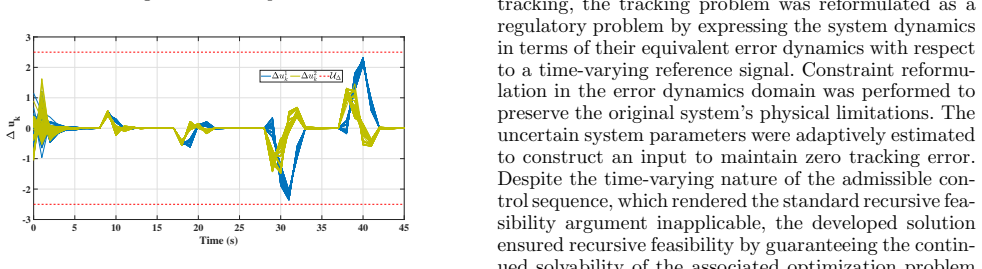
This paper addresses the trajectory-tracking problem for discrete-time linear time-invariant systems with bounded parametric uncertainty, subject to hard constraints on system states, control inputs, and input rates. Unlike existing methods, which often consider only partial uncertainty, omit input-rate or state constraints, or focus on regulation problems, this work provides a systematic adaptive model predictive control (MPC) solution for constrained trajectory tracking under full parametric uncertainty. Determining the control input required to achieve zero tracking error under unknown parameters is challenging. Simultaneously, trajectory tracking under uncertainty with input-rate constraints induces temporal coupling in the control sequence, resulting in a time-varying admissible control set and rendering standard recursive feasibility arguments inapplicable. These challenges are overcome by systematically utilizing the estimated system parameters, coupled with a suitably designed adaptive learning process within a reformulated MPC framework. The recursive feasibility of the proposed MPC optimization routine is then rigorously established despite the time-varying admissible control set induced by input-rate constraints. Closed-loop stability is guaranteed via Lyapunov-based analysis, ensuring convergence of the tracking error and boundedness of system states. Simulation results validate the effectiveness of the pr
Figures


Figures from the paper (1 more)
Reference graph
Works this paper leans on
-
[1]
G. Tian, B. Li, Q. Zhao, and G. Duan. High-precision trajectory tracking control for free-flying space manipula tors 9 with multiple constraints and system uncertainties. IEEE Transactions on Aerospace and Electronic Systems , 60(1):789–801, 2023
work page 2023
-
[2]
C. Hu, Z. W ang, X. Bu, J. Zhao, J. Na, and H. Gao. Optimal tracking control for autonomous vehicle with prescribed performance via adaptive dynamic programming. IEEE Transactions on Intelligent Transportation Systems , 25(9):12437–12449, 2024
work page 2024
-
[3]
B. Dey, A. Dhar, S. K. Pandey, and A. Sengupta. Tlbo integrated mpc for autonomous vehicles with guaranteed safety and passenger comfort. In Proc. Indian Control Conference (ICC), pages 576–581, Bangalore, India, 2025
work page 2025
-
[4]
Z. Liu, O. Zhang, Y. Gao, Y. Zhao, Y. Sun, and J. Liu. Adaptive neural network-based fixed-time control fo r trajectory tracking of robotic systems. IEEE Transactions on Circuits and Systems II: Express Briefs , 70(1):241–245, 2022
work page 2022
-
[5]
P. Ghosh and S. Bhasin. State and input constrained model reference adaptive control with robustness and feasibilit y analysis. IEEE Transactions on Automatic Control , pages 1–7, 2026
work page 2026
-
[6]
A. Dhar and S. Bhasin. Indirect adaptive mpc for discrete - time lti systems with parametric uncertainties. IEEE Transactions on Automatic Control, 66(11):5498–5505, 2021
work page 2021
-
[7]
Z. Yang, J. Huang, H. Yin, D. Yang, and Z. Zhong. Path tracking control for underactuated vehicles with matched- mismatched uncertainties. IEEE Transactions on Intelligent Transportation Systems, 23(8):12894–12907, 2021
work page 2021
-
[8]
J. K¨ ohler. Certainty-equivalent adaptive mpc for unce rtain nonlinear systems, 2026. arXiv:2603.17843
work page Pith review arXiv 2026
Show all 23 references
-
[9]
Kouvaritakis and M
B. Kouvaritakis and M. Cannon. Model Predictive Control . Springer, Cham, Switzerland, 2016
2016
-
[10]
S. V. Rakovi´ c, B. Kouvaritakis, R. Findeisen, and M. Cannon. Homothetic tube model predictive control. Automatica, 48(8):1631–1638, 2012
2012
-
[11]
Langson, I
W. Langson, I. Chryssochoos, S. V. Rakovi´ c, and D. Q. Mayne. Robust model predictive control using tubes. Automatica, 40(1):125–133, 2003
2003
-
[12]
S. Yao, Q. Kang, M. Zhou, M. J. Rawa, and A. Albeshri. Discriminative manifold distribution alignment for domai n adaptation. IEEE Transactions on Systems, Man, and Cybernetics: Systems , 53(2):1183–1197, February 2023
2023
-
[13]
J. Hu, B. Zhang, H. W ang, L. Zhao, and P. Jiang. Coordinated control and torque distribution of differentia l steering and anti-skid driving of distributed drive electr ic vehicle considering stability. Proceedings of the Institution of Mechanical Engineers, Part D: Journal of...
2023
-
[14]
Rosolia and F
U. Rosolia and F. Borrelli. Learning how to autonomousl y race a car: A predictive control approach. IEEE Transactions on Control Systems Technology , 28(6):2713–2719, November 2020
2020
-
[15]
Tanaskovic, L
M. Tanaskovic, L. Fagiano, R. Smith, and M. Morari. Adaptive receding horizon control for constrained mimo systems. Automatica, 50(12):3019–3029, 2014
2014
-
[16]
Fan and S
D. Fan and S. Di Cairano. Further results and properties of indirect adaptive model predictive control for linear syst ems with polytopic uncertainty. In Proceedings of the American Control Conference (ACC) , pages 2948–2953, 2016
2016
-
[17]
Lorenzen, F
M. Lorenzen, F. Allg¨ ower, and M. Cannon. Adaptive mode l predictive control with robust constraint satisfaction. IF AC- PapersOnLine, 50(1):3313–3318, 2017
2017
-
[18]
A. Dhar, A. Dey, and S. Bhasin. Homothetic tube-based adaptive mpc. International Journal of Robust and Nonlinear Control, 35(13):5705–5716, 2025
2025
-
[19]
Zhu and X
B. Zhu and X. Xia. Adaptive model predictive control for unconstrained discrete-time linear systems with parametr ic uncertainties. IEEE Transactions on Automatic Control , 61(10):3171–3176, December 2015
2015
-
[20]
A. D. Ames, J. W. Grizzle, and P. Tabuada. Control barrier function based quadratic programs with applicatio n to adaptive cruise control. In IEEE Conference on Decision and Control , pages 6271–6278, 2014
2014
-
[21]
Bemporad, A
A. Bemporad, A. Casavola, and E. Mosca. Nonlinear control of constrained linear systems via predictive refer ence management. IEEE Transactions on Automatic Control , 42(3):340–349, 1997
1997
-
[22]
Lavretsky and N
E. Lavretsky and N. Hovakimyan. Stable adaptation in th e presence of input constraints. Systems & Control Letters , 56(11-12):722–729, 2007
2007
-
[23]
Niu and C
G. Niu and C. Qu. Global asymptotic nonlinear pid contro l with a new generalized saturation function. IEEE Access , 8:210513–210531, 2020. 10
2020
Reviewed May 8, 2026 · model on record in the stance chip above.
Discussion (0). Continue with ORCID to comment.