Effective long-range attraction of moir\'e excitons under the influence of atomic reconstructions and anisotropic screening
Pith reviewed 2026-05-08 17:17 UTC · model grok-4.3
The pith
Anisotropic dielectric screening in moiré bilayers produces a crossover from repulsive to attractive long-range exciton-exciton interactions.
A machine-rendered reading of the paper's core claim, the machinery that carries it, and where it could break.
Core claim
When the exciton-exciton potential is constructed with the highly anisotropic screening imposed by the bilayer and its dielectric surroundings, the interaction on the scale of the moiré period changes from repulsive to attractive, while lattice reconstructions produce large modifications to the on-site term; these quantities supply the interaction and hopping parameters of a Bose-Hubbard model used to describe correlated interlayer-exciton behavior.
What carries the argument
The exciton-exciton potential that incorporates the highly anisotropic screening of the two-dimensional bilayer together with the moiré-potential shifts caused by lattice reconstructions.
If this is right
- The modified on-site and long-range terms can be inserted directly as parameters in a Bose-Hubbard Hamiltonian for interlayer excitons on the moiré lattice.
- Correlated many-body states of interlayer excitons become describable once the reconstructed moiré potential and the screened interaction are both taken into account.
- Long-range attraction on the moiré length scale opens the possibility of bound multi-exciton clusters at densities lower than those required for short-range repulsion alone.
Where Pith is reading between the lines
- The same screening anisotropy may influence other quasiparticles, such as trions or polaritons, in the same reconstructed moiré landscape.
- Experimental maps of exciton diffusion length versus twist angle could test whether the predicted attraction appears only below a critical twist angle where the moiré period matches the screening length.
- The approach supplies a concrete route to parameterize extended Bose-Hubbard models for other moiré platforms that also possess strong dielectric anisotropy.
Load-bearing premise
The specific functional form chosen for the anisotropic screening in the exciton-exciton potential is sufficiently accurate that it produces the reported sign change from repulsion to attraction at long range.
What would settle it
Direct measurement of the exciton-exciton interaction sign at separations comparable to the moiré period, for example through shifts in photoluminescence or diffusion constants in low-density regimes of twisted bilayer samples.
Figures




read the original abstract
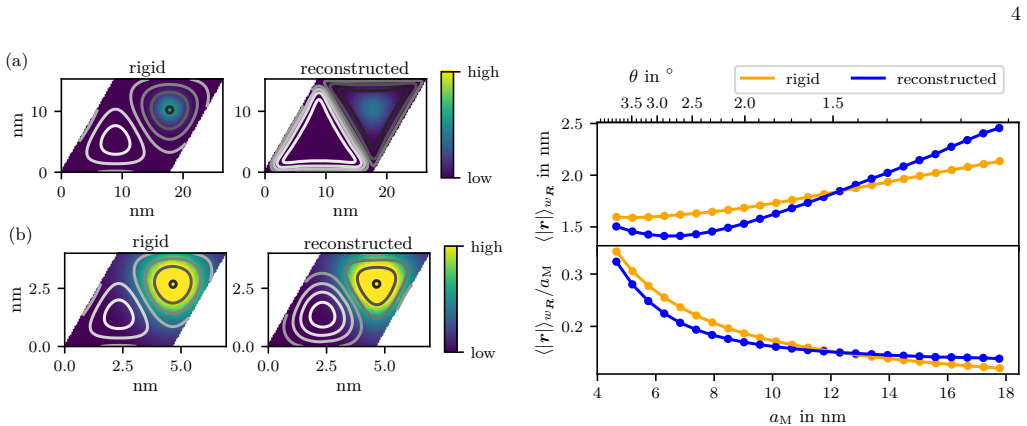
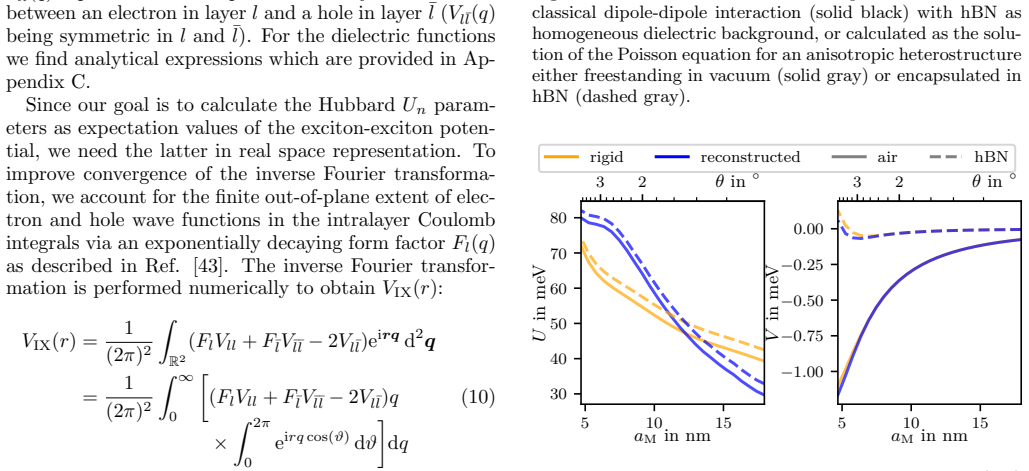
The moir\'e pattern, which emerges due to a relative rotation between two monolayers of transition metal dichalcogenides, features a long lattice period for small twist angles. The resulting band structure modulation acts as an effective potential for interlayer excitons (IXs), which can realize correlated many-body phenomena. Here, we aim for a material-realistic modelling of the exciton-exciton interaction, taking into account lattice reconstructions and an exciton-exciton potential that incorporates the highly anisotropic screening imposed by the two-dimensional bilayer and the dielectric background. We find strong modifications of the on-site interaction induced by the change of the moir\'e potential during lattice reconstructions, while for long-range interactions on the length scale of the moir\'e period, anisotropic dielectric screening leads to a crossover from a repulsive to an attractive interaction. The interaction potential and hopping amplitudes serve as parameters for a Bose-Hubbard model on the moir\'e lattice, which we use to explain correlated behavior of interlayer excitons.
Editorial analysis
A structured set of objections, weighed in public.
Referee Report
Summary. The manuscript develops a material-realistic model for interlayer exciton interactions in twisted TMD bilayers forming moiré superlattices. It incorporates atomic lattice reconstructions that alter the moiré potential and an exciton-exciton interaction derived from the highly anisotropic dielectric screening of the 2D bilayer plus background dielectric. The central findings are that reconstructions strongly modify the on-site repulsion while anisotropic screening produces a sign change to attractive interactions at long range (moiré-period scales); the resulting potential and hopping terms are inserted into a Bose-Hubbard model to interpret correlated exciton behavior.
Significance. If the reported crossover and on-site modifications are robust, the work supplies concrete, material-specific parameters for many-body modeling of moiré excitons, directly relevant to experiments on correlated phases in TMD heterostructures. The explicit inclusion of both reconstruction effects and anisotropic screening is a methodological strength that moves beyond purely phenomenological treatments.
major comments (2)
- [exciton-exciton potential derivation] The section deriving the exciton-exciton potential (the part that imposes the anisotropic screening from the bilayer and dielectric background): the reported long-range sign change from repulsive to attractive is sensitive to the precise functional form chosen for the screened Coulomb interaction. No explicit comparison to the isotropic limit, no local-field corrections, and no first-principles dielectric tensor are shown, leaving open whether the crossover survives modest changes in the screening model or background permittivity.
- [Bose-Hubbard model and results] The Bose-Hubbard analysis that uses the computed potential and hopping amplitudes: without reported error bars on the extracted parameters, sensitivity tests to the screening anisotropy, or direct comparison to measured exciton densities or correlation lengths, it is unclear how strongly the attractive long-range term is required to explain the observed correlated behavior.
minor comments (2)
- [abstract/introduction] The abstract and introduction would benefit from a single schematic figure showing the moiré lattice, the reconstructed potential, and the real-space form of the interaction potential before and after the crossover.
- [modeling section] Notation for the dielectric function and the effective interaction should be defined once with explicit dependence on in-plane wavevector and layer index to avoid ambiguity when the anisotropic screening is introduced.
Simulated Author's Rebuttal
We thank the referee for the positive evaluation of our work's significance and for the constructive comments on the robustness of the exciton-exciton potential and Bose-Hubbard analysis. We address each point below, with revisions to the manuscript where appropriate to strengthen the claims.
read point-by-point responses
-
Referee: The section deriving the exciton-exciton potential (the part that imposes the anisotropic screening from the bilayer and dielectric background): the reported long-range sign change from repulsive to attractive is sensitive to the precise functional form chosen for the screened Coulomb interaction. No explicit comparison to the isotropic limit, no local-field corrections, and no first-principles dielectric tensor are shown, leaving open whether the crossover survives modest changes in the screening model or background permittivity.
Authors: We agree that additional checks on the sensitivity of the long-range attraction are valuable. In the revised manuscript, we have added an explicit comparison to the isotropic screening limit, which shows that the crossover to attraction at moiré-period scales is absent in the isotropic case and arises specifically from the anisotropy. We have also included sensitivity tests varying the background permittivity by ±20% around the value used, confirming that the sign change persists. Local-field corrections and a full first-principles dielectric tensor are not included, as they would require advanced ab initio computations beyond the effective model employed here; our screening function follows established anisotropic models for 2D bilayers validated in the literature. revision: partial
-
Referee: The Bose-Hubbard analysis that uses the computed potential and hopping amplitudes: without reported error bars on the extracted parameters, sensitivity tests to the screening anisotropy, or direct comparison to measured exciton densities or correlation lengths, it is unclear how strongly the attractive long-range term is required to explain the observed correlated behavior.
Authors: We have revised the Bose-Hubbard section to report error bars on the on-site repulsion, hopping amplitudes, and long-range interaction terms, obtained from variations in the reconstruction parameters and screening anisotropy. Sensitivity tests to the degree of anisotropy have been added, showing that the attractive long-range component is essential for reproducing the correlated phases at the relevant filling factors. Direct quantitative comparison to specific experimental exciton densities or correlation lengths is not performed, as the work focuses on providing material-specific parameters for such modeling; we have expanded the discussion to qualitatively connect our results to recent observations of correlated interlayer exciton behavior in TMD heterostructures. revision: yes
- Incorporating local-field corrections and a first-principles dielectric tensor, which would require extensive additional ab initio calculations outside the scope of this effective modeling study.
Circularity Check
No significant circularity: exciton-exciton potential derived from independent screening and reconstruction models
full rationale
The paper computes the interaction potential from a material-realistic model of anisotropic dielectric screening in the bilayer plus dielectric background, combined with lattice reconstructions that modify the moiré potential. The reported crossover to long-range attraction and on-site changes are outcomes of this calculation, then fed as parameters into a Bose-Hubbard model. No quoted equations or steps reduce the central claim to a fit, self-definition, or self-citation chain; the screening form is presented as an input model rather than tuned to force the sign change. The derivation is therefore self-contained against external benchmarks.
Axiom & Free-Parameter Ledger
axioms (2)
- domain assumption The exciton-exciton interaction can be described by a potential that incorporates highly anisotropic screening from the bilayer and dielectric background.
- domain assumption Lattice reconstructions produce a quantifiable change in the moiré potential that directly alters the on-site exciton interaction.
Reference graph
Works this paper leans on
-
[1]
R. Qi, Q. Li, Z. Zhang, J. Nie, B. Zou, Z. Cui, H. Kim, C. Sanborn, S. Chen, J. Xie, T. Taniguchi, K. Watanabe, M. F. Crommie, A. H. MacDonald, and F. Wang, Competition between excitonic insulators and quantum Hall states in correlated electron–hole bilayers, Nature Materials 10.1038/s41563-025-02316-5 (2025)
-
[2]
D. M. Kennes, M. Claassen, L. Xian, A. Georges, A. J. Millis, J. Hone, C. R. Dean, D. N. Basov, A. N. Pasupathy, and A. Rubio, Moir´ e heterostructures as a condensed-matter quantum simulator, Nature Physics17, 155 (2021)
work page 2021
-
[3]
N. P. Wilson, W. Yao, J. Shan, and X. Xu, Excitons and emergent quantum phenomena in stacked 2D semiconductors, Nature599, 383 (2021)
work page 2021
-
[4]
F. Wu, T. Lovorn, and A. H. MacDonald, Topological Exciton Bands in Moir´ e Heterojunctions, Physical Review Letters 118, 147401 (2017)
work page 2017
-
[5]
F. Wu, T. Lovorn, and A. H. MacDonald, Theory of optical absorption by interlayer excitons in transition metal dichalco- genide heterobilayers, Physical Review B97, 035306 (2018)
work page 2018
-
[6]
Electron correlations in narrow energy bands
J. Hubbard, Electron correlations in narrow energy bands, Proceedings of the Royal Society of London. Series A, Mathe- matical and Physical Sciences276, 10.1098/rspa.1963.0204 (1963)
-
[7]
H. A. Gersch and G. C. Knollman, Quantum Cell Model for Bosons, Physical Review129, 959 (1963)
work page 1963
-
[8]
N. G¨ otting, F. Lohof, and C. Gies, Moir´ e-Bose-Hubbard model for interlayer excitons in twisted transition metal dichalco- genide heterostructures, Physical Review B105, 165419 (2022)
work page 2022
-
[9]
Y. Tang, L. Li, T. Li, Y. Xu, S. Liu, K. Barmak, K. Watanabe, T. Taniguchi, A. H. MacDonald, J. Shan, and K. F. Mak, Simulation of Hubbard model physics in WSe2/WS2 moir´ e superlattices, Nature579, 353 (2020)
work page 2020
-
[10]
B. Gao, D. G. Su´ arez-Forero, S. Sarkar, T.-S. Huang, D. Session, M. J. Mehrabad, R. Ni, M. Xie, P. Upadhyay, J. Vannucci, S. Mittal, K. Watanabe, T. Taniguchi, A. Imamoglu, Y. Zhou, and M. Hafezi, Excitonic Mott insulator in a Bose-Fermi- Hubbard system of moir´ e WS2/WSe2 heterobilayer, Nature Communications15, 2305 (2024)
work page 2024
-
[11]
H. Pan, F. Wu, and S. Das Sarma, Quantum phase diagram of a Moir´ e-Hubbard model, Physical Review B102, 201104 (2020)
work page 2020
-
[12]
N. Morales-Dur´ an, N. C. Hu, P. Potasz, and A. H. MacDonald, Nonlocal Interactions in Moir´ e Hubbard Systems, Physical Review Letters128, 217202 (2022)
work page 2022
-
[13]
L. H. Fowler-Gerace, Z. Zhou, E. A. Szwed, D. J. Choksy, and L. V. Butov, Transport and localization of indirect excitons in a van der Waals heterostructure, Nature Photonics18, 823 (2024)
work page 2024
-
[14]
J. Gu, L. Ma, S. Liu, K. Watanabe, T. Taniguchi, J. C. Hone, J. Shan, and K. F. Mak, Dipolar excitonic insulator in a moir´ e lattice, Nature Physics18, 395 (2022)
work page 2022
-
[15]
L. Ma, P. X. Nguyen, Z. Wang, Y. Zeng, K. Watanabe, T. Taniguchi, A. H. MacDonald, K. F. Mak, and J. Shan, Strongly correlated excitonic insulator in atomic double layers, Nature598, 585 (2021)
work page 2021
- [16]
-
[17]
H. Park, J. Zhu, X. Wang, Y. Wang, W. Holtzmann, T. Taniguchi, K. Watanabe, J. Yan, L. Fu, T. Cao, D. Xiao, D. R. Gamelin, H. Yu, W. Yao, and X. Xu, Dipole ladders with large Hubbard interaction in a moir´ e exciton lattice, Nature Physics19, 1286 (2023)
work page 2023
-
[18]
W. Li, X. Lu, S. Dubey, L. Devenica, and A. Srivastava, Dipolar interactions between localized interlayer excitons in van der Waals heterostructures, Nature Materials19, 624 (2020)
work page 2020
- [19]
-
[20]
C. E. M. Nielsen, M. da Cruz, A. Torche, and G. Bester, Accurate force-field methodology capturing atomic reconstructions in transition metal dichalcogenide moir´ e system, Physical Review B108, 045402 (2023)
work page 2023
-
[21]
´A. Rodr´ ıguez, J. Varillas, G. Haider, M. Kalb´ aˇ c, and O. Frank, Complex Strain Scapes in Reconstructed Transition-Metal Dichalcogenide Moir´ e Superlattices, ACS Nano17, 7787 (2023)
work page 2023
-
[22]
H. Zhao, S. Yang, C. Ge, D. Zhang, L. Huang, M. Chen, A. Pan, and X. Wang, Tunable Out-of-Plane Reconstructions in Moir´ e Superlattices of Transition Metal Dichalcogenide Heterobilayers, ACS Nano18, 27479 (2024)
work page 2024
-
[23]
K. Li, F. Xiao, W. Guan, Y. Xiao, C. Xu, J. Zhang, C. Lin, D. Li, Q. Tong, S.-Y. Li, and A. Pan, Morphology Deformation and Giant Electronic Band Modulation in Long-Wavelength WS 2 Moir´ e Superlattices, Nano Letters22, 5997 (2022)
work page 2022
-
[24]
Q. Tong, H. Yu, Q. Zhu, Y. Wang, X. Xu, and W. Yao, Topological mosaics in moir´ e superlattices of van der Waals heterobilayers, Nature Physics13, 356 (2017)
work page 2017
-
[25]
H. Chen, X. Wen, J. Zhang, T. Wu, Y. Gong, X. Zhang, J. Yuan, C. Yi, J. Lou, P. M. Ajayan, W. Zhuang, G. Zhang, and J. Zheng, Ultrafast formation of interlayer hot excitons in atomically thin MoS2/WS2 heterostructures, Nature Commu- nications7, 12512 (2016)
work page 2016
-
[26]
D. Schmitt, J. P. Bange, W. Bennecke, A. AlMutairi, G. Meneghini, K. Watanabe, T. Taniguchi, D. Steil, D. R. Luke, R. T. Weitz, S. Steil, G. S. M. Jansen, S. Brem, E. Malic, S. Hofmann, M. Reutzel, and S. Mathias, Formation of moir´ e interlayer excitons in space and time, Nature608, 499 (2022)
work page 2022
-
[27]
J. Choi, M. Florian, A. Steinhoff, D. Erben, K. Tran, D. S. Kim, L. Sun, J. Quan, R. Claassen, S. Majumder, J. A. Hollingsworth, T. Taniguchi, K. Watanabe, K. Ueno, A. Singh, G. Moody, F. Jahnke, and X. Li, Twist Angle-Dependent Interlayer Exciton Lifetimes in van der Waals Heterostructures, Physical Review Letters126, 047401 (2021)
work page 2021
- [28]
-
[29]
F. Lohof, J. Michl, A. Steinhoff, B. Han, M. von Helversen, S. Tongay, K. Watanabe, T. Taniguchi, S. H¨ ofling, S. Reitzen- stein, C. Anton-Solanas, C. Gies, and C. Schneider, Confined-state physics and signs of fermionization of moir´ e excitons in WSe 2 /MoSe 2 heterobilayers, 2D Materials10, 034001 (2023)
work page 2023
-
[30]
S. Carr, D. Massatt, S. B. Torrisi, P. Cazeaux, M. Luskin, and E. Kaxiras, Relaxation and domain formation in incom- mensurate two-dimensional heterostructures, Physical Review B98, 224102 (2018)
work page 2018
- [31]
-
[32]
M. R. Rosenberger, H.-J. Chuang, M. Phillips, V. P. Oleshko, K. M. McCreary, S. V. Sivaram, C. S. Hellberg, and B. T. Jonker, Twist Angle-Dependent Atomic Reconstruction and Moir´ e Patterns in Transition Metal Dichalcogenide Heterostructures, ACS Nano14, 4550 (2020)
work page 2020
- [33]
-
[34]
M. H. Naik, I. Maity, P. K. Maiti, and M. Jain, Kolmogorov–Crespi Potential For Multilayer Transition-Metal Dichalco- genides: Capturing Structural Transformations in Moir´ e Superlattices, The Journal of Physical Chemistry C123, 9770 (2019)
work page 2019
-
[35]
H. Guo, X. Zhang, and G. Lu, Shedding light on moir´ e excitons: A first-principles perspective, Science Advances6, eabc5638 (2020)
work page 2020
-
[36]
X. Lu, X. Li, and L. Yang, Modulated interlayer exciton properties in a two-dimensional moir´ e crystal, Physical Review B 100, 155416 (2019)
work page 2019
- [37]
-
[38]
S. Brem, C. Linder¨ alv, P. Erhart, and E. Malic, Tunable Phases of Moir´ e Excitons in van der Waals Heterostructures, Nano Letters20, 8534 (2020)
work page 2020
-
[39]
K. Tran, G. Moody, F. Wu, X. Lu, J. Choi, K. Kim, A. Rai, D. A. Sanchez, J. Quan, A. Singh, J. Embley, A. Zepeda, M. Campbell, T. Autry, T. Taniguchi, K. Watanabe, N. Lu, S. K. Banerjee, K. L. Silverman, S. Kim, E. Tutuc, L. Yang, A. H. MacDonald, and X. Li, Evidence for moir´ e excitons in van der Waals heterostructures, Nature567, 71 (2019)
work page 2019
-
[40]
C. Jin, E. C. Regan, A. Yan, M. Iqbal Bakti Utama, D. Wang, S. Zhao, Y. Qin, S. Yang, Z. Zheng, S. Shi, K. Watanabe, T. Taniguchi, S. Tongay, A. Zettl, and F. Wang, Observation of moir´ e excitons in WSe2/WS2 heterostructure superlattices, Nature567, 76 (2019)
work page 2019
-
[41]
B. Bogner,Quantum Monte Carlo Study of Extended Bose-Hubbard Models with Short- and Infinite-Range Interactions, Ph.D. thesis, Universit¨ at des Saarlandes (2020)
work page 2020
-
[42]
M. Kremser, M. Brotons-Gisbert, J. Kn¨ orzer, J. G¨ uckelhorn, M. Meyer, M. Barbone, A. V. Stier, B. D. Gerardot, K. M¨ uller, and J. J. Finley, Discrete interactions between a few interlayer excitons trapped at a MoSe2–WSe2 heterointerface, npj 2D Materials and Applications4, 8 (2020)
work page 2020
-
[43]
V. Villafa˜ ne, M. Kremser, R. H¨ ubner, M. M. Petri´ c, N. P. Wilson, A. V. Stier, K. M¨ uller, M. Florian, A. Steinhoff, and J. J. Finley, Twist-Dependent Intra- and Interlayer Excitons in Moir´ e MoSe 2 Homobilayers, Physical Review Letters130, 026901 (2023)
work page 2023
-
[44]
A. Laturia, M. L. Van de Put, and W. G. Vandenberghe, Dielectric properties of hexagonal boron nitride and transition metal dichalcogenides: From monolayer to bulk, npj 2D Materials and Applications2, 6 (2018)
work page 2018
-
[45]
S. Deng, H. Park, J. Reimann, J. M. Peterson, D. D. Blach, M.-J. Sun, T. Yan, D. Sun, T. Taniguchi, K. Watanabe, X. Xu, D. M. Kennes, and L. Huang, Frozen non-equilibrium dynamics of exciton Mott insulators in moir´ e superlattices, Nature Materials24, 527 (2025)
work page 2025
-
[46]
M. M. Fogler, L. V. Butov, and K. S. Novoselov, High-temperature superfluidity with indirect excitons in van der Waals heterostructures, Nature Communications5, 4555 (2014)
work page 2014
-
[47]
J. Cutshall, F. Mahdikhany, A. Roche, D. N. Shanks, M. R. Koehler, D. G. Mandrus, T. Taniguchi, K. Watanabe, Q. Zhu, B. J. LeRoy, and J. R. Schaibley, Imaging interlayer exciton superfluidity in a 2D semiconductor heterostructure, Science Advances11, eadr1772 (2025)
work page 2025
-
[48]
X. Sun, Y. Zhu, H. Qin, B. Liu, Y. Tang, T. L¨ u, S. Rahman, T. Yildirim, and Y. Lu, Enhanced interactions of interlayer excitons in free-standing heterobilayers, Nature610, 478 (2022)
work page 2022
-
[49]
N. Gheeraert, S. Chester, M. May, S. Eggert, and A. Pelster, Mean-Field Theory for Extended Bose-Hubbard Model with Hard-Core Bosons, inSelforganization in Complex Systems: The Past, Present, and Future of Synergetics, edited by G. Wunner and A. Pelster (Springer International Publishing, Cham, 2016) pp. 289–296
work page 2016
-
[50]
May,Hard-Core Dipolar Bosons in Optical Lattices, Ph.D
M. May,Hard-Core Dipolar Bosons in Optical Lattices, Ph.D. thesis (2013)
work page 2013
- [51]
-
[52]
I. Kyl¨ anp¨ a¨ a and H.-P. Komsa, Binding energies of exciton complexes in transition metal dichalcogenide monolayers and effect of dielectric environment, Physical Review B92, 205418 (2015). 17
work page 2015
-
[53]
During the derivation, we will use the following integrals: Z 2π 0 eiqρcosφ q dφq = 2πJ0(qρ) Z 2π 0 cosφ qeiqρcosφ q dφq = 2πiJ1(qρ) Z 2π 0 cos2 φqeiqρcosφ q dφq = Z 2π 0 (1−sin 2 φq)eiqρcosφ q dφq = 2πJ0(qρ)− 2πJ1(qρ) qρZ ∞ 0 Jn(qρ)Jn(q′ρ)ρdρ= 1 q δ(q−q ′), whereJ n is then-th order Bessel function of the 0-th kind
-
[54]
E. J. Mele, Screening of a point charge by an anisotropic medium: Anamorphoses in the method of images, American Journal of Physics69, 557 (2001)
work page 2001
-
[55]
D. Erkensten, S. Brem, and E. Malic, Exciton-exciton interaction in transition metal dichalcogenide monolayers and van der Waals heterostructures, Physical Review B103, 045426 (2021)
work page 2021
discussion (0)
Sign in with ORCID, Apple, or X to comment. Anyone can read and Pith papers without signing in.