Recognition: unknown
Plastic deformation of B19' martensite where -- where it matters in NiTi technology
Pith reviewed 2026-05-08 17:12 UTC · model grok-4.3
The pith
B19' martensite in NiTi deforms plastically by kwinking, a process of dislocation kinking assisted by twinning that rationalizes nine unusual phenomena observed over 50 years.
A machine-rendered reading of the paper's core claim, the machinery that carries it, and where it could break.
Core claim
The mechanism of plastic deformation of the B19' martensite by kwinking involving dislocation slip based kinking assisted by deformation twinning rationalizes nine listed classes of unusual phenomena reported in NiTi literature over the last 50 years. These phenomena include cold working with high reductions without cracks, plastic strains up to 80 percent at stresses above 1 GPa, refinement of austenite to quasi-amorphous states, high densities of {114} bands, systematic necking ruptures at yield, Luders-band propagation with 40 percent local strain, long upper stress plateaus in superelastic tests, large strains in single thermal cycles under load, and shape setting by constrained heating.
What carries the argument
Kwinking, the combined process of dislocation-slip kinking assisted by deformation twinning that enables large plastic strains inside the B19' monoclinic martensite lattice.
If this is right
- NiTi can be cold worked to high reductions without cracking because kwinking distributes strain locally.
- Martensite sustains plastic strains approaching 80 percent at stresses over 1 GPa through repeated kinking and twinning.
- Tensile deformation of martensite produces quasi-amorphous austenite and dense {114} bands after reverse transformation.
- Superelastic tests show unusually long upper plateaus and thermal cycles under load generate over 20 percent strain because kwinking adds to transformation strain.
- Shape setting of already annealed NiTi becomes possible by heating under constraint when kwinking relaxes internal stresses.
Where Pith is reading between the lines
- Constitutive models of NiTi must treat kwinking as a distinct plastic mode in the martensite phase to capture the observed plateaus and cycle strains.
- Processing schedules for NiTi wires and actuators can be tuned to promote or limit kwinking for desired combinations of strength and ductility.
- Orientation-controlled single-crystal experiments could map the crystallographic conditions under which kwinking operates, providing a test of its geometric requirements.
- Other shape-memory alloys possessing monoclinic martensites may exhibit analogous kwinking and therefore share similar processing advantages.
Load-bearing premise
That kwinking is the dominant or sole mechanism able to explain the nine listed phenomena and that other deformation modes do not contribute substantially under the conditions examined.
What would settle it
In-situ imaging of B19' martensite single crystals oriented to block kinking and twinning that nonetheless sustain 40-80 percent plastic strain without forming the expected bands or twins.
Figures











read the original abstract
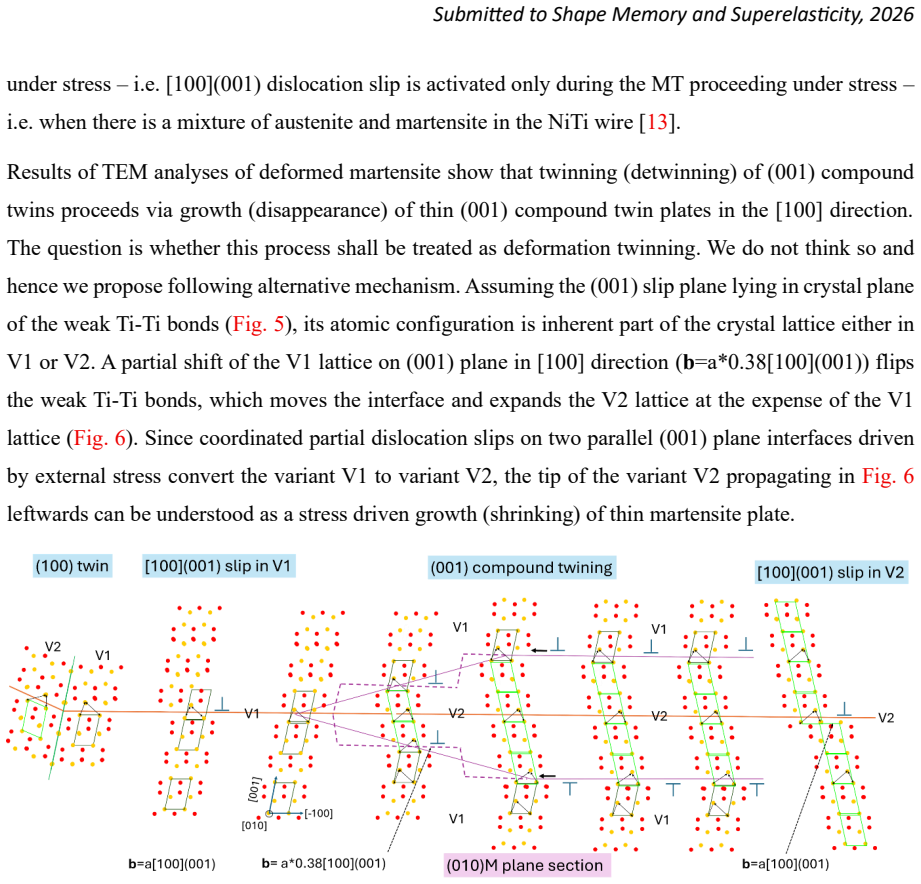
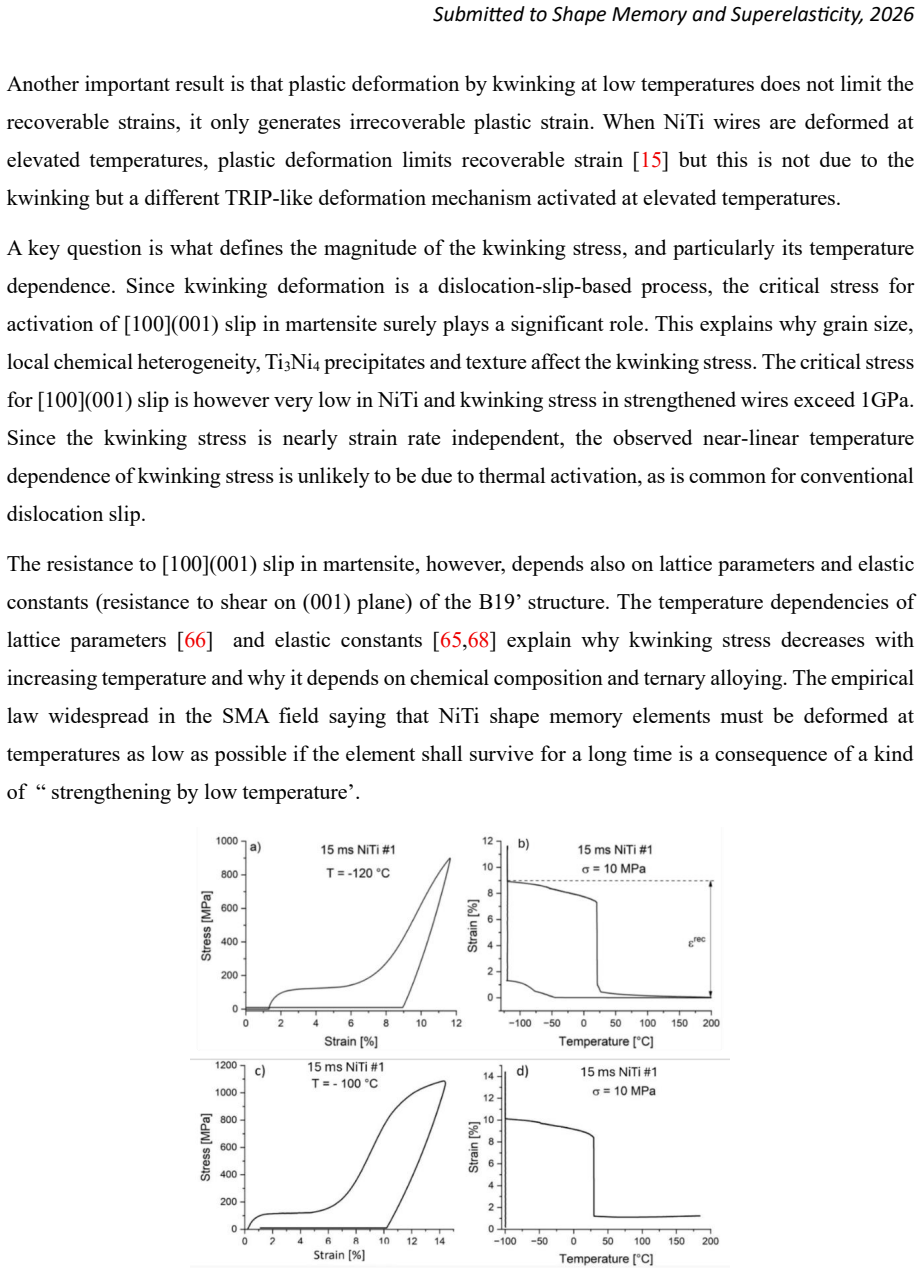
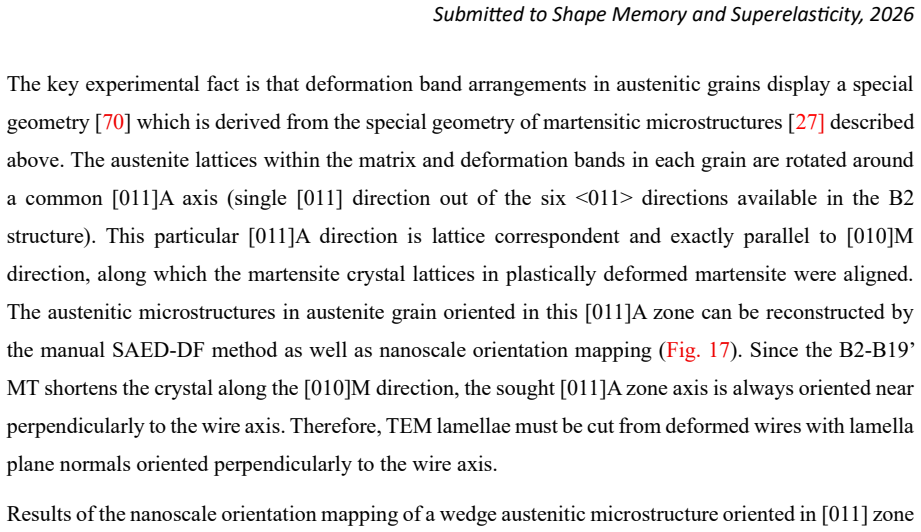
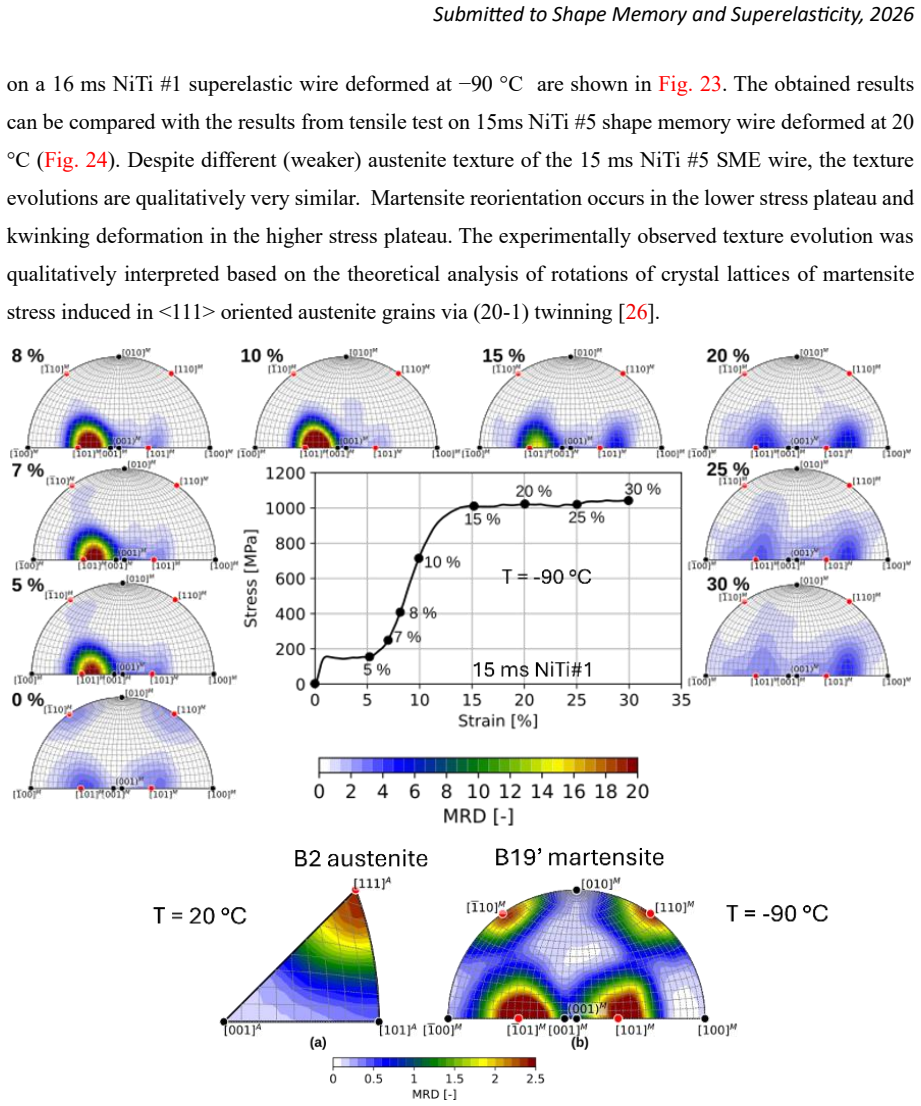
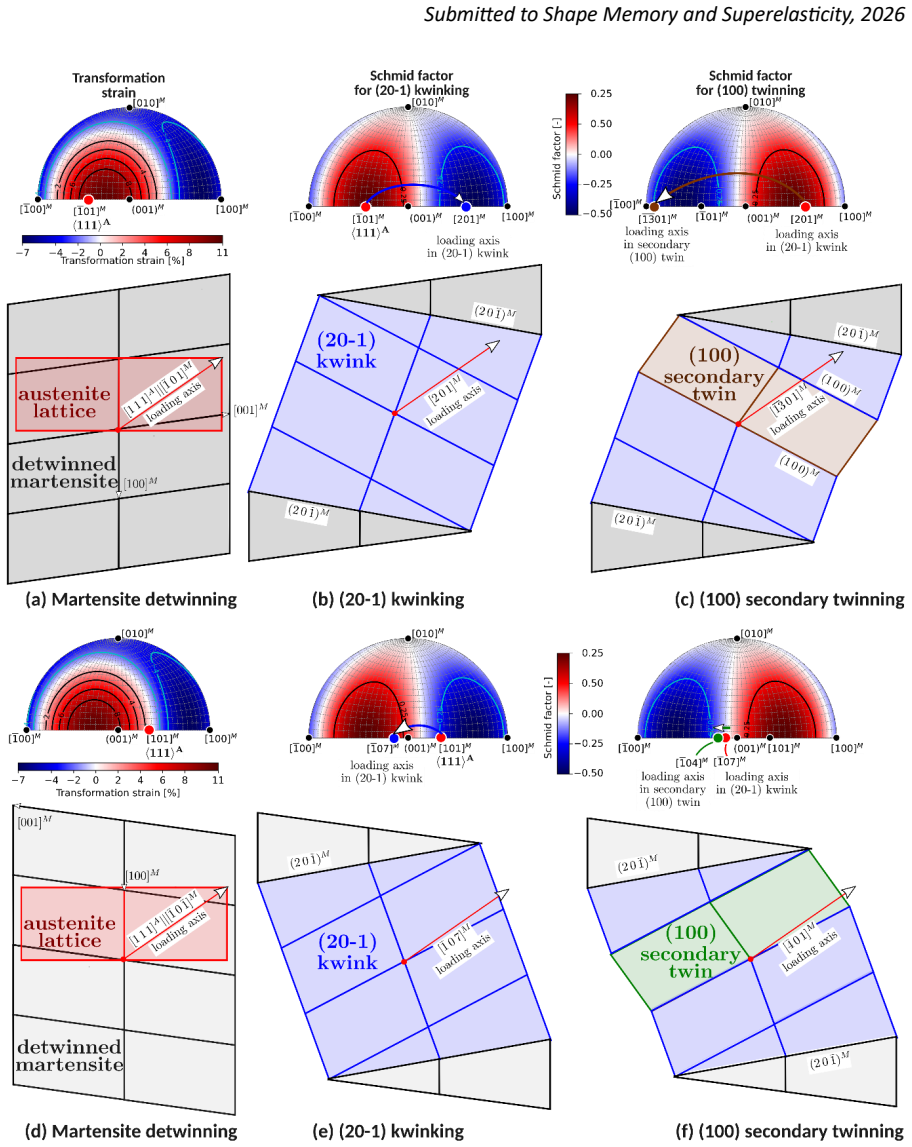
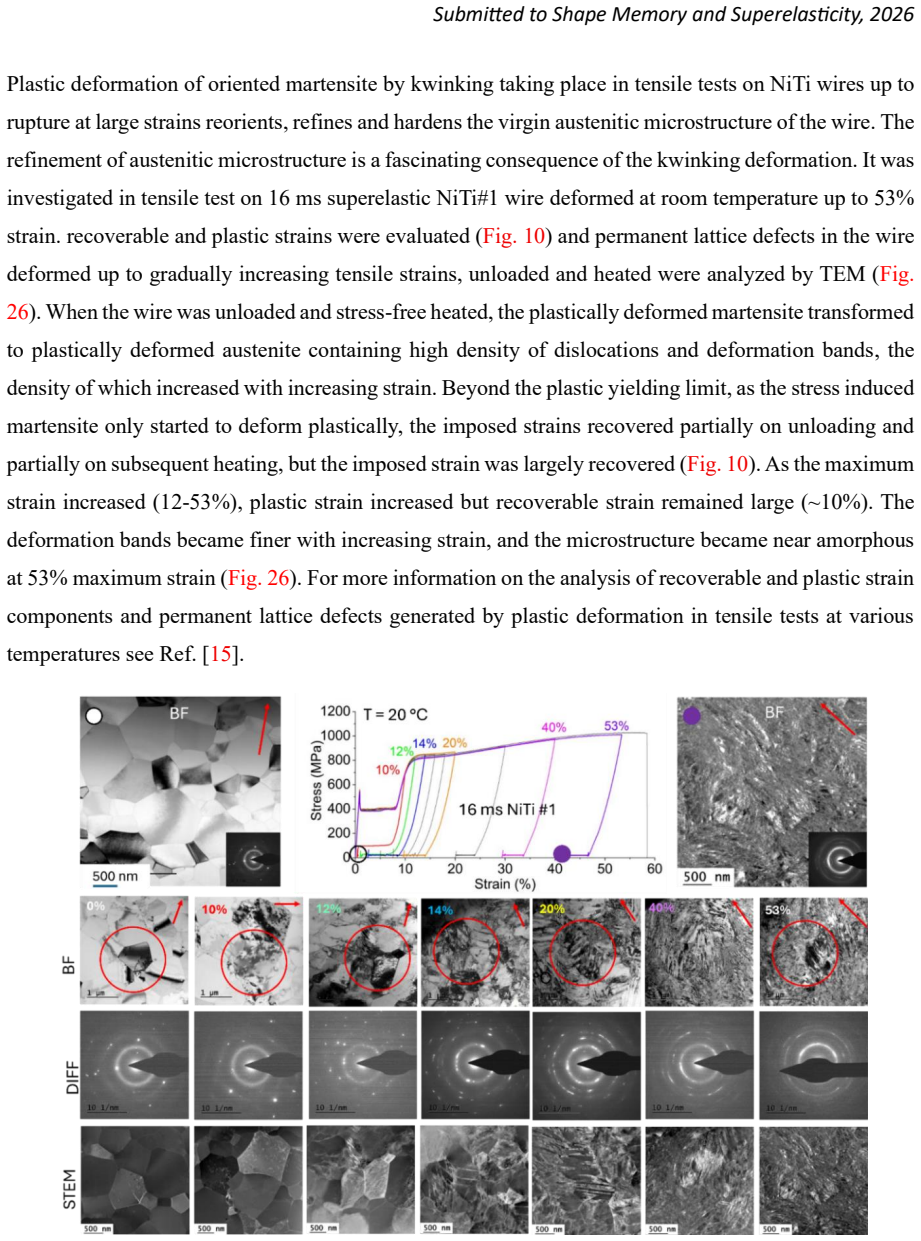
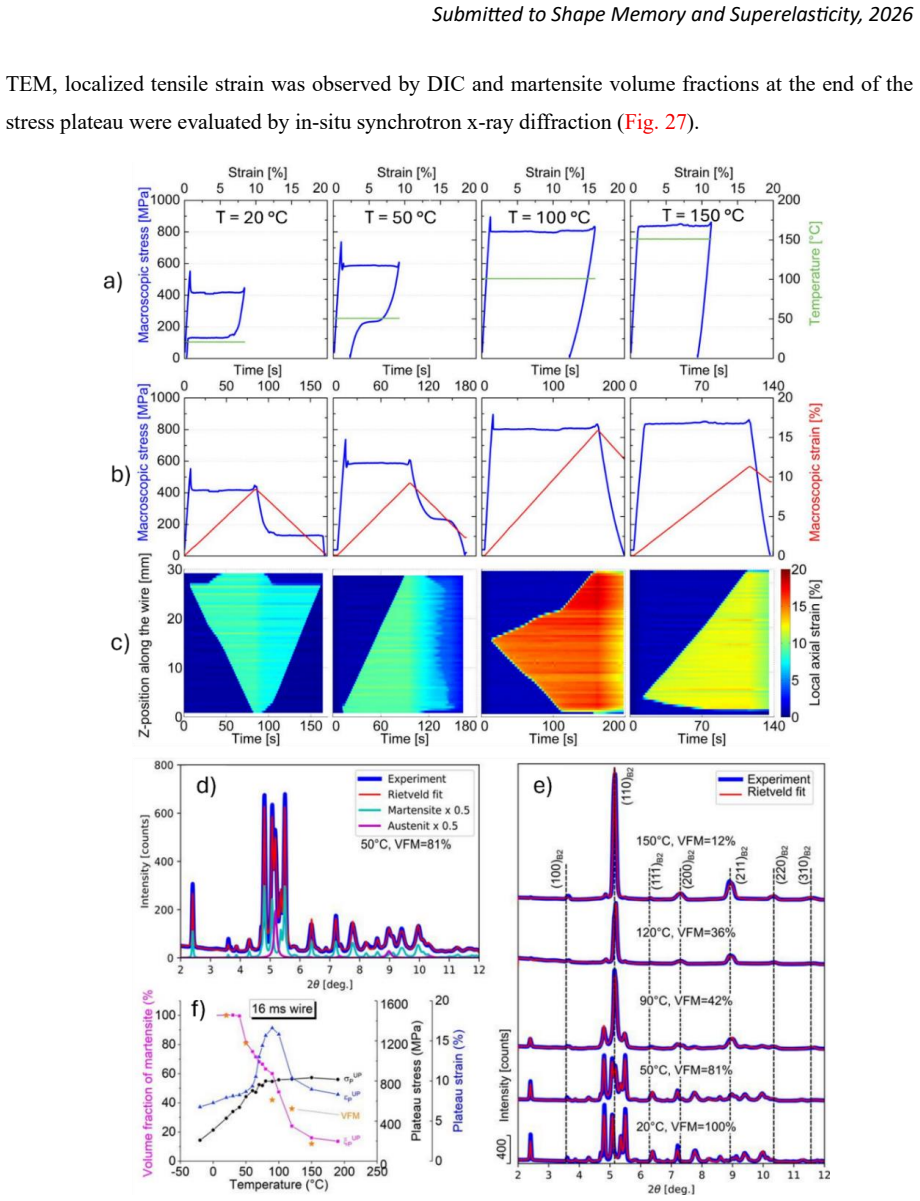
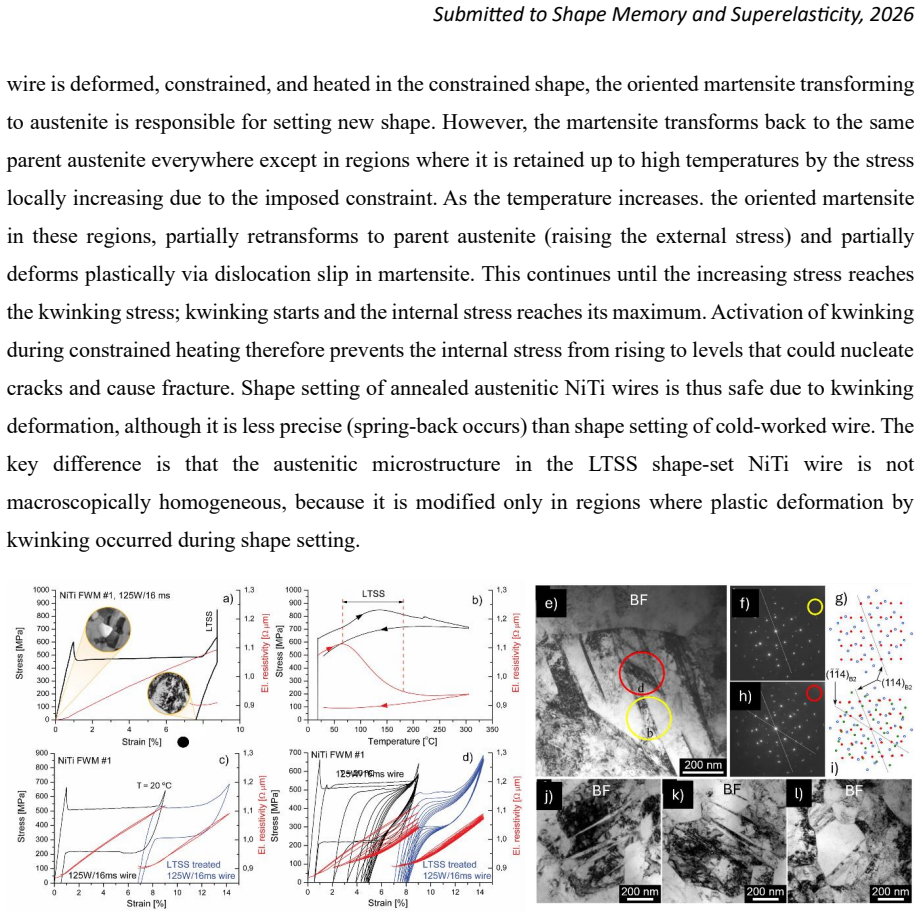
Nitinol technology, besides utilizing the functional thermomechanical properties derived from the B2 cubic to B19' monoclinic martensitic transformation, also exploits the excellent plastic deformability of NiTi in the martensite state. It originates from the unique mechanism of plastic deformation of the B19' martensite by kwinking involving dislocation slip based kinking assisted by deformation twinning. Although the mechanism of plastic deformation of martensite by kwinking was revealed only very recently, various unusual phenomena that can only be rationalized by kwinking, have been reported in literature in the last 50 years. These phenomena include: 1) cold working with a high degree of reduction without introducing cracks, 2) excellent plastic deformability in the martensite state (plastic deformation up to~80% strain at stresses >1GPa), 3) refinement of austenitic microstructure to a quasi-amorphous state by tensile deformation, 4) observation of high density of {114} deformation bands in austenitic microstructures, 5) systematic ruptures of strengthened NiTi wires in tensile tests via necking at the onset of plastic yielding, 6) localized plastic deformation in tensile tests via propagation of L\"uders band fronts with very large localized strain (~40%), 7) unusually long upper stress plateaus in superelastic tensile tests (>8% strain), 8) large plastic strains (> 20 %) generated in a single closed-loop cooling/heating cycle under constant stress, 9) shape setting of already annealed NiTi by heating under external constraint. Finally, we discuss how kwinking deformation was considered in constitutive modelling of thermomechanical behaviors of NiTi and, particularly, what is the role of the kwinking deformation in NiTi technology.
Editorial analysis
A structured set of objections, weighed in public.
Referee Report
Summary. The manuscript claims that plastic deformation of B19' martensite in NiTi occurs via the recently identified 'kwinking' mechanism (dislocation-slip-based kinking assisted by deformation twinning) and that this mechanism alone rationalizes nine classes of unusual phenomena reported in the NiTi literature over the past 50 years, including cold working to high reductions without cracking, plastic strains up to ~80% at stresses >1 GPa, refinement to quasi-amorphous austenite, high density of {114} bands, systematic necking ruptures, Luders-band propagation with ~40% local strain, long upper stress plateaus >8%, single-cycle plastic strains >20%, and shape setting under constraint. It concludes by discussing kwinking's role in constitutive modeling and NiTi technology.
Significance. If the unifying rationalization holds, the work offers a coherent explanatory framework connecting a new mechanistic insight to a broad set of longstanding experimental observations, which could improve predictive modeling of NiTi thermomechanical response without introducing additional free parameters. The linkage of kwinking to multiple phenomena across 50 years of literature is a constructive contribution to the field.
major comments (1)
- [Abstract] Abstract: the central claim that the nine phenomena 'can only be rationalized by kwinking' is not supported by quantitative exclusion of alternative B19' modes (e.g., {111} twinning or <100> slip); no strain-accommodation calculations, orientation predictions, or forward modeling are provided to demonstrate why conventional mechanisms fail to produce the reported strains (>80% at >1 GPa, ~40% local Luders strain) or microstructures under the stated conditions.
minor comments (3)
- [Title] Title: the phrasing 'where -- where it matters' appears to contain a typographical repetition and em dash; revision for grammatical clarity is recommended.
- [Abstract] Abstract: the LaTeX fragment 'Lüders' is rendered with an escaped quote; ensure proper typesetting of 'Lüders band' in the published version.
- [Abstract] Abstract, point 3: the term 'quasi-amorphous state' is used without definition or reference to how it is distinguished from nanocrystalline or highly dislocated microstructures in the cited experiments.
Simulated Author's Rebuttal
We thank the referee for the constructive feedback on our manuscript. The comment highlights an important point about the strength of the claims in the abstract, which we address directly below by agreeing to revise the language.
read point-by-point responses
-
Referee: [Abstract] Abstract: the central claim that the nine phenomena 'can only be rationalized by kwinking' is not supported by quantitative exclusion of alternative B19' modes (e.g., {111} twinning or <100> slip); no strain-accommodation calculations, orientation predictions, or forward modeling are provided to demonstrate why conventional mechanisms fail to produce the reported strains (>80% at >1 GPa, ~40% local Luders strain) or microstructures under the stated conditions.
Authors: We agree that the abstract's phrasing ('can only be rationalized by kwinking') overstates the exclusivity of the mechanism without providing the quantitative analyses requested, such as strain-accommodation calculations, orientation predictions, or forward modeling to rule out alternatives like {111} twinning or <100> slip. The manuscript offers a qualitative rationalization by demonstrating how the recently identified kwinking mechanism (dislocation-slip-based kinking assisted by deformation twinning) consistently accounts for the combination of high plastic strains, specific microstructural features (e.g., high density of {114} bands), and behaviors (e.g., Luders-band propagation with ~40% local strain and necking ruptures) across the nine historical observations, features that conventional B19' modes have not been shown to produce simultaneously in the literature. However, no new quantitative exclusion or modeling is performed in this work. To correct this, we will revise the abstract to state that these phenomena 'are rationalized by kwinking' (removing the exclusive 'can only' language) and add a clarifying sentence in the discussion section noting that while alternative modes may operate under specific conditions, kwinking provides a unifying explanation for the full set of observations without introducing additional parameters. revision: yes
Circularity Check
Minor self-citation of recent kwinking mechanism; central claim is qualitative linkage without equations or fitted-parameter reductions
full rationale
The paper's chain consists of identifying the kwinking mechanism (dislocation-slip kinking assisted by twinning) as the origin of plastic deformability in B19' martensite and then linking it interpretively to nine historical NiTi phenomena. The abstract notes the mechanism was 'revealed only very recently' (implying self-citation to prior overlapping-author work) and asserts these phenomena 'can only be rationalized by kwinking,' yet supplies no equations, strain calculations, orientation predictions, or parameter fits that would reduce any listed effect to a quantity defined by the same observations. The analysis draws on standard martensitic-transformation knowledge and remains self-contained against external benchmarks of reported phenomena; the self-citation is minor and not load-bearing for any deductive step.
Axiom & Free-Parameter Ledger
axioms (2)
- domain assumption B2 austenite transforms to B19' monoclinic martensite under appropriate thermomechanical conditions
- standard math Plastic deformation in martensite can occur by dislocation slip and deformation twinning
Reference graph
Works this paper leans on
-
[1]
T. Duerig, A. Pelton, D. Stöckel, An overview of nitinol medical applications, Materials Science and Engineering: A, 273–275 (1999) 149–160, https://doi.org/10.1016/S0921-5093(99)00294-4
-
[2]
M.-S. Kim, J.-K. Heo, H. Rodrigue, H.-T. Lee, S. Pané, M.-W. Han, S.-H. Ahn, Shape Memory Alloy (SMA) actuators: The role of material, form, and scaling effects, Adv. Mater. 35 (2023) 2208517, https://doi.org/10.1002/adma.202208517
-
[3]
K. Otsuka, X. Ren, Physical metallurgy of Ti–Ni-based shape memory alloys, Progress in Materials Science 50 (2005) 511–678, https://doi.org/10.1016/j.pmatsci.2004.10.001
-
[4]
P. Šittner, P. Sedlák, H. Seiner, P. Sedmák, J. Pilch, R. Delville, L. Heller, L. Kadeřávek, On the coupling between martensitic transformation and plasticity in NiTi: experiments and continuum based modelling, Progress in Materials Science 98 (2018) 249–298, https://doi.org/10.1016/j.pmatsci.2018.07.003
-
[5]
A. Christison, H. M. Paranjape, S. Daly, Plasticity bridges microscale martensitic shear bands in superelastic nitinol, Exp. Mech. 65 (2025) 699–716, https://doi.org/10.1007/s11340-025-01161-6
-
[6]
T. Ezaz, J. Wang, H. Sehitoglu, H. J. Maier, Plastic deformation of NiTi shape memory alloys, Acta Materialia, 61 (2013) 67–78, https://doi.org/10.1016/j.actamat.2012.09.023
-
[7]
https://doi.org/10.1080/09500839.2017.1316019
Sehitoglu, H., Wu, Y ., Alkan, S., Ertekin, E., Plastic deformation of B2-NiTi – is it slip or twinning? Philosophical Magazine Letters, 97(2017)217–228. https://doi.org/10.1080/09500839.2017.1316019
-
[8]
P. Šittner, E. Iaparova, L. Kadeřávek, Y . Chen, O. Tyc, Tensile deformation of NiTi shape memory alloy thermally loaded under applied stress, Materials & Design, 226(2023)111638, https://doi.org/10.1016/j.matdes.2023.111638
-
[9]
X. Bian, L. Heller, O. Tyc, L. Kaderavek, P. Sittner, In-situ synchrotron x-ray diffraction texture analysis of tensile deformation of nanocrystalline superelastic NiTi wire at various temperatures. Mater Sci Eng A 853(2022)143725, https://doi.org/10.1016/j.msea.2022.143725
-
[10]
O. Tyc, E. Iaparova, O. Molnarova, L. Heller, P. Sittner, Stress-induced martensitic transformation in NiTi at elevated temperatures: Martensite variant microstructures, recoverable strains and plastic strains, Acta Materialia, 279 (2024) 120287, https://doi.org/10.1016/j.actamat.2024.120287
-
[11]
P. Sittner, E. Iaparova, O. Molnarova, O. Tyc, X. Bian, L. Kadeřávek, L. Heller, Recoverable and plastic strains generated by forward and reverse martensitic transformations under external stress in NiTi SMA wires, Materials & Design 244(2024)113188, https://doi.org/10.1016/j.matdes.2024.113188
-
[12]
O. Tyc, X. Bian, O. Molnárová, L. Kaderavek, L. Heller, P. Šittner, Martensitic transformation induced by cooling NiTi wire under various tensile stresses: martensite variant microstructure, textures, recoverable strains and plastic strains, Applied Materials Today, 41(2024)102448, https://doi.org/10.1016/j.apmt.2024.102448
-
[13]
P. Šittner, L. Heller, E. Iaparova, L. Kadeřávek, O. Molnárová, O. Tyc, Generation of plastic strains by the martensitic transformations under stress via dislocation slip in martensite as the origin of functional fatigue of NiTi nanocrystalline wires. Shape Memory and Superelasticity, 11 (2025)679–707, https://doi.org/10.1007/s40830-025-00550-z
-
[14]
O. Molnarova, E. Iaparova, O. Tyc, L. Heller, P. Sittner, TEM analysis of dislocation defects in austenite generated by forward and reverse martensitic transformations in NiTi under stress. Acta Materialia,297(2025)121346, https://doi.org/10.1016/j.actamat.2025.121346
-
[15]
Y . Chen, O. Molnárová, O. Tyc, L. Kadeřávek, L. Heller, P. Šittner, Recoverability of large strains and deformation twinning in martensite during tensile deformation of NiTi shape memory alloy polycrystals, Acta Materialia, 180(2019)243-259, https://doi.org/10.1016/j.actamat.2019.09.012. Submitted to Shape Memory and Superelasticity, 2026 61
-
[16]
D. Wurzel, Marforming and tempering of binary Ni–Ti alloys including precipitation effects, Materials Science and Engineering: A, 273–275(1999)634-638, https://doi.org/10.1016/S0921- 5093(99)00338-X
-
[17]
L. Hu, S. Jiang, Y . Zhang, Y . Zhao, S. Liu, C. Zhao, Multiple plastic deformation mechanisms of NiTi shape memory alloy based on local canning compression at various temperatures, Intermetallics, 70(2016)45-52, https://doi.org/10.1016/j.intermet.2015.12.003
-
[18]
Y . Zhang, S. Jiang, L. Hu, Y . Liang, Deformation mechanism of NiTi shape memory alloy subjected to severe plastic deformation at low temperature, Materials Science and Engineering: A, 559(2013)607-614, https://doi.org/10.1016/j.msea.2012.08.149
-
[19]
E.Choi, A. Ostadrahimi, J. Park, On mechanical properties of NiTi SMA wires prestrained by cold rolling, Smart Mater. Struct. 29 (2020) 065009, https://doi.org/10.1088/1361-665X/ab84bb
-
[20]
C.N. Saikrishna, K.V . Ramaiah, S. Vedantam, S.M. Srinivasan, Effect of Strip Rolling and Wire Drawing Processes on NiTi Shape Memory Alloy Properties: A Comparative Study. J. of Materi Eng and Perform 34(2025)11960–11969, https://doi.org/10.1007/s11665-024-09889-3
-
[21]
Y . Chen, O. Tyc, O. Molnárová, L. Heller, P. Šittner, Tensile deformation of superelastic NiTi wires in wide temperature and microstructure ranges, Shape Memory and Superelasticity 5 (2019) 42-62, https://doi.org/10.1007/s40830-018-00205-2
-
[22]
P. Chowdhury, H. Sehitoglu, Deformation physics of shape memory alloys – Fundamentals at atomistic frontier, Progress in Materials Science 88 (2017) 49–88, https://doi.org/10.1016/j.pmatsci.2017.03.003
-
[23]
H. Seiner, P. Sedlak, M. Frost, P. Sittner, Kwinking as the plastic forming mechanism of B19’ NiTi martensite, Int. Journal of Plasticity 168(2023)103697, https://doi.org/10.1016/j.ijplas.2023.103697
-
[24]
O. Molnárová, M. Klinger, J. Duchoň, H. Seiner, P. Šittner, Plastic deformation of B19’ monoclinic martensite in NiTi shape memory alloys: HRTEM analysis of interfaces in martensite variant microstructures, Acta Materialia 258(2023)119242, https://doi.org/10.1016/j.actamat.2023.119242
-
[25]
O. Molnárová, O. Tyc, L. Heller, H. Seiner, P. Šittner, Evolution of martensitic microstructures in nanocrystalline NiTi wires deformed in tension, Acta Materialia 218 (2021) 117166, https://doi.org/10.1016/j.actamat.2021.117166
-
[26]
X. Bian, L. Heller, L. Kaderavek, P. Sittner, In-situ synchrotron x-ray diffraction texture analysis of tensile deformation of nanocrystalline NiTi wire in martensite state. Appl Mater Today 26(2022)101378, https://doi.org/10.1016/j.apmt.2022.101378
-
[27]
O. Molnarova, O. Tyc, M. Klinger and P. Sittner, Reconstruction of martensite variant microstructures in grains of deformed NiTi shape memory alloy by TEM, Materials Characterisation, 214(2024)114084 https://doi.org/10.1016/j.matchar.2024.114084
-
[28]
Y . Chen, O. Tyc, Lukáš Kadeřávek, O. Molnárová, L. Heller, Petr Šittner, Temperature and microstructure dependence of localized tensile deformation of superelastic NiTi wires, Materials & Design, 174 (2019)107797, https://doi.org/10.1016/j.matdes.2019.107797
-
[29]
J.X. Zhang, M. Sato, A. Ishida, Deformation mechanism of martensite in Ti-rich Ti–Ni shape memory alloy thin films, Acta Materialia, 54(2006)1185–1198, https://doi.org/10.1016/j.actamat.2005.10.046
-
[30]
S. Ii, K Yamauchi, Y . Maruhashi, M. Nishida, Direct evidence of correlation between {2 0 -1}B19′ and {1 1 4}B2 deformation twins in Ti–Ni shape memory alloy, Scr. Mater. 49(2003)723–727, https://doi.org/10.1016/S1359-6462(03)00356-7
-
[31]
E. Goo, T. Duerig, K. Melton, R. Sinclair, Mechanical twinning in Ti50Ni47Fe3 and Ti49Ni51 alloys, Acta Metallurgica, 33(1985)1725-1733, https://doi.org/10.1016/0001-6160(85)90167-1. Submitted to Shape Memory and Superelasticity, 2026 62
-
[32]
W.J. Moberly, J.L. Proft, T.W. Duerig, R. Sinclair, Deformation, twinning and thermo-mechanical strengthening of Ti50Ni47Fe3. Acta Metall. Mater. 38(1990)2601–2612, https://doi.org/10.1016/0956-7151(90)90272-I
-
[33]
I. Karaman, A. V . Kulkarni, Z.P. Luo, Transformation behaviour and unusual twinning in a NiTi shape memory alloy ausformed using equal channel angular extrusion, Philos. Mag. 85(2005)1729–1745, https://doi.org/10.1080/14786430412331331961
-
[34]
A.N. Tyumentsev, N.S. Surikova, O.V . Lysenko, I.Yu Litovchenko, Regularities and mechanism of mechanical twinning in NiTi alloys, Phys. Mesomech. 10(2007) 190e202. https://doi.org/10.1016/j.physme.2007.08.008
-
[35]
S. Ii, M. Matsuda, T. Matsui, T. Fujimoto, A. Kakisaka, T. Kikutake, S. Tsurekawa, K. Ikeda, M. Nishida, Controlling grain boundary character distribution of high-temperature B2 phase in Ti–Ni– Fe alloy, Intermetallics,31(2012)65-71, https://doi.org/10.1016/j.intermet.2012.06.009
-
[36]
M. Nishida, S. Ii, K. Kitamura, T. Furukawa, A. Chiba, T. Hara and K. Hiraga, New deformation twinning mode of B19’ martensite in Ti-Ni shape memory shape memory alloy, Scripta Materialia 39(1998)1749-54, https://doi.org/10.1016/S1359-6462(98)00366-2
-
[37]
W. S. Choi, E.L. Pang, W. S. Ko, H. Jun, H. J. Bong, Ch. Kirchlechner, D. Raabe, P. P. Choi, Orientation-dependent plastic deformation mechanisms and competition with stress-induced phase transformation in microscale NiTi, Acta Materialia 208(2021)116731, https://doi.org/10.1016/j.actamat.2021.116731
-
[38]
E. Poliatidis, M. Šmíd, I. Kuběna, W.-N. Hsu, G. Laplanche, H. Van Swygenhoven, Deformation mechanisms in a superelastic NiTi alloy: An in-situ high resolution digital image correlation study, Materials & Design,191(2020)108622, https://doi.org/10.1016/j.matdes.2020.108622
-
[39]
P. Sittner, L. Heller, P. Sedlak, Y . Chen, O. Tyc, O. Molnarova, L. Kaderavek, H. Seiner, B2 ⇒ B19′ ⇒ B2T Martensitic Transformation as a Mechanism of Plastic Deformation of NiTi. Shap. Mem. Superelasticity 5(2019)383–396, https://doi.org/10.1007/s40830-019-00250-5
-
[40]
P. Šittner, O. Molnárová, L. Kadeřávek, O. Tyc, L. Heller, Deformation twinning in martensite affecting functional behaviour of NiTi shape memory alloys, Materialia 9(2020)100506, https://doi.org/10.1016/j.mtla.2019.100506
-
[41]
T. Ezaz, H. Sehitoglu, H.J. Maier, Energetics of twinning in martensitic NiTi, Acta Materialia, 59(2011)5893-5904, https://doi.org/10.1016/j.actamat.2011.05.063
-
[42]
T. Ezaz, H. Sehitoglu, W. Abuzaid, H.J. Maier, Higher order twin modes in martensitic NiTi—The (20-1) case, Materials Science and Engineering: A, 558(2012)422-430, https://doi.org/10.1016/j.msea.2012.08.022
-
[43]
R. Delville, B. Malard, J. Pilch, P. Sittner, D. Schryvers, Transmission electron microscopy investigation of dislocation slip during superelastic cycling of Ni–Ti wires, International Journal of Plasticity 27 (2011) 282–297, https://doi.org/10.1016/j.ijplas.2010.05.005
-
[44]
P. Šittner, O. Molnárová, X. Bian, L. Heller. Tensile Deformation of B19′ Martensite in Nanocrystalline NiTi Wires. Shap. Mem. Superelasticity 9(2023)11–34 https://doi.org/10.1007/s40830-023-00414-4
-
[45]
Development and Testing of a Shape Memory Alloy-Driven Composite Morphing Radiator
O. Tyc, L.Heller, P.Sittner, Lattice defects generated by cyclic thermomechanical loading of superelastic NiTi wire, Shap. Mem. Superelasticity 7(2021)65-88, https://doi.org/10.1007/s40830- 021-00315-4
-
[46]
P. Sedmák, J. Pilch, L. Heller, J. Kopeček, J. Wright, P. Sedlák P, H. Seiner, P. Sittner, Grain- resolved analysis of localized deformation in nickel-titanium wire under tensile load. Science, 353(2016)559–562, https://doi.org/10.1126/science.aad6700 Submitted to Shape Memory and Superelasticity, 2026 63
-
[47]
E. Iaparova, L. Heller, O. Tyc, P. Sittner, Thermally induced reorientation and plastic deformation of B19’ monoclinic martensite in nanocrystalline NiTi wires, Acta Materialia,242(2023)118477, https://doi.org/10.1016/j.actamat.2022.118477
-
[48]
L. Kadeřávek, P. Šittner, O. Molnárová, L.Klimsa, L.Heller, Localized Plastic Deformation of Superelastic NiTi Wires in Tension. Shap. Mem. Superelasticity 9(2023)261–279 https://doi.org/10.1007/s40830-023-00415-3
-
[49]
L. Heller and P. Sittner, On the Habit Planes Between Elastically Distorted Austenite and Martensite in NiTi, Acta Materialia, 269(2024)119828, https://doi.org/10.1016/j.actamat.2024.119828
-
[50]
M. Nishida, M. Matsuda, T. Fujimoto, K. Tanaka, A. Kakisaka, H. Nakashima, Crystallography of deformation twin boundaries in a B2 type Ti –Ni alloy, Materials Science and Engineering A 438– 440(2006)495–499, https://doi.org/10.1016/j.msea.2006.03.111
-
[51]
Bhattacharya, Microstructure of Martensite, Oxford Series on Materials Modelling, New York, 2003
K. Bhattacharya, Microstructure of Martensite, Oxford Series on Materials Modelling, New York, 2003
2003
-
[52]
Y . Gao, T. Y u, Y . Wang, Phase Transformation Graph and Transformation Pathway Engineering for Shape Memory Alloys. Shap. Mem. Superelasticity 6(2020) 115–130, https://doi.org/10.1007/s40830-020-00271-5
-
[53]
Compactifying the Picard scheme
O. Matsumoto, S. Miyazaki, K. Otsuka, H. Tamura, Crystallography of martensitic transformation in Ti-Ni single crystals, Acta Metallurgica 35(1987)2137–2144. https://doi.org/10.1016/0001- 6160(87)90042-3
-
[54]
T. J. Nizolek, T. M. Pollock, R. M. McMeeking, Kink band and shear band localization in anisotropic perfectly plastic solids, Journal of the Mechanics and Physics of Solids 146 (2021) 104183, https://doi.org/10.1016/j.jmps.2020.104183
-
[55]
Y. Kudoh, M. Tokonami, S. Miyazaki, K. Otsuka, Crystal structure of the martensite in Ti-49.2 at.% Ni alloy analyzed by the single crystal X-ray diffraction method, Acta Metall. 33(1985)2049- 2056, https://doi.org/10.1016/0001-6160(85)90128-2
-
[56]
X.W. Lei, A. Nakatani, A deformation mechanism for ridge-shaped kink structure in layered solids, Journal of Applied Mechanics, 82(2015)071016 https://doi.org/10.1115/1.4030328
-
[57]
K. Hagihara, N. Yokotani, Y. Umakoshi, Plastic deformation behavior of Mg12YZn with 18R long-period stacking ordered structure Intermetallics, 18(2010)267 – 276, https://doi.org/10.1016/j.intermet.2009.07.014
-
[58]
T. Inamura, Geometry of kink microstructure analysed by rank-1 connection Acta Materialia, 173(2019)270 – 280, https://doi.org/10.1016/j.actamat.2019.05.023
-
[59]
Z. Wu, J.W. Lawson, Theoretical investigation of phase transitions in the shape memory alloy NiTi Physical Review B, 106 (2022)L140102 https://doi.org/10.1103/PhysRevB.106.L140102
-
[60]
B. Li, Y . Shen, Q. An, Structural origin of reversible martensitic transformation and reversible twinning in NiTi shape memory alloy, Acta Materialia 199(2020)240–252, https://doi.org/10.1016/j.actamat.2020.08.039
-
[61]
S. Wang , K. Tsuchiya , L. Wang , M. Umemoto, Deformation Mechanism and Stabilization of Martensite in TiNi Shape Memory Alloy, J. Mater. Sci. Technol. 26(2010)936–940. https://doi.org/10.1016/S1005-0302(10)60151-X
-
[62]
K. Knowles, D. Smith, The crystallography of the martensitic transformation in equiatomic nickel- titanium, Acta Metallurgica 29(1981)101–110, https://doi.org/10.1016/0001-6160(81)90091-2
-
[63]
G. Hikosaka, Y. Shinohara, R. Matsumura, M. Nishida, T. Inamura, Geometric accommodation of local incompatibility of parent/martensite interface by transformation-induced dislocations in Ti– Ni, Materialia, 45(2026)102624, https://doi.org/10.1016/j.mtla.2025.102624. Submitted to Shape Memory and Superelasticity, 2026 64
-
[64]
S. Pourbabak, X. Wang, D. Van Dyck, B. Verlinden, D. Schryvers, Ni cluster formation in low temperature annealed Ni50.6Ti49.4, Functional Materials Letters, 10 (2017) 1740005, https://doi.org/10.1142/S1793604717400057
-
[65]
P. Sedlák, M. Frost, Ševčík, L. Kaderavek, H.Seiner In situ Observation of Elastic Instability of Stress-Induced B19 Martensite in Thin NiTi Wires. Shap. Mem. Superelasticity 11(2025)513–522 https://doi.org/10.1007/s40830-025-00565-6
-
[66]
S.D. Prokoshkin, A.V . Korotitskiy, V . Brailovski, K.E. Inaekyan, S.M. Dubinskiy Crystal lattice of martensite and the reserve of recoverable strain of thermally and thermomechanically treated Ti– Ni shape memory alloys. Phys Metals Metallogr 12(2011)170–187, https://doi.org/10.1134/S0031918X11020244
-
[67]
K. Bhattacharya, R.V . Kohn, Symmetry, texture and the recoverable strain of shape-memory polycrystals, Acta Materialia, 44(1996)529-542, https://doi.org/10.1016/1359-6454(95)00198-0
-
[68]
L. Bodnárová, M. Janovská, M. Ševčík, M. Frost, L. Kadeřávek, J. Kopeček, H. Seiner, P. Sedlák, Elastic Constants of Single-Crystalline NiTi Studied by Resonant Ultrasound Spectroscopy. Shap. Mem. Superelasticity 11(2025)230–238, https://doi.org/10.1007/s40830-025-00534-z
-
[69]
H. Sehitoglu, L. Patriarca, Y . Wu, Shape memory strains and temperatures in the extreme, Current Opinion in Solid State and Materials Science, 21(2017)113-120, https://doi.org/10.1016/j.cossms.2016.06.005
-
[70]
O. Molnarova, P. Sittner, J. Vesely, M. Cieslar, TEM analysis of deformation bands created by tensile deformation of superelastic NiTi wires, Mater. Characterisation 167(2020)110470, https://doi.org/10.1016/j.matchar.2020.110470
-
[71]
Klinger, CrysTBox - Crystallographic Tool Box https://www.fzu.cz/crystbox
M. Klinger, CrysTBox - Crystallographic Tool Box https://www.fzu.cz/crystbox
-
[72]
P. Hua, B. Wang, C. Y u, Y . Han, Q.P. Sun, Shear-induced amorphization in nanocrystalline NiTi micropillars under large plastic deformation, Acta Materialia,241(2022)118358, https://doi.org/10.1016/j.actamat.2022.118358
-
[73]
Y . Chen, M. Klinger, J. Duchoň, P. Šittner, Modulated martensite in NiTi shape memory alloy exposed to high stress at high temperatures, Acta Materialia, 258(2023)119250, https://doi.org/10.1016/j.actamat.2023.119250
-
[74]
Considère Mémoire sur l'emploi du fer et de l'acier dans les constructions Ann
A.G. Considère Mémoire sur l'emploi du fer et de l'acier dans les constructions Ann. Ponts Chaussées, 9(1885)574-775
-
[75]
Z. Lu, O. Molnárová, Z. Li, S. Hao, P . Šittner, Yao Xiao, Strengthening Ni-rich NiTi alloys against dislocation slip in martensite by introducing local chemical heterogeneity via low temperature aging, Acta Materialia, 2026, https://papers.ssrn.com/sol3/papers.cfm?abstract_id=6507578
2026
-
[76]
Z. Xu, Y. Ji, C. Liu, L. He, Z. Hui, Y . Y uan, Y . Qian, J. Cui,A. Xiao, W.Wang, Y . Yang, T. Ma, X. Ren X., A polymer-like ultrahigh-strength metal alloy. Nature 633(2024)575–581, https://doi.org/10.1038/s41586-024-07900-4
-
[77]
L. Heller, K. Janouchová, P . Šittner and D. V okoun, Functional textiles driven by transforming NiTi wires, MATEC Web of Conferences 33(2015)03010, https://doi.org/10.1051/matecconf/20153303010
-
[78]
D.C. Lagoudas, P.B. Entchev, Modeling of transformation-induced plasticity and its effect on the behavior of porous shape memory alloys. Part I: Constitutive model for fully dense SMAs Mechanics of Materials, 36(2004)865 - 892, https://doi.org/10.1016/j.mechmat.2003.08.006
-
[79]
S. Manchiraju, P .M. Anderson, Coupling between martensitic phase transformations and plasticity: A microstructure-based finite element model International Journal of Plasticity, 26(2010)1508 – 1526, https://doi.org/10.1016/j.ijplas.2010.01.009 . Submitted to Shape Memory and Superelasticity, 2026 65
-
[80]
Q. Kan, G. Kang, Constitutive model for uniaxial transformation ratchetting of super -elastic NiTi shape memory alloy at room temperature International Journal of Plasticity, 26 (2010)441 –465, https://doi.org/10.1016/j.ijplas.2009.08.005
discussion (0)
Sign in with ORCID, Apple, or X to comment. Anyone can read and Pith papers without signing in.