Recognition: unknown
Nonlocal transport phenomena in coupled quasiperiodic Kitaev chains
Pith reviewed 2026-05-08 16:37 UTC · model grok-4.3
The pith
Coupled quasiperiodic Kitaev chains host a new topological phase transition induced by the Fibonacci modulation.
A machine-rendered reading of the paper's core claim, the machinery that carries it, and where it could break.
Core claim
The coupled one-dimensional p-wave superconducting Fibonacci quasicrystal hosts topological phases with Majorana edge modes that exhibit seepage of the wave function. Nonlocal transport phenomena depend on the lead connecting pattern. A new topological phase transition is induced by quasiperiodicity in the coupled system.
What carries the argument
The Fibonacci quasiperiodic modulation applied to the coupled Kitaev Hamiltonian, analyzed through the Keldysh formalism and recursive Green's function method to reveal phase boundaries and conductance spectra.
Load-bearing premise
The observed features in conductance and mode counting correspond to a distinct new topological phase transition rather than a gradual change or one already known from periodic coupled Kitaev models.
What would settle it
Calculating or measuring the winding number or the presence of zero-energy states while varying the quasiperiodic amplitude; absence of a sharp transition at the predicted critical value would falsify the claim of a new quasiperiodicity-induced transition.
Figures




read the original abstract
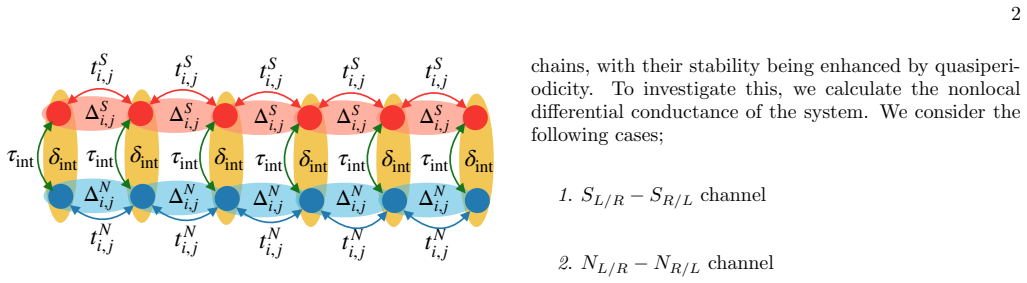
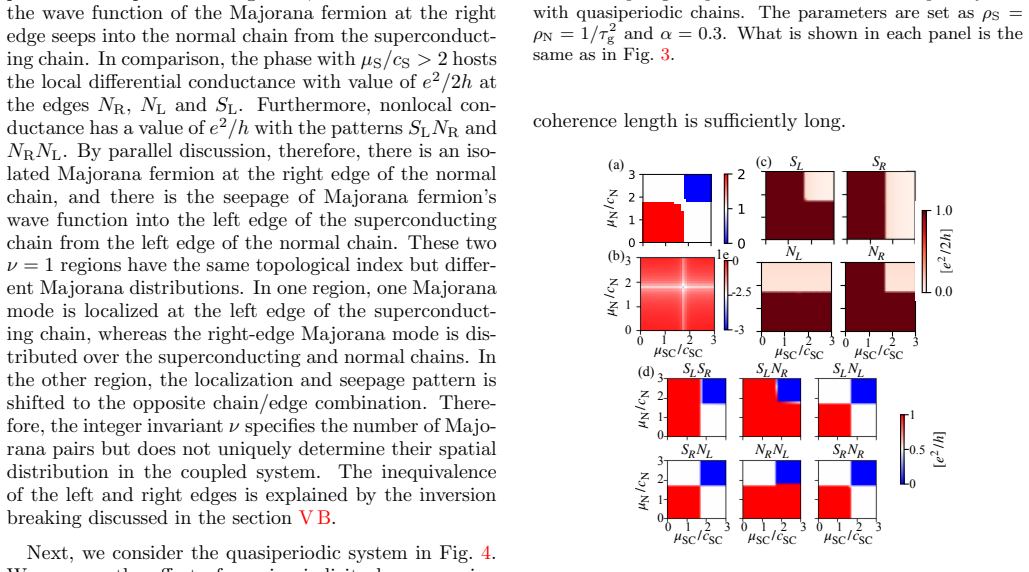
We investigate the topological phases in a coupled one-dimensional p-wave superconducting Fibonacci quasicrystal modeled by the quasiperiodic Kitaev chain. Recent studies have shown that the coupled system can host topological edge modes with Majorana fermions and enhance their topological protection, depending on the pattern of quasiperiodicity. In this work, we elucidate the topological phases of the coupled system and demonstrate the dependence of differential conductance on the lead connecting pattern employing the Keldysh formalism and the recursive Green's function method. Our findings reveal the emergence of topological phases in the coupled system, which are characterized by the presence of Majorana edge modes and the seepage of the Majorana wave function. Furthermore, we identify a new topological phase transition induced by quasiperiodicity in the coupled system.
Editorial analysis
A structured set of objections, weighed in public.
Referee Report
Summary. The paper studies topological phases and nonlocal transport in a system of two coupled one-dimensional p-wave superconducting chains with Fibonacci quasiperiodic modulation (quasiperiodic Kitaev chains). Using the Keldysh formalism and recursive Green's function techniques, it computes differential conductance for different lead-attachment patterns, reports the presence and seepage of Majorana edge modes, and claims to identify a new quasiperiodicity-induced topological phase transition in the coupled system that is distinct from single-chain or periodic cases.
Significance. If the central claim is confirmed, the work would add to the literature on how quasiperiodic potentials modify topological protection and edge-mode localization in coupled superconducting wires, with possible relevance to Majorana-based devices. The choice of recursive Green's functions for conductance is a concrete numerical strength that allows direct comparison with transport experiments.
major comments (1)
- [Results / discussion of the phase transition] The identification of a 'new topological phase transition' (abstract and main results) rests on changes in differential conductance and Majorana wave-function seepage as a function of the quasiperiodic amplitude. However, no calculation or plot shows that the reported critical value coincides with a jump, zero-crossing, or level crossing in a bulk topological invariant (winding number, Pfaffian, or Majorana polarization) of the Bogoliubov-de Gennes Hamiltonian. Conductance signatures alone can arise from localization or finite-size effects without a change in bulk topology; this cross-check is load-bearing for the topological character of the transition.
minor comments (2)
- [Model and abstract] The abstract refers to 'the pattern of quasiperiodicity' and 'lead connecting pattern' without quoting the explicit values of the Fibonacci modulation strength, inter-chain coupling, or chemical potential used for the claimed transition; these should be stated once in the model section and again in the figure captions for reproducibility.
- [Methods] Notation for the recursive Green's function and the Keldysh contour ordering is introduced without a compact summary equation; a single reference equation collecting the definitions would improve readability.
Simulated Author's Rebuttal
We thank the referee for their careful reading of our manuscript and for the constructive feedback. We address the major comment point by point below and outline the revisions we will make to strengthen the topological characterization of the reported phase transition.
read point-by-point responses
-
Referee: The identification of a 'new topological phase transition' (abstract and main results) rests on changes in differential conductance and Majorana wave-function seepage as a function of the quasiperiodic amplitude. However, no calculation or plot shows that the reported critical value coincides with a jump, zero-crossing, or level crossing in a bulk topological invariant (winding number, Pfaffian, or Majorana polarization) of the Bogoliubov-de Gennes Hamiltonian. Conductance signatures alone can arise from localization or finite-size effects without a change in bulk topology; this cross-check is load-bearing for the topological character of the transition.
Authors: We agree that a direct verification via a bulk topological invariant is important to confirm the topological nature of the transition and to rule out purely localization-driven effects. The original manuscript identifies the transition through the appearance and seepage of Majorana edge modes (computed from the eigenvectors of the Bogoliubov-de Gennes Hamiltonian) together with the associated nonlocal conductance signatures obtained via the Keldysh-recursive Green's function approach. To address the referee's concern, we will add in the revised version an explicit calculation of the winding number of the BdG Hamiltonian as a function of the quasiperiodic amplitude. This will be plotted alongside the conductance data to demonstrate that the critical point coincides with a change in the bulk invariant, thereby establishing the bulk-boundary correspondence for the quasiperiodicity-induced transition. The new figure and accompanying discussion will be placed in the results section on the phase diagram. revision: yes
Circularity Check
No significant circularity detected in derivation chain
full rationale
The paper computes differential conductance via the Keldysh formalism and recursive Green's functions applied to the Bogoliubov-de Gennes Hamiltonian of the coupled Fibonacci Kitaev chains. The identification of a quasiperiodicity-induced topological phase transition rests on the presence of Majorana edge modes and their seepage, which are diagnosed from the numerical transport signatures rather than from any self-defined parameter or fitted quantity. No equations in the provided text reduce a claimed prediction to an input by construction, and no load-bearing self-citation chain is invoked to establish the transition itself. The numerical methods are standard and externally verifiable independent of the specific phase diagram reported.
Axiom & Free-Parameter Ledger
Reference graph
Works this paper leans on
-
[1]
Model We consider the N-S-N system constructed by half- infinite normal metal lead and finite quasiperiodic Kitaev chain illustrated in Fig. 7. The tight-binding Hamilto- nian of this system is read as follows; Hα = ±∞X i=0 h µc† α,icα,i −t N c† α,i+1cα,i +h.c. i , (A1) 9 HS = NX i=1 h µd† i di i + N−1X i=1 h −ti,i+1d† i+1di + ∆i,i+1didi+1 +h.c. i , (A2) ...
-
[2]
First of all, we derive the surface Green’s function at the end of left and right leads by the recur- sive Green’s function method [20, 24]
Formulations of differential conductance In this section, we derive the real space of Green’s of the finite-size quasiperiodic Kitaev chain with leads at both edges. First of all, we derive the surface Green’s function at the end of left and right leads by the recur- sive Green’s function method [20, 24]. This method is so useful for the derivation of sur...
-
[3]
Numerical results First, we calculate the differential conductance of a single periodic or quasiperiodic Kitaev chain defined by Eq. (A28). Now, we remark that the gap size for Bo- goliubov quasiparticles depends on the average of the pair potential [25]. Thus we assume that the average c= PN i=1 ∆i,i+1/LN conserves, whereL N is the total bond number ofNs...
-
[4]
Sato and Y
M. Sato and Y. Ando, Topological superconductors: a re- view, Reports on Progress in Physics80, 076501 (2017)
2017
-
[5]
Leijnse and K
M. Leijnse and K. Flensberg, Introduction to topological superconductivity and majorana fermions, Semiconduc- tor Science and Technology27, 124003 (2012)
2012
-
[6]
Sato and S
M. Sato and S. Fujimoto, Topological phases of noncen- trosymmetric superconductors: Edge states, majorana fermions, and non-abelian statistics, Phys. Rev. B79, 094504 (2009)
2009
-
[7]
R. M. Lutchyn, E. P. Bakkers, L. P. Kouwenhoven, P. Krogstrup, C. M. Marcus, and Y. Oreg, Majo- rana zero modes in superconductor–semiconductor het- erostructures, Nature Reviews Materials3, 52 (2018)
2018
-
[8]
Nayak, S
C. Nayak, S. H. Simon, A. Stern, M. Freedman, and S. Das Sarma, Non-abelian anyons and topological quan- tum computation, Rev. Mod. Phys.80, 1083 (2008)
2008
-
[9]
Tutschku, R
C. Tutschku, R. W. Reinthaler, C. Lei, A. H. MacDonald, and E. M. Hankiewicz, Majorana-based quantum com- puting in nanowire devices, Phys. Rev. B102, 125407 (2020)
2020
-
[10]
S. D. Sarma, M. Freedman, and C. Nayak, Majorana zero modes and topological quantum computation, npj Quantum Information1, 1–13 (2015)
2015
-
[11]
Zhang, K
P. Zhang, K. Yaji, T. Hashimoto, Y. Ota, T. Kondo, K. Okazaki, Z. Wang, J. Wen, G. D. Gu, H. Ding, and S. Shin, Observation of topological superconductivity on the surface of an iron-based superconductor, Science360, 14 182–186 (2018)
2018
-
[12]
Sasaki, M
S. Sasaki, M. Kriener, K. Segawa, K. Yada, Y. Tanaka, M. Sato, and Y. Ando, Topological superconductivity in cuxbi2se3, Phys. Rev. Lett.107, 217001 (2011)
2011
-
[13]
Mandal, N
M. Mandal, N. C. Drucker, P. Siriviboon, T. Nguyen, A. Boonkird, T. N. Lamichhane, R. Okabe, A. Chotrat- tanapituk, and M. Li, Topological superconductors from a materials perspective, Chemistry of Materials35, 6184–6200 (2023)
2023
-
[14]
A. Y. Kitaev, Unpaired majorana fermions in quantum wires, Physics-Uspekhi44, 131 (2001)
2001
-
[15]
Y. Oreg, G. Refael, and F. von Oppen, Helical liquids and majorana bound states in quantum wires, Phys. Rev. Lett.105, 177002 (2010)
2010
-
[16]
R. M. Lutchyn, J. D. Sau, and S. Das Sarma, Ma- jorana fermions and a topological phase transition in semiconductor-superconductor heterostructures, Phys. Rev. Lett.105, 077001 (2010)
2010
-
[17]
M. Sato, Y. Takahashi, and S. Fujimoto, Non-abelian topological orders and majorana fermions in spin-singlet superconductors, Phys. Rev. B82, 134521 (2010)
2010
-
[18]
M. T. Deng, C. L. Yu, G. Y. Huang, M. Larsson, P. Caroff, and H. Q. Xu, Anomalous zero-bias conduc- tance peak in a nb–insb nanowire–nb hybrid device, Nano Letters12, 6414–6419 (2012)
2012
-
[19]
L. P. Rokhinson, X. Liu, and J. K. Furdyna, The fractional ac josephson effect in a semiconductor– superconductor nanowire as a signature of majorana par- ticles, Nature Physics8, 795 (2012)
2012
-
[20]
A. Das, Y. Ronen, Y. Most, Y. Oreg, M. Heiblum, and H. Shtrikman, Zero-bias peaks and splitting in an al– inas nanowire topological superconductor as a signature of majorana fermions, Nature Physics8, 887 (2012)
2012
-
[21]
S. M. Albrecht, A. P. Higginbotham, M. Madsen, F. Kuemmeth, T. S. Jespersen, J. Nyg˚ ard, P. Krogstrup, and C. Marcus, Exponential protection of zero modes in majorana islands, Nature531, 206 (2016)
2016
-
[22]
M. Deng, S. Vaitiek˙ enas, E. B. Hansen, J. Danon, M. Lei- jnse, K. Flensberg, J. Nyg˚ ard, P. Krogstrup, and C. M. Marcus, Majorana bound state in a coupled quantum-dot hybrid-nanowire system, Science354, 1557 (2016)
2016
-
[23]
Takagi, S
D. Takagi, S. Tamura, and Y. Tanaka, Odd-frequency pairing and proximity effect in kitaev chain systems in- cluding a topological critical point, Phys. Rev. B101, 024509 (2020)
2020
-
[24]
Leumer, M
N. Leumer, M. Grifoni, B. Muralidharan, and M. Mar- ganska, Linear and nonlinear transport across a finite ki- taev chain: An exact analytical study, Phys. Rev. B103, 165432 (2021)
2021
-
[25]
Pientka, G
F. Pientka, G. Kells, A. Romito, P. W. Brouwer, and F. von Oppen, Enhanced zero-bias majorana peak in the differential tunneling conductance of disordered multi- subband quantum-wire/superconductor junctions, Phys. Rev. Lett.109, 227006 (2012)
2012
-
[26]
K. T. Law, P. A. Lee, and T. K. Ng, Majorana fermion in- duced resonant andreev reflection, Phys. Rev. Lett.103, 237001 (2009)
2009
-
[27]
Asano and Y
Y. Asano and Y. Tanaka, Majorana fermions and odd- frequency cooper pairs in a normal-metal nanowire proximity-coupled to a topological superconductor, Phys. Rev. B87, 104513 (2013)
2013
-
[28]
Jeon and S
J. Jeon and S. Lee, Pattern-dependent proximity effect and majorana edge mode in one-dimensional quasicrys- tals, Phys. Rev. B105, 064502 (2022)
2022
-
[29]
Ghadimi, T
R. Ghadimi, T. Sugimoto, and T. Tohyama, Majorana zero-energy mode and fractal structure in fibonacci– kitaev chain, J. Phys. Soc. Jpn.86, 114707 (2017)
2017
-
[30]
S. Roy, S. N. Nabi, and S. Basu, Critical and topological phases of dimerized kitaev chain in presence of quasiperi- odic potential, Phys. Rev. B107, 014202 (2023)
2023
-
[31]
Peng and G
Y. Peng and G. Refael, Time-quasiperiodic topological superconductors with majorana multiplexing, Phys. Rev. B98, 220509 (2018)
2018
-
[32]
Jiang, Y
X.-P. Jiang, Y. Qiao, and J. Cao, Non-hermitian kitaev chain with complex periodic and quasiperiodic potentials, Chinese Physics B30, 077101 (2021)
2021
-
[33]
I. C. Fulga, M. Maksymenko, M. T. Rieder, N. H. Lind- ner, and E. Berg, Topology and localization of a peri- odically driven kitaev model, Phys. Rev. B99, 235408 (2019)
2019
-
[34]
Jeon and S
J. Jeon and S. Lee, Topological critical states and anoma- lous electronic transmittance in one-dimensional qua- sicrystals, Phys. Rev. Res.3, 013168 (2021)
2021
-
[35]
M. Sun, T. ˇCadeˇ z, I. Yurkevich, and A. Andreanov, En- hancement of superconductivity in the fibonacci chain, Phys. Rev. B109, 134504 (2024)
2024
-
[36]
Kobia lka, O
A. Kobia lka, O. A. Awoga, M. Leijnse, T. Doma´ nski, P. Holmvall, and A. M. Black-Schaffer, Topological su- perconductivity in fibonacci quasicrystals, Phys. Rev. B 110, 134508 (2024)
2024
-
[37]
Sandberg, O
A. Sandberg, O. A. Awoga, A. M. Black-Schaffer, and P. Holmvall, Josephson effect in a fibonacci quasicrystal, Physical Review B110, 104513 (2024)
2024
-
[38]
Zhu, G.-Q
Q. Zhu, G.-Q. Zha, A. A. Shanenko, and Y. Chen, Super- conducting properties of fibonacci chains with enhanced superconducting pairing at the boundaries, Phys. Rev. B 112, 134503 (2025)
2025
-
[39]
Y. Yang, Z. Pan, and X. Li, Emergent multiple mobility edges and reentrant localization in a quasiperiodic mod- ulated dimerized kitaev superconductor model, Physica B: Condensed Matter707, 417146 (2025)
2025
-
[40]
T. A. Loring, K-theory and pseudospectra for topological insulators, Annals of Physics356, 383 (2015)
2015
-
[41]
Saito, M
K. Saito, M. Hori, R. Okugawa, K. Tanaka, and T. To- hyama, Gapless superconductivity and its real-space topology in quasicrystals, Phys. Rev. Res.7, L022077 (2025)
2025
-
[42]
I. C. Fulga, D. I. Pikulin, and T. A. Loring, Aperiodic weak topological superconductors, Phys. Rev. Lett.116, 257002 (2016)
2016
-
[43]
C. Wang, F. Liu, and H. Huang, Effective model for frac- tional topological corner modes in quasicrystals, Phys. Rev. Lett.129, 056403 (2022)
2022
-
[44]
Jagannathan, The fibonacci quasicrystal: Case study of hidden dimensions and multifractality, Rev
A. Jagannathan, The fibonacci quasicrystal: Case study of hidden dimensions and multifractality, Rev. Mod. Phys.93, 045001 (2021)
2021
-
[45]
Deguchi, S
K. Deguchi, S. Matsukawa, N. K. Sato, T. Hattori, K. Ishida, H. Takakura, and T. Ishimasa, Quantum criti- cal state in a magnetic quasicrystal, Nature materials11, 1013 (2012)
2012
-
[46]
Deguchi, M
K. Deguchi, M. Nakayama, S. Matsukawa, K. Imura, K. Tanaka, T. Ishimasa, and N. K. Sato, Superconduc- tivity of au–ge–yb approximants with tsai-type clusters, Journal of the Physical Society of Japan84, 023705 (2015)
2015
-
[47]
Kamiya, T
K. Kamiya, T. Takeuchi, N. Kabeya, N. Wada, T. Ishi- masa, A. Ochiai, K. Deguchi, K. Imura, and N. Sato, Discovery of superconductivity in quasicrystal, Nature 15 communications9, 154 (2018)
2018
-
[48]
Shiino, G
T. Shiino, G. H. Gebresenbut, F. Denoel, R. Mathieu, U. H¨ aussermann, and A. Rydh, Superconductivity at 1 k in y-au-si quasicrystal approximants, Phys. Rev. B103, 054510 (2021)
2021
-
[49]
Y. Wang, G. Rai, C. Matsumura, A. Jagannathan, and S. Haas, Superconductivity in the fibonacci chain, Phys. Rev. B109, 214507 (2024)
2024
-
[50]
Tamura, A
R. Tamura, A. Ishikawa, S. Suzuki, T. Kotajima, Y. Tanaka, T. Seki, N. Shibata, T. Yamada, T. Fujii, C.- W. Wang,et al., Experimental observation of long-range magnetic order in icosahedral quasicrystals, Journal of the American Chemical Society143, 19938 (2021)
2021
-
[51]
N. Sato, S. Matsukawa, K. Nobe, K. Imura, K. Deguchi, and T. Ishimasa, Quantum critical behavior in mag- netic quasicrystals and approximant crystals, Journal of Physics: Conference Series868, 012005 (2017)
2017
-
[52]
Ishikawa, T
A. Ishikawa, T. Fujii, T. Takeuchi, T. Yamada, Y. Mat- sushita, and R. Tamura, Antiferromagnetic order is pos- sible in ternary quasicrystal approximants, Phys. Rev. B 98, 220403 (2018)
2018
-
[53]
Sriram, S
P. Sriram, S. S. Kalantre, K. Gharavi, J. Baugh, and B. Muralidharan, Supercurrent interference in semicon- ductor nanowire josephson junctions, Phys. Rev. B100, 155431 (2019)
2019
-
[54]
Nagai, Y
Y. Nagai, Y. Shinohara, Y. Futamura, and T. Saku- rai, Reduced-shifted conjugate-gradient method for a green’s function: Efficient numerical approach in a nano- structured superconductor, Journal of the Physical Soci- ety of Japan86, 014708 (2017)
2017
discussion (0)
Sign in with ORCID, Apple, or X to comment. Anyone can read and Pith papers without signing in.