Recognition: unknown
Activity and composition of periodic comets 67P/Churyumov-Gerasimenko and 103P/Hartley 2 at two different perihelion passages
Pith reviewed 2026-05-08 16:43 UTC · model grok-4.3
The pith
Comets 67P and 103P show unchanging chemical compositions across separate perihelion passages despite shifts in activity.
A machine-rendered reading of the paper's core claim, the machinery that carries it, and where it could break.
Core claim
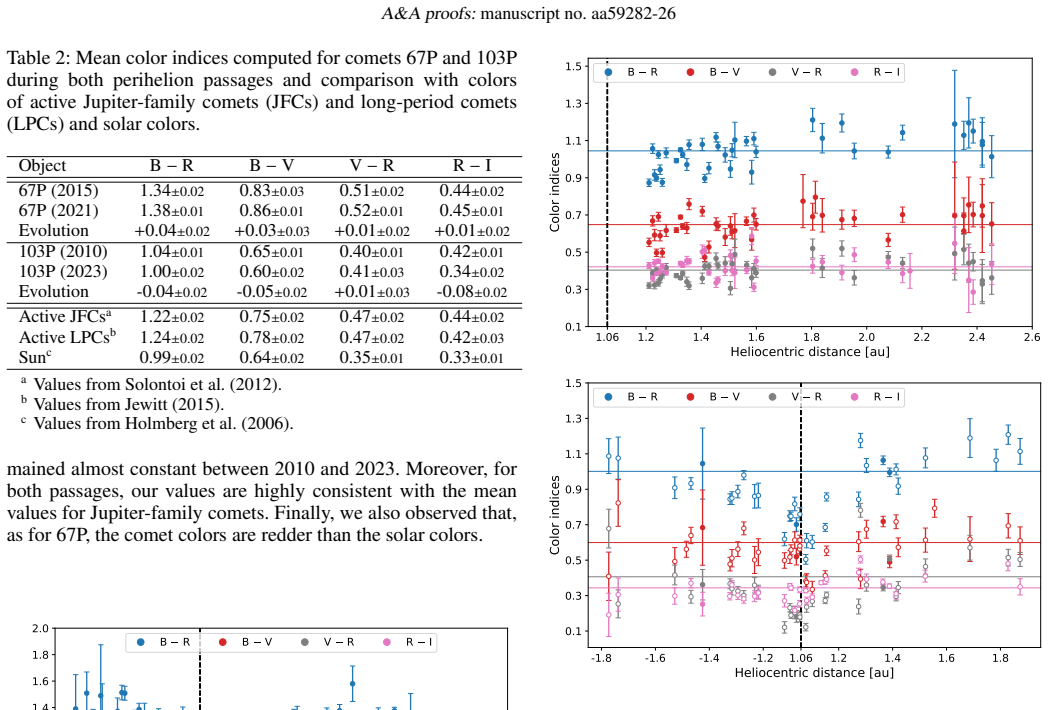
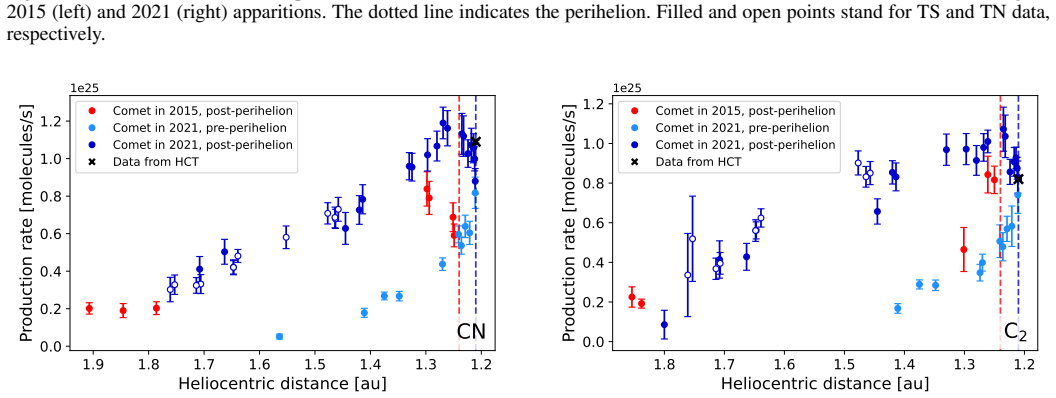
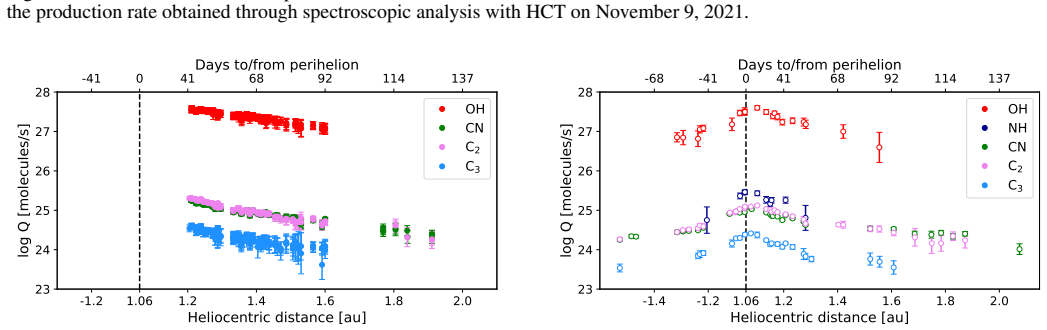
Both comets exhibit typical chemical compositions for Jupiter-family objects, with no variation of the C2-to-CN production rate ratios and dust-to-gas ratios from one passage to the other. This indicates constant compositions even if the level of activity has changed for 103P, which decreased substantially between 2010 and 2023, while 67P showed a small increase between 2015 and 2021 likely due to orbital evolution.
What carries the argument
Haser model applied to narrowband photometry to compute production rates of CN, C2, C3, OH, and NH, together with the Afrho parameter as a dust activity proxy and broadband color indices.
If this is right
- The unchanged ratios imply that the volatile inventories and dust properties of these comets are not being progressively altered by repeated solar passages.
- Variations in overall activity are driven by small changes in orbital parameters rather than by intrinsic evolution of the nucleus.
- Stable coma colors indicate that the ejection and scattering properties of dust grains remain consistent from one apparition to the next.
- These comets can serve as reference objects for tracking long-term stability in the Jupiter-family population.
Where Pith is reading between the lines
- Similar monitoring of additional periodic comets over multiple orbits would test whether constant composition is typical or depends on each object's dynamical history.
- If the active layers release material of unchanging composition, this may indicate that deeper interior material is being exposed without significant chemical processing.
- Combining these photometric results with space-based infrared measurements could reveal whether the observed stability extends to less volatile species not captured by optical filters.
Load-bearing premise
The Haser model scale lengths and filter transmission curves remain valid across apparitions, and differences in observing conditions or calibration do not introduce systematic offsets that would hide real changes in composition or activity.
What would settle it
A statistically significant deviation in the measured C2-to-CN production rate ratio or dust-to-gas ratio for either comet during its next perihelion passage would show that the compositions are not constant.
Figures






read the original abstract
Through photometry and spectroscopy, we studied the evolution of the activity and chemical composition of comet 67P during its 2025 and 2021 perihelion passages and of comet 103P during its 2010 and 2023 passages. For each comet, we aim to compare their behavior from one apparition to another. We used the TRAPPIST telescopes to monitor the comets using broadband and narrowband filters. From the broadband images, we produced light curves and computed color indices for each passage, and we derived the activity slopes. We used a Haser model to compute the production rates of five gaseous species (CN, C2, C3, OH, and NH) and derived the proxy parameter Afrho for dust activity. We also observed both comets in spectroscopy during their most recent apparition using the Himalayan Chandra Telescope and compared the spectroscopic data to our results obtained through photometry. For both comets, our analysis of coma colors does not reveal any significant change from one passage to the other, indicating that the properties of the released dust grains are similar. Our values of the color indices are consistent with the mean values for Jupiter-family comets. We measured a slight increase in the gas and dust activities of comet 67P between 2015 and 2021, probably due to the small change in the comet's orbit that led the perihelion distance to decrease from 1.24 au for the first apparition to 1.21 au for the second one. Regarding 103P, we unambiguously measured a decrease (of at least 50\%) in the gas and dust activities between 2010 and 2023, showing a different behavior for this young, active comet. We find a typical chemical composition for both comets and detect no variation of the C2-to-CN production rate ratios and dust-to-gas ratios from one passage to the other, indicating constant compositions, even if the level of activity has changed for 103P.
Editorial analysis
A structured set of objections, weighed in public.
Referee Report
Summary. The manuscript presents TRAPPIST broadband and narrowband photometry of comets 67P (2021 and 2025 apparitions) and 103P (2010 and 2023 apparitions), supplemented by HCT spectroscopy for the recent passages. Haser models are applied to derive production rates for CN, C2, C3, OH and NH; Afrho is used as a dust proxy. Color indices and activity slopes are extracted from broadband data. The central claim is that both comets show typical Jupiter-family compositions, with no detectable change in C2/CN production-rate ratios or dust-to-gas ratios between apparitions, even though 67P exhibits a modest activity increase and 103P a >50% activity decrease.
Significance. If the reported constancy of the composition ratios is robust, the work supplies direct empirical evidence that volatile and dust mixing ratios in these Jupiter-family comets remain stable across orbital cycles despite changes in insolation and overall activity. The consistent use of the same telescope network for both epochs of each comet is a methodological strength that reduces some instrumental variables. The results constrain models of cometary evolution and outgassing that predict either progressive depletion or compositional alteration between apparitions.
major comments (3)
- [Haser modeling section] Haser modeling section: the C2-to-CN and Afrho-to-gas ratios are reported as statistically identical between epochs without any sensitivity analysis to the adopted scale lengths (fixed from literature values at a reference r_h). For 103P the 2010 and 2023 apparitions differ in both perihelion distance and activity level; if the true outflow velocity or photodissociation rates scale with these quantities, the derived ratios could remain artificially constant even if the underlying mixing ratios changed. This assumption is load-bearing for the central claim of unchanged composition.
- [Results on activity and composition ratios] Results on activity and composition ratios: no quantitative error bars, covariance estimates, or Monte-Carlo realizations are supplied for the production-rate ratios or Afrho/gas values. Without these, it is impossible to determine whether the reported constancy is statistically significant or merely consistent within unstated uncertainties.
- [Cross-epoch comparison paragraphs] Cross-epoch comparison paragraphs: potential zero-point or filter-transmission offsets between the two TRAPPIST campaigns are not quantified or bounded. Any systematic photometric offset comparable to the reported activity change for 103P would directly affect the dust-to-gas ratios and could mask real compositional differences.
minor comments (3)
- [Abstract] The abstract states that color indices are 'consistent with the mean values for Jupiter-family comets' but does not cite the specific reference sample or provide the numerical mean values used for comparison.
- [Figure captions] Figure captions for the light curves should explicitly mark the times of perihelion for each apparition to facilitate visual comparison of activity evolution.
- [Methods] The source of the adopted Haser scale lengths (e.g., specific literature values and any r_h dependence) should be stated explicitly in the methods rather than assumed standard.
Simulated Author's Rebuttal
We thank the referee for the constructive and detailed report. The comments highlight important aspects of our analysis that we will address to strengthen the manuscript. Below we respond point-by-point to the major comments.
read point-by-point responses
-
Referee: [Haser modeling section] Haser modeling section: the C2-to-CN and Afrho-to-gas ratios are reported as statistically identical between epochs without any sensitivity analysis to the adopted scale lengths (fixed from literature values at a reference r_h). For 103P the 2010 and 2023 apparitions differ in both perihelion distance and activity level; if the true outflow velocity or photodissociation rates scale with these quantities, the derived ratios could remain artificially constant even if the underlying mixing ratios changed. This assumption is load-bearing for the central claim of unchanged composition.
Authors: We agree that a sensitivity analysis to the adopted Haser scale lengths would strengthen the robustness of the reported constancy in composition ratios. The scale lengths were taken from standard literature values appropriate to the heliocentric distance range of our observations. In the revised manuscript we will add a dedicated subsection performing a sensitivity test by varying the CN and C2 scale lengths by ±20% (a range encompassing typical uncertainties in the literature) and recomputing the production-rate ratios for both epochs of each comet. We will show that the C2/CN ratios remain consistent within the derived uncertainties, thereby supporting that the constancy is not an artifact of the fixed scale lengths. revision: yes
-
Referee: [Results on activity and composition ratios] Results on activity and composition ratios: no quantitative error bars, covariance estimates, or Monte-Carlo realizations are supplied for the production-rate ratios or Afrho/gas values. Without these, it is impossible to determine whether the reported constancy is statistically significant or merely consistent within unstated uncertainties.
Authors: We acknowledge that the manuscript lacks explicit uncertainties on the derived ratios. In the revision we will propagate the photometric measurement uncertainties through the Haser model to provide formal error bars on all production rates, Afrho values, and the resulting C2/CN and Afrho/gas ratios. We will also include a Monte Carlo analysis (drawing from the observed flux uncertainties) to quantify the covariance between species and to assess the statistical significance of the inter-epoch constancy. These additions will allow readers to evaluate the robustness of our central claim directly. revision: yes
-
Referee: [Cross-epoch comparison paragraphs] Cross-epoch comparison paragraphs: potential zero-point or filter-transmission offsets between the two TRAPPIST campaigns are not quantified or bounded. Any systematic photometric offset comparable to the reported activity change for 103P would directly affect the dust-to-gas ratios and could mask real compositional differences.
Authors: The same TRAPPIST telescopes and reduction pipeline were used for both epochs of each comet, which minimizes instrumental differences. Nevertheless, we agree that small zero-point offsets should be bounded. In the revised manuscript we will quantify any potential offsets by comparing the photometry of field stars and standard stars observed in both campaigns and will report the resulting upper limits on systematic photometric differences. We will then propagate these bounds into the activity levels and dust-to-gas ratios to demonstrate that they cannot account for the >50% activity decrease observed for 103P or alter the conclusion of unchanged composition ratios. revision: partial
Circularity Check
No circularity; direct empirical ratios from new observations using standard models
full rationale
The paper computes production rates via the standard Haser model applied to fresh TRAPPIST narrowband photometry and derives C2/CN and Afrho/gas ratios directly from those rates. These ratios are then compared across apparitions as an observational result. No equation or step defines a claimed prediction in terms of quantities fitted or assumed within the same paper, nor does any load-bearing premise rest on a self-citation whose content is itself unverified. Scale lengths and filter curves are invoked as literature standards rather than author-derived fits, and the constancy claim is a straightforward data comparison, not a renaming or self-referential construction.
Axiom & Free-Parameter Ledger
axioms (1)
- domain assumption The Haser model accurately describes the radial distribution of coma species for the observed heliocentric distances and production rates.
Reference graph
Works this paper leans on
-
[1]
F., Belton, M
A’Hearn, M. F., Belton, M. J. S., Delamere, W. A., et al. 2011, Science, 332, 1396 A’Hearn, M. F., Millis, R. C., Schleicher, D. O., Osip, D. J., & Birch, P. V . 1995, Icarus, 118, 223 A’Hearn, M. F., Schleicher, D. G., Millis, R. L., Feldman, P. D., & Thompson, D. T. 1984, AJ, 89, 579
2011
-
[2]
2022, Icarus, 383, 115042
Aravind, K., Halder, P., Ganesh, S., et al. 2022, Icarus, 383, 115042
2022
-
[3]
2019, A&A, 630, A18
Attree, N., Jorda, L., Groussin, O., et al. 2019, A&A, 630, A18
2019
-
[4]
L., Barker, E
Cochran, A. L., Barker, E. S., Ramseyer, T. F., & Storrs, A. D. 1992, Icarus, 98, 151
1992
-
[5]
R., Mäkinen, T., Bertaux, J.-L., et al
Combi, M. R., Mäkinen, T., Bertaux, J.-L., et al. 2020, The Planetary Science Journal, 1, 72 De Pater, I. & Lissauer, J. J. 2015, Planetary sciences (Cambridge University Press)
2020
-
[6]
L., Schleicher, D
Farnham, T. L., Schleicher, D. G., & A’Hearn, M. F. 2000, Icarus, 147, 180
2000
-
[7]
D., A’hearn, M
Feldman, P. D., A’hearn, M. F., Feaga, L. M., et al. 2016, The Astrophysical journal letters, 825, L8
2016
-
[8]
2023, in LPI Contributions, V ol
Gardener, D., Snodgrass, C., & Jehin, E. 2023, in LPI Contributions, V ol. 2851,
2023
-
[9]
Asteroids, Comets, Meteors Conference, 2093
2093
-
[10]
F., Fitzsimmons, A., Denneau, L., et al
Gillan, A. F., Fitzsimmons, A., Denneau, L., et al. 2024, The Planetary Science Journal, 5, 25
2024
-
[11]
2004, A&A, 419, 375
Groussin, O., Lamy, P., Jorda, L., & Toth, I. 2004, A&A, 419, 375
2004
-
[12]
1957, Bulletin de la Societe Royale des Sciences de Liege, 43, 740
Haser, L. 1957, Bulletin de la Societe Royale des Sciences de Liege, 43, 740
1957
-
[13]
2025, A&A, 701, A61
Hmiddouch, S., Jehin, E., Lippi, M., et al. 2025, A&A, 701, A61
2025
-
[14]
2006, Monthly Notices of the Royal Astronomical Society, 367, 449
Holmberg, J., Flynn, C., & Portinari, L. 2006, Monthly Notices of the Royal Astronomical Society, 367, 449
2006
-
[15]
2011, The Messenger, 145, 2
Jehin, E., Gillon, M., Queloz, D., et al. 2011, The Messenger, 145, 2
2011
-
[16]
M., Lin, Z.-Y ., Rodrigo, R., & Ip, W.-H
Lara, L. M., Lin, Z.-Y ., Rodrigo, R., & Ip, W.-H. 2011, A&A, 525, A36
2011
-
[17]
J., A’Hearn, M
Meech, K. J., A’Hearn, M. F., Adams, J. A., et al. 2011, ApJ, 734, L1
2011
-
[18]
2017, MNRAS, 469, S222
Opitom, C., Snodgrass, C., Fitzsimmons, A., et al. 2017, MNRAS, 469, S222
2017
-
[19]
2018, MNRAS, 481, 1235
Rinaldi, G., Bockelée-Morvan, D., Ciarniello, M., et al. 2018, MNRAS, 481, 1235
2018
-
[20]
Schleicher, D. G. 2006, Icarus, 181, 442
2006
-
[21]
A., & Boehnhardt, H
Schulz, R., Stüwe, J. A., & Boehnhardt, H. 2004, A&A, 422, L19
2004
-
[22]
2016, MNRAS, 462, S138
Snodgrass, C., Opitom, C., de Val-Borro, M., et al. 2016, MNRAS, 462, S138
2016
-
[23]
2012, Icarus, 218, 571
Solontoi, M., Ivezi´c, Ž., Juri ´c, M., et al. 2012, Icarus, 218, 571
2012
-
[24]
Swamy, K. K. 2010, Physics of comets, V ol. 12 (World Scientific)
2010
-
[25]
2020, An Introduction to Comets; Post-Rosetta Perspectives Vander Donckt, M., Jehin, E., Aravind, K., et al
Thomas, N. 2020, An Introduction to Comets; Post-Rosetta Perspectives Vander Donckt, M., Jehin, E., Aravind, K., et al. 2026, A&A, 705, A89 Article number, page 12 of 12
2020
discussion (0)
Sign in with ORCID, Apple, or X to comment. Anyone can read and Pith papers without signing in.