Recognition: unknown
Modelling Farm-to-Farm Interaction Using a Fast Linearised Numerical Approach
Pith reviewed 2026-05-08 17:09 UTC · model grok-4.3
The pith
A fast linearised 2D model shows ground proximity drives upward displacement of wind farm wakes, making downstream farms with higher hub heights more vulnerable.
A machine-rendered reading of the paper's core claim, the machinery that carries it, and where it could break.
Core claim
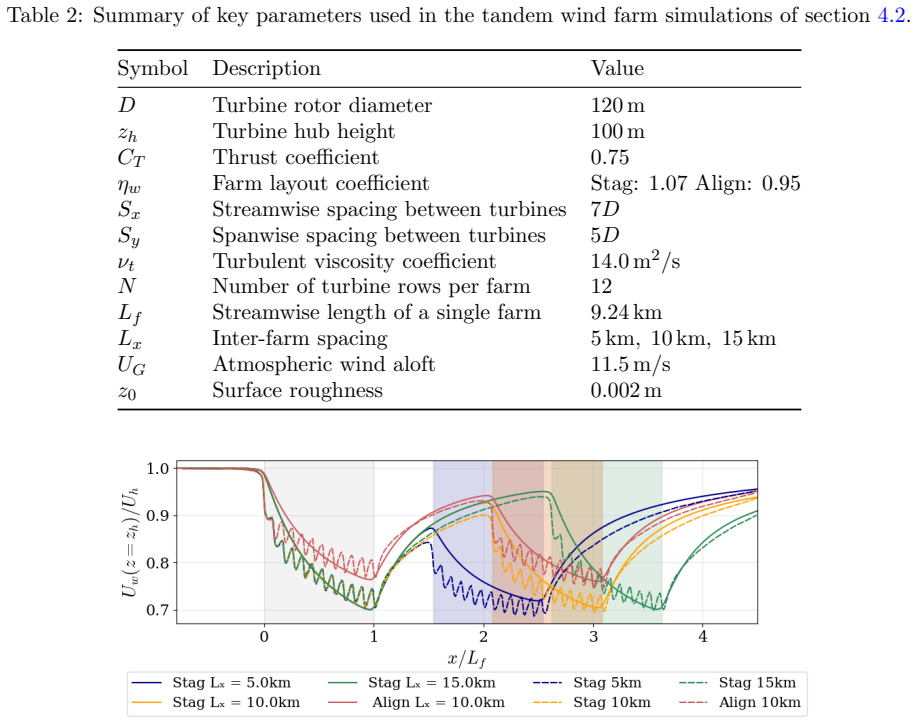
The linearised two-dimensional incompressible equations, solved with Fourier transforms in the horizontal direction and finite-difference discretisation in the vertical, predict that wakes from an upstream wind farm displace upward in a tandem configuration. This displacement arises because proximity to the ground restricts downward wake expansion and produces asymmetric turbulent entrainment. Parametric runs across inter-farm distances and hub-height ratios indicate that the upward shift causes downstream farms with higher hub heights to experience greater power losses from upstream wakes than farms with lower hub heights.
What carries the argument
Linearised two-dimensional incompressible equations solved by Fourier transforms horizontally and finite differences vertically, which rapidly computes farm-to-farm wake recovery and vertical displacement without full turbulence simulation.
If this is right
- Downstream wind farms should use lower hub heights relative to upstream farms to reduce wake interference.
- Optimal inter-farm spacing depends on the vertical wake shift, which grows with distance from the ground.
- The fast model enables rapid exploration of many farm layouts before committing to expensive full simulations.
- Wake recovery rates in tandem configurations are controlled by the same asymmetric entrainment that produces the upward displacement.
Where Pith is reading between the lines
- Farm planners could test staggered hub-height arrangements within a single large array to exploit the vertical displacement effect.
- The two-dimensional assumption might be relaxed by adding a spanwise Fourier mode to check whether lateral spreading alters the upward shift.
- If atmospheric stability changes the effective ground blocking, the model would need an adjusted entrainment coefficient to remain predictive.
- Real-time control systems for wind farms could use the linearised solver to forecast wake positions from measured upstream conditions.
Load-bearing premise
The linearised two-dimensional incompressible equations remain accurate enough to capture wake recovery and the observed vertical displacement even in real turbulent flows at the tested distances and height ratios.
What would settle it
Measure the vertical position of the wake centerline at the downstream farm location in a large-eddy simulation or field experiment for a hub-height ratio of 1.2 at an inter-farm spacing of 10 diameters; if the model over- or under-predicts the upward shift by more than the reported validation error, the displacement mechanism is not supported.
Figures



read the original abstract
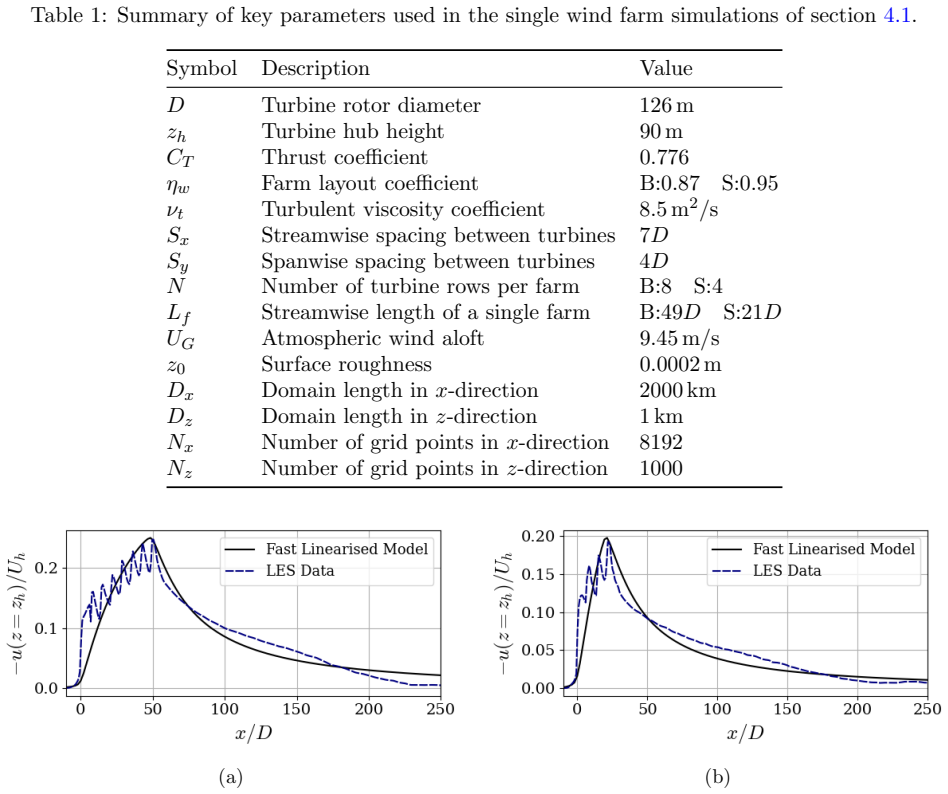
This paper presents a computationally efficient, linearised numerical method for modelling aerodynamic interactions between wind farms. The linearised two-dimensional incompressible equations are solved using Fourier transforms in the horizontal direction and finite-difference discretisation in the vertical. Model predictions are validated against large-eddy simulation (LES) data, focusing on a tandem wind farm configuration where a downstream wind farm operates within the wake of an upstream array. A parametric study is then conducted to examine the impact of this wake on the performance of the downstream farm across a range of inter-farm distances and hub-height ratios. We demonstrate that the upward vertical displacement of these wakes is driven by asymmetric turbulent entrainment caused by the farm's proximity to the ground, which restricts downward wake expansion. Consequently, the results suggest that, due to this upward wake displacement, downstream wind farms with higher hub heights may be more strongly affected by upstream farms than those with lower hub heights.
Editorial analysis
A structured set of objections, weighed in public.
Referee Report
Summary. The manuscript introduces a computationally efficient linearised two-dimensional numerical method for modeling aerodynamic interactions between wind farms. The approach solves the linearised incompressible Navier-Stokes equations using Fourier transforms in the horizontal direction and finite-difference discretisation in the vertical. Predictions are validated against large-eddy simulation (LES) data for tandem wind farm configurations, followed by a parametric study examining the effects of inter-farm distances and hub-height ratios on downstream farm performance. The key result is that wakes exhibit upward vertical displacement due to asymmetric turbulent entrainment restricted by the ground, implying that downstream wind farms with higher hub heights are more strongly affected by upstream wakes.
Significance. If the results hold, this work provides a valuable fast modeling tool for wind farm wake interactions that could facilitate extensive parametric studies and optimization in wind energy applications. The finding regarding hub-height sensitivity to wake displacement offers a new perspective on farm layout design that may improve energy yield predictions in multi-farm setups.
major comments (2)
- [§4] §4 (validation against LES): The abstract states validation against LES for the tandem configuration, but no quantitative agreement metrics (e.g., L2 norms on velocity deficit profiles, wake centroid vertical shift, or vertical momentum flux) are referenced. Without these, the support for the asymmetric entrainment mechanism and the subsequent hub-height claim cannot be fully assessed.
- [§5] §5 (parametric study and mechanism attribution): The demonstration that upward wake displacement is driven by ground-restricted asymmetric turbulent entrainment is diagnosed from the linearised 2D solutions. However, linearisation suppresses nonlinear advection and 3D turbulent structures that dominate real entrainment; the paper should include a direct comparison of model-predicted vs. LES wake centroid trajectories across the tested hub-height ratios to confirm the causal explanation is not an artifact of the approximation.
minor comments (2)
- The abstract refers to 'a range of inter-farm distances and hub-height ratios' but does not list the specific values used; these should be stated explicitly for reproducibility.
- Figures showing vertical profiles would benefit from explicit annotation of the ground plane and hub-height locations to clarify the displacement effect.
Simulated Author's Rebuttal
We thank the referee for their constructive comments, which help clarify the validation and strengthen the interpretation of our results. We address each major comment below and outline the revisions we will make.
read point-by-point responses
-
Referee: [§4] §4 (validation against LES): The abstract states validation against LES for the tandem configuration, but no quantitative agreement metrics (e.g., L2 norms on velocity deficit profiles, wake centroid vertical shift, or vertical momentum flux) are referenced. Without these, the support for the asymmetric entrainment mechanism and the subsequent hub-height claim cannot be fully assessed.
Authors: We agree that explicit quantitative metrics will improve the assessment of the validation results. We will add L2-norm errors for the velocity deficit profiles, wake centroid vertical shifts, and vertical momentum flux comparisons in Section 4. We will also revise the abstract to reference these metrics, providing clearer quantitative support for the model accuracy and the proposed entrainment mechanism. revision: yes
-
Referee: [§5] §5 (parametric study and mechanism attribution): The demonstration that upward wake displacement is driven by ground-restricted asymmetric turbulent entrainment is diagnosed from the linearised 2D solutions. However, linearisation suppresses nonlinear advection and 3D turbulent structures that dominate real entrainment; the paper should include a direct comparison of model-predicted vs. LES wake centroid trajectories across the tested hub-height ratios to confirm the causal explanation is not an artifact of the approximation.
Authors: We acknowledge that the linearised model omits nonlinear advection and three-dimensional turbulent structures, which are important for real entrainment processes. The upward wake displacement in the model arises specifically from the ground boundary condition that restricts downward entrainment, an effect retained in the linearised equations with the imposed eddy viscosity. We will add plots of wake centroid trajectories from the linear model across the hub-height ratios in the revised parametric study section. However, we do not have LES data available for the varying hub-height configurations, so a direct model-versus-LES comparison of trajectories cannot be provided. revision: partial
- Direct comparison of linear model wake centroid trajectories versus LES for the tested hub-height ratios, due to the absence of LES data for those specific configurations.
Circularity Check
No significant circularity; derivation is self-contained from standard equations
full rationale
The paper derives its fast linearised numerical method directly from the standard linearised 2D incompressible Navier-Stokes equations, discretised via established Fourier transforms in the horizontal and finite differences in the vertical. Results for wake recovery, vertical displacement, and farm-to-farm interactions are obtained by solving these equations for given inputs (inter-farm distances, hub-height ratios) and are validated against independent LES data rather than being presupposed. The attribution of upward wake displacement to asymmetric entrainment is an inference drawn from the computed solutions, not a definitional or fitted input. No self-citations are invoked as load-bearing uniqueness theorems, no parameters are fitted to a subset and then relabelled as predictions, and no ansatz is smuggled via prior work. The central claims therefore remain independent of their own outputs.
Axiom & Free-Parameter Ledger
axioms (2)
- domain assumption Linearised two-dimensional incompressible Navier-Stokes equations are adequate for farm-to-farm wake interactions
- standard math Fourier transforms horizontally and finite differences vertically yield an accurate and efficient discretisation
Reference graph
Works this paper leans on
-
[1]
Bastankhah M, Mohammadi M, Lees C, Diaz G, Buxton O and Ivanell S 2024 A fast-running physics-based wake model for a semi-infinite wind farmJournal of Fluid Mechanics985A43
2024
-
[2]
Nygaard N Get al.2020 Modelling cluster wakes and wind farm blockageJournal of Physics: Conference Seriesvol 1618 aDS / Harv. Press
2020
-
[3]
Pettas Vet al.2021 On the effects of inter-farm interactions at the offshore windWind Energy Science61455
2021
-
[4]
Stevens R and Meneveau C 2017 Flow structure and turbulence in wind farmsAnnual review of fluid mechanics49311–339
2017
-
[5]
Port´ e-Agel Fet al.2020 Wind-turbine and wind-farm flows: A reviewBoundary-Layer Meteorology1741–59
2020
-
[6]
Jensen N O 1983 A note on wind generator interaction Tech. rep. Risø National Laboratory
1983
-
[7]
Bastankhah M and Port´ e-Agel F 2014 A new analytical model for wind-turbine wakesRenewable Energy70116–123
2014
-
[8]
Bastankhah M, Welch B, Mart´ ınez-Tossas L, King J and Fleming P 2021 Analytical solution for the cumulative wake of wind turbines in wind farmsJournal of Fluid Mechanics911
2021
-
[9]
Bleeg J, Purcell M, Ruisi R and Traiger E 2018 Wind farm blockage and the consequences of neglecting its impact on energy productionEnergies111609
2018
-
[10]
Nygaard N, Steen S, Poulsen L and Pedersen J 2020 Modelling cluster wakes and wind farm blockageJournal of Physics: Conference Seriesvol 1618 (IOP Publishing) p 062072
2020
-
[11]
Ott S 2011 Linearised cfd models for wakes Tech. rep. Danmarks Tekniske Universitet, Risø Nationallaboratoriet for Bæredygtig Energi
2011
-
[12]
Ott S and Nielsen M 2014 Developments of the offshore wind turbine wake model fuga
2014
-
[13]
Ebenhoch R, Muro B, Dahlberg J, Berkesten H¨ agglund P and Segalini A 2017 A linearized numerical model of wind-farm flowsWind Energy20859–875
2017
-
[14]
Drazin P G and Reid W H 2004Hydrodynamic Stability2nd ed Cambridge Mathematical Library (Cambridge University Press)
-
[15]
Belcher S, Jerram N and Hunt J 2003 Adjustment of a turbulent boundary layer to a canopy of roughness elementsJournal of Fluid Mechanics488369–398
2003
-
[16]
Smith R B 2010 Gravity wave effects on wind farm efficiencyWind Energy13449–458 ISSN 1095-4244, 1099-1824
2010
-
[17]
Allaerts D and Meyers J 2019 Sensitivity and feedback of wind-farm-induced gravity waves Journal of fluid mechanics862990–1028
2019
-
[18]
Stieren A and Stevens R J 2022 Impact of wind farm wakes on flow structures in and around downstream wind farmsFlow2E21
2022
-
[19]
Wang Z and Yang X 2023 Upward Shift of Wind Turbine Wakes in Large Wind FarmsEnergies 168051 ISSN 1996-1073
2023
-
[20]
Kasper J, Stieren A and Stevens R 2024 Simulation and modeling of wind farms in baroclinic atmospheric boundary layersJournal of Renewable and Sustainable Energy16
2024
-
[21]
Souaiby M and Port´ e-Agel F 2025 Atmospheric stability effect on wind farm flow and performance Physics of Fluids37095152 ISSN 1070-6631
2025
discussion (0)
Sign in with ORCID, Apple, or X to comment. Anyone can read and Pith papers without signing in.