Recognition: unknown
Concurrence of Symmetry Breaking and Nonlocality Phase Transitions in Diffusion Models
Pith reviewed 2026-05-08 17:23 UTC · model grok-4.3
The pith
In diffusion transformers the moment trajectories split into distinct meanings coincides with the moment local denoising steps stop working.
A machine-rendered reading of the paper's core claim, the machinery that carries it, and where it could break.
Core claim
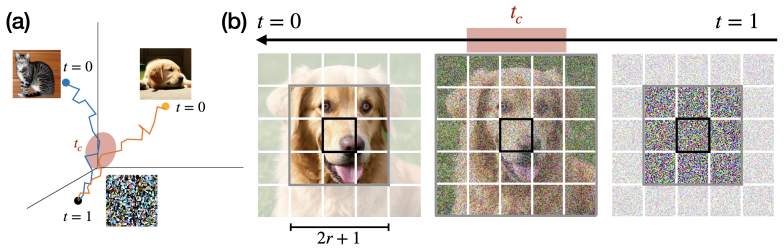
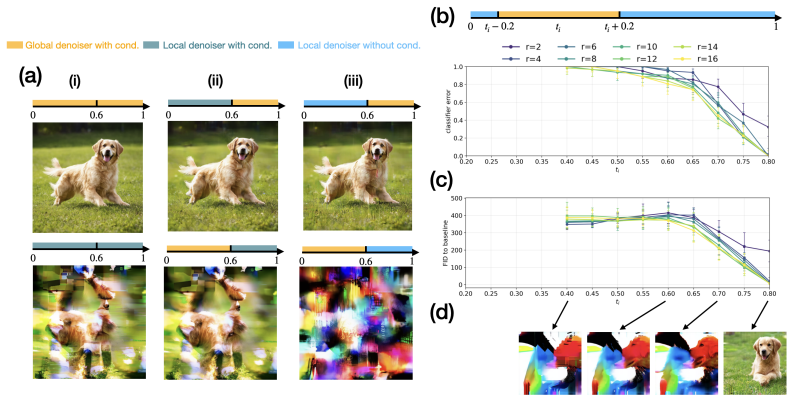
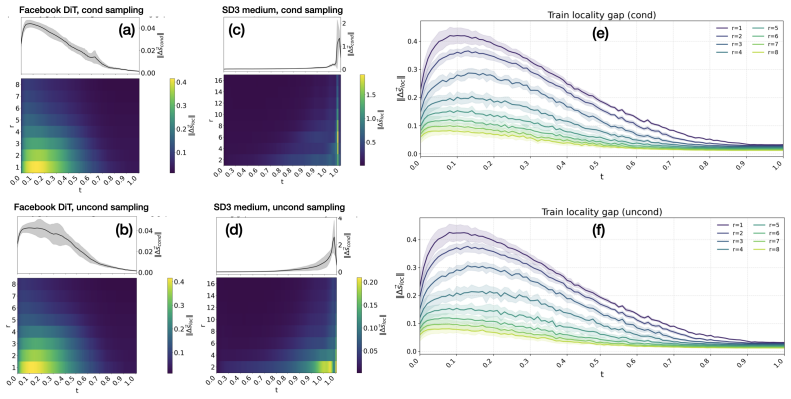
By evaluating the dynamics and outcomes of the generation trajectory, we observe a near-simultaneous occurrence of the non-locality and symmetry breaking critical times. This is the first practical unification of the two notions of phase transitions in diffusion models, providing a concrete diagnostic for when and why diffusion models rely on conditioning and global denoising.
What carries the argument
The near-simultaneous critical times identified by tracking when trajectories bifurcate into semantic minima and when local denoising fails.
If this is right
- Conditioning and global denoising are required only inside the shared critical window rather than throughout the entire trajectory.
- The aligned times give a direct test for whether a model is using its conditioning signal at the right moment.
- Sampling schemes can limit expensive global operations to the identified window and use cheaper local steps elsewhere.
Where Pith is reading between the lines
- The concurrence implies that semantic commitment and the loss of local predictability are two sides of the same computational step.
- Targeted changes to the model or sampler at the shared critical time could steer outputs with lower total cost.
- The same measurement approach may reveal comparable alignment in other iterative generative processes.
Load-bearing premise
The chosen quantitative diagnostics correctly locate the underlying symmetry-breaking and nonlocality transitions without post-hoc adjustment.
What would settle it
Repeating the trajectory analysis on another diffusion transformer or dataset and measuring a clear separation between the two reported critical times.
Figures


read the original abstract
Diffusion models undergo a phase transition in a critical time window during generation dynamics, with two complementary diagnoses of criticality. The symmetry breaking picture views the critical window as when trajectories bifurcate into different semantic minima of the energy landscape, whereas the nonlocality picture views the critical window as when local denoising fails. We study whether two notions of such phase transitions are concurrent in modern diffusion transformers. By evaluating the dynamics and outcomes of the generation trajectory, we observe a near-simultaneous occurrence of the non-locality and symmetry breaking critical times. Our work is the first to unify the two notions of phase transitions in practice: it provides a concrete diagnostic for when and why diffusion models rely on conditioning and global denoising, enabling principled evaluation of model efficiency and guiding the design of architectures and sampling schemes that avoid unnecessary computation.
Editorial analysis
A structured set of objections, weighed in public.
Referee Report
Summary. The manuscript presents an empirical study of phase transitions in diffusion transformers during the sampling/generation process. It argues that the symmetry-breaking transition, identified by bifurcation of trajectories into distinct semantic classes, and the nonlocality transition, identified by the breakdown of purely local denoising, occur at approximately the same timestep. This concurrence is demonstrated through analysis of generation trajectories and is claimed to provide a practical diagnostic for when global context and conditioning become essential.
Significance. Should the near-concurrence of these transitions prove robust, the result would offer a useful empirical handle on the computational structure of diffusion sampling, potentially informing reduced-computation sampling strategies that switch between local and global modes at the appropriate time. The contribution is primarily observational and does not derive the concurrence from first principles or prove it for broad classes of models, so its significance hinges on the reproducibility and generality of the reported diagnostics.
major comments (2)
- [Section 3] Section 3: The precise operational definitions used to locate the symmetry-breaking critical window (trajectory bifurcation into semantic minima) and the nonlocality critical window (failure of local denoising) are not accompanied by a sensitivity analysis; small changes in the semantic clustering threshold or the locality radius could shift the reported critical times and alter the apparent concurrence.
- [Section 4, Table 1] Section 4, Table 1: The table of critical times across models shows concurrence within a few steps, but no variance estimates or results from multiple random seeds are reported, leaving open the possibility that the observed alignment is within the natural fluctuation of the diagnostics.
minor comments (2)
- Notation for the critical time t_c is used without an explicit equation defining how it is computed from the trajectory statistics.
- [Figure 2] Figure 2: The plots would be clearer if the critical windows were shaded or marked with vertical lines for direct visual comparison.
Simulated Author's Rebuttal
We thank the referee for their thoughtful review and positive recommendation for minor revision. We address each major comment below and have revised the manuscript accordingly to improve the robustness of our empirical claims.
read point-by-point responses
-
Referee: [Section 3] Section 3: The precise operational definitions used to locate the symmetry-breaking critical window (trajectory bifurcation into semantic minima) and the nonlocality critical window (failure of local denoising) are not accompanied by a sensitivity analysis; small changes in the semantic clustering threshold or the locality radius could shift the reported critical times and alter the apparent concurrence.
Authors: We agree that sensitivity analysis strengthens the operational definitions. In the revised manuscript we have added a dedicated paragraph and supplementary figure in Section 3 that systematically varies the semantic clustering threshold by ±5 % and ±10 % and the locality radius by ±10 % and ±20 %. Across these ranges the identified critical windows shift by at most three timesteps and the near-concurrence of the two transitions is preserved. We now explicitly state the default parameter choices and the robustness bounds. revision: yes
-
Referee: [Section 4, Table 1] Section 4, Table 1: The table of critical times across models shows concurrence within a few steps, but no variance estimates or results from multiple random seeds are reported, leaving open the possibility that the observed alignment is within the natural fluctuation of the diagnostics.
Authors: We acknowledge the absence of variance estimates. We have rerun all experiments with five independent random seeds per model and updated Table 1 to report mean critical times together with standard deviations. The standard deviations are 1–2 steps, which remains smaller than the reported concurrence window. The alignment between symmetry-breaking and nonlocality transitions continues to hold across seeds; these results and a brief discussion of seed-to-seed variability have been incorporated into Section 4. revision: yes
Circularity Check
No significant circularity detected
full rationale
The paper presents an empirical observation of concurrent phase transitions in diffusion models by evaluating generation trajectories and outcomes. No derivation chain, equations, or fitted parameters are described that reduce to inputs by construction. The central claim relies on applying quantitative diagnostics to existing models rather than any self-definitional, fitted-prediction, or self-citation load-bearing step. This is a standard observational study whose results are falsifiable independently of the paper's own measurements.
Axiom & Free-Parameter Ledger
axioms (2)
- domain assumption Diffusion models possess an energy landscape with semantic minima that trajectories can bifurcate toward.
- domain assumption Local denoising can fail at specific times, marking a transition to nonlocal dependence.
Reference graph
Works this paper leans on
-
[1]
How Out-of-Equilibrium Phase Transitions can Seed Pattern Formation in Trained Diffusion Models
URLhttps://arxiv.org/abs/2603.20092. Giulio Biroli and Marc Mézard. Generative diffusion in very large dimensions.Journal of Statistical Mechanics: Theory and Experiment, 2023(9):093402, September
work page internal anchor Pith review Pith/arXiv arXiv 2023
-
[2]
ISSN 1742-5468. doi: 10.1088/1742-5468/acf8ba. URLhttp://dx.doi.org/10.1088/1742-5468/acf8ba. Giulio Biroli, Tony Bonnaire, Valentin de Bortoli, and Marc Mézard. Dynamical regimes of diffusion models.Nature Communications, 15(1):9957, November
-
[3]
Dynamical regimes of diffusion models.Nature Communications, 15:9957, 2024
ISSN 2041-1723. doi: 10.1038/ s41467-024-54281-3. URLhttps://doi.org/10.1038/s41467-024-54281-3. Jooyoung Choi, Jungbeom Lee, Chaehun Shin, Sungwon Kim, Hyunwoo Kim, and Sungroh Yoon. Perception prioritized training of diffusion models. In2022 IEEE/CVF Conference on Computer Vision and Pattern Recognition (CVPR), pages 11462–11471,
-
[4]
doi: 10.1109/CVPR52688. 2022.01118. Jia Deng, Wei Dong, Richard Socher, Li-Jia Li, Kai Li, and Li Fei-Fei. Imagenet: A large-scale hierarchical image database. In2009 IEEE conference on computer vision and pattern recognition, pages 248–255. Ieee,
-
[5]
Scaling Rectified Flow Transformers for High-Resolution Image Synthesis
URLhttps://arxiv.org/abs/2403.03206. Yiqiu Han, Xiaoyang Huang, Zohar Komargodski, Andrew Lucas, and Fedor K Popov. Entropic order.Nature Communications,
work page internal anchor Pith review arXiv
-
[6]
Florian Handke, Dejan Stanˇcevi´c, Felix Koulischer, Thomas Demeester, and Luca Ambrogioni
URL https://arxiv.org/abs/ 2506.10433. Florian Handke, Dejan Stanˇcevi´c, Felix Koulischer, Thomas Demeester, and Luca Ambrogioni. The entropic signature of class speciation in diffusion models,
-
[7]
The entropic signature of class speciation in diffusion models.arXiv preprint arXiv:2602.09651,
URL https://arxiv.org/ abs/2602.09651. 10 Ali Hassani. Neighborhood attention: Dynamic restriction of self attention. Technical Report AREA-202307, University of Oregon, Department of Computer Science,
-
[8]
Ali Hassani, Steven Walton, Jiachen Li, Shen Li, and Humphrey Shi
URL https: //arxiv.org/abs/2209.15001. Ali Hassani, Steven Walton, Jiachen Li, Shen Li, and Humphrey Shi. Neighborhood attention transformer. InProceedings of the IEEE/CVF Conference on Computer Vision and Pattern Recognition (CVPR), pages 6185–6194,
-
[9]
In: IEEE/CVF Conference on Computer Vision and Pattern Recognition (CVPR)
doi: 10.1109/CVPR52729.2023.00599. Kaiming He, Xiangyu Zhang, Shaoqing Ren, and Jian Sun. Deep residual learning for image recognition. InProceedings of the IEEE conference on computer vision and pattern recognition, pages 770–778,
-
[10]
Classifier-Free Diffusion Guidance
Jonathan Ho and Tim Salimans. Classifier-free diffusion guidance.arXiv preprint arXiv:2207.12598,
work page internal anchor Pith review arXiv
-
[11]
Local Diffusion Models and Phases of Data Distributions
URLhttps://arxiv.org/abs/2508.06614. Fangjun Hu, Christian Kokail, Milan Kornjaˇca, Pedro L. S. Lopes, Weiyuan Gong, Sheng-Tao Wang, Xun Gao, and Stefan Ostermann. Learning and generating mixed states prepared by shallow channel circuits.arXiv:2604.01197 [quant-ph],
work page internal anchor Pith review Pith/arXiv arXiv
-
[12]
Learning and Generating Mixed States Prepared by Shallow Channel Circuits
URLhttps://arxiv.org/abs/2604.01197. Hugging Face and Microsoft. Resnet-50 v1.5. https://huggingface.co/microsoft/ resnet-50,
work page internal anchor Pith review Pith/arXiv arXiv
-
[13]
Stage-wise dynamics of classifier-free guidance in diffusion models
Cheng Jin, Qitan Shi, and Yuantao Gu. Stage-wise dynamics of classifier-free guidance in diffusion models.arXiv preprint arXiv:2509.22007,
-
[14]
Mason Kamb and Surya Ganguli. An analytic theory of creativity in convolutional diffusion models. arXiv preprint arXiv:2412.20292,
-
[16]
URL https://arxiv. org/abs/2602.11262. Tuomas Kynkäänniemi, Miika Aittala, Tero Karras, Samuli Laine, Timo Aila, and Jaakko Lehti- nen. Applying guidance in a limited interval improves sample and distribution quality in diffu- sion models. InAdvances in Neural Information Processing Systems, volume 37,
-
[17]
DOI: 10.52202/079017-3892. Marvin Li and Sitan Chen. Critical windows: non-asymptotic theory for feature emergence in diffusion models. InProceedings of the 41st International Conference on Machine Learning, ICML’24. JMLR.org,
-
[18]
Artem Lukoianov, Chenyang Yuan, Justin Solomon, and Vincent Sitzmann
URLhttps://arxiv.org/abs/2602.15914. Artem Lukoianov, Chenyang Yuan, Justin Solomon, and Vincent Sitzmann. Locality in image diffusion models emerges from data statistics.arXiv preprint arXiv:2509.09672,
-
[19]
doi: 10.1103/ PhysRevLett.17.1133. URL https://link.aps.org/doi/10.1103/PhysRevLett.17.1133. Matthew Niedoba, Berend Zwartsenberg, Kevin Murphy, and Frank Wood. Towards a mechanistic explanation of diffusion model generalization.arXiv preprint arXiv:2411.19339,
-
[20]
Memorization to generalization: The emergence of diffusion models from associative memory
Bao Pham, Gabriel Raya, Matteo Negri, Mohammed J Zaki, Luca Ambrogioni, and Dmitry Krotov. Memorization to generalization: The emergence of diffusion models from associative memory. In NeurIPS 2024 Workshop on Scientific Methods for Understanding Deep Learning,
2024
-
[21]
URL https://link.aps.org/doi/10.1103/PhysRevLett.134.070403
doi: 10.1103/PhysRevLett.134.070403. URL https://link.aps.org/doi/10.1103/PhysRevLett.134.070403. Antonio Sclocchi, Alessandro Favero, Noam Itzhak Levi, and Matthieu Wyart. Probing the latent hierarchical structure of data via diffusion models. InProceedings of the International Conference on Learning Representations (ICLR), 2025a. URLhttps://arxiv.org/ab...
-
[22]
Denoising Diffusion Implicit Models
URL https://arxiv.org/abs/2010.02502. Yang Song, Jascha Sohl-Dickstein, Diederik P Kingma, Abhishek Kumar, Stefano Ermon, and Ben Poole. Score-based generative modeling through stochastic differential equations. InInternational Conference on Learning Representations,
work page internal anchor Pith review arXiv 2010
-
[23]
ISSN 1099-4300. doi: 10.3390/e28020195. URL https://www.mdpi.com/ 1099-4300/28/2/195. Christian Szegedy, Vincent Vanhoucke, Sergey Ioffe, Jon Shlens, and Zbigniew Wojna. Rethinking the inception architecture for computer vision. InProceedings of the IEEE conference on computer vision and pattern recognition, pages 2818–2826,
-
[24]
Dynamical Regimes of Discrete Diffusion Models
URLhttps://arxiv.org/abs/2604.10961. Enrico Ventura, Beatrice Achilli, Luca Ambrogioni, and Carlo Lucibello. Emergence of distortions in high-dimensional guided diffusion models,
work page internal anchor Pith review Pith/arXiv arXiv
-
[25]
Emergence of Distortions in High-Dimensional Guided Diffusion Models
URL https://arxiv.org/abs/2602.00716. Jiafu Wu, Yabiao Wang, Jian Li, Jinlong Peng, Yun Cao, Chengjie Wang, and Jiangning Zhang. Swin dit: Diffusion transformer using pseudo shifted windows.arXiv preprint arXiv:2505.13219,
work page internal anchor Pith review arXiv
-
[26]
URL https://link.aps.org/doi/ 10.1103/mqp8-y1m7
doi: 10.1103/mqp8-y1m7. URL https://link.aps.org/doi/ 10.1103/mqp8-y1m7. Zhihang Yuan, Hanling Zhang, Pu Lu, Xuefei Ning, Linfeng Zhang, Tianchen Zhao, Shengen Yan, Guohao Dai, and Yu Wang. Ditfastattn: Attention compression for diffusion transformer models. InAdvances in Neural Information Processing Systems, volume 37,
-
[27]
DOI: 10.52202/079017-
-
[28]
Conditional mutual information and information-theoretic phases of decohered gibbs states, 2025a
Yifan Zhang and Sarang Gopalakrishnan. Conditional mutual information and information-theoretic phases of decohered gibbs states, 2025a. URLhttps://arxiv.org/abs/2502.13210. Yifan F. Zhang and Sarang Gopalakrishnan. Stability of mixed-state phases under weak decoherence, 2025b. URLhttps://arxiv.org/abs/2511.01976. 13 Figure 7:Windowed conditioning in SD3 ...
-
[29]
[2021], respectively
and Song et al. [2021], respectively. Early empirical work, such as Choi et al
2021
-
[30]
[2022], already noted that information injection during denoising is not uniform in time, and these observations rapidly inspired a detailed study into dynamics of denoising
or Meng et al. [2022], already noted that information injection during denoising is not uniform in time, and these observations rapidly inspired a detailed study into dynamics of denoising. Its origin in non-equilibrium physics invited a study of generative diffusion via a statistical physics lens. Raya and Ambrogioni
2022
-
[31]
Existence of a phase transition in generation motivates understanding the full denoising process, which was analyzed asymptotically by Biroli et al
analyze symmetry breaking (origin of phase transitions) toy models for data distributions. Existence of a phase transition in generation motivates understanding the full denoising process, which was analyzed asymptotically by Biroli et al. [2024],and non-asymptotically by Li and Chen [2024]for when features emerge during generation. Other works by Sclocch...
2024
-
[32]
measure class-semantic information production along diffu- sion trajectories, and Stan ˇcevi´c and Ambrogioni [2026]connect entropy production, score divergence, and branching dynamics, and Ramachandran et al
2026
-
[33]
Very recent extensions study entropic signatures of class speciation Handke et al
study how nonreversible perturbations can steer dynamical regimes by breaking detailed balance. Very recent extensions study entropic signatures of class speciation Handke et al. [2026],out-of-equilibrium pattern formation in trained diffusion models Ambrogioni [2026],and analogous regimes in discrete diffusion models Takahashi et al. [2026]. Our symmetry...
2026
-
[34]
Conversely, distributions with long-ranged CMI are known to be hard to learn Kumar et al
has further shown that if a distribution admits a diffusion noise path along which the CMI remains short-ranged, then one can construct a generative procedure that samples from this distribution using only local operations. Conversely, distributions with long-ranged CMI are known to be hard to learn Kumar et al. [2026]. Taken together, these results sugge...
2026
-
[35]
a golden retriever playing in a park, high detail, soft lighting
as Theorem 1 therein: Proposition 1(Local denoising from finite Markov length).Consider the Lx ×L y image space X∈R Lx·Ly. Fix a diffusion time t and let pt(X) denote the noisy image distribution. Suppose the Markov length ξ(t)≤ξ max for all t≤t c. Then a local denoiser with radius O(ξmax log(LxLy/ϵ)) that can producep 0(X)givenp t(X)witht≤t c, up to tota...
2025
discussion (0)
Sign in with ORCID, Apple, or X to comment. Anyone can read and Pith papers without signing in.