Recognition: unknown
Quantum algorithm for solving differential equations using SLAC derivatives
Pith reviewed 2026-05-08 16:47 UTC · model grok-4.3
The pith
Efficient block-encodings of SLAC derivative operators allow quantum linear solvers to handle partial differential equations on finite lattices.
A machine-rendered reading of the paper's core claim, the machinery that carries it, and where it could break.
Core claim
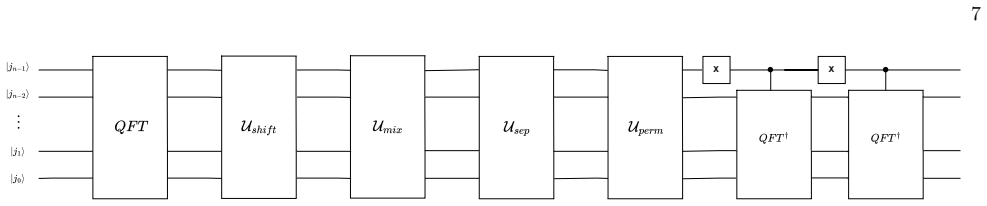
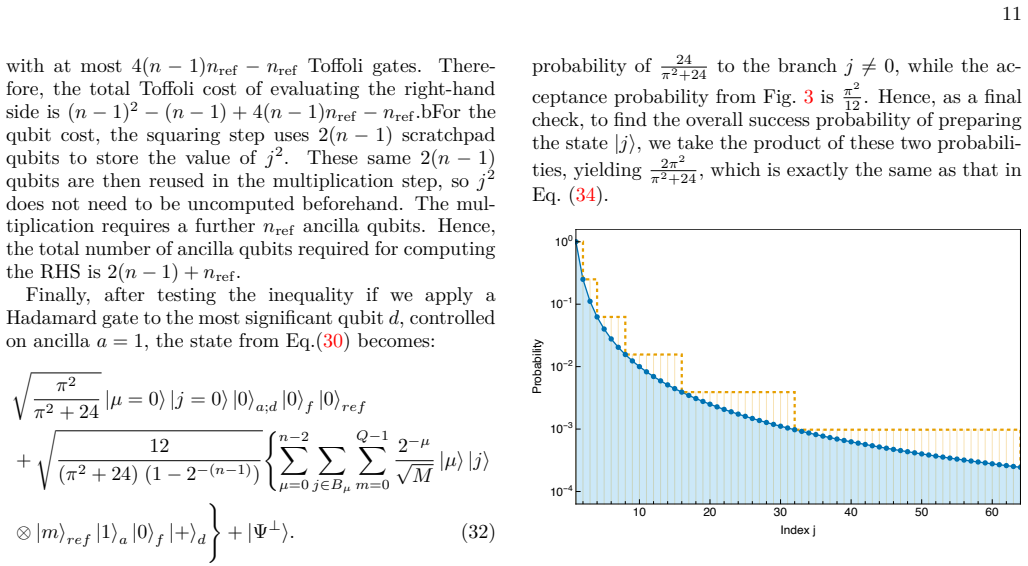
We present the construction of efficient linear-combination-of-unitaries (LCU)-based block-encodings for the first-order derivative and Laplacian operators in the SLAC representation. We use state-preparation techniques designed for smoothly decaying functions to efficiently prepare the dense LCU amplitudes with high success probability and low gate cost. Furthermore, we demonstrate how Shannon wavelet transforms can be applied to these block-encodings to efficiently obtain multi-scale representations of the SLAC derivative operators. We then show how to apply a diagonal preconditioner that reduces the condition number of these matrices in the multi-scale wavelet basis to a small constant. 1
What carries the argument
LCU-based block-encodings of SLAC first-order derivative and Laplacian operators, combined with Shannon wavelet transforms for multi-scale representation and a diagonal preconditioner in the wavelet basis.
If this is right
- The dense LCU amplitudes for SLAC operators can be prepared with high success probability using state-preparation for smoothly decaying functions.
- Shannon wavelet transforms produce efficient multi-scale representations of the block-encoded operators.
- The condition number is reduced to a small constant by the diagonal preconditioner in the wavelet basis.
- Partial differential equations discretized on finite lattices with SLAC derivatives become solvable using the quantum linear solving algorithm, with explicit complexity and error bounds.
Where Pith is reading between the lines
- Such encodings could extend to other derivative operators or higher-order terms in PDEs without changing the core approach.
- Applications to specific physical systems like fluid dynamics or quantum mechanics simulations on lattices might follow directly.
- The error scaling analysis suggests the method remains efficient even as lattice size increases, provided the state preparation succeeds.
Load-bearing premise
The state-preparation techniques designed for smoothly decaying functions can efficiently prepare the dense LCU amplitudes with high success probability and low gate cost.
What would settle it
Numerical simulation of the block-encoding and preconditioned system for a small lattice size, such as solving the Poisson equation in 1D or 2D, to verify if the quantum linear solver achieves the predicted scaling in gate count and error.
Figures



read the original abstract
We present the construction of efficient linear-combination-of-unitaries (LCU)-based block-encodings for the first-order derivative and Laplacian operators in the SLAC representation. We use state-preparation techniques designed for smoothly decaying functions to efficiently prepare the dense LCU amplitudes with high success probability and low gate cost. Furthermore, we demonstrate how Shannon wavelet transforms can be applied to these block-encodings to efficiently obtain multi-scale representations of the SLAC derivative operators. We then show how to apply a diagonal preconditioner that reduces the condition number of these matrices in the multi-scale wavelet basis to a small constant. This approach enables the solution of partial differential equations with SLAC-discretised derivative operators on a finite lattice using the quantum linear solving algorithm (QLSA). Throughout this work, we analyse the computational complexity and error scaling of each implementation.
Editorial analysis
A structured set of objections, weighed in public.
Referee Report
Summary. The paper constructs LCU-based block-encodings for the SLAC first-order derivative and Laplacian operators on finite lattices. It invokes state-preparation routines designed for smoothly decaying functions to handle the resulting dense amplitudes with claimed high success probability and low gate cost, incorporates Shannon wavelet transforms to obtain multi-scale representations, and applies a diagonal preconditioner in the wavelet basis that reduces the condition number to a small constant. This enables application of the quantum linear solving algorithm (QLSA) to PDEs discretized with SLAC operators, accompanied by complexity and error analyses.
Significance. If the block-encoding costs remain polylogarithmic and the preconditioner achieves a constant condition number independent of lattice size, the approach could yield an efficient quantum solver for PDEs that exploits the spectral accuracy of SLAC discretizations. The integration of wavelets for multi-resolution analysis and the explicit complexity/error scaling constitute strengths, provided the state-preparation overhead does not introduce hidden exponential factors.
major comments (2)
- [LCU block-encoding and state-preparation construction] The central efficiency claim rests on applying state-preparation techniques for smoothly decaying functions to the dense LCU amplitudes arising from the SLAC stencil. No explicit bounds, decay-rate analysis, or numerical verification is provided showing that the SLAC coefficient sequence (a linear combination of shift operators) satisfies the smoothness/decay hypotheses of the cited preparation routine; violation would drop the success probability below 1/poly(log N) and introduce exponential overhead via amplitude amplification, negating the claimed advantage over classical methods.
- [Wavelet transform and preconditioner section] The assertion that the diagonal preconditioner reduces the condition number of the SLAC operators to a small constant in the multi-scale wavelet basis lacks supporting eigenvalue bounds or scaling analysis across wavelet levels and lattice sizes. Without this, the QLSA runtime (which depends on both condition number and block-encoding cost) cannot be guaranteed to remain polylogarithmic in the lattice dimension.
minor comments (2)
- [Abstract] The abstract and introduction would benefit from a brief statement of the specific PDE classes (e.g., Poisson, advection-diffusion) and spatial dimensions for which the constructions are demonstrated.
- [Notation and preliminaries] Notation for the SLAC derivative operator and its LCU decomposition should be introduced with an explicit equation at first appearance to improve readability for readers unfamiliar with the stencil.
Simulated Author's Rebuttal
We thank the referee for the thorough review and insightful comments, which have helped us identify areas where the manuscript can be strengthened. We address each major comment below and outline the revisions we will make.
read point-by-point responses
-
Referee: The central efficiency claim rests on applying state-preparation techniques for smoothly decaying functions to the dense LCU amplitudes arising from the SLAC stencil. No explicit bounds, decay-rate analysis, or numerical verification is provided showing that the SLAC coefficient sequence (a linear combination of shift operators) satisfies the smoothness/decay hypotheses of the cited preparation routine; violation would drop the success probability below 1/poly(log N) and introduce exponential overhead via amplitude amplification, negating the claimed advantage over classical methods.
Authors: We appreciate the referee's careful scrutiny of this foundational step. The SLAC stencil coefficients derive from the Fourier representation of the derivative on a periodic lattice and are known to exhibit exponential decay away from the origin due to the analyticity of the underlying symbol. Nevertheless, we acknowledge that the original manuscript did not supply explicit decay-rate bounds or numerical verification against the hypotheses of the cited state-preparation routine. In the revised version we will add a new subsection that (i) derives an explicit exponential decay bound for the LCU amplitudes of both the first-order SLAC derivative and the Laplacian, (ii) verifies that this decay satisfies the smoothness conditions required for success probability 1-O(1/poly(log N)), and (iii) includes numerical plots of the coefficient tails for lattice sizes up to N=2^12. These additions will remove any ambiguity regarding hidden exponential overhead. revision: yes
-
Referee: The assertion that the diagonal preconditioner reduces the condition number of the SLAC operators to a small constant in the multi-scale wavelet basis lacks supporting eigenvalue bounds or scaling analysis across wavelet levels and lattice sizes. Without this, the QLSA runtime (which depends on both condition number and block-encoding cost) cannot be guaranteed to remain polylogarithmic in the lattice dimension.
Authors: We agree that a rigorous justification of the preconditioner's effect on the condition number is essential for the claimed polylogarithmic complexity. While the manuscript demonstrates the construction of the diagonal preconditioner in the Shannon wavelet basis and states that the resulting condition number is O(1), we did not provide explicit eigenvalue bounds or scaling analysis with respect to wavelet level and lattice size. In the revision we will insert a theorem that bounds the eigenvalues of the preconditioned SLAC operators, proving that the condition number remains bounded by a small constant independent of the lattice dimension. The proof will combine the spectral properties of the SLAC symbol with the multi-resolution orthogonality of the Shannon wavelets; we will also supply numerical eigenvalue computations across multiple scales and lattice sizes to corroborate the analytic bound. revision: yes
Circularity Check
No circularity: explicit constructions and standard primitives
full rationale
The paper constructs LCU block-encodings for SLAC derivative and Laplacian operators, applies Shannon wavelet transforms for multi-scale representations, introduces a diagonal preconditioner in the wavelet basis, and invokes QLSA. These steps are presented as explicit algorithmic constructions relying on cited state-preparation routines for decaying functions and standard quantum linear algebra primitives. No step reduces by definition or self-citation to the target PDE solution, no fitted parameters are relabeled as predictions, and no load-bearing uniqueness theorem or ansatz is imported from the authors' prior work. The derivation chain remains independent of the final result.
Axiom & Free-Parameter Ledger
axioms (2)
- domain assumption State-preparation techniques for smoothly decaying functions can prepare dense LCU amplitudes with high success probability and low gate cost
- domain assumption A diagonal preconditioner reduces the condition number of the SLAC operators in the multi-scale wavelet basis to a small constant
Reference graph
Works this paper leans on
-
[1]
Natural flavor conservation in higgs induced neutral currents and the quark mixing angles,
H. Nielsen and M. Ninomiya, “Absence of neu- trinos on a lattice: (i). proof by homotopy the- ory,”Nuclear Physics B185no. 1, (1981) 20–40. https://www.sciencedirect.com/science/article/ pii/0550321381903618
-
[2]
Renormalization of lattice field theories with infinite- range wavelets,
P. Fries, I. Reyes, J. Erdmenger, and H. Hinrichsen, “Renormalization of lattice field theories with infinite- range wavelets,”J. Stat. Mech.1906no. 6, (2019) 064001,arXiv:1811.05388 [hep-th]
-
[3]
Strong- coupling field theories. ii. fermions and gauge fields on a lattice,
S. D. Drell, M. Weinstein, and S. Yankielowicz, “Strong- coupling field theories. ii. fermions and gauge fields on a lattice,”Phys. Rev. D14(Sep, 1976) 1627–1647.https: //link.aps.org/doi/10.1103/PhysRevD.14.1627
-
[4]
Lattice theories of chiral fermions,
H. R. Quinn and M. Weinstein, “Lattice theories of chiral fermions,”Phys. Rev. D34(1986) 2440–2450
1986
-
[6]
Mallat,A Wavelet Tour of Signal Processing, Third Edition: The Sparse Way
S. Mallat,A Wavelet Tour of Signal Processing, Third Edition: The Sparse Way. Academic Press, Inc., USA, 3rd ed., 2008
2008
-
[7]
Efficient quantum algorithm for all quantum wavelet trans- forms,
M. Bagherimehrab and A. Aspuru-Guzik, “Efficient quantum algorithm for all quantum wavelet trans- forms,”Quantum Sci. Technol.9no. 3, (2024) 035010, arXiv:2309.09350 [quant-ph]
-
[8]
Multiscale quantum simulation of quantum field theory using wavelets,
G. K. Brennen, P. Rohde, B. C. Sanders, and S. Singh, “Multiscale quantum simulation of quantum field theory using wavelets,”Phys. Rev. A92no. 3, (2015) 032315, arXiv:1412.0750 [quant-ph]
-
[9]
Holographic Con- struction of Quantum Field Theory using Wavelets,
S. Singh and G. K. Brennen, “Holographic Con- struction of Quantum Field Theory using Wavelets,” arXiv:1606.05068 [quant-ph]
-
[10]
Nearly Optimal Quantum Algorithm for Generating the Ground State of a Free Quantum Field Theory,
M. Bagherimehrab, Y. R. Sanders, D. W. Berry, G. K. Brennen, and B. C. Sanders, “Nearly Optimal Quantum Algorithm for Generating the Ground State of a Free Quantum Field Theory,”PRX Quantum3no. 2, (2022) 020364,arXiv:2110.05708 [quant-ph]
-
[11]
Entanglement in quan- tum field theory via wavelet representations,
D. J. George, Y. R. Sanders, M. Bagherimehrab, B. C. Sanders, and G. K. Brennen, “Entanglement in quan- tum field theory via wavelet representations,”Phys. Rev. D106no. 3, (2022) 036025,arXiv:2201.06211 [quant-ph]
-
[12]
Scale limited fields and the Casimir effect,
Š. Vedl, D. J. George, and G. K. Brennen, “Scale limited fields and the Casimir effect,”Phys. Rev. D109no. 1, (2024) 016018,arXiv:2310.04089 [quant-ph]
-
[13]
Fastquantum algorithm for differential equations,
M. Bagherimehrab, K. Nakaji, N. Wiebe, G. K. Bren- nen, B.C.Sanders, andA.Aspuru-Guzik, “Fastquantum algorithm for differential equations,”arXiv:2306.11802 [quant-ph]
-
[16]
Precon- ditionedQuantumLinearSystemAlgorithm,
B. D. Clader, B. C. Jacobs, and C. R. Sprouse, “Precon- ditionedQuantumLinearSystemAlgorithm,”Phys. Rev. Lett.110no. 25, (June, 2013) 250504,arXiv:1301.2340 [quant-ph]
-
[17]
Childs, Robin Kothari, and Rolando D
C. Andrew M., K. Robin, and S. Rolando D., “Quantum Algorithm for Systems of Linear Equations with Expo- nentially Improved Dependence on Precision,”SIAM J. Comput.46no. 6, (2017) 1920–1950,arXiv:1511.02306 [quant-ph]
-
[18]
A. Ambainis, “Variable time amplitude amplification and a faster quantum algorithm for solving systems of linear equations,”arXiv:1010.4458 [quant-ph]
-
[19]
Entanglement renormalization for quan- tum field theories with discrete wavelet transforms,
D. S. M. Alves, “Entanglement renormalization for quan- tum field theories with discrete wavelet transforms,” Journal of High Energy Physics2024no. 7, (2024) 81. https://doi.org/10.1007/JHEP07(2024)081
-
[20]
Scale limited fields and the casimir effect,
Š. Vedl, D. J. George, and G. K. Brennen, “Scale limited fields and the casimir effect,”Phys. Rev. D 109(Jan, 2024) 016018.https://link.aps.org/doi/ 10.1103/PhysRevD.109.016018
-
[21]
Hamiltonian Simulation Using Linear Combinations of Unitary Operations
A. M. Childs and N. Wiebe, “Hamiltonian Simula- tion Using Linear Combinations of Unitary Operations,” Quant. Inf. Comput.12no. 11&12, (2012) 0901–0924, arXiv:1202.5822 [quant-ph]
work page Pith review arXiv 2012
-
[22]
Quantum simulation of chemistry with sublinear scaling in basis size,
R. Babbush, D. W. Berry, J. R. McClean, and H. Neven, “Quantum simulation of chemistry with sublinear scaling in basis size,”npj Quantum Inf.5(2019) 92
2019
-
[23]
On efficient quantum block encoding of pseudo-differential operators,
H. Li, H. Ni, and L. Ying, “On efficient quantum block encoding of pseudo-differential operators,”Quantum7 (2023) 1031,arXiv:2301.08908 [quant-ph]
-
[24]
Halving the cost of quantum addition,
C. Gidney, “Halving the cost of quantum addition,” Quantum2(June, 2018) 74.http://dx.doi.org/10. 22331/q-2018-06-18-74
2018
-
[25]
Explicit quantum circuits for block encodings of certain sparse matrices
D. Camps, L. Lin, R. Van Beeumen, and C. Yang, “Ex- plicit Quantum Circuits for Block Encodings of Certain Sparse Matrices,”SIAM J. Matrix Anal. Appl.45no. 1, (2024) 801–827,arXiv:2203.10236 [quant-ph]
-
[26]
Block-encoding structured matrices for data input in quantum computing
C. Sünderhauf, E. Campbell, and J. Camps, “Block- encoding structured matrices for data input in quantum computing,”Quantum8(2024) 1226,arXiv:2302.10949 [quant-ph]
-
[27]
Black-box quantum state preparation without arith- metic,
Y. R. Sanders, G. Hao Low, A. Scherer, and D. W. Berry, “Black-box quantum state preparation without arith- metic,”arXiv e-prints(July, 2018) arXiv:1807.03206, arXiv:1807.03206 [quant-ph]
-
[28]
A new proposal for the fermion doubling problem. ii. improving the operators for finite lattices,
J. P. Costella, “A new proposal for the fermion doubling problem. ii. improving the operators for finite lattices,” 2002.https://arxiv.org/abs/hep-lat/0207015
work page internal anchor Pith review arXiv 2002
-
[29]
Fault-Tolerant Quantum Simulations of Chemistry in First Quantization
Y. Su, D. W. Berry, N. Wiebe, N. Rubin, and R. Bab- bush, “Fault-Tolerant Quantum Simulations of Chem- istry in First Quantization,”PRX Quantum2no. 4, (2021) 040332,arXiv:2105.12767 [quant-ph]
-
[30]
Quantum sam- pling algorithms for quantum state preparation and ma- trix block-encoding,
J. Lemieux, M. Lostaglio, S. Pallister, W. Pol, K. Seetharam, S. Sim, and B. Şahinoğlu, “Quantum sam- pling algorithms for quantum state preparation and ma- trix block-encoding,”arXiv:2405.11436 [quant-ph]
-
[31]
Q. T. Nguyen, B. T. Kiani, and S. Lloyd, “Block- encoding dense and full-rank kernels using hierarchi- cal matrices: applications in quantum numerical lin- ear algebra,”Quantum6(2022) 876,arXiv:2201.11329 [quant-ph]
-
[32]
A. Gilyén, Y. Su, G. H. Low, and N. Wiebe, “Quantum singular value transformation and beyond: exponential improvements for quantum matrix arithmetics,” in51st Annual ACM SIGACT Symposium on Theory of Com- puting. 6, 2018.arXiv:1806.01838 [quant-ph]
-
[33]
J. Zylberman, U. Nzongani, A. Simonetto, and F. Deb- basch, “Efficient Quantum Circuits for Non-Unitary and Unitary Diagonal Operators with Space-Time-Accuracy Trade-Offs,”ACM Trans. Quant. Comput.6no.2, (2025) 15,arXiv:2404.02819 [quant-ph]
-
[34]
Rise of conditionally clean ancillae for efficient quantum circuit construc- tions,
T. Khattar and C. Gidney, “Rise of conditionally clean ancillae for efficient quantum circuit construc- tions,”Quantum9(2025) 1752,arXiv:2407.17966 [quant-ph]
-
[35]
Harrow and Avinatan Hassidim and Seth Lloyd , Date-Added =
A. W. Harrow, A. Hassidim, and S. Lloyd, “Quan- tum Algorithm for Linear Systems of Equations,”Phys. Rev. Lett.103no. 15, (2009) 150502,arXiv:0811.3171 [quant-ph]
-
[36]
Validity of SLAC fermions for the (1 +1 ) -dimensional helical Lut- tinger liquid,
Z. Wang, F. Assaad, and M. Ulybyshev, “Validity of SLAC fermions for the (1 +1 ) -dimensional helical Lut- tinger liquid,”Phys. Rev. B108no. 4, (July, 2023) 045105,arXiv:2211.02960 [cond-mat.str-el]
-
[37]
Tangent Fermions: Dirac or Majorana Fermions on a Lattice Without Fermion Doubling,
C. W. J. Beenakker, A. Donís Vela, G. Lemut, M. J. Pacholski, and J. Tworzydło, “Tangent Fermions: Dirac or Majorana Fermions on a Lattice Without Fermion Doubling,”Annalen der Physik535no. 7, (July, 2023) 2300081,arXiv:2302.12793 [cond-mat.mes-hall]
-
[38]
Chiral Heisenberg Gross-Neveu-Yukawa criticality: honeycomb vs. SLAC fermions,
T. C. Lang and A. M. Läuchli, “Chiral Heisenberg Gross-Neveu-Yukawa criticality: honeycomb vs. SLAC fermions,”arXiv:2503.15000 [cond-mat.str-el]
-
[39]
A Comprehensive Study of Quantum Arithmetic Circuits,
S. Wang, X. Li, W. J. B. Lee, S. Deb, E. Lim, and A. Chattopadhyay, “A Comprehensive Study of Quantum Arithmetic Circuits,”arXiv:2406.03867 [quant-ph]. 29 A. The ingredients for the LCU based block-encoding In Sections IV and V, we adapt the nested-box inequality-test framework to prepare the requiredNam- plitudes with the desired weighting on each basis ...
-
[40]
The preparation circuit: PREP For both block-encoding—the first-order SLAC deriva- tive and the Laplacian—we begin by preparing the de- sired scaling through an inequality test. From Eq. (32), the result of implementing the state- preparation module underlying theLCU-based block- encoding (forn≫0) of the SLAC Laplacian can be formalised as follows: Result...
-
[41]
This ensures that while un- computing the flipped qubitC, the undesired branches get discarded
The Copy oracle As the preparation circuit constructed above had some overall contribution from irrelavant states|ω⟩fail, we want to mark the relevant and undesirable branch with a marker qubit labelledC. This ensures that while un- computing the flipped qubitC, the undesired branches get discarded. To do this one needs to applyCXgate from flagf to marker...
-
[42]
(21) that we must also apply al- ternating signs to the computational basis states|j⟩to obtain the correct weightings in the SLAC Laplacian
The Sign Oracle for SLAC Laplacian It is clear from Eq. (21) that we must also apply al- ternating signs to the computational basis states|j⟩to obtain the correct weightings in the SLAC Laplacian. This can be done efficiently using a sign oracle, sayOsgn, which has the following action: Osgn|j⟩|ψ⟩sys = (−1)1+j|j⟩|ψ⟩sys .(A5) This operation can be realised...
-
[43]
The Phase Oracle for first order SLAC derivative The first-order SLAC derivative operator also hasj- dependent phases, as evident in Eq. (44). These phases can be realised, up to a global factor of−1, by applying a Phase oracleOp which acts on a computational basis state|j⟩as follows: O(1) p |j⟩= { −eiαj|j⟩, j̸= 0,α=π ( 1 + 1 N ) . (A7) Hence, up to an ov...
-
[44]
The SELECT oracle of theLCU The SLAC Laplacian and the first-order SLAC deriva- tive for a periodic lattice are translationally invariant cir- culant dense matrices. To construct the block-encoding 31 usingthestate-preparationandsignoraclesdefinedinthe previous subsections, it is necessary to apply appropriate cyclic shift matrices to the states prepared ...
discussion (0)
Sign in with ORCID, Apple, or X to comment. Anyone can read and Pith papers without signing in.