Recognition: unknown
Efficient estimators for power spectrum and bispectrum multipole measurements
Pith reviewed 2026-05-08 17:14 UTC · model grok-4.3
The pith
Symmetries of spherical-harmonic Fourier transforms halve the computational cost for power and bispectrum multipole estimators.
A machine-rendered reading of the paper's core claim, the machinery that carries it, and where it could break.
Core claim
The paper claims that a suite of FFT-based estimators for power-spectrum and bispectrum multipoles can be made efficient by using exact conjugation and parity symmetries of spherical-harmonic-weighted Fourier transforms of real fields to eliminate redundant magnetic sub-configurations. This reduces computational cost by a factor of 2. High-order even multipoles are rewritten in terms of lower-order Legendre polynomials for additional savings, and a new TripoSH bispectrum estimator is introduced by compressing along an alternative triangle side, together with an analytic treatment of bispectrum shot noise.
What carries the argument
Exact conjugation and parity symmetries in spherical-harmonic-weighted Fourier transforms of real fields that eliminate redundant magnetic sub-configurations.
If this is right
- High-order even power-spectrum multipoles can be measured using only low-ℓ fields.
- The TripoSH estimator substantially reduces FFT scaling for quadrupole bispectrum configurations in the large-k-bin limit.
- Bispectrum shot noise can be subtracted using an analytic integral over triangle-constrained k-space volumes without additional FFTs.
- The optimizations support an open-source package for efficient clustering measurements in large galaxy surveys.
Where Pith is reading between the lines
- These reductions could enable real-time or repeated measurements on the largest upcoming survey volumes.
- The approach might generalize to other anisotropic statistics involving higher-order correlations.
- Direct implementation tests would show the exact speedup factor achieved in practice on survey-like data volumes.
- The small deviation in modified multipoles may require updating covariance matrices when combining with traditional estimators.
Load-bearing premise
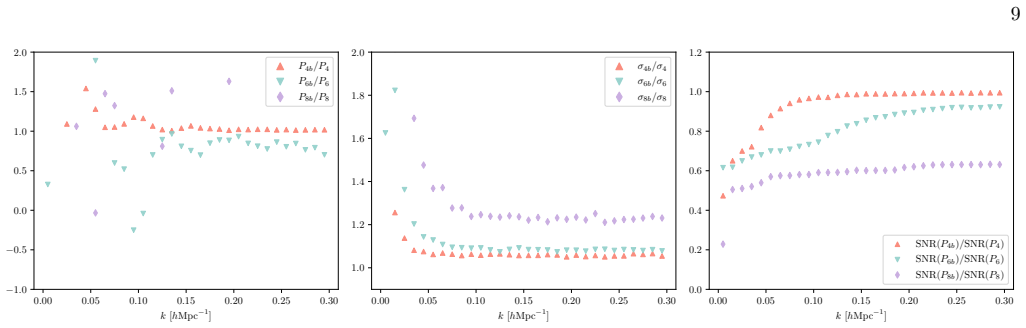
Rewriting high-order even multipoles algebraically in terms of lower-order Legendre polynomials produces only a small and controlled deviation from the traditional Yamamoto definition.
What would settle it
Compare the power-spectrum multipoles obtained from the modified estimator against those from the standard Yamamoto estimator on the same set of mock galaxy catalogs to check whether the differences remain small and controlled as claimed.
Figures




read the original abstract
Large galaxy surveys demand fast and scalable estimators for anisotropic clustering statistics beyond the monopole. We present a suite of efficient FFT-based estimators for power-spectrum and bispectrum multipoles, built upon exact conjugation and parity symmetries of spherical-harmonic--weighted Fourier transforms of real fields. These symmetries eliminate redundant magnetic sub-configurations, thereby reducing the computational cost by a factor of 2. For the Yamamoto power-spectrum multipoles, we further decrease the cost of high-order even multipoles by algebraically expressing ${L}_{2n}$ in terms of lower-order Legendre polynomials, thereby measuring modified high-order multipoles using only low-$\ell$ fields with a small and controlled deviation from the traditional definition. We introduce a new TripoSH bispectrum estimator obtained by compressing the Scoccimarro bispectrum along an alternative triangle side, which substantially reduces the FFT scaling for commonly used quadrupole configurations in the large-$k$-bin limit. We also derive an analytic treatment of bispectrum shot noise by integrating spherical-harmonic kernels over the triangle-constrained $k$-space volumes, avoiding additional FFTs or costly spherical-Bessel evaluations and enabling fast and accurate shot-noise subtraction. Based on these optimizations, we also introduce CosmoNPC, an open-source Python package for large-scale-structure clustering measurements.
Editorial analysis
A structured set of objections, weighed in public.
Referee Report
Summary. The manuscript presents a suite of efficient FFT-based estimators for power-spectrum and bispectrum multipoles in large-scale structure analyses. It exploits exact conjugation and parity symmetries of spherical-harmonic-weighted Fourier transforms of real fields to eliminate redundant magnetic sub-configurations and halve the computational cost. For Yamamoto power-spectrum multipoles, high-order even multipoles L_{2n} are algebraically rewritten in terms of lower-order Legendre polynomials, yielding modified estimators with a claimed small controlled deviation from the standard definition. A new TripoSH bispectrum estimator is introduced by compressing the Scoccimarro estimator along an alternative triangle side, reducing FFT scaling in the large-k-bin limit for quadrupole configurations. An analytic treatment of bispectrum shot noise is derived by integrating spherical-harmonic kernels over triangle-constrained k-space volumes. The work also releases the open-source CosmoNPC Python package implementing these methods.
Significance. If the controlled approximations are shown to be sufficiently accurate, the estimators could enable substantially faster multipole measurements for upcoming surveys such as DESI and Euclid while preserving compatibility with standard cosmological modeling. The open-source implementation and analytic shot-noise formula represent concrete strengths that support reproducibility and practical adoption.
major comments (2)
- [§3.2] §3.2, Eq. (14): The algebraic rewriting of L_{2n} in terms of lower-order Legendre polynomials is asserted to produce only a small and controlled deviation from the traditional Yamamoto definition. No analytic bound on the k-dependent difference or explicit numerical comparison (e.g., relative error plots across 0.01 < k < 0.2 h/Mpc) is provided; without this, the practical utility for analyses relying on precise multipole ratios remains conditional.
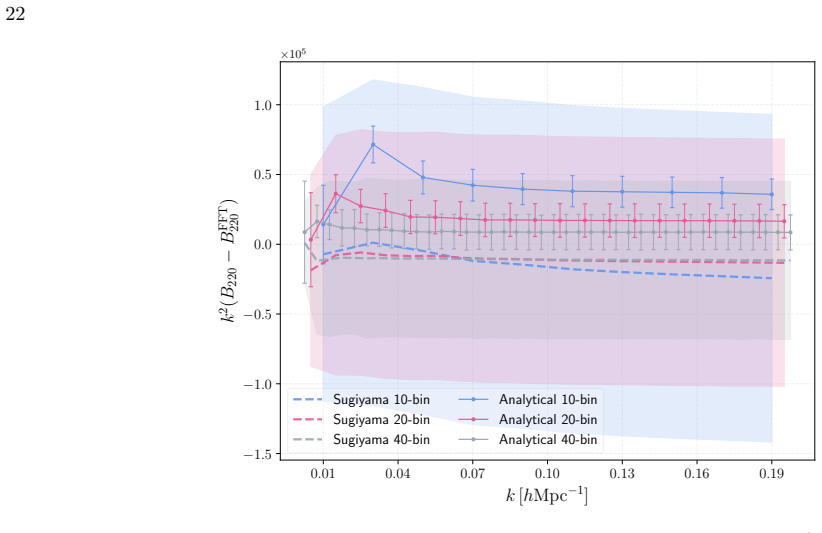
- [§5.3] §5.3, Eq. (28): The analytic bispectrum shot-noise formula is derived by integrating kernels over constrained k-space volumes. Its accuracy for all triangle configurations (especially squeezed and folded limits) must be validated against direct numerical integration or Monte Carlo estimates to confirm absence of systematic residuals at the level required for covariance modeling.
minor comments (2)
- [Table 1] Table 1: The timing benchmarks should specify the exact k-bin widths and number of realizations used, to allow direct reproduction of the reported speed-up factors.
- [§2.1] §2.1: Notation for the spherical-harmonic-weighted fields (e.g., distinction between Y_{ℓm} and the modified weights) could be made more explicit to avoid confusion with standard Yamamoto conventions.
Simulated Author's Rebuttal
We thank the referee for the careful reading and constructive comments on our manuscript. We address each major comment below and will revise the manuscript to incorporate the suggested validations, thereby strengthening the presentation of the estimators.
read point-by-point responses
-
Referee: [§3.2] §3.2, Eq. (14): The algebraic rewriting of L_{2n} in terms of lower-order Legendre polynomials is asserted to produce only a small and controlled deviation from the traditional Yamamoto definition. No analytic bound on the k-dependent difference or explicit numerical comparison (e.g., relative error plots across 0.01 < k < 0.2 h/Mpc) is provided; without this, the practical utility for analyses relying on precise multipole ratios remains conditional.
Authors: We agree that explicit validation strengthens the claim of a controlled deviation. The algebraic relation follows directly from the recurrence properties of Legendre polynomials and the even parity of the multipoles, ensuring the difference is bounded by the width of the k-bin and the smoothness of the underlying power spectrum. In the revised manuscript we will add both the explicit analytic expression for the k-dependent difference and numerical comparisons (relative error plots) between the modified and standard Yamamoto estimators over 0.01 < k < 0.2 h/Mpc, confirming that the fractional deviation remains well below the statistical precision of upcoming surveys. revision: yes
-
Referee: [§5.3] §5.3, Eq. (28): The analytic bispectrum shot-noise formula is derived by integrating kernels over constrained k-space volumes. Its accuracy for all triangle configurations (especially squeezed and folded limits) must be validated against direct numerical integration or Monte Carlo estimates to confirm absence of systematic residuals at the level required for covariance modeling.
Authors: The formula is obtained by exact integration of the spherical-harmonic kernels over the triangle-constrained k-space volumes, so it is analytically precise by construction. Nevertheless, to address possible numerical subtleties in implementation and to demonstrate robustness for covariance applications, we will include in the revised manuscript direct comparisons of the analytic expression against both numerical quadrature and Monte Carlo sampling for representative triangle configurations, with particular emphasis on the squeezed and folded limits. These tests will confirm the absence of systematic residuals at the sub-percent level. revision: yes
Circularity Check
No significant circularity; efficiency claims rest on standard symmetries and explicit algebraic approximations.
full rationale
The derivation chain relies on exact conjugation/parity properties of spherical-harmonic-weighted Fourier transforms (standard mathematical identities, not self-defined) and algebraic rewriting of even Legendre polynomials L_{2n} into lower-order terms, which the paper explicitly flags as producing a controlled deviation rather than an exact match to the Yamamoto estimator. No equations reduce claimed predictions or efficiencies to fitted parameters, self-citations, or ansatzes imported from prior author work. The bispectrum shot-noise analytic treatment and TripoSH compression follow from direct integration over k-space volumes without circular reduction. The central efficiency factor-of-2 reduction is therefore self-contained against external benchmarks.
Axiom & Free-Parameter Ledger
axioms (2)
- domain assumption Spherical-harmonic-weighted Fourier transforms of real fields obey exact conjugation and parity symmetries that eliminate redundant magnetic sub-configurations.
- standard math Higher even multipoles L_{2n} can be expressed in terms of lower-order Legendre polynomials with only small controlled deviation from the standard definition.
Reference graph
Works this paper leans on
-
[1]
Abdul Karim, M., et al. 2025, Phys. Rev. D, 112, 083515, doi: 10.1103/tr6y-kpc6
-
[2]
Adame, A. G., et al. 2025, JCAP, 09, 008, doi: 10.1088/1475-7516/2025/09/008
-
[3]
Alam, S., Albareti, F. D., Prieto, C. A., et al. 2015, The Astrophysical Journal Supplement Series, 219, 12, doi: 10.1088/0067-0049/219/1/12
-
[4]
B., Weber, H
Arfken, G. B., Weber, H. J., & Harris, F. E. 2011, Mathematical methods for physicists: a comprehensive guide (Academic press)
2011
-
[5]
2021, JCAP, 11, 031, doi: 10.1088/1475-7516/2021/11/031
Beutler, F., & McDonald, P. 2021, JCAP, 11, 031, doi: 10.1088/1475-7516/2021/11/031
-
[6]
2014, Monthly Notices of the Royal Astronomical Society, 443, 1065–1089, doi: 10.1093/mnras/stu1051
Beutler, F., Saito, S., Seo, H.-J., et al. 2014, Monthly Notices of the Royal Astronomical Society, 443, 1065–1089, doi: 10.1093/mnras/stu1051
-
[7]
Bianchi, D., Gil-Mar´ ın, H., Ruggeri, R., & Percival, W. J. 2015, Monthly Notices of the Royal Astronomical Society: Letters, 453, L11–L15, doi: 10.1093/mnrasl/slv090
-
[8]
2020, Journal of Physics A: Mathematical and Theoretical
Cahn, R., & Slepian, Z. 2020, Journal of Physics A: Mathematical and Theoretical
2020
-
[9]
Chen, S.-F., Vlah, Z., & White, M. 2020, JCAP, 07, 062, doi: 10.1088/1475-7516/2020/07/062
-
[10]
The Astrophysical Journal , author =
Feldman, H. A., Kaiser, N., & Peacock, J. A. 1994, Astrophys. J., 426, 23, doi: 10.1086/174036 Gil-Mar´ ın, H., Nore˜ na, J., Verde, L., et al. 2015, MNRAS, 451, 539, doi: 10.1093/mnras/stv961 Gil-Mar´ ın, H., Percival, W. J., Verde, L., et al. 2017, MNRAS, 465, 1757, doi: 10.1093/mnras/stw2679 Gil-Mar´ ın, H., Nore˜ na, J., Verde, L., et al. 2015, Monthl...
-
[11]
Constraining M_ with the bispectrum
Hahn, C., & Villaescusa-Navarro, F. 2021, Journal of Cosmology and Astroparticle Physics, 2021, 029, doi: 10.1088/1475-7516/2021/04/029
-
[12]
Scoccimarro, R. 2020, Journal of Cosmology and Astroparticle Physics, 2020, 040–040, doi: 10.1088/1475-7516/2020/03/040
-
[13]
2017, Journal of Cosmology and Astroparticle Physics, 2017, 002, doi: 10.1088/1475-7516/2017/07/002
Hand, N., Li, Y., Slepian, Z., & Seljak, U. 2017, Journal of Cosmology and Astroparticle Physics, 2017, 002, doi: 10.1088/1475-7516/2017/07/002
-
[14]
Astronomy & Astrophysics , author =
Hartlap, J., Simon, P., & Schneider, P. 2006, Astronomy & Astrophysics, 464, 399–404, doi: 10.1051/0004-6361:20066170
-
[15]
Heinrich, C., Dore, O., & Krause, E. 2023, Measuringf NL with the SPHEREx Multi-tracer Redshift Space Bispectrum, https://arxiv.org/abs/2311.13082
-
[16]
Jing, Y. P. 2005, The Astrophysical Journal, 620, 559, doi: 10.1086/427087
-
[17]
Kitaura, F.-S., Rodr´ ıguez-Torres, S., Chuang, C.-H., et al. 2016, Monthly Notices of the Royal Astronomical Society, 456, 4156, doi: 10.1093/mnras/stv2826
-
[18]
Maus, M., et al. 2025, JCAP, 01, 138, doi: 10.1088/1475-7516/2025/01/138
-
[19]
Philcox, O. H. E., & Slepian, Z. 2022, Proceedings of the National Academy of Science, 119, e2111366119, doi: 10.1073/pnas.2111366119 Rodr´ ıguez-Torres, S. A., Chuang, C.-H., Prada, F., et al. 2016, Monthly Notices of the Royal Astronomical Society, 460, 1173, doi: 10.1093/mnras/stw1014 33
-
[20]
2000, ApJ, 544, 597, doi: 10.1086/317248
Scoccimarro, R. 2000, The Astrophysical Journal, 544, 597, doi: 10.1086/317248
-
[21]
Scoccimarro, R. 2015, Phys. Rev. D, 92, 083532, doi: 10.1103/PhysRevD.92.083532
-
[22]
Scoccimarro, R., Colombi, S., Fry, J. N., et al. 1998, ApJ, 496, 586, doi: 10.1086/305399
-
[23]
S., Saito, S., Beutler, F., & Seo, H.-J
Sugiyama, N. S., Saito, S., Beutler, F., & Seo, H.-J. 2019, MNRAS, 484, 364, doi: 10.1093/mnras/sty3249
-
[24]
S., Shiraishi, M., & Okumura, T
Sugiyama, N. S., Shiraishi, M., & Okumura, T. 2018, MNRAS, 473, 2737, doi: 10.1093/mnras/stx2333
-
[25]
Varshalovich, D. A., Moskalev, A. N., & Khersonskii, V. K. 1988, Quantum Theory of Angular Momentum: Irreducible Tensors, Spherical Harmonics, Vector Coupling Coefficients, 3nj Symbols (World Scientific Publishing Company), doi: 10.1142/0270
-
[26]
2020, The Quijote simulations, Astrophys
Villaescusa-Navarro, F., Hahn, C., Massara, E., et al. 2020, The Astrophysical Journal Supplement Series, 250, 2, doi: 10.3847/1538-4365/ab9d82
-
[27]
2024, Communications Physics, 7, doi: 10.1038/s42005-024-01624-7
Wang, Y., Zhao, G.-B., Koyama, K., et al. 2024, Communications Physics, 7, doi: 10.1038/s42005-024-01624-7
-
[28]
Yamamoto, K., Nakamichi, M., Kamino, A., Bassett, B. A., & Nishioka, H. 2006, Publications of the Astronomical Society of Japan, 58, 93, doi: 10.1093/pasj/58.1.93
discussion (0)
Sign in with ORCID, Apple, or X to comment. Anyone can read and Pith papers without signing in.