Recognition: unknown
Understanding the Dynamics of Evaporation-Driven Colloidal Self-Assembly
Pith reviewed 2026-05-08 16:23 UTC · model grok-4.3
The pith
Interparticle friction disproportionately determines the final structure of evaporating colloidal clusters even when smaller than other forces.
A machine-rendered reading of the paper's core claim, the machinery that carries it, and where it could break.
Core claim
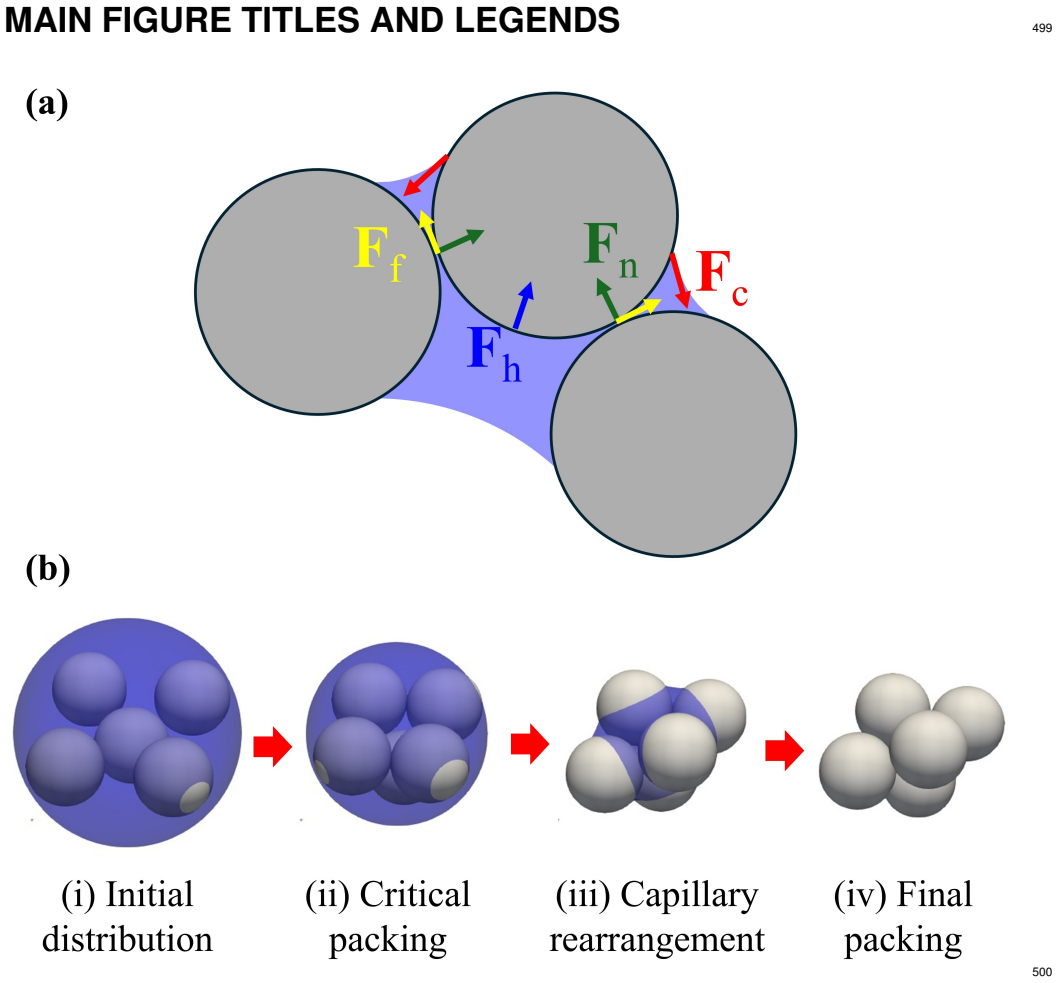
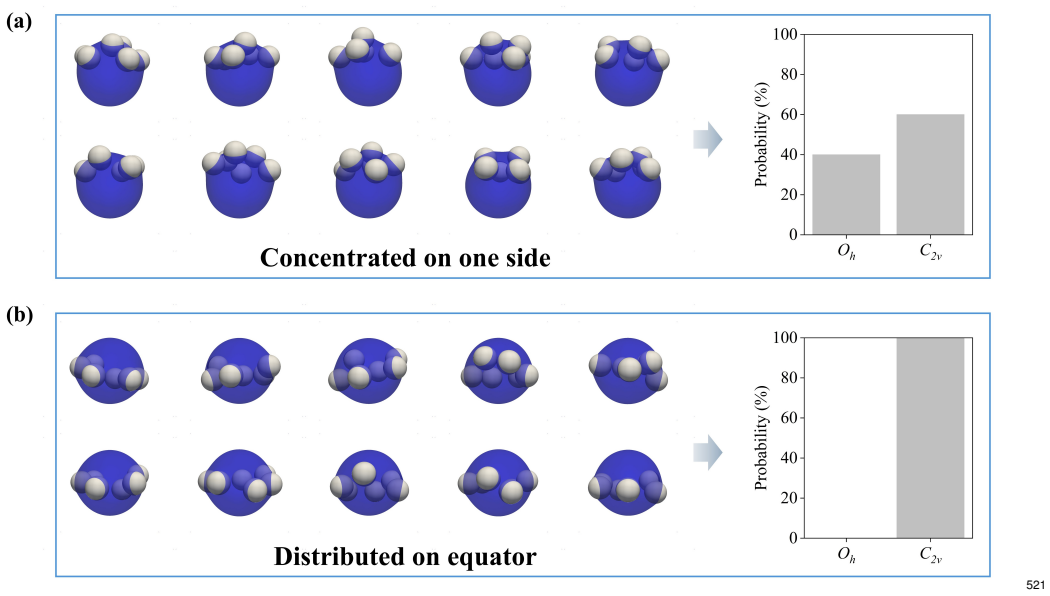
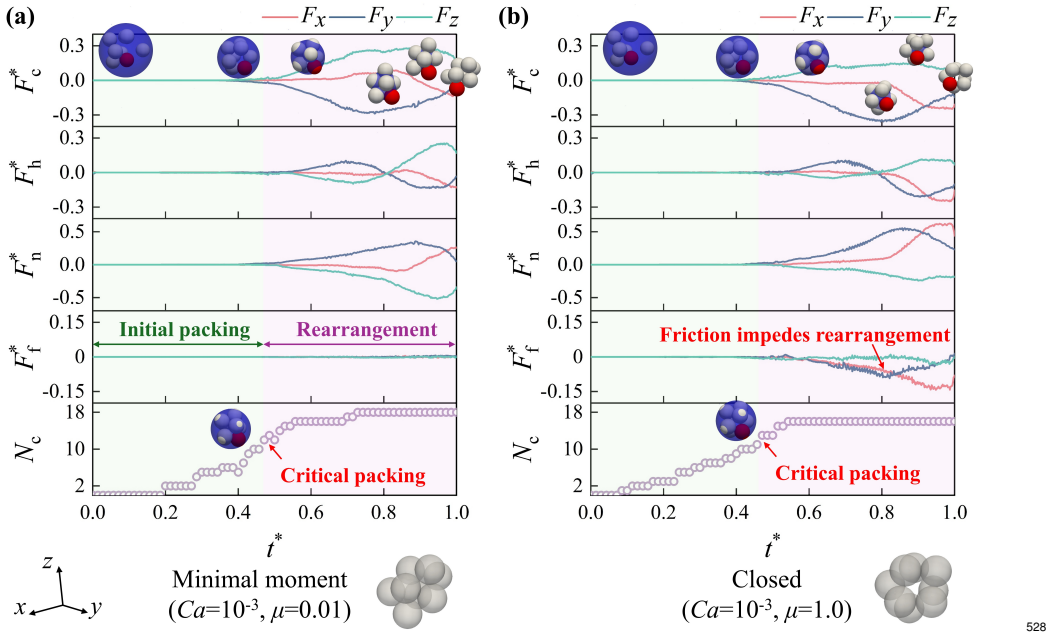
By coupling lattice Boltzmann and discrete element methods, the authors construct a regime diagram across evaporation rates, interparticle friction coefficients, and particle numbers that identifies conditions for open, closed, and minimal-moment-of-inertia colloidal cluster configurations. Analysis of the competing capillary, hydrodynamic, normal, and friction forces shows that interparticle friction exerts a disproportionately strong influence on the final packing outcome despite its smaller magnitude, and that dynamic trajectories during evaporation further shape the result.
What carries the argument
The regime diagram that classifies cluster configurations (open, closed, minimal moment of inertia) according to evaporation rate, friction coefficient, and particle number, produced by tracking the competition among capillary, hydrodynamic, normal contact, and friction forces in coupled fluid-particle simulations.
Load-bearing premise
The coupled lattice Boltzmann and discrete element simulations accurately reproduce real fluid-particle interactions, capillary forces, and friction effects during evaporation without major numerical artifacts or missing physics.
What would settle it
Laboratory experiments that vary evaporation rate and particle surface friction while counting the resulting open, closed, or minimal-inertia cluster fractions and checking whether the observed boundaries match the simulated regime diagram.
Figures


read the original abstract
Complex colloidal cluster morphologies are desirable for the fabrication of advanced materials, such as photonic crystals and meta-materials, and can be formed through evaporation-driven packing. By coupling lattice Boltzmann and discrete element methods, here we elucidate the rich interplay between fluid and particle dynamics during evaporation-driven self-assembly of spherical colloidal particles. We construct a regime diagram for a wide range of evaporation rates, interparticle friction coefficients, and particle numbers, identifying parameter regimes for open, closed, and minimal moment of inertia cluster configurations. Analyzing the competition between capillary, hydrodynamic, normal, and friction forces, we show that interparticle friction can exert a disproportionately strong influence on the final packing outcome despite being considerably smaller in magnitude than other forces at play. Our simulation results further highlight the potential for tuning colloidal cluster configurations via their dynamic trajectories.
Editorial analysis
A structured set of objections, weighed in public.
Referee Report
Summary. The paper couples lattice Boltzmann and discrete element methods to simulate evaporation-driven self-assembly of spherical colloidal particles. It constructs a regime diagram over ranges of evaporation rates, interparticle friction coefficients, and particle numbers, classifying outcomes into open, closed, and minimal-moment-of-inertia clusters. The central claim is that interparticle friction exerts a disproportionately strong influence on final morphology despite its small magnitude relative to capillary, hydrodynamic, and normal forces, by steering dynamic trajectories during assembly.
Significance. If the LB-DEM force balances are accurate, the regime diagram and trajectory-based analysis would offer useful guidance for tuning colloidal cluster morphologies in applications such as photonic crystals. The emphasis on dynamic competition among forces rather than static equilibrium is a conceptual strength. However, the purely numerical nature of the study, without benchmarks or experiments, limits its immediate significance for the field.
major comments (3)
- [Methods and Results] The manuscript provides no convergence tests, error analysis, or direct comparisons to analytic limits for evaporating droplets or capillary/hydrodynamic interactions (e.g., known single-particle or few-particle cases). This is load-bearing for the claim that friction's small magnitude still controls outcomes, as discretization or coupling artifacts in LB-DEM could artificially amplify friction-like effects.
- [Methods] Details on the implementation of capillary forces (diffuse interface or effective potential), hydrodynamic coupling, and how relative force magnitudes are computed and compared are insufficient. Without these, the analysis of force competition and the conclusion that friction is 'disproportionately strong' cannot be rigorously evaluated.
- [Results] The criteria used to classify clusters as open, closed, or minimal-MOI in the regime diagram are not quantitatively defined (e.g., via specific packing metrics, coordination numbers, or MOI thresholds). This undermines assessment of the robustness of the identified parameter regimes.
minor comments (1)
- [Abstract] The abstract and introduction would benefit from explicit numerical ranges for the evaporation rates, friction coefficients, and particle numbers explored in the sweeps.
Simulated Author's Rebuttal
We thank the referee for their detailed and constructive comments, which highlight important aspects of numerical validation and clarity in our manuscript. We address each major comment below and will incorporate revisions to strengthen the work.
read point-by-point responses
-
Referee: [Methods and Results] The manuscript provides no convergence tests, error analysis, or direct comparisons to analytic limits for evaporating droplets or capillary/hydrodynamic interactions (e.g., known single-particle or few-particle cases). This is load-bearing for the claim that friction's small magnitude still controls outcomes, as discretization or coupling artifacts in LB-DEM could artificially amplify friction-like effects.
Authors: We agree that systematic validation is essential to support the force-balance claims. In the revised manuscript we will add a dedicated subsection (or appendix) presenting grid-convergence and time-step convergence tests for representative evaporation rates and particle numbers. We will also include direct comparisons to analytic limits: the evaporation rate of an isolated droplet (following the d^{2}-law) and the capillary interaction force between two particles at fixed separation. These benchmarks will be used to quantify numerical error and confirm that observed friction effects are not discretization artifacts. revision: yes
-
Referee: [Methods] Details on the implementation of capillary forces (diffuse interface or effective potential), hydrodynamic coupling, and how relative force magnitudes are computed and compared are insufficient. Without these, the analysis of force competition and the conclusion that friction is 'disproportionately strong' cannot be rigorously evaluated.
Authors: We acknowledge the need for greater methodological transparency. The revised Methods section will explicitly state that capillary forces are implemented via an effective potential derived from the diffuse-interface LB model, with the precise functional form and cutoff distance provided. Hydrodynamic coupling follows the standard momentum-exchange scheme between LB fluid nodes and DEM particles. Force-magnitude analysis will be described in detail: at each time step we compute the vector sum of capillary, hydrodynamic, normal-contact, and friction forces on every particle, then report time-averaged magnitudes normalized by the instantaneous capillary force scale during the assembly trajectory. These additions will allow readers to reproduce and evaluate the reported force competition. revision: yes
-
Referee: [Results] The criteria used to classify clusters as open, closed, or minimal-MOI in the regime diagram are not quantitatively defined (e.g., via specific packing metrics, coordination numbers, or MOI thresholds). This undermines assessment of the robustness of the identified parameter regimes.
Authors: We thank the referee for identifying this ambiguity. In the revised manuscript we will define the classification criteria quantitatively in the caption of the regime diagram and in a new paragraph of the Results section. Open clusters are those with average coordination number < 4 and normalized moment of inertia > 1.2; closed clusters satisfy average coordination number > 6; minimal-MOI clusters are those whose moment of inertia lies within 5 % of the theoretical minimum for the given particle number (computed from the convex hull). These thresholds were chosen after inspecting the bimodal distributions of the metrics across all simulated trajectories and will be accompanied by the exact formulas used. revision: yes
Circularity Check
No circularity: numerical regime diagram generated from independent simulation
full rationale
The paper performs parameter-sweep simulations with coupled LB-DEM to map regimes of cluster morphology as functions of evaporation rate, friction coefficient, and particle number. Central claims about relative force magnitudes and friction's influence emerge directly as outputs of the numerical integration rather than from any equation or prediction that reduces by construction to fitted parameters, self-citations, or ansatzes internal to the work. No load-bearing derivation step equates a result to its own input; the study is self-contained against external benchmarks of the method.
Axiom & Free-Parameter Ledger
free parameters (3)
- evaporation rate
- interparticle friction coefficient
- particle number
axioms (2)
- domain assumption Lattice Boltzmann method accurately captures hydrodynamic and capillary forces during evaporation.
- domain assumption Discrete element method with friction and normal forces correctly represents particle-particle interactions.
Reference graph
Works this paper leans on
-
[1]
Results for other particle numbers (N= 5,7,8) are provided in112 Figures S3– S5
For each point in the diagram, we compile statistics from 50 realizations with distinct initial111 particle distributions (Figure S2). Results for other particle numbers (N= 5,7,8) are provided in112 Figures S3– S5. AcrossN, the regime diagrams share the same qualitative structure; differences113 arise mainly in the positions of the boundaries. For ease o...
-
[2]
Poon, W. (2004). Colloids as big atoms. Science304, 830–831.536
2004
-
[3]
van Blaaderen, A. (2003). Chemistry: Colloidal molecules and beyond. Science301, 470–537
2003
-
[4]
Hou, S., Bai, L., Lu, D., and Duan, H. (2023). Interfacial colloidal self-assembly for functional539 materials. Accounts of Chemical Research56, 740–751.540
2023
-
[5]
From colloidal particles to photonic crystals: advances in self-assembly and their542 emerging applications
Cai, Z., Li, Z., Ravaine, S., He, M., Song, Y ., Yin, Y ., Zheng, H., Teng, J., and Zhang, A.541 (2021). From colloidal particles to photonic crystals: advances in self-assembly and their542 emerging applications. Chemical Society Reviews50, 5898–5951.543
2021
-
[6]
Cui, Y ., Zhu, H., Cai, J., and Qiu, H. (2021). Self-regulated co-assembly of soft and hard544 nanoparticles. Nature Communications12, 5682. 545
2021
-
[7]
Lyu, D., Xu, W., and Wang, Y . (2022). Low-symmetry mof-based patchy colloids and their546 precise linking via site-selective liquid bridging to form supra-colloidal and supra-framework547 architectures. Angewandte Chemie134, e202115076. 548
2022
-
[8]
(2022).549 Self-assembly dynamics of reconfigurable colloidal molecules
Chakraborty, I., Pearce, D.J., Verweij, R.W., Matysik, S.C., Giomi, L., and Kraft, D.J. (2022).549 Self-assembly dynamics of reconfigurable colloidal molecules. ACS nano16, 2471–2480.550
2022
-
[9]
Zaibudeen, A., and Bandyopadhyay, R. (2021). Dc field coupled evaporation of a sessile551 gold nanofluid droplet. Soft Matter17, 10294–10300. 552
2021
-
[10]
Kang, N., Zhu, J., Zhang, X., Wang, H., and Zhang, Z. (2022). Reconfiguring self-assembly553 of photoresponsive hybrid colloids. Journal of the American Chemical Society144, 4754–554
2022
-
[11]
Grzelczak, M., Vermant, J., Furst, E.M., and Liz-Marzán, L.M. (2010). Directed self-556 assembly of nanoparticles. ACS nano4, 3591–3605. 557
2010
-
[12]
Vialetto, J., Gaichies, T., Rudiuk, S., Morel, M., and Baigl, D. (2024). Versatile deposition558 of complex colloidal assemblies from the evaporation of hanging drops. Advanced Science559 11, 2307893. 560
2024
-
[13]
Rao, A.B., Shaw, J., Neophytou, A., Morphew, D., Sciortino, F ., Johnston, R.L., and561 Chakrabarti, D. (2020). Leveraging hierarchical self-assembly pathways for realizing col-562 loidal photonic crystals. ACS nano14, 5348–5359. 563
2020
-
[14]
Kim, Y .J., Kim, J.H., Jo, I.S., Pine, D.J., Sacanna, S., and Yi, G.R. (2021). Patchy colloidal564 clusters with broken symmetry. Journal of the American Chemical Society143, 13175–565 13183. 566
2021
-
[15]
Manoharan, V.N., Elsesser, M.T., and Pine, D.J. (2003). Dense packing and symmetry in567 small clusters of microspheres. Science301, 483–487. 568
2003
-
[16]
Meng, G., Arkus, N., Brenner, M.P ., and Manoharan, V.N. (2010). The free-energy land-569 scape of clusters of attractive hard spheres. Science327, 560–563.570
2010
-
[17]
Hueckel, T., Hocky, G.M., and Sacanna, S. (2021). Total synthesis of colloidal matter. Nature571 Reviews Materials6, 1053–1069. 572 19
2021
-
[18]
Avvisati, G., Dasgupta, T., and Dijkstra, M. (2017). Fabrication of colloidal laves phases via573 hard tetramers and hard spheres: Bulk phase diagram and sedimentation behavior. ACS574 nano11, 7702–7709. 575
2017
-
[19]
Marson, R.L., Teich, E.G., Dshemuchadse, J., Glotzer, S.C., and Larson, R.G. (2019). Com-576 putational self-assembly of colloidal crystals from platonic polyhedral sphere clusters. Soft577 Matter15, 6288–6299. 578
2019
-
[20]
Beneduce, C., Sciortino, F ., Sulc, P ., and Russo, J. (2023). Engineering azeotropy to opti-579 mize the self-assembly of colloidal mixtures. ACS nano17, 24841–24853.580
2023
-
[21]
Wagner, C.S., Fischer, B., May, M., and Wittemann, A. (2010). Templated assembly of581 polymer particles into mesoscopic clusters with well-defined configurations. Colloid and582 Polymer Science288, 487–498. 583
2010
-
[22]
Zargartalebi, H., Hejazi, S.H., and Sanati-Nezhad, A. (2022). Self-assembly of highly or-584 dered micro-and nanoparticle deposits. Nature Communications13, 3085.585
2022
-
[23]
Lauga, E., and Brenner, M.P . (2004). Evaporation-driven assembly of colloidal particles.586 Physical review letters93, 238301. 587
2004
-
[24]
Arkus, N., Manoharan, V.N., and Brenner, M.P . (2009). Minimal energy clusters of hard588 spheres with short range attractions. Physical review letters103, 118303.589
2009
-
[25]
Li, Q., Jonas, U., Zhao, X., and Kappl, M. (2008). The forces at work in colloidal self-590 assembly: a review on fundamental interactions between colloidal particles. Asia-Pacific591 Journal of Chemical Engineering3, 255–268. 592
2008
-
[26]
Y ethiraj, A. (2007). Tunable colloids: control of colloidal phase transitions with tunable inter-593 actions. Soft Matter3, 1099–1115. 594
2007
-
[27]
Cho, Y .S., Yi, G.R., Chung, Y .S., Park, S.B., and Y ang, S.M. (2007). Complex colloidal595 microclusters from aerosol droplets. Langmuir23, 12079–12085.596
2007
-
[28]
Zhou, H., Pujales-Paradela, R., Groppe, P ., Wintzheimer, S., and Mandel, K. (2022). Tuning597 the morphology of spray-dried supraparticles: Effects of building block size and concentra-598 tion. Particle & Particle Systems Characterization39, 2200127.599
2022
-
[29]
Holtzman, R., Szulczewski, M.L., and Juanes, R. (2012). Capillary fracturing in granular600 media. Physical review letters108, 264504. 601
2012
-
[30]
Badetti, M., Fall, A., Chevoir, F ., and Roux, J.N. (2018). Shear strength of wet granular602 materials: Macroscopic cohesion and effective stress: Discrete numerical simulations, con-603 fronted to experimental measurements. The European Physical Journal E41, 1–16.604
2018
-
[31]
Vivacqua, V., López, A., Hammond, R., and Ghadiri, M. (2019). Dem analysis of the effect605 of particle shape, cohesion and strain rate on powder rheometry. Powder Technology342,606 653–663. 607
2019
-
[32]
Comtet, J., Chatté, G., Nigues, A., Bocquet, L., Siria, A., and Colin, A. (2017). Pairwise608 frictional profile between particles determines discontinuous shear thickening transition in609 non-colloidal suspensions. Nature communications8, 15633.610
2017
-
[33]
Xie, Q., and Harting, J. (2018). From dot to ring: the role of friction in the deposition pattern611 of a drying colloidal suspension droplet. Langmuir34, 5303–5311.612 20
2018
- [34]
-
[35]
Zhao, Y ., Zhao, Y ., Wang, D., Zheng, H., Chakraborty, B., and Socolar, J.E. (2022). Ultra-616 stable shear-jammed granular material. Physical Review X12, 031021.617
2022
-
[36]
Katiyar, P ., and Singh, J.K. (2019). Evaporation induced self-assembly of different shapes618 and sizes of nanoparticles: A molecular dynamics study. The Journal of chemical physics619
2019
-
[37]
Flavell, W., Neophytou, A., Demetriadou, A., Albrecht, T., and Chakrabarti, D. (2023). Pro-621 grammed self-assembly of single colloidal gyroids for chiral photonic crystals. Advanced622 Materials35, 2211197. 623
2023
-
[38]
Zhang, X., Liu, H., and Zhang, J. (2020). A new capillary force model implemented in lattice624 boltzmann method for gas–liquid–solid three-phase flows. Physics of Fluids32.625
2020
-
[39]
Guzowski, J., and Garstecki, P . (2015). Droplet clusters: Exploring the phase space of soft626 mesoscale atoms. Physical review letters114, 188302. 627
2015
-
[40]
Ameta, R., and Ameta, S.C. (2016). Chemical Applications of Symmetry and Group Theory.628 Apple Academic Press. 629
2016
-
[41]
Marín-Aguilar, S., Camerin, F ., van der Ham, S., Feasson, A., Vutukuri, H.R., and Dijkstra,630 M. (2023). A colloidal viewpoint on the sausage catastrophe and the finite sphere packing631 problem. Nature communications14, 7896. 632
2023
-
[42]
Nist chemistry webbook.https://webbook.nist.gov/633 chemistry/
NIST Chemistry WebBook (2024). Nist chemistry webbook.https://webbook.nist.gov/633 chemistry/. . National Institute of Standards and Technology, Gaithersburg MD, USA.634
2024
-
[43]
B ˛ ak, A., and Podgórska, W. (2016). Interfacial and surface tensions of toluene/water and635 air/water systems with nonionic surfactants tween 20 and tween 80. Colloids and Surfaces636 A: Physicochemical and Engineering Aspects504, 414–425.637
2016
-
[44]
Ni, L., Yu, C., Wei, Q., Liu, D., and Qiu, J. (2022). Pickering emulsion catalysis: interfa-638 cial chemistry, catalyst design, challenges, and perspectives. Angewandte Chemie134,639 e202115885. 640
2022
-
[45]
Bianchi, E., Likos, C.N., and Kahl, G. (2013). Self-assembly of heterogeneously charged641 particles under confinement. ACS nano7, 4657–4667. 642
2013
-
[46]
Li, W., Zhang, C., and Wang, Y . (2024). Evaporative self-assembly in colloidal droplets:643 Emergence of ordered structures from complex fluids. Advances in Colloid and Interface644 Science333, 103286. 645
2024
-
[47]
Butt, H.J., and Kappl, M. (2018). Surface and interfacial forces. John Wiley & Sons.646
2018
-
[48]
Israelachvili, J.N. (2011). Intermolecular and surface forces. Academic press.647
2011
-
[49]
Scherrer, S., Ramakrishna, S.N., Niggel, V., Hsu, C.P ., Style, R.W., Spencer, N.D., and Isa,648 L. (2025). Characterizing sliding and rolling contacts between single particles. Proceedings649 of the National Academy of Sciences122, e2411414122.650 21
2025
-
[50]
Lahiri, S.K., and Golovin, K. (2023). Low-friction coatings reduce microplastic release from651 textiles. NATURE PORTFOLIO HEIDELBERGER PLATZ 3, BERLIN, 14197, GERMANY .652
2023
-
[51]
Qin, C., Y ang, H., Lu, Y ., Li, B., Ma, S., Ma, Y ., and Zhou, F . (2025). Tribology in nature:653 Inspirations for advanced lubrication materials. Advanced Materials pp. 2420626.654
2025
-
[52]
Hayler, H.J., Groves, T.S., Guerrini, A., Southam, A., Zheng, W., and Perkin, S. (2024). The655 surface force balance: direct measurement of interactions in fluids and soft matter. Reports656 on Progress in Physics87, 046601. 657
2024
-
[53]
Butt, H.J., Cappella, B., and Kappl, M. (2005). Force measurements with the atomic force658 microscope: Technique, interpretation and applications. Surface science reports59, 1–152.659
2005
-
[54]
Liang, H., Wang, R., Wei, Y ., and Xu, J. (2023). Lattice boltzmann method for interface660 capturing. Physical Review E107, 025302. 661
2023
-
[55]
Sugimoto, M., Sawada, Y ., Kaneda, M., and Suga, K. (2021). Consistent evaporation for-662 mulation for the phase-field lattice boltzmann method. Physical Review E103, 053307.663
2021
- [56]
-
[57]
Y ang, J., Lei, T., Wang, G., Xu, Q., Chen, J., and Luo, K.H. (2023). Lattice boltzmann667 modelling of salt precipitation during brine evaporation. Advances in Water Resources180,668 104542. 669
2023
-
[58]
Y ang, J. (2025). Junyuyanged/lbm-dem-code: Lbm-dem. Zenodo. URL:https://doi.org/670 10.5281/zenodo.17913776. doi:10.5281/zenodo.17913776.671 22
discussion (0)
Sign in with ORCID, Apple, or X to comment. Anyone can read and Pith papers without signing in.