Recognition: unknown
Guidelines for band gap opening in graphene superlattices with periodic {π}-vacancy distribution
Pith reviewed 2026-05-08 16:26 UTC · model grok-4.3
The pith
C3 and specific C2 π-vacancies open band gaps in 3n graphene superlattices by pinning Dirac cones at Γ
A machine-rendered reading of the paper's core claim, the machinery that carries it, and where it could break.
Core claim
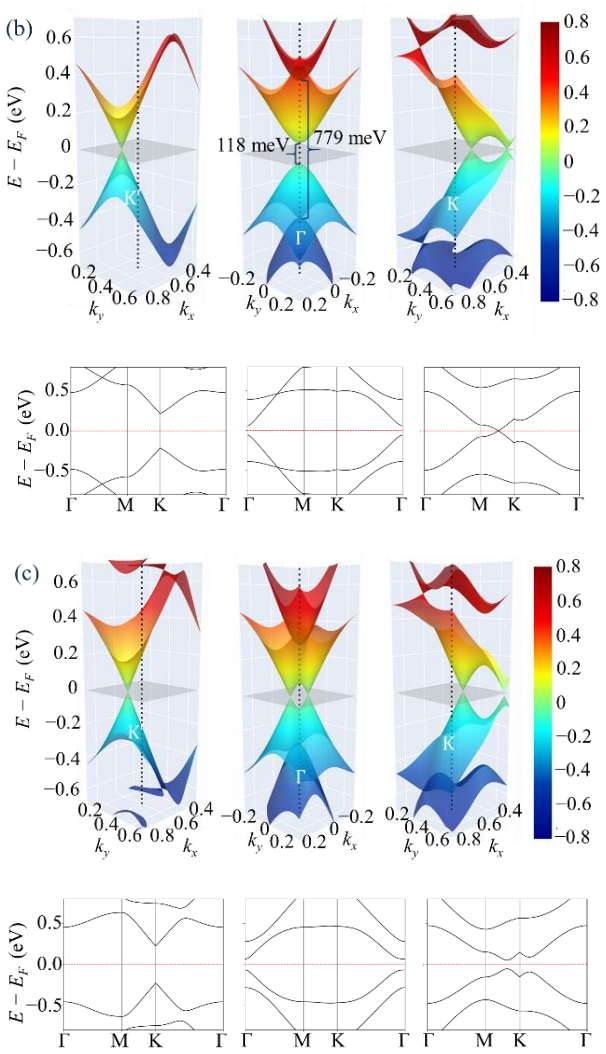
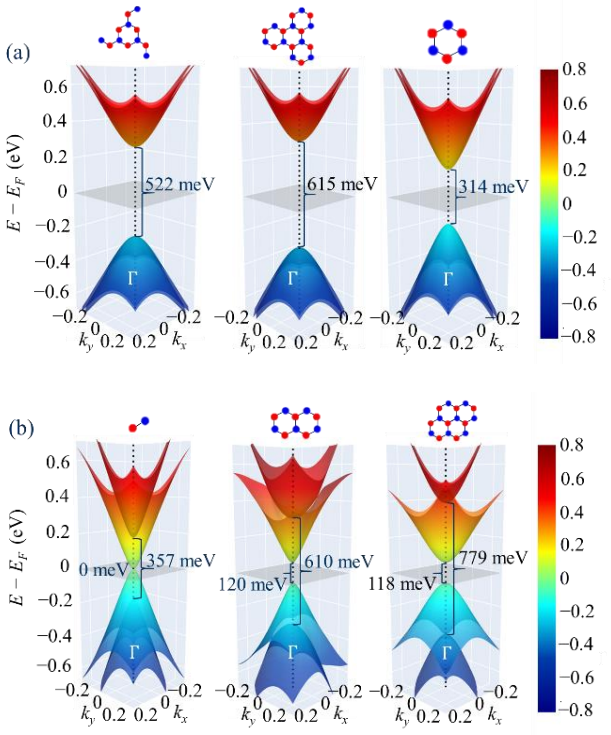
In 3n × 3n graphene superlattices, π-vacancy motifs with C3 point-group symmetry keep the Dirac cones at high-symmetry points including Γ, allowing a band gap to open. C2-type vacancies constrain the cones to Γ only when they preserve perpendicular mirror symmetries σv ⊥ σd that reduce the global point group to D2h; when these mirror planes are absent the cones are free to shift to (±Δq, ±Δq) in the superlattice Brillouin zone.
What carries the argument
Point-group symmetry analysis of C2 and C3 vacancy motifs that decides whether Dirac cones remain pinned at Γ after K/K' folding in 3n graphene superlattices
Load-bearing premise
The nearest-neighbor tight-binding model with one pz orbital per site and vacancies modeled as simple deletions fully captures the symmetry-determined positions of the Dirac cones.
What would settle it
A band-structure calculation or measurement on a 3n GSL with C2 vacancies that lack the mirror planes yet still show cones pinned at Γ, or with preserved mirrors yet show shifted cones, would falsify the claimed symmetry constraint.
Figures




read the original abstract
Periodic $\pi$-vacancies in graphene superlattices (GSLs) provide a symmetry-based route to band-gap opening in graphene by modifying the $\pi$-band dispersion. However, the symmetry conditions that determine whether a vacancy motif can open a band gap remain unclear. Here, we investigate periodic $\pi$-vacancy GSLs using a nearest-neighbor tight-binding model with one $p_z$ orbital per carbon site to identify the symmetry requirements for gap opening. $\pi$-vacancies, representing functionalized, substituted, or missing carbon sites, are modeled as site deletions in the $\pi$ basis, with all hopping matrix elements to and from the deleted sites set to zero. We focus on $\pi$-vacancy motifs with $C_2$ and $C_3$ point-group symmetry. A $3n \times 3n$ GSL, where $n=1,2,3,\ldots$ is the integer scaling factor multiplying the honeycomb primitive-cell vectors, folds $K$ and $K'$ to $\Gamma$ and can therefore open a band gap. For $C_3$-type vacancies, the Dirac cones remain pinned at high-symmetry points and thus stay at $\Gamma$ in folded $3n$ GSLs. In contrast, $C_2$-type vacancies that reduce the global point group of the GSL to $D_{2h}$ by preserving a pair of perpendicular mirror symmetries, $\sigma_v \perp \sigma_d$, can also constrain the Dirac cones to $\Gamma$. When the $\sigma_v$ and $\sigma_d$ mirror planes are absent, the cones are allowed to shift away from $\Gamma$ to $(\pm \Delta q,\pm \Delta q)$ in the $3n$ superlattice.
Editorial analysis
A structured set of objections, weighed in public.
Referee Report
Summary. The manuscript investigates periodic π-vacancy distributions in 3n × 3n graphene superlattices using a nearest-neighbor tight-binding model with one pz orbital per site (vacancies as site deletions). It claims that C3-symmetric vacancy motifs pin Dirac cones at high-symmetry points (hence at Γ after K/K' folding), while C2-symmetric motifs that preserve perpendicular mirror planes (σv ⊥ σd) reduce the global point group to D2h and likewise constrain cones to Γ; absence of these mirrors permits shifts of the cones to (±Δq, ±Δq), which precludes gap opening at the folded Γ point.
Significance. If the symmetry classification holds, the work supplies concrete, parameter-free guidelines for selecting vacancy motifs to open gaps at the Dirac point in graphene superlattices, which is of direct relevance to 2D electronics. The logical derivation from Brillouin-zone folding and point-group reduction, together with the minimal TB model that exactly respects those symmetries, constitutes a clear strength; any additional terms preserving the same point group leave the pinning/shifting conclusions unchanged.
major comments (1)
- [Results section on C2-type vacancies] The central distinction for C2 motifs (pinning only when σv ⊥ σd are present) is load-bearing for the gap-opening guideline. Explicit TB band-structure calculations for at least one 3n supercell (n=1 or 2) with and without the mirror pair must be shown to confirm that the Dirac points actually move to (±Δq, ±Δq) and that no gap opens at Γ in the latter case; symmetry alone does not replace this numerical verification.
minor comments (3)
- [Abstract and Methods] The abstract and methods should explicitly state the supercell construction (how the 3n scaling folds K/K' to Γ) and include a schematic of the vacancy motifs with labeled mirror planes.
- [Throughout] Notation for the shift vector (±Δq, ±Δq) should be defined once with reference to the reduced Brillouin zone of the 3n superlattice.
- [Discussion or Methods] A short discussion of why next-nearest-neighbor hoppings (which can preserve the same point group) do not alter the conclusions would strengthen the robustness claim without changing the model.
Simulated Author's Rebuttal
We thank the referee for the careful reading of the manuscript, the positive assessment of its significance, and the recommendation for minor revision. We address the single major comment below.
read point-by-point responses
-
Referee: [Results section on C2-type vacancies] The central distinction for C2 motifs (pinning only when σv ⊥ σd are present) is load-bearing for the gap-opening guideline. Explicit TB band-structure calculations for at least one 3n supercell (n=1 or 2) with and without the mirror pair must be shown to confirm that the Dirac points actually move to (±Δq, ±Δq) and that no gap opens at Γ in the latter case; symmetry alone does not replace this numerical verification.
Authors: We agree that explicit numerical verification strengthens the presentation of the central distinction for C2-type motifs. Although the pinning versus shifting behavior follows directly from the reduction of the point group in the minimal nearest-neighbor tight-binding model (which exactly respects the symmetries under consideration), we will add band-structure plots for the 3×3 (n=1) supercell in the revised manuscript. These will include one representative C2 motif that preserves the perpendicular mirror planes σv ⊥ σd (showing Dirac cones pinned at Γ) and one that lacks them (showing the cones shifted to (±Δq, ±Δq) with no gap opening at Γ). The added figures will use the same TB parameters as the rest of the work. revision: yes
Circularity Check
No significant circularity; derivation is symmetry-driven and self-contained
full rationale
The paper derives its claims on Dirac-cone pinning and band-gap opening directly from the point-group symmetries of the 3n-folded superlattice Hamiltonian under the standard nearest-neighbor pz tight-binding model with site-deletion vacancies. The mapping of K/K' to Γ, the constraints imposed by C3 motifs versus D2h-preserving C2 motifs (via σv ⊥ σd mirrors), and the allowance for shifts to (±Δq, ±Δq) when mirrors are absent all follow from Brillouin-zone folding and representation theory without any fitted parameters, self-referential predictions, or load-bearing self-citations. The minimal Hamiltonian respects exactly the symmetries under discussion, and the conclusions remain unchanged for any symmetry-preserving extension, rendering the chain independent of its own inputs.
Axiom & Free-Parameter Ledger
axioms (2)
- domain assumption Nearest-neighbor tight-binding model with one pz orbital per carbon site suffices to determine symmetry-protected band features.
- domain assumption Vacancies are modeled exactly as site deletions with all associated hopping matrix elements set to zero.
Reference graph
Works this paper leans on
-
[1]
P. R. Wallace, Phys. Rev. 71, 622 (1947)
1947
-
[2]
A. H. Castro Neto et al., Rev. Mod. Phys. 81, 109 (2009)
2009
-
[3]
a) K. S. Novoselov et al., Nature 438, 197 (2005); b) K. S. Novoselov et al., Science (New York, N.Y.) 306, 666 (2004)
2005
-
[4]
Joucken et al., Phys
F. Joucken et al., Phys. Rev. B 85 (2012). *Contact author: thomas.heine@tu-dresden.de
2012
-
[5]
T. G. Pedersen and J. G. Pedersen, Phys. Rev. B 87 (2013)
2013
-
[6]
Gebhardt et al., Phys
J. Gebhardt et al., Phys. Rev. B 87 (2013)
2013
-
[7]
Lherbier et al., Phys
A. Lherbier et al., Phys. Rev. B 86 (2012)
2012
-
[8]
T. G. Pedersen et al., Physical review letters 100, 136804 (2008)
2008
-
[9]
Ouyang, S
F. Ouyang, S. Peng, Z. Liu, and Z. Liu, ACS nano 5, 4023 (2011)
2011
-
[10]
Lebègue, M
S. Lebègue, M. Klintenberg, O. Eriksson, and M. I. Katsnelson, Phys. Rev. B 79 (2009)
2009
-
[11]
Balog et al., Nature materials 9, 315 (2010)
R. Balog et al., Nature materials 9, 315 (2010)
2010
-
[12]
Ryu et al., Nano letters 8, 4597 (2008)
S. Ryu et al., Nano letters 8, 4597 (2008)
2008
-
[13]
C.-Y. Hou, C. Chamon, and C. Mudry, Physical review letters 98, 186809 (2007)
2007
-
[14]
Tuček et al., Nature communications 8, 14525 (2017)
J. Tuček et al., Nature communications 8, 14525 (2017)
2017
-
[15]
E. A. Kolesov et al., Materials Science and Engineering: B 284, 115918 (2022)
2022
-
[16]
Li et al., Scientific reports 5, 9935 (2015)
W. Li et al., Scientific reports 5, 9935 (2015)
2015
-
[17]
A. J. M. Giesbers, E. C. Peters, M. Burghard, and K. Kern, Phys. Rev. B 86 (2012)
2012
-
[18]
Bai et al., Nature nanotechnology 5, 190 (2010)
J. Bai et al., Nature nanotechnology 5, 190 (2010)
2010
-
[19]
a) T. Qin, T. Wang, and J. Zhu, Communications chemistry 7, 154 (2024); b) M. Bieri et al., Chemical communications (Cambridge, England), 6919 (2009)
2024
-
[20]
Moreno et al., Science (New York, N.Y.) 360, 199 (2018)
C. Moreno et al., Science (New York, N.Y.) 360, 199 (2018)
2018
-
[21]
Wang et al., Small (Weinheim an der Bergstrasse, Germany) 17, e2102246 (2021); b) M
a) D. Wang et al., Small (Weinheim an der Bergstrasse, Germany) 17, e2102246 (2021); b) M. Wang et al., Scientific reports 3, 1238 (2013)
2021
-
[22]
Esaki and R
a) L. Esaki and R. Tsu, IBM J. Res. & Dev. 14, 61 (1970); b) C.-H. Park et al., Nature Phys 4, 213 (2008)
1970
-
[23]
Oswald and Z
W. Oswald and Z. Wu, Phys. Rev. B 85 (2012)
2012
-
[24]
V. M. Pereira, J. M. B. Lopes dos Santos, and A. H. Castro Neto, Phys. Rev. B 77 (2008). *Contact author: thomas.heine@tu-dresden.de
2008
-
[25]
Ochiai and M
T. Ochiai and M. Onoda, Phys. Rev. B 80 (2009)
2009
-
[26]
Ding et al., Phys
a) J. Ding et al., Phys. Rev. B 84 (2011); b) S. L. Xiu et al., J. Phys. Chem. C 118, 8174 (2014)
2011
-
[27]
V. V. Cheianov, V. I. Fal’ko, O. Syljuåsen, and B. L. Altshuler, Solid State Communications 149, 1499 (2009)
2009
-
[28]
S. Coh, D. Vanderbilt, and T. Cole, Python Tight Binding (PythTB) (Zenodo, 2025)
2025
-
[29]
E. H. Lieb, Physical review letters 62, 1201 (1989)
1989
-
[30]
a) J. J. Palacios, J. Fernández-Rossier, and L. Brey, Phys. Rev. B 77 (2008); b) M. M. Ugeda, I. Brihuega, F. Guinea, and J. M. Gómez-Rodríguez, Physical review letters 104, 96804 (2010)
2008
-
[31]
T. Ando, J. Phys. Soc. Jpn. 74, 777 (2005)
2005
-
[32]
M. S. Dresselhaus and G. Dresselhaus, Advances in Physics 51, 1 (2002)
2002
-
[33]
McCann, in Graphene Nanoelectronics, edited by H
E. McCann, in Graphene Nanoelectronics, edited by H. Raza (Springer Berlin Heidelberg, Berlin, Heidelberg, 2012), p. 237
2012
-
[34]
I. F. Herbut, Phys. Rev. B 79 (2009). *Contact author: thomas.heine@tu-dresden.de Guidelines for band gap opening in graphene superlattices with periodic π-vacancy distribution Diyan Unmu Dzujah,1 Hongde Yu,1 and Thomas Heine,1, 2, 3* 1 Faculty of Chemistry and Food Chemistry, Technische Universität Dresden, 01062 Dresden, Germany 2 Center for Advanced Sy...
2009
discussion (0)
Sign in with ORCID, Apple, or X to comment. Anyone can read and Pith papers without signing in.