Recognition: unknown
Geant4 Optical Simulation without C++
Pith reviewed 2026-05-08 15:43 UTC · model grok-4.3
The pith
Geant4's plain text geometry syntax now handles full optical simulations without any C++ code.
A machine-rendered reading of the paper's core claim, the machinery that carries it, and where it could break.
Core claim
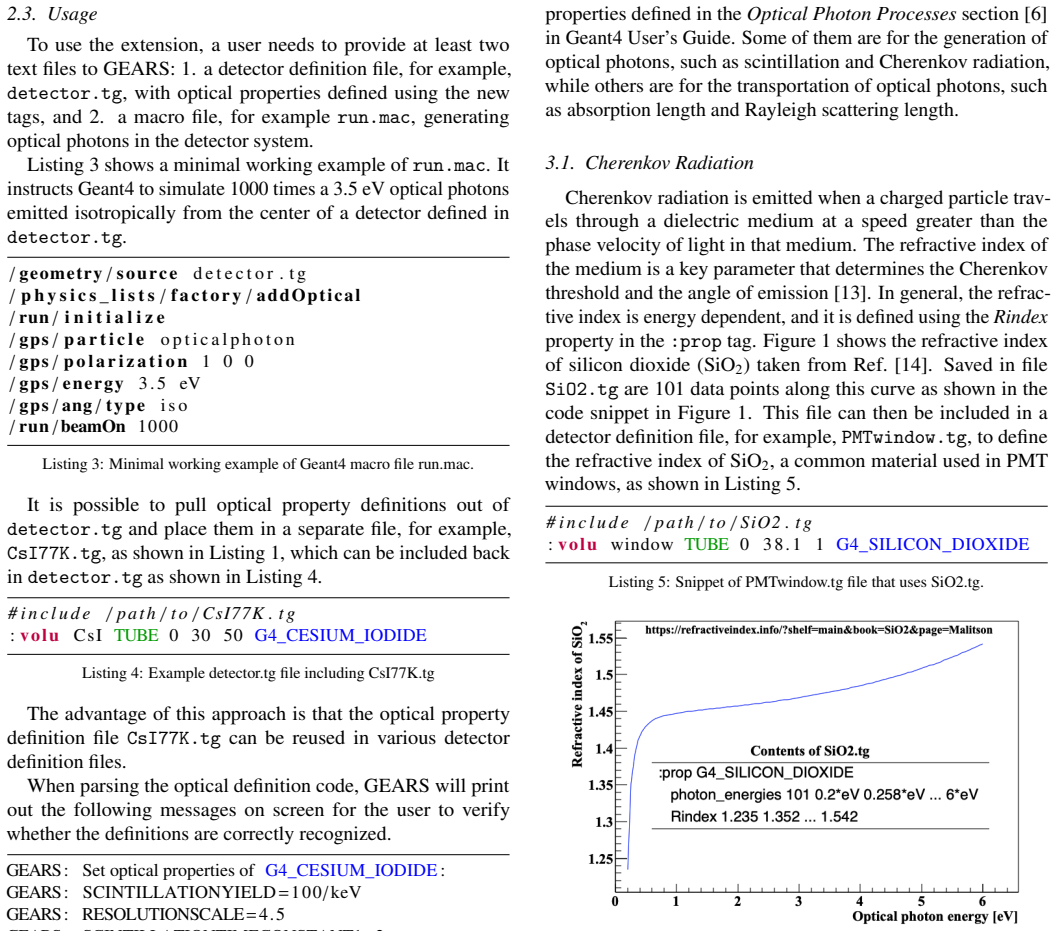
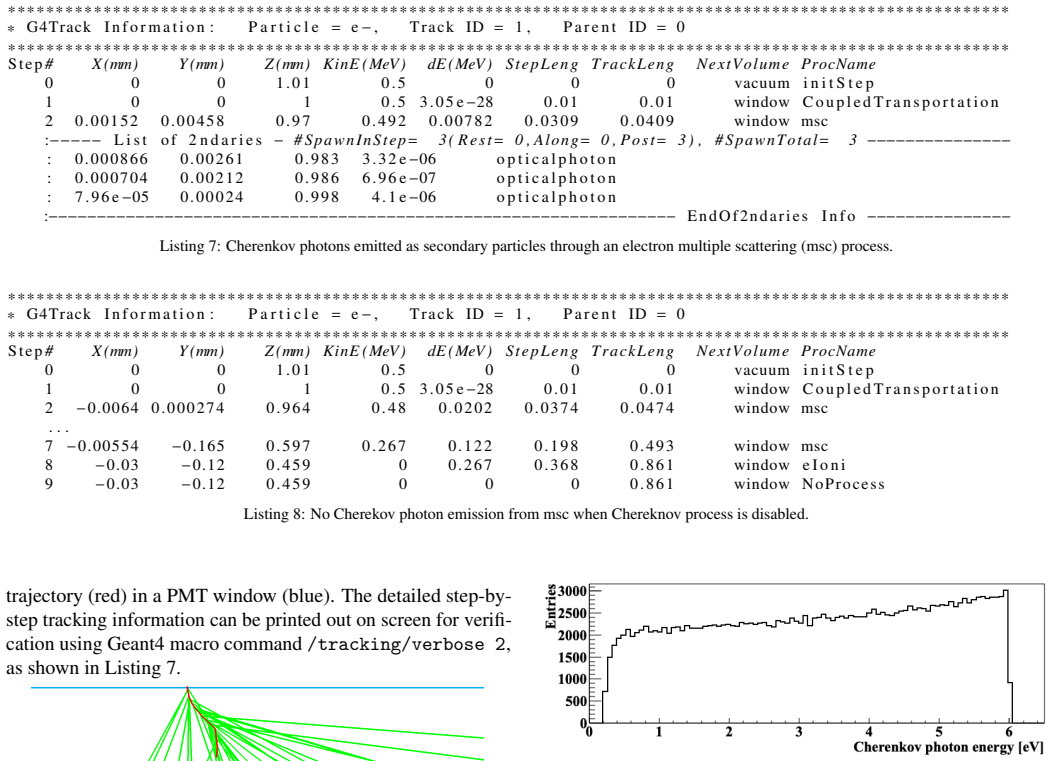
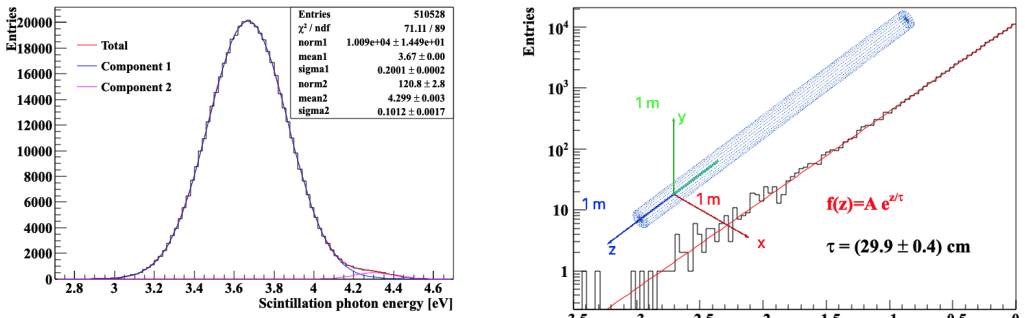
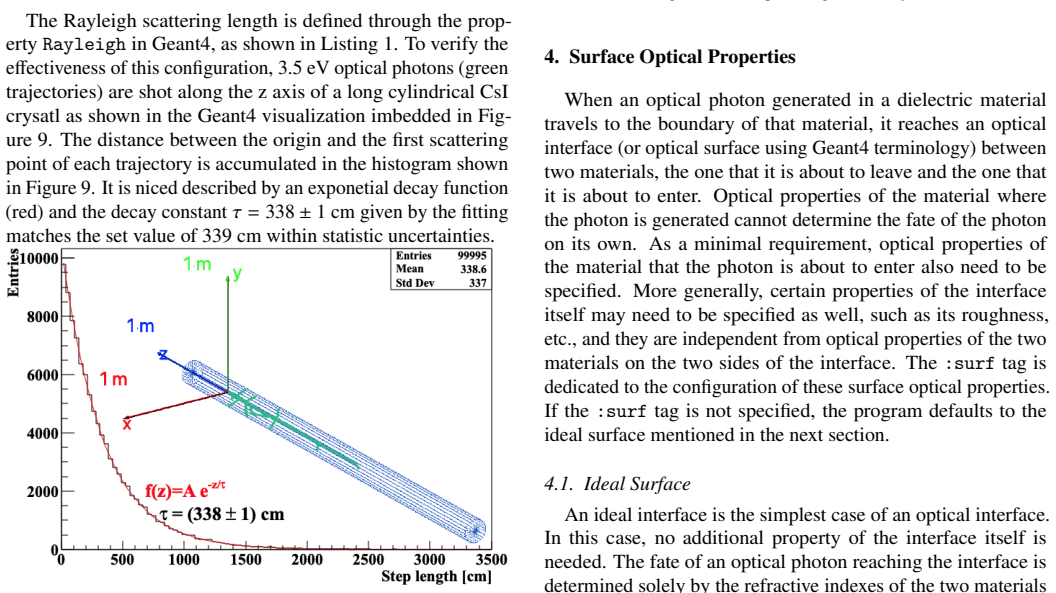
The plain text geometry description syntax in Geant4 has been extended to incorporate optical properties for bulk materials and surface interfaces. This extension enables users to configure and execute comprehensive optical simulations without writing C++ code, significantly lowering the learning curve and eliminating the need for frequent recompilation. In this paper, we detail the implementation of the new :prop and :surf tags and validate them through examples of key optical processes, including Cherenkov radiation, scintillation, Rayleigh scattering, and absorption. Furthermore, we provide a thorough demonstration of configuring complex optical boundaries using the UNIFIED model.
What carries the argument
The :prop and :surf tags added to Geant4's plain text geometry syntax, which embed optical properties for materials and surfaces directly into the file.
If this is right
- Users can set up Cherenkov radiation, scintillation, Rayleigh scattering, and absorption entirely through text file edits.
- Complex optical surface interfaces become configurable via the UNIFIED model without writing code.
- Simulation parameters can be changed and the program rerun without recompilation.
- Rapid prototyping of optical detector designs becomes practical for users without C++ experience.
- The approach supports quick iteration during simulation studies in high-energy physics.
Where Pith is reading between the lines
- Non-programmer collaborators in physics experiments could contribute directly to optical modeling tasks.
- Detector optimization loops might shorten because text edits replace code-compile-test cycles.
- The same text-extension pattern could later simplify setup for other Geant4 physics processes.
- Side-by-side runs on standard benchmark geometries would test whether the text version reproduces known results.
Load-bearing premise
The new tags fully support all required optical properties and integrate correctly with Geant4's existing optical physics processes without introducing bugs or limitations.
What would settle it
Running one of the paper's example simulations using only the new text tags and checking whether its output matches the result from an equivalent traditional C++ implementation.
Figures









read the original abstract
The plain text geometry description syntax in Geant4 has been extended to incorporate optical properties for bulk materials and surface interfaces. This extension enables users to configure and execute comprehensive optical simulations without writing C++ code, significantly lowering the learning curve and eliminating the need for frequent recompilation. In this paper, we detail the implementation of the new ":prop" and ":surf" tags and validate them through examples of key optical processes, including Cherenkov radiation, scintillation, Rayleigh scattering, and absorption. Furthermore, we provide a thorough demonstration of configuring complex optical boundaries using the UNIFIED model. These capabilities are contextualized through practical scenarios, showcasing the extension's potential for rapid prototyping and simulation studies.
Editorial analysis
A structured set of objections, weighed in public.
Referee Report
Summary. The paper describes the addition of ':prop' and ':surf' tags to Geant4's plain text geometry description syntax. This extension allows definition of optical properties for materials and surfaces, enabling users to perform optical simulations involving Cherenkov radiation, scintillation, Rayleigh scattering, absorption, and UNIFIED model boundaries without C++ code or recompilation. Validation is provided through examples of these processes.
Significance. This work has good significance for the field. Geant4 is central to HEP simulations, and optical modeling is key for many detectors. Removing the C++ requirement facilitates faster iteration and broader accessibility, with the examples demonstrating practical use for prototyping.
minor comments (3)
- The abstract could include the specific Geant4 version(s) used for development and testing to improve reproducibility.
- Figure captions in the validation section should more explicitly describe the optical configuration and expected outcomes for each example.
- A brief table or list summarizing all supported optical properties via the new tags would aid users in assessing coverage without consulting the full Geant4 C++ API documentation.
Simulated Author's Rebuttal
We thank the referee for the positive review of our manuscript and for recommending minor revision. The acknowledgment of the work's significance for enabling optical simulations in Geant4 without requiring C++ code or recompilation is appreciated, as is the recognition of its value for rapid prototyping in the HEP community.
Circularity Check
No significant circularity: pure implementation paper
full rationale
This is a software extension paper describing new ':prop' and ':surf' tags that expose Geant4's existing G4MaterialPropertiesTable and G4OpticalSurface APIs in a text-based GDML-like syntax. There are no mathematical derivations, equations, fitted parameters, predictions, or uniqueness theorems. Validation consists of example configurations that register the same Geant4 objects the C++ API would create; no self-referential definitions or load-bearing self-citations appear in the claim chain. The work is self-contained against external Geant4 benchmarks and requires no circular reduction.
Axiom & Free-Parameter Ledger
axioms (1)
- domain assumption Geant4's existing optical physics processes are correctly implemented and can be configured via the new tags
Reference graph
Works this paper leans on
-
[1]
Agostinelli, et al., Geant4: a simulation toolkit, Nucl
S. Agostinelli, et al., Geant4: a simulation toolkit, Nucl. Instrum. Meth. A 506 (2003) 250–303. doi:10.1016/S0168-9002(03)01304-1
-
[2]
Allison, et al., Geant4 developments and applications, IEEE Trans
J. Allison, et al., Geant4 developments and applications, IEEE Trans. Nucl. Sci. 53 (1) (2006) 270–278. doi:10.1109/TNS.2006.869826
-
[3]
Allison, et al., Recent developments in Geant4, Nucl
J. Allison, et al., Recent developments in Geant4, Nucl. Instrum. Meth. A 835 (2016) 186–225. doi:10.1016/j.nima.2016.06.125
-
[4]
R. Chytracek, J. Mccormick, W. Pokorski, G. Santin, Geometry Description Markup Language for Physics Simulation and Analysis Applications, IEEE Trans. Nucl. Sci. 53 (5) (2006) 2892–2896. doi:10.1109/TNS.2006.881062
-
[5]
Geant4 Collaboration, Geant4 Geometry from Text File Version 1.0,https: //geant4.web.cern.ch/collaboration/workingi_ groups/persistency/docs/textgeom.pdf(2025)
2025
-
[6]
Geant4 Collaboration, Geant4 User’s Guide for Application Developers, https://geant4-userdoc.web.cern.ch/ UsersGuides/ForApplicationDeveloper/html (2025)
2025
-
[7]
Gruber, Markdown,https: //daringfireball.net/projects/markdown(2004)
J. Gruber, Markdown,https: //daringfireball.net/projects/markdown(2004)
2004
-
[8]
FreeCAD Team, FreeCAD, https://www.freecad.org/(2025)
2025
-
[9]
ROOT Collaboration, ROOT Data Analysis Framework, https://root.cern/(2025). doi:10.5281/zenodo.17290128
-
[10]
Cosmo, Adding optical properties to built-in Geant4 materials using GDML, https://geant4-forum.web.cern.ch/t/340/4 (2019)
G. Cosmo, Adding optical properties to built-in Geant4 materials using GDML, https://geant4-forum.web.cern.ch/t/340/4 (2019)
2019
-
[11]
Liu, GEARS - Geant4 Example Application with Rich feature and Small foodprint, https://github.com/jintonic/gears(2025)
J. Liu, GEARS - Geant4 Example Application with Rich feature and Small foodprint, https://github.com/jintonic/gears(2025)
2025
-
[12]
Wikipedia, Camel case, https://en.wikipedia.org/wiki/Camel_case (2025)
2025
-
[13]
Geant4 Collaboration, Geant4 Physics Reference Manual, https://geant4-userdoc.web.cern.ch/ UsersGuides/PhysicsReferenceManual/html (2025)
2025
-
[14]
M. N. Polyanskiy, Refractive index database, https://refractiveindex.info(2025). 13
2025
discussion (0)
Sign in with ORCID, Apple, or X to comment. Anyone can read and Pith papers without signing in.