Recognition: 3 theorem links
· Lean TheoremDelving into Non-Exchangeability for Conformal Prediction in Graph-Structured Multivariate Time Series
Pith reviewed 2026-05-08 17:34 UTC · model grok-4.3
The pith
Conditioning on low-frequency trends restores exchangeability for high-frequency residuals, enabling valid conformal prediction in graph time series.
A machine-rendered reading of the paper's core claim, the machinery that carries it, and where it could break.
Core claim
The authors establish that non-exchangeability in graph-structured multivariate time series stems from low-frequency global couplings across nodes, while high-frequency components satisfy conditional exchangeability. They define Spectral Graph Conditional Exchangeability to formalize this separation and propose the SCALE algorithm, which uses graph wavelets to isolate low- and high-frequency components and conformalizes the high-frequency prediction residuals with adaptive gating conditioned on a low-frequency embedding. This construction yields valid coverage guarantees together with a better coverage-efficiency balance than prior conformal prediction techniques when evaluated on real-world
What carries the argument
Spectral Graph Conditional Exchangeability realized by graph wavelet decomposition of the time series followed by adaptive gating of high-frequency residuals over a low-frequency embedding.
If this is right
- SCALE supplies valid coverage guarantees for uncertainty quantification on graph-structured time series forecasts.
- The method improves the coverage-efficiency trade-off relative to existing conformal prediction baselines.
- Global trends are preserved through the low-frequency conditioning step while exchangeability-based guarantees are applied to the residuals.
- Performance gains are demonstrated on real multivariate traffic forecasting data.
Where Pith is reading between the lines
- The same frequency-separation idea could be tested on other temporally structured graph data such as sensor networks or financial correlation graphs.
- A direct test would involve synthetic graphs engineered so that high-frequency residuals retain dependence after conditioning; failure of coverage there would bound the method's applicability.
- Pairing SCALE with graph neural network predictors offers a practical route to deploy the uncertainty estimates in production forecasting systems.
Load-bearing premise
High-frequency components remain nearly exchangeable once low-frequency global trends are conditioned upon.
What would settle it
A graph time series dataset in which high-frequency residuals still exhibit strong dependence after low-frequency conditioning, producing empirical coverage rates for SCALE that fall materially below the nominal target.
Figures



read the original abstract
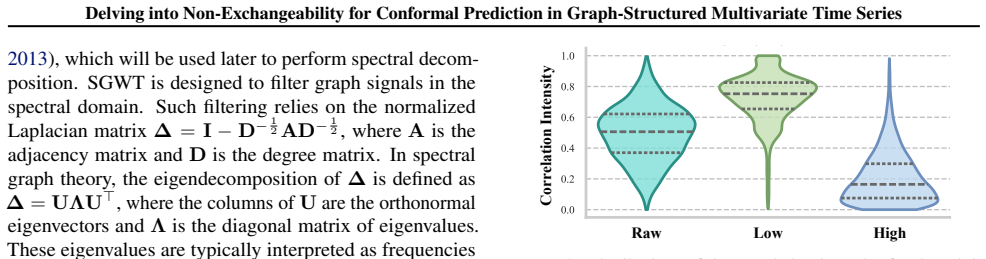
Point forecasting for graph-structured multivariate time series is a fundamental problem, but rigorous uncertainty quantification for such predictions is still underexplored. Conformal prediction (CP) offers uncertainty estimation with a solid coverage guarantee under the exchangeability assumption, which requires the joint data distribution to be unchanged under permutation. However, in graph-structured time series, inherent cross-node coupling can violate the exchangeability condition, making direct application of CP unreliable. Inspired by the spectral graph theory, such coupling resides in global trends and can be characterized by the low-frequency components, while high-frequency components are nearly exchangeable. Therefore, we propose a novel concept named Spectral Graph Conditional Exchangeability (SGCE), which conditions exchangeable high-frequency components on low-frequency ones to preserve global trends and enable effective CP in the spectral domain. Based on SGCE, we further propose Spectral Conformal prediction via wAveLEt transform (SCALE). SCALE uses graph wavelets to decompose low/high-frequency components and conformalizes high-frequency residuals via adaptive gating over a low-frequency embedding. Experimental results on real-world traffic datasets show that SCALE not only achieves valid coverage but also consistently improves the coverage-efficiency trade-off over the state-of-the-art CP methods.
Editorial analysis
A structured set of objections, weighed in public.
Referee Report
Summary. The paper claims that standard conformal prediction is unreliable for graph-structured multivariate time series due to violations of exchangeability from cross-node coupling. It introduces the concept of Spectral Graph Conditional Exchangeability (SGCE), under which low-frequency components capture non-exchangeable global trends while high-frequency components are nearly exchangeable when conditioned on them. Building on SGCE, it proposes SCALE, which decomposes signals via graph wavelets, applies adaptive gating over a low-frequency embedding, and performs conformal prediction on the high-frequency residuals. Experiments on real-world traffic datasets are reported to achieve valid coverage while improving the coverage-efficiency trade-off over existing CP methods.
Significance. If the SGCE assumption holds with a supporting theorem, the approach would offer a useful extension of conformal prediction to non-exchangeable graph time series by exploiting spectral separation of trends and residuals. The reported empirical gains on traffic data indicate potential practical value for uncertainty quantification in structured forecasting tasks, particularly if the method generalizes beyond the tested datasets.
major comments (2)
- [Abstract (SGCE definition) and Section 3 (method)] The coverage guarantee in SCALE depends entirely on the SGCE assumption that high-frequency residuals become (nearly) exchangeable after wavelet decomposition and conditioning on the low-frequency embedding. No theorem or derivation is supplied showing that the joint distribution of the gated residuals is permutation-invariant; the abstract only states that high-frequency components are 'nearly exchangeable' as an inspired observation from spectral graph theory. This is load-bearing for the central claim, since standard CP coverage theorems require exchangeability (or a suitable relaxation with explicit bounds), and persistent cross-node dependencies in the high-frequency band would invalidate the guarantee.
- [Experimental results (traffic datasets)] The experimental claims of 'valid coverage' and 'improved coverage-efficiency trade-off' are presented without supporting details such as coverage rates with error bars, ablation on the adaptive gating or wavelet choice, or explicit comparison to spectral baselines. Without these, it is impossible to verify whether the reported improvements stem from the proposed conditioning step or from other implementation choices.
minor comments (1)
- [Abstract and Section 4] The acronym SCALE is stylized with mixed capitalization ('wAveLEt'); standardize the presentation and expand it on first use for clarity.
Simulated Author's Rebuttal
We thank the referee for the constructive comments, which highlight important aspects of the theoretical justification and experimental rigor. We address each major point below and will revise the manuscript to incorporate the suggested improvements.
read point-by-point responses
-
Referee: [Abstract (SGCE definition) and Section 3 (method)] The coverage guarantee in SCALE depends entirely on the SGCE assumption that high-frequency residuals become (nearly) exchangeable after wavelet decomposition and conditioning on the low-frequency embedding. No theorem or derivation is supplied showing that the joint distribution of the gated residuals is permutation-invariant; the abstract only states that high-frequency components are 'nearly exchangeable' as an inspired observation from spectral graph theory. This is load-bearing for the central claim, since standard CP coverage theorems require exchangeability (or a suitable relaxation with explicit bounds), and persistent cross-node dependencies in the high-frequency band would invalidate the guarantee.
Authors: We agree that a formal derivation establishing conditional permutation invariance of the gated high-frequency residuals is not present in the current version. The manuscript motivates SGCE via spectral graph theory observations but does not supply an explicit theorem or bounds on the deviation from exchangeability. In the revision we will add a dedicated subsection to Section 3 that derives the conditional exchangeability property from the spectral localization of graph wavelets: specifically, we will show that, under the assumption that the graph Laplacian eigenvectors separate global trends into the lowest eigenvalues, the high-frequency wavelet coefficients become conditionally independent of node permutations once conditioned on the low-frequency embedding. We will also state the precise conditions on the wavelet filters and the graph under which the approximation error remains controlled, thereby grounding the coverage claim. revision: yes
-
Referee: [Experimental results (traffic datasets)] The experimental claims of 'valid coverage' and 'improved coverage-efficiency trade-off' are presented without supporting details such as coverage rates with error bars, ablation on the adaptive gating or wavelet choice, or explicit comparison to spectral baselines. Without these, it is impossible to verify whether the reported improvements stem from the proposed conditioning step or from other implementation choices.
Authors: We acknowledge that the experimental section lacks the quantitative details needed for full verification. In the revised manuscript we will augment the results with (i) coverage rates reported as means and standard errors over multiple random seeds, (ii) ablation tables isolating the contribution of the adaptive gating module and the specific wavelet family, and (iii) additional baselines that perform conformal prediction directly in the spectral domain (e.g., using graph Fourier transforms without the proposed conditioning). These additions will allow readers to attribute performance gains specifically to the SGCE mechanism. revision: yes
Circularity Check
No circularity: derivation applies external CP theory under a posited spectral assumption
full rationale
The paper introduces SGCE as a novel conditioning concept drawn from spectral graph theory (external), decomposes via graph wavelets, and applies standard conformal prediction to the resulting high-frequency residuals. No equations, fitted parameters, or self-citations are shown that would make the coverage guarantee equivalent to an input by construction; the validity claim rests on the (unproven in the excerpt) conditional exchangeability assumption plus classical CP, which is independent of the present work. This is the normal non-circular case.
Axiom & Free-Parameter Ledger
axioms (1)
- domain assumption High-frequency components are nearly exchangeable when conditioned on low-frequency global trends
invented entities (1)
-
Spectral Graph Conditional Exchangeability (SGCE)
no independent evidence
Lean theorems connected to this paper
-
Foundation.LogicAsFunctionalEquation / Cost.FunctionalEquationwashburn_uniqueness_aczel (no overlap) unclear?
unclearRelation between the paper passage and the cited Recognition theorem.
We propose a novel concept named Spectral Graph Conditional Exchangeability (SGCE), which conditions exchangeable high-frequency components on low-frequency ones to preserve global trends and enable effective CP in the spectral domain.
What do these tags mean?
- matches
- The paper's claim is directly supported by a theorem in the formal canon.
- supports
- The theorem supports part of the paper's argument, but the paper may add assumptions or extra steps.
- extends
- The paper goes beyond the formal theorem; the theorem is a base layer rather than the whole result.
- uses
- The paper appears to rely on the theorem as machinery.
- contradicts
- The paper's claim conflicts with a theorem or certificate in the canon.
- unclear
- Pith found a possible connection, but the passage is too broad, indirect, or ambiguous to say the theorem truly supports the claim.
Reference graph
Works this paper leans on
-
[1]
Proceedings of the International Conference on Learning Representations , year =
Error-Quantified Conformal Inference for Time Series , author =. Proceedings of the International Conference on Learning Representations , year =
-
[2]
Proceedings of the 28th International Joint Conference on Artificial Intelligence , pages =
Graph WaveNet for Deep Spatial-Temporal Graph Modeling , author =. Proceedings of the 28th International Joint Conference on Artificial Intelligence , pages =
-
[3]
ICLR Workshop on Representation Learning on Graphs and Manifolds , year =
Fast Graph Representation Learning with PyTorch Geometric , author =. ICLR Workshop on Representation Learning on Graphs and Manifolds , year =
-
[4]
Proceedings of the Thirteenth Symposium on Conformal and Probabilistic Prediction with Applications , pages =
ConForME: Multi-horizon conditional conformal time series forecasting , author =. Proceedings of the Thirteenth Symposium on Conformal and Probabilistic Prediction with Applications , pages =. 2024 , volume =
2024
-
[5]
Advances in Neural Information Processing Systems , volume =
Conformal Prediction for Time Series with Modern Hopfield Networks , author =. Advances in Neural Information Processing Systems , volume =
-
[6]
Proceedings of the 42nd International Conference on Machine Learning , year =
Relational Conformal Prediction for Correlated Time Series , author =. Proceedings of the 42nd International Conference on Machine Learning , year =
-
[7]
Proceedings of the 41st International Conference on Machine Learning , year =
Conformal Prediction for Deep Classifier via Label Ranking , author =. Proceedings of the 41st International Conference on Machine Learning , year =
-
[8]
Proceedings of the 40th International Conference on Machine Learning , volume =
Sequential Predictive Conformal Inference for Time Series , author =. Proceedings of the 40th International Conference on Machine Learning , volume =
-
[9]
Proceedings of the AAAI Conference on Artificial Intelligence , volume =
Neural Conformal Control for Time Series Forecasting , author =. Proceedings of the AAAI Conference on Artificial Intelligence , volume =
-
[10]
Proceedings of the AAAI Conference on Artificial Intelligence , volume =
Attention Based Spatial-Temporal Graph Convolutional Networks for Traffic Flow Forecasting , author =. Proceedings of the AAAI Conference on Artificial Intelligence , volume =
-
[11]
Proceedings of the AAAI Conference on Artificial Intelligence , volume =
GMAN: A Graph Multi-Attention Network for Traffic Prediction , author =. Proceedings of the AAAI Conference on Artificial Intelligence , volume =
-
[12]
Proceedings of the AAAI Conference on Artificial Intelligence , year =
Spatial-Temporal Synchronous Graph Convolutional Networks: A New Framework for Spatial-Temporal Network Data Forecasting , author =. Proceedings of the AAAI Conference on Artificial Intelligence , year =
-
[13]
Proceedings of the AAAI Conference on Artificial Intelligence , year =
Dynamic Graph Convolutional Recurrent Network for Traffic Prediction , author =. Proceedings of the AAAI Conference on Artificial Intelligence , year =
-
[14]
Proceedings of the AAAI Conference on Artificial Intelligence , year =
FiLM: Visual Reasoning with a General Conditioning Layer , author =. Proceedings of the AAAI Conference on Artificial Intelligence , year =
-
[15]
Proceedings of the International Conference on Learning Representations , year =
Diffusion Convolutional Recurrent Neural Network: Data-Driven Traffic Forecasting , author =. Proceedings of the International Conference on Learning Representations , year =
-
[16]
Proceedings of the International Conference on Learning Representations , year =
Semi-Supervised Classification with Graph Convolutional Networks , author =. Proceedings of the International Conference on Learning Representations , year =
-
[17]
Proceedings of the International Conference on Learning Representations , year =
Spectral Networks and Locally Connected Networks on Graphs , author =. Proceedings of the International Conference on Learning Representations , year =
-
[18]
Proceedings of the 31st ACM International Conference on Information and Knowledge Management , pages =
Spatial-Temporal Identity: A Simple yet Effective Baseline for Multivariate Time Series Forecasting , author =. Proceedings of the 31st ACM International Conference on Information and Knowledge Management , pages =
-
[19]
Proceedings of the 31st ACM SIGKDD Conference on Knowledge Discovery and Data Mining , pages =
Non-Exchangeable Conformal Prediction for Temporal Graph Neural Networks , author =. Proceedings of the 31st ACM SIGKDD Conference on Knowledge Discovery and Data Mining , pages =
-
[20]
Proceedings of the 26th ACM SIGKDD International Conference on Knowledge Discovery and Data Mining , pages =
Connecting the Dots: Multivariate Time Series Forecasting with Graph Neural Networks , author =. Proceedings of the 26th ACM SIGKDD International Conference on Knowledge Discovery and Data Mining , pages =
-
[21]
Proceedings of the 27th International Joint Conference on Artificial Intelligence , pages =
Spatio-Temporal Graph Convolutional Networks: A Deep Learning Framework for Traffic Forecasting , author =. Proceedings of the 27th International Joint Conference on Artificial Intelligence , pages =
-
[22]
Advances in Neural Information Processing Systems , year =
Exploring the Noise Robustness of Online Conformal Prediction , author =. Advances in Neural Information Processing Systems , year =
-
[23]
Advances in Neural Information Processing Systems , year =
Conformalized Quantile Regression , author =. Advances in Neural Information Processing Systems , year =
-
[24]
Advances in Neural Information Processing Systems , year =
PyTorch: An Imperative Style, High-Performance Deep Learning Library , author =. Advances in Neural Information Processing Systems , year =
-
[25]
Advances in Neural Information Processing Systems , volume =
LargeST: A Benchmark Dataset for Large-Scale Traffic Forecasting , author =. Advances in Neural Information Processing Systems , volume =
-
[26]
Advances in Neural Information Processing Systems , year =
Adaptive Graph Convolutional Recurrent Network for Traffic Forecasting , author =. Advances in Neural Information Processing Systems , year =
-
[27]
Advances in Neural Information Processing Systems , year =
Convolutional Neural Networks on Graphs with Fast Localized Spectral Filtering , author =. Advances in Neural Information Processing Systems , year =
-
[28]
Advances in Neural Information Processing Systems , volume =
Spatio-Spectral Graph Neural Networks , author =. Advances in Neural Information Processing Systems , volume =
-
[29]
Advances in Neural Information Processing Systems , volume =
Unifying Homophily and Heterophily for Spectral Graph Neural Networks via Triple Filter Ensembles , author =. Advances in Neural Information Processing Systems , volume =
-
[30]
Advances in Neural Information Processing Systems , year =
HeroFilter: Adaptive Spectral Graph Filter for Varying Heterophilic Relations , author =. Advances in Neural Information Processing Systems , year =
-
[31]
IEEE Transactions on Knowledge and Data Engineering , volume =
Exploring Progress in Multivariate Time Series Forecasting: Comprehensive Benchmarking and Heterogeneity Analysis , author =. IEEE Transactions on Knowledge and Data Engineering , volume =
-
[32]
A Gentle Introduction to Conformal Prediction and Distribution-Free Uncertainty Quantification
Anastasios N. Angelopoulos and Stephen Bates , title =. arXiv preprint arXiv:2107.07511 , year =
work page internal anchor Pith review arXiv
-
[33]
The Annals of Statistics , volume =
Conformal Prediction Beyond Exchangeability , author =. The Annals of Statistics , volume =
-
[34]
Neurocomputing , volume =
Spatio-Temporal Prediction Using Graph Neural Networks: A Survey , author =. Neurocomputing , volume =
-
[35]
ACM Computing Surveys , volume =
Bridging the Gap Between Spatial and Spectral Domains: A Unified Framework for Graph Neural Networks , author =. ACM Computing Surveys , volume =
-
[36]
IEEE Transactions on Signal Processing , volume =
Verifying the Smoothness of Graph Signals: A Graph Signal Processing Approach , author =. IEEE Transactions on Signal Processing , volume =
-
[37]
Engineering Applications of Artificial Intelligence , volume =
Short-Term Electricity-Load Forecasting by Deep Learning: A Comprehensive Survey , author =. Engineering Applications of Artificial Intelligence , volume =
-
[38]
Journal of the American Statistical Association , volume =
Strictly Proper Scoring Rules, Prediction, and Estimation , author =. Journal of the American Statistical Association , volume =
-
[39]
Applied and Computational Harmonic Analysis , volume =
Wavelets on Graphs via Spectral Graph Theory , author =. Applied and Computational Harmonic Analysis , volume =
-
[40]
Nature , volume =
Array Programming with NumPy , author =. Nature , volume =
-
[41]
Sensors , volume =
Multi-Granularity Temporal Embedding Transformer Network for Traffic Flow Forecasting , author =. Sensors , volume =
-
[42]
IEEE Transactions on Signal Processing , volume =
Graph Filters for Signal Processing and Machine Learning on Graphs , author =. IEEE Transactions on Signal Processing , volume =
-
[43]
IEEE Transactions on Pattern Analysis and Machine Intelligence , volume =
A Survey on Graph Neural Networks for Time Series: Forecasting, Classification, Imputation, and Anomaly Detection , author =. IEEE Transactions on Pattern Analysis and Machine Intelligence , volume =
-
[44]
IEEE Transactions on Knowledge and Data Engineering , volume =
Spatio-Temporal Graph Neural Networks for Predictive Learning in Urban Computing: A Survey , author =. IEEE Transactions on Knowledge and Data Engineering , volume =
-
[45]
Econometrica , pages =
Regression Quantiles , author =. Econometrica , pages =
-
[46]
Journal of the American Statistical Association , volume =
Distribution-Free Predictive Inference for Regression , author =. Journal of the American Statistical Association , volume =
-
[47]
Philosophical Transactions of the Royal Society A , volume =
Deep Learning for Time Series Forecasting: A Survey , author =. Philosophical Transactions of the Royal Society A , volume =
-
[48]
IEEE Transactions on Intelligent Transportation Systems , volume =
Uncertainty Quantification for Traffic Forecasting Using Deep-Ensemble-Based Spatiotemporal Graph Neural Networks , author =. IEEE Transactions on Intelligent Transportation Systems , volume =
-
[49]
IEEE Transactions on Signal Processing , volume =
Discrete Signal Processing on Graphs , author =. IEEE Transactions on Signal Processing , volume =
-
[50]
Journal of Machine Learning Research , volume =
A Tutorial on Conformal Prediction , author =. Journal of Machine Learning Research , volume =
-
[51]
IEEE Transactions on Signal and Information Processing over Networks , volume =
Multi-Scale Graph Convolutional Network with Spectral Graph Wavelet Frame , author =. IEEE Transactions on Signal and Information Processing over Networks , volume =
-
[52]
IEEE Signal Processing Magazine , volume =
The Emerging Field of Signal Processing on Graphs: Extending High-Dimensional Data Analysis to Networks and Other Irregular Domains , author =. IEEE Signal Processing Magazine , volume =
-
[53]
Machine Learning , volume =
Conditional Validity of Inductive Conformal Predictors , author =. Machine Learning , volume =
-
[54]
Journal of the American Statistical Association , volume =
A Decision-Theoretic Approach to Interval Estimation , author =. Journal of the American Statistical Association , volume =
-
[55]
Transactions on Machine Learning Research , year =
Does Confidence Calibration Help Conformal Prediction? , author =. Transactions on Machine Learning Research , year =
-
[56]
Neural Processing Letters , volume =
Gated Fusion Adaptive Graph Neural Network for Urban Road Traffic Flow Prediction , author =. Neural Processing Letters , volume =
-
[57]
IEEE Transactions on Pattern Analysis and Machine Intelligence , volume =
Conformal Prediction for Time Series , author =. IEEE Transactions on Pattern Analysis and Machine Intelligence , volume =
-
[58]
Journal of the Royal Statistical Society Series B: Statistical Methodology , volume =
Conformal Prediction with Conditional Guarantees , author =. Journal of the Royal Statistical Society Series B: Statistical Methodology , volume =
-
[59]
IEEE Transactions on Neural Networks and Learning Systems , volume =
Denoising Multiscale Spectral Graph Wavelet Neural Networks for Gas Utilization Ratio Prediction in Blast Furnace , author =. IEEE Transactions on Neural Networks and Learning Systems , volume =
-
[60]
2005 , publisher =
Algorithmic Learning in a Random World , author =. 2005 , publisher =
2005
-
[61]
1997 , publisher =
Spectral Graph Theory , author =. 1997 , publisher =
1997
-
[62]
Cini, Andrea and Marisca, Ivan , title =
-
[63]
2025 , version =
PyTorch Lightning , author =. 2025 , version =
2025
-
[64]
2026 , note =
The Python Language Reference , author =. 2026 , note =
2026
-
[65]
2021 , eprint =
Exchangeability, Conformal Prediction, and Rank Tests , author =. 2021 , eprint =
2021
-
[66]
2025 , eprint =
Theoretical Foundations of Conformal Prediction , author =. 2025 , eprint =
2025
discussion (0)
Sign in with ORCID, Apple, or X to comment. Anyone can read and Pith papers without signing in.