Recognition: unknown
Nonlinear phonon dispersion in disordered solids and non-Debye vibrational spectra
Pith reviewed 2026-05-08 16:06 UTC · model grok-4.3
The pith
Nonlinear phonon dispersion in disordered solids emerges from a mesoscopic disorder-induced lengthscale that also governs wave attenuation.
A machine-rendered reading of the paper's core claim, the machinery that carries it, and where it could break.
Core claim
Nonlinear phonon dispersion in a broad range of disordered solids, including elastic networks and various glasses, emerges from a mesoscopic, disorder-induced lengthscale that also controls wave attenuation. Quantitative analysis and simulations establish that the relative weight of nonlinear phonon softening versus non-phononic vibrations in producing non-Debye anomalies and the boson peak depends on the strength of disorder, for example as set by thermal history during glass formation, and that both mechanisms contribute significantly to the boson peak in realistic laboratory glasses.
What carries the argument
The mesoscopic, disorder-induced lengthscale that simultaneously produces nonlinear phonon dispersion and controls wave attenuation.
If this is right
- The onset of non-Debye features in the vibrational density of states is shaped by both nonlinear phonon effects and disorder-induced modes across elastic networks and glasses.
- The boson peak's composition changes with disorder strength, such as that tuned by the thermal history of glass formation.
- Wave attenuation and nonlinear dispersion are linked through the same disorder lengthscale in multiple classes of disordered solids.
- For typical laboratory glasses both nonlinear softening and non-phononic vibrations contribute meaningfully to the boson peak.
Where Pith is reading between the lines
- If the lengthscale is primary, experimental probes of attenuation at intermediate wavelengths could directly measure it in real materials.
- Processing routes that alter disorder strength could be used to adjust the balance between the two contributions to vibrational anomalies.
- The same lengthscale may set universal trends in wave propagation across different disordered solids, independent of microscopic details.
Load-bearing premise
The mesoscopic lengthscale identified in simulations is the root cause of the nonlinear dispersion rather than a secondary consequence, and the numerical decomposition separating phonon softening from non-phononic contributions can be performed without model-specific artifacts.
What would settle it
An observation or simulation in which clear nonlinear phonon dispersion appears but no corresponding mesoscopic lengthscale is detectable, or in which the two contributions to the boson peak cannot be isolated as described.
Figures





read the original abstract
All solids, whether crystalline or disordered, support elastic wave propagation with a linear dispersion relation in the long-wavelength limit. These waves, corresponding to low-frequency phonons, feature a vibrational density of states that follows Debye's classical model. Deviations from Debye's predictions with increasing frequency can emerge from phonon dispersion nonlinearity and from non-phononic vibrational modes, which exist in non-crystalline solids due to structural disorder. Both nonlinear phonon dispersion in disordered solids and its relative contribution to non-Debye anomalies, most notably manifested by the controversial boson peak, remain poorly understood. Here we show that nonlinear phonon dispersion in a broad range of disordered solids, including elastic networks and various glasses, emerge from a mesoscopic, disorder-induced lengthscale, which also controls wave attenuation. We subsequently use analysis and large-scale computer simulations to quantitatively determine the relative contributions of nonlinear phonon softening and non-phononic vibrations to the onset of non-Debye anomalies and to the boson peak. We show that the relative magnitude of the two contributions strongly depends on the strength of disorder of the solid, e.g., controlled by the thermal history upon glass formation, and that for realistic laboratory glasses both pieces of physics significantly contribute to the boson peak. These findings constitute basic progress in understanding disordered solids.
Editorial analysis
A structured set of objections, weighed in public.
Referee Report
Summary. The manuscript claims that nonlinear phonon dispersion in disordered solids (elastic networks and glasses) emerges from a mesoscopic disorder-induced lengthscale that also controls wave attenuation. Analysis and large-scale simulations are used to quantify the relative contributions of nonlinear phonon softening versus non-phononic modes to the onset of non-Debye anomalies and the boson peak, with the balance shown to depend on disorder strength (e.g., thermal history) such that both mechanisms contribute substantially in realistic laboratory glasses.
Significance. If the central claims hold, the work would advance understanding of vibrational anomalies in glasses by identifying a unifying mesoscopic lengthscale and demonstrating the interplay between dispersion nonlinearity and disorder-induced modes. The breadth of systems simulated and the quantitative separation of contributions are strengths that could inform both theory and experiment on the boson peak.
major comments (2)
- [§4] §4 (lengthscale extraction): the mesoscopic lengthscale is presented as emerging from disorder and setting the scale of nonlinear softening and attenuation, yet the extraction procedure appears to rely on the same wave-vector/frequency window where softening is observed; this risks making the causality claim circular rather than independently established.
- [§5.2] §5.2 (boson-peak decomposition): the quantitative separation of nonlinear softening and non-phononic contributions to the boson peak is load-bearing for the final claim that both are significant in realistic glasses; the manuscript provides insufficient detail on error analysis, sensitivity to fitting ranges, and model-specific artifacts to confirm the separation is unambiguous.
minor comments (2)
- [Figure 4] Figure 4: the curves for different disorder strengths overlap in a way that makes visual comparison of the relative contributions difficult; adding inset zooms or normalized plots would improve clarity.
- [Methods] Methods: the description of how disorder realizations are averaged and how finite-size effects are controlled is brief; expanding this would aid reproducibility.
Simulated Author's Rebuttal
We thank the referee for the careful and constructive review of our manuscript. The comments highlight important aspects of our analysis that we have addressed through clarifications and expanded details in the revised version. Below we respond point by point to the major comments.
read point-by-point responses
-
Referee: [§4] §4 (lengthscale extraction): the mesoscopic lengthscale is presented as emerging from disorder and setting the scale of nonlinear softening and attenuation, yet the extraction procedure appears to rely on the same wave-vector/frequency window where softening is observed; this risks making the causality claim circular rather than independently established.
Authors: We appreciate the referee's concern about potential circularity in establishing the mesoscopic lengthscale. In our analysis, this lengthscale is extracted independently from the disorder-induced wave attenuation in the long-wavelength regime, where the phonon dispersion remains linear (i.e., at wave-vectors well below the onset of nonlinear softening). We then demonstrate that this attenuation-derived lengthscale coincides with the characteristic scale at which nonlinear dispersion emerges. To eliminate any ambiguity, we have revised §4 to explicitly separate the extraction steps: first, attenuation data are fitted in the linear-dispersion window to obtain the lengthscale; second, this value is compared to the softening onset. We have also added a supplementary figure showing the attenuation lengthscale versus disorder strength, together with a direct structural correlation to the disorder correlation length obtained from the pair-correlation function, providing an independent, non-dynamic confirmation. revision: yes
-
Referee: [§5.2] §5.2 (boson-peak decomposition): the quantitative separation of nonlinear softening and non-phononic contributions to the boson peak is load-bearing for the final claim that both are significant in realistic glasses; the manuscript provides insufficient detail on error analysis, sensitivity to fitting ranges, and model-specific artifacts to confirm the separation is unambiguous.
Authors: We agree that additional methodological details are required to substantiate the decomposition. In the revised manuscript we have expanded §5.2 with a new subsection describing the fitting protocol in full: the phonon contribution is modeled using the nonlinear dispersion relation extracted from the dynamical structure factor, while the non-phononic excess is represented by a disorder-dependent term whose functional form is motivated by the low-frequency tail of the vibrational density of states. We now report (i) bootstrap-derived error bars on the relative weights, (ii) a systematic sensitivity study in which the upper and lower fitting bounds are varied by ±25 % around the boson-peak region, and (iii) results for three distinct model classes (elastic networks, Lennard-Jones glasses, and network glasses with different thermal histories). These tests show that the conclusion—both mechanisms contribute substantially for disorder strengths typical of laboratory glasses—remains robust and is not an artifact of the chosen fitting window or model specifics. revision: yes
Circularity Check
No significant circularity detected; derivation is self-contained
full rationale
The paper identifies a mesoscopic disorder-induced lengthscale through structural analysis and simulations across elastic networks and glasses, then demonstrates its control over nonlinear phonon dispersion and attenuation. Relative contributions to non-Debye features (including the boson peak) are quantified by varying disorder strength via thermal history in simulations. This chain does not reduce by construction to inputs: the lengthscale is not fitted to dispersion data, no predictions are statistically forced from subsets, and no self-citation chains or imported uniqueness theorems bear the central load. Claims rest on reproducible numerical evidence independent of the target spectra.
Axiom & Free-Parameter Ledger
free parameters (1)
- disorder strength
axioms (2)
- domain assumption Vibrations can be decomposed into phononic and non-phononic contributions
- domain assumption Harmonic approximation remains valid for the frequency range of interest
Reference graph
Works this paper leans on
-
[1]
To put things on equal footing with crystals, we expand Eq
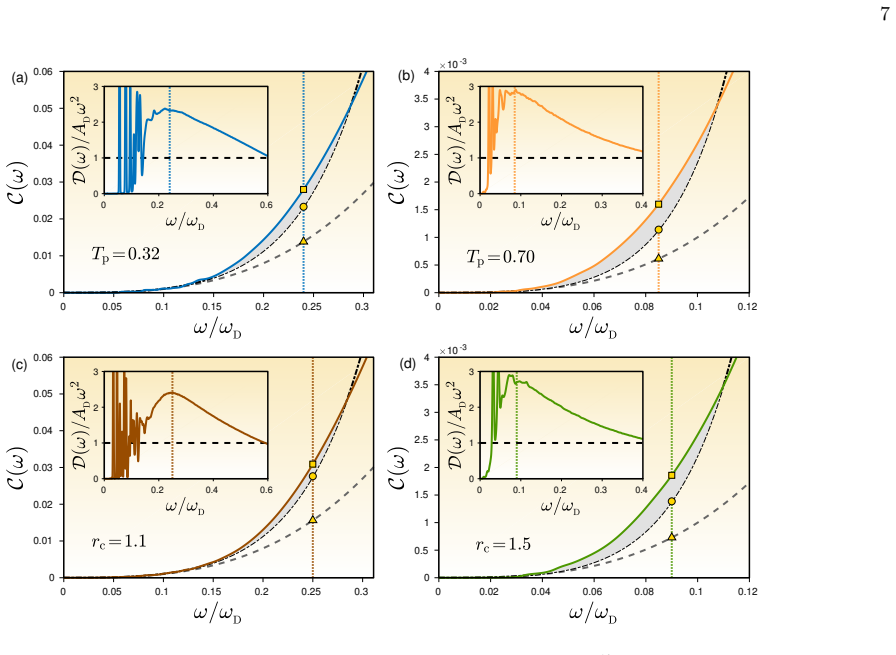
The question then is whether the dispersion-related lengthξidentifies witha 0 or not. To put things on equal footing with crystals, we expand Eq. (1) up to the leading-order (cubic) nonlinearity and present it in the formω(k)/ck=1−Υx 2 +O(x 4), where Υ = 1/96 andξ=a 0. In Fig. 1c-d, we use this Υ value to extractξfrom the leading-order (cubic) nonlinearit...
-
[2]
The po- tential is smoothed at the interaction cutoff as described in [53]
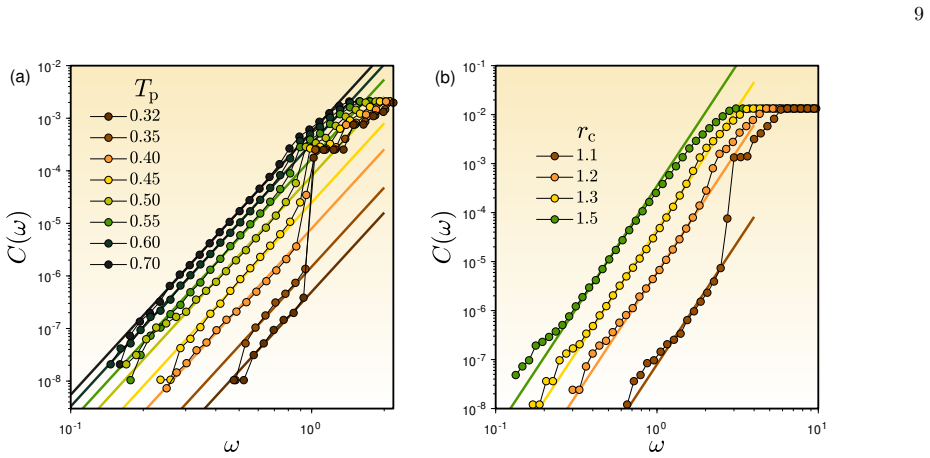
Lennard-Jones FCC crystal We place particles interacting via a standard Lennard- Jones potential in an FCC crystal structure. The po- tential is smoothed at the interaction cutoff as described in [53]. We set the number density atN/V= 1.0467 (in simulation units), resulting in a vanishing hydrostatic 10 -1 10 0 10 1 10 -2 10 -1 10 0 10 1 10 2 10 -1 10 0 1...
-
[3]
Disordered Hookean spring networks We employ disordered networks of relaxed Hookean springs that are derived from binary inverse-power-law (BIPL) glasses, to be described below. Springs are di- luted from the initial dense interaction network to reach a target coordinationzfollowing the algorithm described in [17], which maintains low coordination fluctua...
-
[4]
Details of this model can be found in [53]
Polydisperse inverse-power-law (PIPL) glasses The polydisperse inverse-power-law (PIPL) glass for- mer employs a purely repulsive,∼1/r 10 pairwise poten- tial, where the effective size parameters of the particles are drawn from a distribution that optimizes the applica- bility of the swap-Monte-Carlo algorithm for very deep supercooling [54]. Details of t...
-
[5]
Details about the model can be found in [48]
Binary inverse-power-law (BIPL) glasses The binary inverse-power-law (BIPL) is a 50:50 bi- nary mixture of ‘large’ and ‘small’ particles interacting via the same purely repulsive∼1/r 10 pairwise poten- tial as employed in the PIPL model. Details about the model can be found in [48]. Glasses are quenched from high-temperature equilibrium states at a rate o...
-
[6]
Sticky-sphere binary glasses The so-called sticky-sphere glass is a 50:50 binary mix- ture of ‘large’ and ‘small’ particles interacting via a Lennard-Jones-like pairwise potential with a tunable at- tractive branch controlled by the dimensionless parame- terr c: a largerr c results in a weaker attraction accom- panied by a longer interaction range. All de...
-
[7]
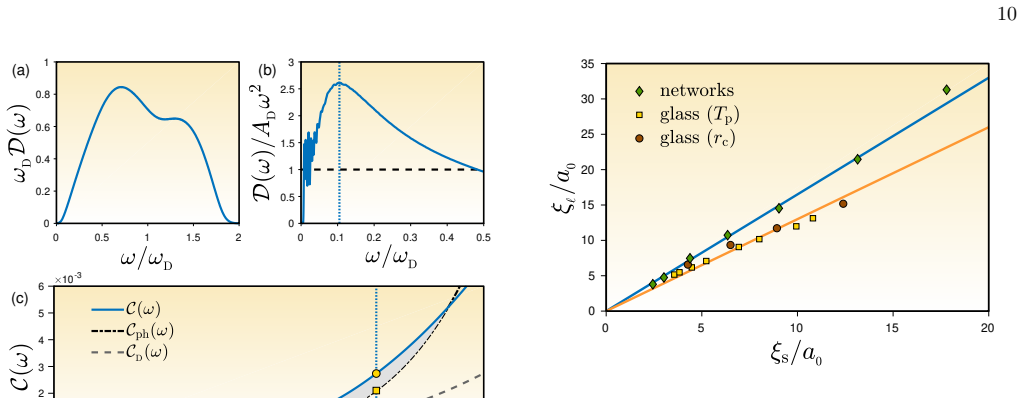
Elastic wave dispersion measurements: 0 5 10 15 20 0 5 10 15 20 25 30 35 FIG. 8.Proportionality of the shear and longitudinal disorder-induced dispersion lengthscales.The longitudinal dispersion lengthξ ℓ is plotted against the shear dispersion length ξs, for our networks, the PIPL model and the sticky spheres model. We findξ ℓ ∼ξ s to a good approximatio...
-
[8]
The Kernel Polynomial Method (KPM) In order to obtain vibrational spectraD(ω) of very large computer glasses, needed for quantitatively resolv- ing the low-frequency vibrational properties, we employ the Kernel Polynomial Method (KPM) as described, e.g., in [59]. The method requires 3 input parameters:ω max is a bound on the maximal vibrational frequency ...
-
[9]
Fur- thermore, it was shown [40] to be closely related to the ‘disorder parameter’γof HET [31, 42, 43]
The disorder quantifierχ The broadly applicable disorder quantifierχhas been studied extensively in previous work; it was shown to control wave attenuation rates in disordered solids [39], to control phonon-band widths in the vibrational spectra of finite-size computer glasses [14], and to follow scaling laws in the vicinity of the unjamming point [60]. F...
-
[10]
Kittel,Introduction to Solid State Physics(Wiley, 2005)
C. Kittel,Introduction to Solid State Physics(Wiley, 2005)
2005
-
[11]
M. A. Ramos,Low-temperature thermal and vibrational properties of disordered solids: a half-century of univer- sal” anomalies” of glasses(World Scientific, 2023)
2023
-
[12]
Buchenau, Y
U. Buchenau, Y. M. Galperin, V. L. Gurevich, and H. R. Schober, Anharmonic potentials and vibrational localiza- tion in glasses, Phys. Rev. B43, 5039 (1991). 14
1991
-
[13]
H. R. Schober and B. B. Laird, Localized low-frequency vibrational modes in glasses, Phys. Rev. B44, 6746 (1991)
1991
-
[14]
V. L. Gurevich, D. A. Parshin, and H. R. Schober, An- harmonicity, vibrational instability, and the boson peak in glasses, Phys. Rev. B67, 094203 (2003)
2003
-
[15]
Wyart, L
M. Wyart, L. E. Silbert, S. R. Nagel, and T. A. Wit- ten, Effects of compression on the vibrational modes of marginally jammed solids, Phys. Rev. E72, 051306 (2005)
2005
-
[16]
Leonforte, R
F. Leonforte, R. Boissi` ere, A. Tanguy, J. P. Wittmer, and J.-L. Barrat, Continuum limit of amorphous elastic bodies. III. three-dimensional systems, Phys. Rev. B72, 224206 (2005)
2005
-
[17]
Wyart, Scaling of phononic transport with connec- tivity in amorphous solids, Europhys
M. Wyart, Scaling of phononic transport with connec- tivity in amorphous solids, Europhys. Lett.89, 64001 (2010)
2010
-
[18]
Lerner, G
E. Lerner, G. D¨ uring, and E. Bouchbinder, Statistics and properties of low-frequency vibrational modes in struc- tural glasses, Phys. Rev. Lett.117, 035501 (2016)
2016
-
[19]
Mizuno, H
H. Mizuno, H. Shiba, and A. Ikeda, Continuum limit of the vibrational properties of amorphous solids, Proc. Natl. Acad. Sci. U.S.A.114, E9767 (2017)
2017
-
[20]
L. Wang, A. Ninarello, P. Guan, L. Berthier, G. Szamel, and E. Flenner, Low-frequency vibrational modes of sta- ble glasses, Nat. Commun.10, 26 (2019)
2019
-
[21]
Lerner and E
E. Lerner and E. Bouchbinder, Low-energy quasilocal- ized excitations in structural glasses, J. Chem. Phys.155, 200901 (2021)
2021
-
[22]
Hu and H
Y.-C. Hu and H. Tanaka, Origin of the boson peak in amorphous solids, Nat. Phys.18, 669 (2022)
2022
-
[23]
Bouchbinder and E
E. Bouchbinder and E. Lerner, Universal disorder- induced broadening of phonon bands: from disordered lattices to glasses, New J. Phys.20, 073022 (2018)
2018
-
[24]
L. E. Silbert, A. J. Liu, and S. R. Nagel, Vibrations and diverging length scales near the unjamming transition, Phys. Rev. Lett.95, 098301 (2005)
2005
-
[25]
Rainone, E
C. Rainone, E. Bouchbinder, and E. Lerner, Pinching a glass reveals key properties of its soft spots, Proc. Natl. Acad. Sci. U.S.A.117, 5228 (2020)
2020
-
[26]
Lerner and E
E. Lerner and E. Bouchbinder, Anomalous linear elastic- ity of disordered networks, Soft Matter19, 1076 (2023)
2023
-
[27]
Van Hove, The occurrence of singularities in the elastic frequency distribution of a crystal, Phys
L. Van Hove, The occurrence of singularities in the elastic frequency distribution of a crystal, Phys. Rev.89, 1189 (1953)
1953
-
[28]
Malinovsky and A
V. Malinovsky and A. Sokolov, The nature of boson peak in raman scattering in glasses, Solid State Commun.57, 757 (1986)
1986
-
[29]
M. A. Ramos, S. Vieira, F. J. Bermejo, J. Dawidowski, H. E. Fischer, H. Schober, M. A. Gonz´ alez, C. K. Loong, and D. L. Price, Quantitative assessment of the effects of orientational and positional disorder on glassy dynamics, Phys. Rev. Lett.78, 82 (1997)
1997
-
[30]
A. J. D. W. A. K. A. Wischnewski, U. Buchenau and J. L. Zarestky, Neutron scattering analysis of low-frequency modes in silica, Philos. Mag. B77, 579 (1998)
1998
-
[31]
Surovtsev, J
N. Surovtsev, J. Wiedersich, A. Batalov, V. Novikov, M. Ramos, and E. R¨ ossler, Inelastic light scattering in B2O3 glasses with different thermal histories, J. Chem. Phys.113, 5891 (2000)
2000
-
[32]
P´ erez-Enciso, M
E. P´ erez-Enciso, M. A. Ramos, and S. Vieira, Low- temperature specific heat of different B2O3 glasses, Phys. Rev. B56, 32 (1997)
1997
-
[33]
Surovtsev, A
N. Surovtsev, A. Shebanin, and M. Ramos, Density of states and light-vibration coupling coefficient in B 2O3 glasses with different thermal history, Phys. Rev. B67, 024203 (2003)
2003
-
[34]
Parisi, On the origin of the boson peak, J
G. Parisi, On the origin of the boson peak, J. Phys. Con- dens. Matter15, S765 (2003)
2003
-
[35]
T. S. Grigera, V. Mart´ ın-Mayor, G. Parisi, and P. Ver- rocchio, Phonon interpretation of the ‘boson peak’ in su- percooled liquids, Nature422, 289 (2003)
2003
-
[36]
Wyart, S
M. Wyart, S. R. Nagel, and T. A. Witten, Geomet- ric origin of excess low-frequency vibrational modes in weakly connected amorphous solids, Europhys. Lett.72, 486 (2005)
2005
-
[37]
Monaco, A
A. Monaco, A. Chumakov, Y.-Z. Yue, G. Monaco, L. Comez, D. Fioretto, W. Crichton, and R. R¨ uffer, Den- sity of vibrational states of a hyperquenched glass, Phys. Rev. Lett.96, 205502 (2006)
2006
-
[38]
Anomalies
G. Baldi, A. Fontana, and G. Monaco, Vibrational dynamics of non-crystalline solids, inLow-Temperature Thermal and Vibrational Properties of Disordered Solids: A Half-Century of Universal “Anomalies” of Glasses (World Scientific, 2023) pp. 177–226
2023
-
[39]
Shintani and H
H. Shintani and H. Tanaka, Universal link between the boson peak and transverse phonons in glass, Nat. Mater. 7, 870 (2008)
2008
-
[40]
Marruzzo, W
A. Marruzzo, W. Schirmacher, A. Fratalocchi, and G. Ruocco, Heterogeneous shear elasticity of glasses: the origin of the boson peak, Sci. Rep.3, 1407 (2013)
2013
-
[41]
DeGiuli, A
E. DeGiuli, A. Laversanne-Finot, G. During, E. Lerner, and M. Wyart, Effects of coordination and pressure on sound attenuation, boson peak and elasticity in amor- phous solids, Soft Matter10, 5628 (2014)
2014
-
[42]
Gonz´ alez-Jim´ enez, T
M. Gonz´ alez-Jim´ enez, T. Barnard, B. Russell, N. Tukachev, U. Javornik, L.-A. Hayes, A. Farrell, S. Guinane, H. Senn, A. Smith,et al., Understanding the emergence of the boson peak in molecular glasses, , Nat. Commun.14, 215 (2023)
2023
-
[43]
G. Ding, E. Ma, F. Jiang, J. Duan, S. Cai, N. Xu, B. Cui, L. Dai, and M. Jiang, Unified theory of phonon in solids with phase diagram of non-debye anomalies, Nat. Physics 21, 1911 (2025)
1911
-
[44]
Festi, E
I. Festi, E. Alfinelli, D. Bessas, F. Caporaletti, A. I. Chumakov, M. Moratalla, M. A. Ramos, M. Rodr´ ıguez- L´ opez, C. Rodr´ ıguez-Tinoco, J. Rodr´ ıguez-Viejo, and G. Baldi, Effect of glass stability on the low frequency vibrations of vapor deposited glasses, Phys. Rev. X16, 021021 (2026)
2026
-
[45]
Lerner and E
E. Lerner and E. Bouchbinder, Boson-peak vibrational modes in glasses feature hybridized phononic and quasilo- calized excitations, J. Chem. Phys.158, 194503 (2023)
2023
-
[46]
Shimada, H
M. Shimada, H. Mizuno, M. Wyart, and A. Ikeda, Spatial structure of quasilocalized vibrations in nearly jammed amorphous solids, Phys. Rev. E98, 060901 (2018)
2018
-
[47]
A. J. Liu, S. R. Nagel, W. Van Saarloos, and M. Wyart, The jamming scenario - an introduction and outlook, in Dynamical heterogeneities in glasses, colloids, and gran- ular media(Oxford University Press, 2011)
2011
-
[48]
Kapteijns, D
G. Kapteijns, D. Richard, E. Bouchbinder, and E. Lerner, Elastic moduli fluctuations predict wave attenuation rates in glasses, J. Chem. Phys.154, 081101 (2021)
2021
-
[49]
Kapteijns, E
G. Kapteijns, E. Bouchbinder, and E. Lerner, Unified quantifier of mechanical disorder in solids, Phys. Rev. E 104, 035001 (2021)
2021
-
[50]
Gonz´ alez-L´ opez, E
K. Gonz´ alez-L´ opez, E. Bouchbinder, and E. Lerner, Vari- ability of mesoscopic mechanical disorder in disordered 15 solids, J. Non-Cryst. Solids604, 122137 (2023)
2023
-
[51]
Lett.73, 892 (2006)
Schirmacher, W., Thermal conductivity of glassy materi- als and the ”boson peak”, Europhys. Lett.73, 892 (2006)
2006
-
[52]
Schirmacher, G
W. Schirmacher, G. Ruocco, and T. Scopigno, Acoustic attenuation in glasses and its relation with the boson peak, Phys. Rev. Lett.98, 025501 (2007)
2007
-
[53]
Klemens, The thermal conductivity of dielectric solids at low temperatures (theoretical), Proceedings of the Royal Society of London
P. Klemens, The thermal conductivity of dielectric solids at low temperatures (theoretical), Proceedings of the Royal Society of London. Series A. Mathematical and Physical Sciences208, 108 (1951)
1951
-
[54]
Moriel, G
A. Moriel, G. Kapteijns, C. Rainone, J. Zylberg, E. Lerner, and E. Bouchbinder, Wave attenuation in glasses: Rayleigh and generalized-rayleigh scattering scaling, J. Chem. Phys.151, 104503 (2019)
2019
-
[55]
A. I. Chumakov, G. Monaco, A. Monaco, W. A. Crich- ton, A. Bosak, R. R¨ uffer, A. Meyer, F. Kargl, L. Comez, D. Fioretto, H. Giefers, S. Roitsch, G. Wortmann, M. H. Manghnani, A. Hushur, Q. Williams, J. Balogh, K. Parli´ nski, P. Jochym, and P. Piekarz, Equivalence of the boson peak in glasses to the transverse acoustic van hove singularity in crystals, P...
2011
-
[56]
A. I. Chumakov, G. Monaco, X. Han, L. Xi, A. Bosak, L. Paolasini, D. Chernyshov, and V. Dyadkin, Relation between the boson peak in glasses and van hove singu- larity in crystals, Philos. Mag.96, 743 (2016)
2016
-
[57]
Kapteijns, E
G. Kapteijns, E. Bouchbinder, and E. Lerner, Universal nonphononic density of states in 2D, 3D, and 4D glasses, Phys. Rev. Lett.121, 055501 (2018)
2018
-
[58]
Richard, K
D. Richard, K. Gonz´ alez-L´ opez, G. Kapteijns, R. Pater, T. Vaknin, E. Bouchbinder, and E. Lerner, Universality of the nonphononic vibrational spectrum across different classes of computer glasses, Phys. Rev. Lett.125, 085502 (2020)
2020
-
[59]
Moriel, E
A. Moriel, E. Lerner, and E. Bouchbinder, Experimental evidence for theω 4 tail of the nonphononic spectra of glasses, J. Appl. Phys.136, 225105 (2024)
2024
-
[60]
Rainone, E
C. Rainone, E. Bouchbinder, and E. Lerner, Statistical mechanics of local force dipole responses in computer glasses, J. Chem. Phys.152, 194503 (2020)
2020
-
[61]
Moriel, E
A. Moriel, E. Lerner, and E. Bouchbinder, Boson peak in the vibrational spectra of glasses, Phys. Rev. Res.6, 023053 (2024)
2024
-
[62]
Lerner, Mechanical properties of simple computer glasses, J
E. Lerner, Mechanical properties of simple computer glasses, J. Non-Cryst. Solids522, 119570 (2019)
2019
-
[63]
Ninarello, L
A. Ninarello, L. Berthier, and D. Coslovich, Models and algorithms for the next generation of glass transition studies, Phys. Rev. X7, 021039 (2017)
2017
-
[64]
Karmakar, E
S. Karmakar, E. Lerner, I. Procaccia, and J. Zylberg, Effect of the interparticle potential on the yield stress of amorphous solids, Phys. Rev. E83, 046106 (2011)
2011
-
[65]
Gonz´ alez-L´ opez, M
K. Gonz´ alez-L´ opez, M. Shivam, Y. Zheng, M. P. Cia- marra, and E. Lerner, Mechanical disorder of sticky- sphere glasses. I. effect of attractive interactions, Phys. Rev. E103, 022605 (2021)
2021
-
[66]
S. S. Schoenholz, C. P. Goodrich, O. Kogan, A. J. Liu, and S. R. Nagel, Stability of jammed packings II: the transverse length scale, Soft Matter9, 11000 (2013)
2013
-
[67]
Baumgarten, D
K. Baumgarten, D. V˚ agberg, and B. P. Tighe, Nonlocal elasticity near jamming in frictionless soft spheres, Phys. Rev. Lett.118, 098001 (2017)
2017
-
[68]
Y. M. Beltukov, C. Fusco, D. A. Parshin, and A. Tanguy, Boson peak and Ioffe-Regel criterion in amorphous sili- conlike materials: The effect of bond directionality, Phys. Rev. E93, 023006 (2016)
2016
-
[69]
J. A. Giannini, E. Lerner, F. Zamponi, and M. L. Man- ning, Scaling regimes and fluctuations of observables in computer glasses approaching the unjamming transition, J. Chem. Phys.160, 034502 (2024)
2024
discussion (0)
Sign in with ORCID, Apple, or X to comment. Anyone can read and Pith papers without signing in.