Recognition: unknown
DualTCN: A Physics-Constrained Temporal Convolutional Network for 2 Time-Domain Marine CSEM Inversion
Pith reviewed 2026-05-08 16:47 UTC · model grok-4.3
The pith
DualTCN regresses four earth-model parameters from marine CSEM transients and reconstructs conductivity profiles via a differentiable soft-step decoder to deliver faster and more accurate inversion than local optimization methods.
A machine-rendered reading of the paper's core claim, the machinery that carries it, and where it could break.
Core claim
DualTCN is a deep-learning framework that inverts time-domain marine CSEM transients by regressing the four parameters σ1, σ2, d1, d2 of a layered earth model and then reconstructing the conductivity-depth profile with a differentiable soft-step decoder; the optimized TCN encoder with late-time branch and auxiliary seafloor-depth head yields a 25.3 percent loss reduction over baselines, mean R-squared of 0.877, and up to 21,000-fold reduction in compute time relative to Levenberg-Marquardt or L-BFGS-B while remaining robust to noise through curriculum amplitude augmentation.
What carries the argument
DualTCN architecture: a Temporal Convolutional Network encoder paired with a late-time branch, an auxiliary seafloor-depth head, and a differentiable soft-step decoder that converts the four regressed parameters into a conductivity-depth profile.
If this is right
- Inversion speed reaches 3.5 milliseconds per sample on an A100 GPU, making large-scale or repeated inversions practical.
- Mean predictive accuracy across the four parameters reaches R-squared of 0.877, with the strongest result on the second-layer conductivity.
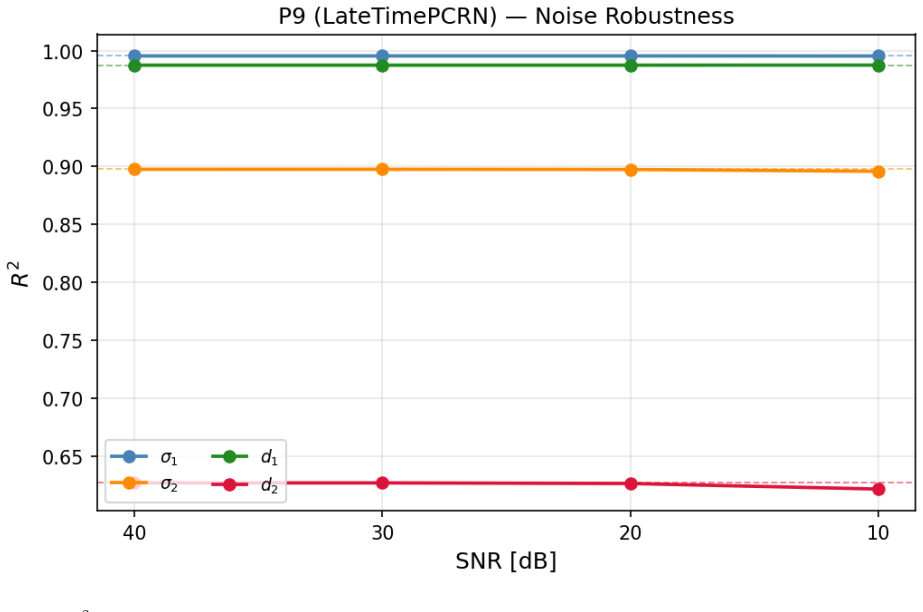
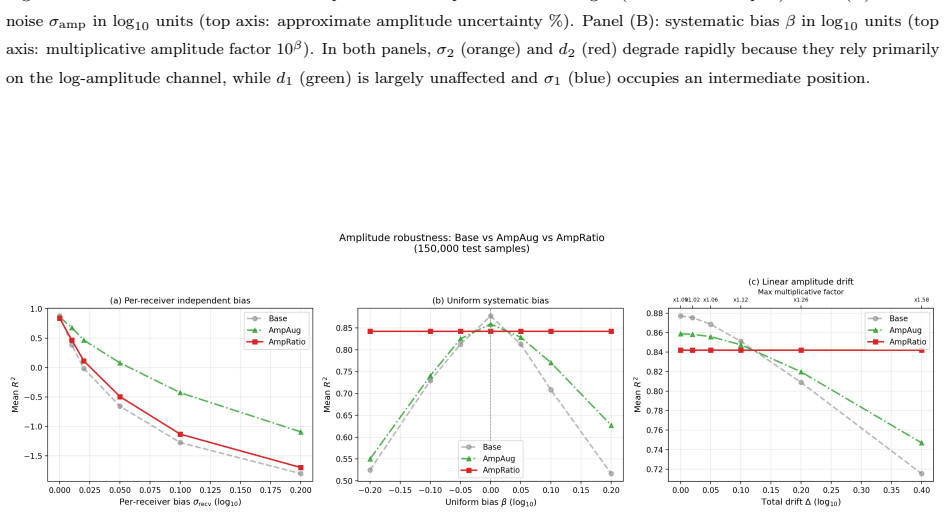
- Curriculum-based amplitude augmentation raises noise robustness so that mean R-squared remains 0.858 even at plus or minus 2 percent random error.
- Monte Carlo dropout supplies uncertainty estimates that are well-calibrated for shallow conductivity but require post-hoc scaling for deeper thickness.
- The same network structure generalizes to three-layer models and recovers basement conductivity with R-squared approximately 0.88.
Where Pith is reading between the lines
- The parameter-regression-plus-decoder pattern could be adapted to other electromagnetic or potential-field inversion tasks that currently rely on iterative local optimization.
- Real-time marine survey interpretation becomes feasible if the network is embedded in acquisition hardware or shipboard processing pipelines.
- The thin-layer resolution limit (R-squared approximately 0.23) indicates that multi-offset or multi-frequency data would be needed to extend the method beyond simple layered cases.
- Hybrid workflows that use the fast DualTCN output as a starting model for a final physics-based refinement step could combine speed with higher fidelity on complex geology.
Load-bearing premise
The true subsurface can be adequately represented by a two-layer model whose conductivity and thickness parameters are recovered accurately enough that the soft-step decoder produces profiles whose forward responses match the input data within noise levels at the offsets used.
What would settle it
Generate synthetic CSEM transients from a known three-dimensional or finely layered conductivity model, run DualTCN inversion, then forward-model the recovered two-layer parameters and observe whether the mismatch between predicted and input data exceeds the level attributable to added noise.
Figures




read the original abstract
DualTCN is the first deep-learning framework for inverting time-domain marine controlled-source electromagnetic (MCSEM) transient data. Moving away from traditional subsurface discretization, the framework regresses four earth-model parameters -- $\sigma_1$, $\sigma_2$, $d_1$, $d_2$ -- and reconstructs conductivity-depth profiles using a differentiable soft-step decoder. The optimized architecture (379K parameters) features a Temporal Convolutional Network (TCN) encoder paired with a late-time branch and an auxiliary seafloor-depth head. This design achieves a 25.3\% loss reduction over baseline models, with high predictive accuracy ($R^2 = 0.898$ for $\sigma_2$) and an inversion speed of 3.5~ms per sample on an A100 GPU. The framework demonstrates high robustness to noise through curriculum-based amplitude augmentation, maintaining a mean $\bar{R}^2$ of 0.858 at $\pm2\%$ random amplitude error, compared to $0.363$ without augmentation. DualTCN generalizes effectively to three-layer extensions (seawater/resistive layer/basement), accurately resolving basement conductivity ($R^2 \approx 0.88$), though thin-layer resolution remains a physical limitation ($R^2 \approx 0.23$). In comparative benchmarks, DualTCN significantly outperforms traditional local optimization methods like Levenberg-Marquardt and L-BFGS-B, yielding a mean $\bar{R}^2 = 0.877$ versus 0.129-0.439 for multi-start baselines, while operating at up to 21,000$\times$ lower computational cost. Finally, the framework incorporates uncertainty quantification via Monte Carlo (MC) Dropout. While well-calibrated for $\sigma_1$ (PICP90 = 0.944), inherent signal limitations at short offsets (200m) lead to under-coverage for $d_2$ (PICP90 = 0.572), which can be mitigated through post-hoc temperature scaling or split conformal prediction.
Editorial analysis
A structured set of objections, weighed in public.
Referee Report
Summary. The manuscript introduces DualTCN, the first deep-learning framework for inverting time-domain marine controlled-source electromagnetic (MCSEM) transient data. It regresses four earth-model parameters (σ₁, σ₂, d₁, d₂) from TCN-encoded transients and reconstructs conductivity-depth profiles via a differentiable soft-step decoder, augmented by a late-time branch and auxiliary seafloor-depth head. The 379K-parameter model reports a 25.3% loss reduction over baselines, R²=0.898 for σ₂, mean R²=0.877, 3.5 ms inference (up to 21,000× faster than Levenberg-Marquardt or L-BFGS-B), noise robustness via curriculum amplitude augmentation (mean R²=0.858 at ±2% error), generalization to three-layer models (basement R²≈0.88), and uncertainty quantification via MC Dropout (PICP90=0.944 for σ₁ but 0.572 for d₂).
Significance. If the central claims hold after addressing decoder fidelity, this would be a significant contribution to physics-constrained ML for geophysical inversion. The explicit speed-accuracy tradeoff versus local optimization methods, combined with curriculum training for robustness and MC-Dropout uncertainty, addresses practical bottlenecks in marine CSEM workflows. The differentiable decoder approach to enforcing two-layer (and extensible three-layer) physics without full discretization is a clear strength that could generalize to other transient EM problems.
major comments (2)
- [Methods (differentiable soft-step decoder)] Methods (differentiable soft-step decoder description): The headline metrics (25.3% loss reduction, R²=0.898 for σ₂, mean R²=0.877) rest on the decoder accurately mapping regressed parameters to conductivity profiles whose forward responses match the data-generating two-layer model to within the 2% noise level. At the 200 m offsets used, late-time transients are sensitive to interface location and sharpness; no quantitative bound on decoder approximation error (e.g., L2 mismatch in reconstructed vs. true forward responses or sensitivity to transition width) is supplied. This must be added, as any systematic mismatch would render the reported accuracy and robustness figures optimistic.
- [Results (three-layer generalization)] Results (three-layer extension and thin-layer resolution): The claim that thin-layer R²≈0.23 is purely a physical limitation (rather than decoder-induced) requires an ablation that compares the soft-step decoder against direct parameter regression or a hard-step baseline on the same short-offset data. Without this, it remains unclear whether the reported basement conductivity accuracy (R²≈0.88) generalizes reliably or is inflated by the two-layer training distribution.
minor comments (3)
- [Abstract and Results] Abstract and §4: The PICP90=0.572 for d₂ is correctly flagged as under-coverage due to short-offset signal limits; the post-hoc mitigation via temperature scaling or split conformal prediction should be shown with before/after calibration plots for all four parameters.
- [Experimental setup] Experimental details: Full specification of data-generation procedure (including exact offset ranges, time windows, and how the 2% amplitude noise is sampled during curriculum training) and train/validation/test splits is required for reproducibility of the 25.3% loss reduction.
- [Architecture] Notation: The auxiliary seafloor-depth head is mentioned but its loss weighting relative to the main parameter regression loss is not stated; clarify in the architecture diagram or equations.
Simulated Author's Rebuttal
We thank the referee for the constructive and detailed comments on our manuscript introducing DualTCN for time-domain marine CSEM inversion. The feedback highlights important aspects of decoder fidelity and generalization that we will address to strengthen the paper. Below we provide point-by-point responses to the major comments.
read point-by-point responses
-
Referee: Methods (differentiable soft-step decoder description): The headline metrics (25.3% loss reduction, R²=0.898 for σ₂, mean R²=0.877) rest on the decoder accurately mapping regressed parameters to conductivity profiles whose forward responses match the data-generating two-layer model to within the 2% noise level. At the 200 m offsets used, late-time transients are sensitive to interface location and sharpness; no quantitative bound on decoder approximation error (e.g., L2 mismatch in reconstructed vs. true forward responses or sensitivity to transition width) is supplied. This must be added, as any systematic mismatch would render the reported accuracy and robustness figures optimistic.
Authors: We agree that an explicit quantitative bound on the soft-step decoder's approximation error is necessary to support the headline metrics and ensure they are not optimistic. In the revised manuscript, we will add to the Methods section a dedicated analysis that computes the L2 mismatch between forward-modeled responses of the decoded conductivity profiles and the ground-truth two-layer models, along with a sensitivity study varying the transition width parameter. This will confirm that the decoder error remains below the 2% noise level used in training and evaluation. revision: yes
-
Referee: Results (three-layer extension and thin-layer resolution): The claim that thin-layer R²≈0.23 is purely a physical limitation (rather than decoder-induced) requires an ablation that compares the soft-step decoder against direct parameter regression or a hard-step baseline on the same short-offset data. Without this, it remains unclear whether the reported basement conductivity accuracy (R²≈0.88) generalizes reliably or is inflated by the two-layer training distribution.
Authors: We acknowledge that an ablation is required to rigorously separate physical limitations from potential decoder effects in the three-layer generalization results. We will add this ablation to the revised Results section, comparing the soft-step decoder against (i) direct regression of the four parameters without any decoder and (ii) a hard-step (discontinuous) baseline, all evaluated on the same short-offset three-layer test data. The outcomes will be used to substantiate that the thin-layer R²≈0.23 reflects a physical resolution limit at 200 m offsets rather than decoder bias, while the basement conductivity R²≈0.88 remains reliable. revision: yes
Circularity Check
Derivation chain is self-contained; no load-bearing steps reduce to inputs by construction
full rationale
The framework regresses four parameters (σ1, σ2, d1, d2) via a TCN encoder and reconstructs profiles with a differentiable soft-step decoder; reported metrics (R²=0.898 for σ2, 25.3% loss reduction, mean R²=0.877) are computed on held-out test data after supervised training, not by equating outputs to fitted inputs. The physics constraint is architectural (decoder enforces two-layer structure) rather than definitional. No self-citations, uniqueness theorems, or ansatzes are invoked to force the central claims; curriculum augmentation and MC dropout are standard techniques evaluated externally. The derivation therefore remains independent of its own fitted values.
Axiom & Free-Parameter Ledger
free parameters (1)
- TCN network weights and hyperparameters
axioms (2)
- domain assumption Subsurface conductivity structure can be represented by two layers with parameters σ1, σ2, d1, d2
- domain assumption The soft-step decoder produces a sufficiently accurate continuous conductivity profile
invented entities (2)
-
Differentiable soft-step decoder
no independent evidence
-
Late-time branch
no independent evidence
Reference graph
Works this paper leans on
-
[1]
Inversion algorithms for large-scale geophysical electromagnetic measurements. Inverse Problems 28, 123012. doi:10.1088/0266-5611/28/12/123012. Angelopoulos, A.N., Bates, S.,
-
[2]
Conformal prediction: A gentle introduction. Foundations and Trends in Machine Learning 16, 494–591. doi:10.1561/2200000101. 20 Araya-Polo, M., Jennings, J., Adler, A., Dahlke, T.,
-
[3]
Deep-learning tomography. The Leading Edge 37, 58–66. doi:10.1190/tle37010058.1. Ardizzone, L., Kruse, J., Wirkert, S., Rahner, D., Pellegrini, E.W., Klessen, R.S., Maier-Hein, L., Rother, C., Köthe, U.,
- [4]
-
[5]
Geophysical Journal International 237, 1–15
Unsupervised deep learning magnetotelluric inversion. Geophysical Journal International 237, 1–15. doi:10.1093/gji/ggae005. Byrd, R.H., Lu, P., Nocedal, J., Zhu, C.,
-
[6]
A limited memory algorithm for bound constrained optimization. SIAM J. Sci. Comput. 16, 1190–1208. doi:10.1137/0916069. Colombo, D., Turkoglu, E., Li, W., Sandoval-Curiel, E., Rovetta, D.,
-
[7]
Physics-driven deep learning electromagnetic data inversion with applications to subsurface imaging. Geophysics 86, B225–B245. doi:10.1190/geo2020-0759.1. Constable, S.,
-
[8]
Ten years of marine CSEM for hydrocarbon exploration. Geophysics 75, 75A67–75A81. doi:10.1190/1.3483451. Constable, S., Srnka, L.J.,
-
[9]
An introduction to marine controlled-source electromagnetic methods for hydrocarbon exploration. Geophysics 72, WA3–WA12. doi:10.1190/1.2432483. Constable, S.C., Parker, R.L., Constable, C.G.,
-
[10]
Occam’s inversion: A practical algorithm for generating smooth models from electromagnetic sounding data. Geophysics 52, 289–300. doi:10.1190/1.1442303. Gal, Y., Ghahramani, Z.,
-
[11]
Ensemble Kalman methods for inverse problems. Inverse Problems 29, 045001. doi:10.1088/0266-5611/29/4/045001. Key, K.,
-
[12]
1D inversion of multicomponent, multifrequency marine CSEM data: Methodology and synthetic studies for resolving thin resistive layers. Geophysics 74, F9–F20. doi:10.1190/1.3058434. Key, K.,
-
[13]
Surveys in Geophysics 33, 135–167
Marine electromagnetic studies of seafloor resources and tectonics. Surveys in Geophysics 33, 135–167. doi:10.1007/s10712-011-9139-x. 21 Lakshminarayanan, B., Pritzel, A., Blundell, C.,
-
[14]
Simple and Scalable Predictive Uncertainty Estimation using Deep Ensembles
Simple and scalable predictive uncertainty estimation using deep ensembles, in: Advances in Neural Information Processing Systems (NeurIPS), pp. 6402–6413. [Online]. Available:https://arxiv.org/abs/1612.01474. LeCun, Y., Bengio, Y., Hinton, G.,
-
[15]
Deep learning. Nature 521, 436–444. doi:10.1038/nature14539. Li, G., et al.,
-
[16]
Geophysical Prospecting doi:10.1111/1365-2478.13622
One-dimensional deep learning inversion of marine controlled-source electromagnetic data. Geophysical Prospecting doi:10.1111/1365-2478.13622. early access. Liu, W., Wang, H., Xi, Z., Zhou, L.,
-
[17]
Physics-driven deep learning inversion with application to transient electromagnetic data. IEEE Trans. Geosci. Remote Sens. 60, 5901212. doi:10.1109/TGRS.2021.3120138. Moghadas, D.,
-
[18]
Near Surface Geophysics 18, 11–32
One-dimensional deep learning inversion of electromagnetic induction data using convolutional neural network. Near Surface Geophysics 18, 11–32. doi:10.1002/nsg.12030. Moré, J.J.,
-
[19]
The Levenberg–Marquardt algorithm: Implementation and theory, in: Numerical Analysis. Springer. volume 630 ofLecture Notes in Mathematics, pp. 105–116. doi:10.1007/BFb0067700. Papamakarios, G., Nalisnick, E., Rezende, D.J., Mohamed, S., Lakshminarayanan, B.,
-
[20]
Geophysical Journal International 218, 817–832
Deep learning electromagnetic inversion with convolutional neural networks. Geophysical Journal International 218, 817–832. doi:10.1093/gji/ggz204. Puzyrev, V., Swidinsky, A.,
-
[21]
Computers & Geosciences 149, 104681
Inversion of 1D frequency- and time-domain electromagnetic data with convolutional neural networks. Computers & Geosciences 149, 104681. doi:10.1016/j.cageo.2020.104681. Raissi, M., Perdikaris, P., Karniadakis, G.E.,
-
[22]
Physics-informed neural networks: A deep learning framework for solving forward and inverse problems involving nonlinear partial differential equations. J. Comput. Phys. 378, 686–707. doi:10.1016/j.jcp.2018.10.045. Reichstein, M., Camps-Valls, G., Stevens, B., Jung, M., Denzler, J., Carvalhais, N., Prabhat,
-
[23]
Geophysical Journal International 235, 2231–2247
Deep image prior for magnetotelluric inversion. Geophysical Journal International 235, 2231–2247. doi:10.1093/gji/ggad345. Werthmüller, D.,
-
[24]
An open-source full 3D electromagnetic modeler for 1D VTI media in Python: empymod. Geophysics 82, WB9–WB19. doi:10.1190/geo2016-0626.1. 22 Zhang, Z., Hu, Z.,
-
[25]
Physics-driven deep-learning for marine CSEM data inversion. J. Appl. Geophys. 229, 105497. doi:10.1016/j.jappgeo.2024.105497. Zhang, Z., Huang, J., Wan, L.,
-
[26]
3-D CSEM data inversion using deep convolutional neural networks: A feasibility study. Geophysics 89, E55–E68. doi:10.1190/geo2023-0201.1. Zhu, C., Byrd, R.H., Lu, P., Nocedal, J.,
-
[27]
Algorithm 778: L-BFGS-B: Fortran subroutines for large-scale bound-constrained optimization. ACM Trans. Math. Softw. 23, 550–560. doi:10.1145/279232.279236. 23 Figure 3: DualTCN predictions on six test samples. Left: normalised E-field traces from four receivers. Right: true profile (blue) and prediction (red dashed). 24 Figure 4: Absolute d2 prediction e...
discussion (0)
Sign in with ORCID, Apple, or X to comment. Anyone can read and Pith papers without signing in.