Recognition: unknown
Characterizing the quark-hadron mixed phase in compact star cores : sensitivity to nuclear saturation and quark-model parameters at finite-temperature
Pith reviewed 2026-05-08 16:01 UTC · model grok-4.3
The pith
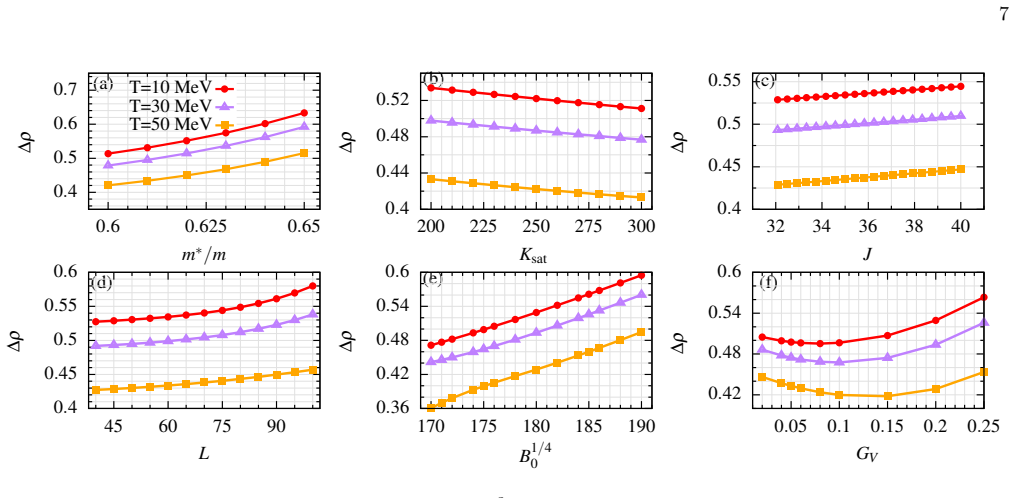
The width of the quark-hadron mixed phase is controlled mainly by the effective nucleon mass and symmetry energy, especially at higher temperatures.
A machine-rendered reading of the paper's core claim, the machinery that carries it, and where it could break.
Core claim
Using the Gibbs construction for global charge neutrality, the authors demonstrate that the width of the quark-hadron mixed phase in hot dense matter is predominantly determined by the effective nucleon mass and the symmetry energy coefficient. The incompressibility and the slope of the symmetry energy exert comparatively minor effects, particularly as temperature increases. Rising temperature shrinks the mixed phase region and softens the equation of state within the coexistence area due to the constraints of phase equilibrium. These modifications appear in the speed of sound and trace anomaly, while changes in symmetry energy, effective mass, and quark vector coupling alter the transition,
What carries the argument
Gibbs construction with global charge neutrality applied to the quark-hadron coexistence region, using relativistic mean-field parametrizations for hadrons and bag model with vector term for quarks.
If this is right
- Increasing temperature reduces the width of the mixed phase and softens the equation of state in the coexistence region.
- The effective mass and symmetry energy have the strongest impact on the mixed phase structure and hybrid star properties.
- Strong vector repulsion in the quark model is necessary to achieve high maximum masses consistent with pulsar observations and NICER data.
- Weaker vector repulsion favors more compact low-mass hybrid star configurations.
- Finite temperature enhances radius jumps across the mixed phase in the stellar structure.
Where Pith is reading between the lines
- The sensitivity to effective mass suggests that improved constraints on nuclear matter from terrestrial experiments could narrow the allowed range for hybrid star interiors.
- Temperature dependence implies that the phase structure in proto-neutron stars or merger remnants may differ markedly from cold neutron stars.
- The requirement for vector repulsion links the quark model parameters to possible signals in heavy ion collisions at high densities.
Load-bearing premise
The Gibbs construction assuming global charge neutrality is taken to accurately represent the mixed phase, and the specific relativistic mean-field and bag model parametrizations are assumed valid throughout the parameter space and temperature range examined.
What would settle it
A measurement of hybrid star radii or maximum masses that shows no significant dependence on the effective nucleon mass or symmetry energy, or an absence of radius discontinuities at the predicted transition densities, would falsify the claimed dominance of these parameters.
Figures




read the original abstract
A thorough knowledge of the quark-hadron phase transition in hot and dense matter is essential for constraining the equation of state of neutron stars. In this work, we study the thermodynamics of the quark-hadron mixed phase at finite temperature using the Gibbs construction and examine its impact on hybrid star matter. We systematically explore the role of nuclear saturation properties, including the effective nucleon mass, incompressibility, symmetry energy coefficient, and its slope, together with quark matter parameters such as the bag constant and the vector coupling strength. We find that the width of the mixed phase is mainly controlled by the effective mass and symmetry energy, while the roles of incompressibility and symmetry energy slope are comparatively weak, particularly at higher temperatures. Thermal effects substantially modify the phase structure: increasing temperature reduces the mixed-phase width and softens the equation of state in the coexistence region due to Gibbs phase equilibrium constraints. These effects are reflected in the behavior of the speed of sound, the trace anomaly, and its derivative. Variations in the symmetry energy, effective mass, and quark parameters significantly affect the hadron-quark transition, stellar radii, and maximum mass, while finite temperature softens the equation of state and enhances radius jumps in the mixed phase. Strong vector repulsion is essential to reconcile massive pulsar observations with NICER constraints, whereas weaker repulsion favors more compact, low-mass configurations.
Editorial analysis
A structured set of objections, weighed in public.
Referee Report
Summary. The manuscript studies the quark-hadron mixed phase in hot dense matter for compact stars via the Gibbs construction with global charge neutrality. It systematically varies nuclear saturation parameters (effective nucleon mass, incompressibility, symmetry energy coefficient J and slope L) together with quark parameters (bag constant B and vector coupling strength) at finite temperature, reporting that the mixed-phase width is primarily controlled by effective mass and J while incompressibility and L play weaker roles especially at higher T. Thermal effects are shown to narrow the coexistence region, soften the EOS, alter sound speed and trace anomaly, and influence hybrid-star radii and maximum masses, with strong vector repulsion needed to satisfy massive pulsar and NICER constraints.
Significance. If the central sensitivities hold under the stated construction, the work offers a useful parameter survey linking nuclear saturation properties and quark-model choices to finite-T phase structure and observable stellar properties. The explicit mapping of how temperature reduces mixed-phase width and enhances radius jumps provides concrete trends that could help interpret future multi-messenger data once the construction dependence is clarified.
major comments (3)
- [Methods] Methods (Gibbs construction section): The central claim that mixed-phase width is mainly controlled by effective mass and symmetry energy is obtained exclusively under the Gibbs construction with global charge neutrality. The manuscript does not quantify the surface-tension or Coulomb-energy threshold at which the mixed phase collapses to a Maxwell-like sharp transition (as discussed in many hybrid-star studies); if that threshold is low, the reported parameter sensitivities become construction-specific rather than general.
- [Results] Results on EOS and stellar structure: All reported effects on sound speed, trace anomaly, radius jumps, and maximum mass are tied to the finite-width mixed phase produced by the Gibbs construction. Without an explicit comparison to the Maxwell construction or an estimate of the surface tension value that would eliminate the coexistence region, the strength of the conclusion that thermal effects 'substantially modify the phase structure' cannot be assessed independently of the construction choice.
- [Results] Parameter variation procedure: The abstract states that the width is 'mainly controlled by the effective mass and symmetry energy' while incompressibility and L are 'comparatively weak.' The manuscript should show the explicit functional dependence (e.g., partial derivatives or tabulated widths versus each parameter at fixed T) rather than qualitative trends, and confirm that each variation preserves the saturation properties of the RMF parametrization.
minor comments (3)
- [Introduction] Notation: Define all RMF parameters (e.g., the specific form of the effective mass and the vector coupling G_v) at first use and ensure consistent symbols between text, tables, and figures.
- [Introduction] References: Add citations to recent finite-temperature hybrid-star studies that employ both Gibbs and Maxwell constructions for direct comparison.
- [Results] Figures: Ensure that all curves in the EOS, sound-speed, and mass-radius plots are labeled with the exact parameter values used and include error bands or sensitivity ranges where applicable.
Simulated Author's Rebuttal
We thank the referee for the detailed and constructive report. The comments highlight important aspects of the construction dependence and the presentation of parameter sensitivities. We address each major comment below and will revise the manuscript to improve clarity and provide additional quantitative details.
read point-by-point responses
-
Referee: [Methods] Methods (Gibbs construction section): The central claim that mixed-phase width is mainly controlled by effective mass and symmetry energy is obtained exclusively under the Gibbs construction with global charge neutrality. The manuscript does not quantify the surface-tension or Coulomb-energy threshold at which the mixed phase collapses to a Maxwell-like sharp transition (as discussed in many hybrid-star studies); if that threshold is low, the reported parameter sensitivities become construction-specific rather than general.
Authors: We acknowledge that all results, including the dominant role of effective mass and symmetry energy, are obtained within the Gibbs construction with global charge neutrality. In the revised manuscript we will add a dedicated paragraph in the Methods section discussing the surface tension and Coulomb energy contributions. We will note that sufficiently large surface tension can suppress the mixed phase in favor of a sharp Maxwell transition and cite the relevant hybrid-star literature. This addition will explicitly state that the reported sensitivities apply to the Gibbs framework employed here. revision: yes
-
Referee: [Results] Results on EOS and stellar structure: All reported effects on sound speed, trace anomaly, radius jumps, and maximum mass are tied to the finite-width mixed phase produced by the Gibbs construction. Without an explicit comparison to the Maxwell construction or an estimate of the surface tension value that would eliminate the coexistence region, the strength of the conclusion that thermal effects 'substantially modify the phase structure' cannot be assessed independently of the construction choice.
Authors: We agree that the thermal narrowing of the mixed phase and the associated modifications to the speed of sound, trace anomaly, and stellar properties are specific to the finite-width coexistence region allowed by the Gibbs construction. In the revision we will insert a short comparative discussion in the Results section that contrasts the Gibbs case with the Maxwell construction (where the transition is discontinuous). We will reference existing studies that compare the two constructions and clarify that our statements on thermal softening apply to the extended mixed phase realized under global neutrality. No new numerical Maxwell runs will be performed, but the added text will allow readers to gauge the construction dependence. revision: partial
-
Referee: [Results] Parameter variation procedure: The abstract states that the width is 'mainly controlled by the effective mass and symmetry energy' while incompressibility and L are 'comparatively weak.' The manuscript should show the explicit functional dependence (e.g., partial derivatives or tabulated widths versus each parameter at fixed T) rather than qualitative trends, and confirm that each variation preserves the saturation properties of the RMF parametrization.
Authors: The original manuscript demonstrates the dependencies through figures that vary one parameter at a time. To make the functional dependence explicit we will add a table in the revised version that reports the mixed-phase width for several discrete values of the effective nucleon mass, symmetry energy coefficient J, incompressibility, and slope L, all evaluated at fixed temperatures (T = 0, 20, 50 MeV). We will also insert a sentence confirming that each variation is performed by adjusting the corresponding RMF coupling constants while keeping the saturation density, binding energy, and other saturation properties fixed at their reference values. This will replace purely qualitative statements with tabulated quantitative trends. revision: yes
Circularity Check
No significant circularity detected
full rationale
The paper performs a standard parameter-variation study within the Gibbs construction for the mixed phase, using RMF for hadrons and bag+vector model for quarks. The reported sensitivities of mixed-phase width to effective mass and symmetry energy are direct computational outcomes of varying these externally motivated inputs; they are not defined by or reduced to the inputs themselves. No load-bearing self-citations, self-definitional equations, or fitted quantities renamed as predictions appear in the abstract or described methods. The derivation chain relies on established thermodynamic constructions without circular reduction.
Axiom & Free-Parameter Ledger
free parameters (6)
- effective nucleon mass
- incompressibility
- symmetry energy coefficient
- symmetry energy slope
- bag constant
- vector coupling strength
axioms (2)
- domain assumption Gibbs phase equilibrium: equal pressure, baryon chemical potential, and temperature between hadronic and quark phases
- domain assumption Global charge neutrality and beta equilibrium throughout the star
Reference graph
Works this paper leans on
-
[1]
This source represents the lightest neutron star known to date and has been suggested as a possible can- didate for an exotic compact object, such as a strange quark star
has been inferred to have a remarkably low mass, M= 0.77 +0.20 −0.17, M⊙, and a small radius,R= 10.4 +0.86 −0.78 km. This source represents the lightest neutron star known to date and has been suggested as a possible can- didate for an exotic compact object, such as a strange quark star. Such observations strongly motivate a care- ful examination of phase...
-
[2]
+ b 3(gσσ0)3 + c 4(gσσ0)4 + ζ 8(gωω0)4 + 3Λω(gρgωρ03ω0)2, PH = 1 6π2 X i γi Z ∞ 0 dk k4 p k2 +m ∗2 i (fi(k, T) +f ¯i(k, T)) + 1 6π2 X l γl Z ∞ 0 dk k4 p k2 +m 2 l (fb(k, T) +f ¯b(k, T)) +1 2(m2 ωω2 0 +m 2 ρρ2 03 −m 2 σσ2 0)− b 3(gσσ0)3 − c 4(gσσ0)4 + ζ 24(gωω0)4 + Λω(gρgωρ03ω0)2, sH = 1 T PH +ε H − X i µiρi ! . (6) The saturation properties atρ 0, namely ...
-
[3]
6 shows the impact of the symmetric nuclear mat- ter parameters,m ∗/mandK sat, on hybrid star prop- erties for weak (G V = 0.02) and strong (G V = 0.2) vector interactions
Effect of symmetric nuclear matter parameters Fig. 6 shows the impact of the symmetric nuclear mat- ter parameters,m ∗/mandK sat, on hybrid star prop- erties for weak (G V = 0.02) and strong (G V = 0.2) vector interactions. Panels (a,c) display the mass– radius relations, (b,d) the tidal deformabilities. We im- pose observational constraints on the stella...
-
[4]
Constraints on theJ–Lcorrelation have been ob- tained from a variety of experimental measurements and theoretical approaches [54]
Effect of symmetry energy and its slope parameters In addition to constraints from astrophysical observa- tions, the nuclear symmetry energy parametersJandL are also constrained by experiments and theoretical stud- ies. Constraints on theJ–Lcorrelation have been ob- tained from a variety of experimental measurements and theoretical approaches [54]. In par...
1951
-
[5]
In contrast, the incompressibilityK sat has a comparatively weak effect, mainly inducing a 13 reordering of configurations after the onset of the quark–hadron transition
The effective mass ratiom ∗/mstrongly influences the mass, radius, and mixed-phase properties, with distinct behaviors for weak and strong vector in- teractions, while the vector couplingG V primarily controls the maximum mass and overall stiffness of the EOS. In contrast, the incompressibilityK sat has a comparatively weak effect, mainly inducing a 13 re...
-
[6]
IncreasingJlowers the hadron–quark transition mass in both cases, yielding a small radius change forG V = 0.2 but a much larger radius jump (∼2 km) forG V = 0.02. IncreasingL sym shifts the hadron–quark transition to lower masses and en- larges the radius jump, with ∆Rgrowing rapidly (exceeding 2 km) for weak repulsion (G V = 0.02) but remaining more mode...
-
[7]
Variations inJandLmildly reduceM max and moderately affect radii, with NICER observations favoring lowerLand remaining fully consistent with strong quark-matter repulsion (G V = 0.2)
-
[8]
From an observational standpoint, lower vector coupling strengths favor compact stars with small radii and tidal deformabilities consistent with GW170817 and low-radius pulsars, while higherGV is required to explain massive (≳2, M ⊙) pulsars
-
[9]
Variations in the bag constant shift the mass–radius relations between different NICER constraints, highlighting a tension between low-radius canoni- cal pulsars and high-mass observations that can be alleviated by strong quark-matter repulsion
-
[10]
Finite temperature softens the EoS, shifting hybrid stars to larger radii, reducing the maximum mass, and enhancing ∆R(up to∼4−5 km), while strong vector repulsion (GV = 0.2) mitigates these effects
-
[11]
Low-temperature configurations with weak repul- sion satisfy GW170817, whereas strong vector re- pulsion maintains smaller deformabilities and con- sistency with massive pulsar constraints even at higher temperatures
-
[12]
Doroshenko, V
V. Doroshenko, V. Suleimanov, G. P¨ uhlhofer, and A. Santangelo, Nature Astronomy6, 1444 (2022)
2022
-
[13]
Fonseca et al.,Refined Mass and Geometric Measurements of the High-mass PSR J0740+6620, Astrophys
E. Fonsecaet al., Astrophys. J. Lett.915, L12 (2021), arXiv:2104.00880 [astro-ph.HE]
- [14]
- [15]
- [16]
-
[17]
B. P. Abbottet al.(LIGO Scientific, Virgo), Phys. Rev. Lett.119, 161101 (2017), arXiv:1710.05832 [gr-qc]
work page internal anchor Pith review arXiv 2017
-
[18]
B. P. Abbottet al.(LIGO Scientific, Virgo), Phys. Rev. Lett.121, 161101 (2018), arXiv:1805.11581 [gr-qc]
work page Pith review arXiv 2018
-
[19]
T. Maruyama, S. Chiba, H.-J. Schulze, and T. Tatsumi, Phys. Lett. B659, 192 (2008), arXiv:nucl-th/0702088
-
[20]
T. Maruyama, S. Chiba, H.-J. Schulze, and T. Tatsumi, Phys. Rev. D76, 123015 (2007), arXiv:0708.3277 [nucl- th]
-
[21]
N. K. Glendenning, Phys. Rev. D46, 1274 (1992)
1992
-
[22]
M. Orsaria, H. Rodrigues, F. Weber, and G. A. Contrera, Phys. Rev. C89, 015806 (2014), arXiv:1308.1657 [nucl- th]
- [23]
- [24]
-
[25]
A. Bhattacharyya, I. N. Mishustin, and W. Greiner, J. Phys. G37, 025201 (2010), arXiv:0905.0352 [nucl-th]
-
[26]
G. Pagliara, M. Hempel, and J. Schaffner-Bielich, Phys. Rev. Lett.103, 171102 (2009), arXiv:0907.3075 [astro- ph.HE]
- [27]
-
[28]
N. Yasutake, T. Maruyama, and T. Tatsumi, Phys. Rev. D80, 123009 (2009), arXiv:0910.1144 [nucl-th]
- [29]
-
[30]
A. Steiner, M. Prakash, and J. M. Lattimer, Phys. Lett. B486, 239 (2000), arXiv:nucl-th/0003066
-
[31]
G. Pagliara, M. Hempel, and J. Schaffner-Bielich, Physical Review Letters103(2009), 10.1103/phys- revlett.103.171102
-
[32]
N. K. Glendenning, Phys. Rept.342, 393 (2001)
2001
- [33]
- [34]
- [35]
- [36]
- [37]
-
[38]
R. Karimi and H. R. Moshfegh, Nucl. Phys. A1037, 122684 (2023), arXiv:2212.06375 [nucl-th]
- [39]
- [40]
-
[41]
M. Mariani and G. Lugones, Phys. Rev. D109, 063022 (2024), arXiv:2308.13973 [nucl-th]
- [42]
- [43]
-
[44]
A. M. S. Santos and D. P. Menezes, Phys. Rev. C69, 045803 (2004)
2004
- [45]
- [46]
-
[47]
Hoogkameret al., (2025), arXiv:2510.27619 [astro- ph.HE]
M. Hoogkameret al., (2025), arXiv:2510.27619 [astro- ph.HE]. 14
-
[48]
D. Choudhuryet al., Astrophys. J. Lett.971, L20 (2024), arXiv:2407.06789 [astro-ph.HE]
-
[49]
T. Salmiet al., Astrophys. J.976, 58 (2024), arXiv:2409.14923 [astro-ph.HE]
-
[50]
L. Qiet al., Astrophys. J.981, 99 (2025), arXiv:2502.09147 [astro-ph.HE]
-
[51]
L. Mauviardet al., Astrophys. J.995, 60 (2025), arXiv:2506.14883 [astro-ph.HE]
-
[52]
Doroshenko, V
V. Doroshenko, V. Suleimanov, G. P¨ uhlhofer, and A. Santangelo, Nature Astron.6, 1444 (2022)
2022
-
[53]
Abbottet al.(LIGO Scientific and Virgo),Astrophys
R. Abbottet al.(LIGO Scientific, Virgo), Astrophys. J. Lett.896, L44 (2020), arXiv:2006.12611 [astro-ph.HE]
- [54]
-
[55]
W.-C. Chen and J. Piekarewicz, Phys. Rev. C90, 044305 (2014), arXiv:1408.4159 [nucl-th]
-
[56]
N. Hornick, L. Tolos, A. Zacchi, J.-E. Christian, and J. Schaffner-Bielich, Phys. Rev. C98, 065804 (2018), [Erratum: Phys.Rev.C 103, 039902 (2021)], arXiv:1808.06808 [astro-ph.HE]
- [57]
- [58]
-
[59]
V. Dexheimer, J. R. Torres, and D. P. Menezes, Eur. Phys. J. C73, 2569 (2013), arXiv:1303.5102 [astro- ph.HE]
-
[60]
A. Kurkela, K. Rajagopal, and R. Steinhorst, Phys. Rev. Lett.132, 262701 (2024), arXiv:2401.16253 [astro- ph.HE]
- [61]
- [62]
-
[63]
Y. Fujimoto, K. Fukushima, L. D. McLerran, and M. Praszalowicz, Phys. Rev. Lett.129, 252702 (2022), arXiv:2207.06753 [nucl-th]
- [64]
-
[65]
C. Drischler, R. J. Furnstahl, J. A. Melendez, and D. R. Phillips, Phys. Rev. Lett.125, 202702 (2020), arXiv:2004.07232 [nucl-th]
- [66]
discussion (0)
Sign in with ORCID, Apple, or X to comment. Anyone can read and Pith papers without signing in.