Recognition: unknown
Dephasing Effects on the Dynamical Evolution of Quantum Correlations and Coherence in Neutrino Oscillations
Pith reviewed 2026-05-08 16:14 UTC · model grok-4.3
The pith
In neutrino oscillations treated as open two-level systems, quantum steering decays fastest under decoherence while coherence persists longest.
A machine-rendered reading of the paper's core claim, the machinery that carries it, and where it could break.
Core claim
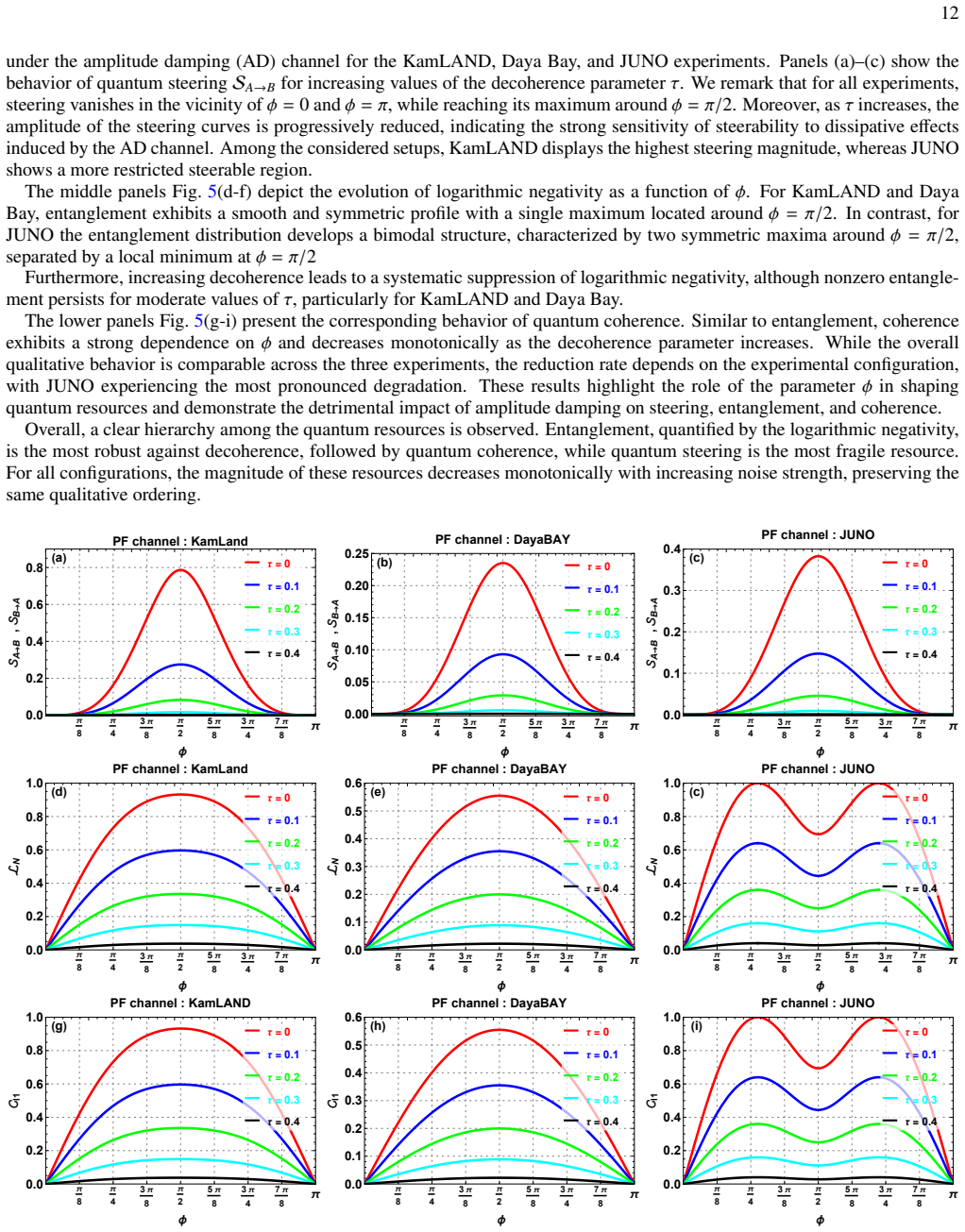
By representing neutrino flavor transitions as the dynamics of an open two-level system subject to amplitude-damping, phase-flip and phase-damping noise, the authors establish that quantum steering vanishes under the weakest decoherence, logarithmic negativity decays at an intermediate rate, and quantum coherence remains finite over the largest interval of parameters; furthermore, in phase-flip and phase-damping channels the negativity and coherence exhibit identical functional dependence on time.
What carries the argument
The open-system evolution of the two-flavor neutrino density matrix under the amplitude-damping, phase-flip, and phase-damping channels, from which the decay rates of steering, logarithmic negativity, and coherence are extracted.
If this is right
- Steering signatures in neutrino systems are lost at shorter distances or lower energies than entanglement or coherence signatures.
- Phase-flip and phase-damping noise produce indistinguishable dynamics for entanglement and coherence.
- Non-Markovian memory allows temporary restoration of entanglement and coherence but not of steering.
- Coherence can serve as a more robust witness of nonclassicality in noisy neutrino propagation than entanglement measures.
Where Pith is reading between the lines
- Experiments at longer baselines might still detect coherence even after steering and entanglement have decohered.
- The shared behavior under phase noise points to a common dependence on off-diagonal phase relations in the density matrix.
- Generalizing the model to three neutrino flavors could reveal whether the robustness hierarchy survives additional mixing angles.
Load-bearing premise
The physical decoherence experienced by propagating neutrinos is well approximated by the combination of amplitude-damping, phase-flip, and phase-damping channels acting on an effective two-level system.
What would settle it
Detection of steering that survives longer than quantum coherence for any choice of neutrino energy, baseline, or noise strength would falsify the reported robustness ordering.
Figures




read the original abstract
Neutrino oscillations confirm the presence of mode entanglement, as each flavor eigenstate is composed of a coherent superposition of distinct mass eigenstates. In this work, we investigate the dynamics of quantum resources in neutrino oscillation systems by analyzing quantum steering, logarithmic negativity, and quantum coherence within a two-flavor framework. Treating neutrino oscillations as an effective two-level quantum system, we study the influence of environmental decoherence on these nonclassical features by modeling the system as an open quantum system. Three representative noise channels are considered, namely amplitude damping (AD), phase flip (PF), and phase damping (PD), allowing us to capture both dissipative and dephasing mechanisms. We examine the evolution of quantum resources in both Markovian and non-Markovian regimes, highlighting the role of memory effects in the system-environment interaction. The results reveal a clear hierarchy in the robustness of quantum resources under decoherence. Steering is the most sensitive correlation in the hierarchy under decoherence effects. while logarithmic negativity exhibits intermediate robustness. Quantum coherence displays the highest resilience, persisting over a wider range of parameters. In the PF and PD channels, logarithmic negativity and coherence are shown to exhibit identical dynamical behavior, reflecting their common dependence on phase-related noise. In contrast, the non-Markovian regime leads to delayed decoherence and partial revivals of entanglement and coherence due to information backflow, whereas quantum steering remains strongly suppressed. These findings provide a comparison of different quantum resources in neutrino oscillation systems and offer new insights into the interplay between decoherence mechanisms and quantum correlations.
Editorial analysis
A structured set of objections, weighed in public.
Referee Report
Summary. The manuscript models two-flavor neutrino oscillations as an effective qubit and evolves the state under amplitude-damping, phase-flip, and phase-damping channels in both Markovian and non-Markovian regimes. It computes the time dependence of quantum steering, logarithmic negativity, and quantum coherence, reporting a robustness hierarchy (steering most fragile, negativity intermediate, coherence most resilient), identical dynamics of negativity and coherence under PF and PD, and partial revivals of entanglement and coherence (but not steering) due to non-Markovian backflow.
Significance. If the chosen noise channels are accepted as representative, the work supplies a concrete comparison of how standard quantum-information measures respond to dissipative versus dephasing noise and to memory effects in a neutrino-oscillation context. The explicit demonstration that steering is suppressed while coherence persists, together with the PF/PD equivalence, is a clear, falsifiable result that could be checked by other groups using the same Kraus maps.
major comments (2)
- [Model section] §2 (or the section introducing the open-system model): the physical motivation for replacing neutrino propagation decoherence with the Kraus operators of AD, PF, and PD is not supplied. The dominant mechanisms in the literature (wave-packet separation yielding a Gaussian factor exp[−(Δm²L/2E)²σ²/2], MSW matter effects, or stochastic magnetic fields) produce baseline- or energy-dependent damping that is not equivalent to the exponential or oscillatory decay generated by these channels. Because the abstract and conclusions present the hierarchy as a feature of “neutrino oscillation systems,” this modeling choice is load-bearing and requires explicit justification or a comparative calculation.
- [Results] Results section (figures showing the three measures): the reported identity between logarithmic negativity and coherence under PF and PD is stated but not derived from the explicit evolved density-matrix elements. The paper should show that the off-diagonal terms that enter both measures are damped by exactly the same factor in these two channels, or supply the algebraic reason for the coincidence.
minor comments (2)
- [Introduction] The abstract and introduction cite no prior works on decoherence in neutrino oscillations (e.g., wave-packet or matter-effect treatments). Adding two or three key references would clarify how the present channel-based approach relates to existing literature.
- [Numerical results] Parameter values (mixing angle, mass-squared difference, baseline L, energy E, and the decoherence rates Γ) are not listed in the text or figure captions. Supplying a table of the numerical values used for all plots would make the results reproducible.
Simulated Author's Rebuttal
We thank the referee for the careful reading of our manuscript and the constructive comments. We address each major point below and have revised the manuscript to strengthen the presentation where appropriate.
read point-by-point responses
-
Referee: [Model section] §2: the physical motivation for replacing neutrino propagation decoherence with the Kraus operators of AD, PF, and PD is not supplied. The dominant mechanisms in the literature (wave-packet separation yielding a Gaussian factor exp[−(Δm²L/2E)²σ²/2], MSW matter effects, or stochastic magnetic fields) produce baseline- or energy-dependent damping that is not equivalent to the exponential or oscillatory decay generated by these channels. Because the abstract and conclusions present the hierarchy as a feature of “neutrino oscillation systems,” this modeling choice is load-bearing and requires explicit justification or a comparative calculation.
Authors: We agree that the original manuscript did not sufficiently articulate the rationale for selecting these particular channels. In the revised Section 2 we have added an explicit statement clarifying that the amplitude-damping, phase-flip and phase-damping maps are employed as standard phenomenological models that separately capture dissipative and dephasing effects within an effective two-level description of neutrino oscillations. This choice permits a controlled comparison of the robustness of steering, negativity and coherence under Markovian and non-Markovian dynamics, which is the central aim of the work. While we acknowledge that realistic neutrino decoherence (e.g., Gaussian wave-packet damping) is baseline- and energy-dependent and not identical to the exponential or oscillatory factors produced by the chosen Kraus operators, the paper does not claim equivalence to any specific physical mechanism; it reports the hierarchy that emerges for these representative channels. A quantitative comparison with microscopic neutrino decoherence models would constitute a separate study and is therefore left for future work. revision: partial
-
Referee: [Results] Results section: the reported identity between logarithmic negativity and coherence under PF and PD is stated but not derived from the explicit evolved density-matrix elements. The paper should show that the off-diagonal terms that enter both measures are damped by exactly the same factor in these two channels, or supply the algebraic reason for the coincidence.
Authors: We thank the referee for this observation. The original text noted the numerical coincidence but did not supply the algebraic origin. In the revised Results section we now present the explicit time-evolved density matrices for both the phase-flip and phase-damping channels. For both maps the off-diagonal element ρ_{12}(t) acquires the identical damping factor (1−2λ(t)), where λ(t) is the channel parameter. Because the logarithmic negativity is determined by the singular values involving |ρ_{12}| and the l1-norm coherence is exactly 2|ρ_{12}|, the two quantities necessarily share the same functional dependence on time. This algebraic identity is now derived and displayed explicitly in the manuscript. revision: yes
Circularity Check
No significant circularity in the derivation chain
full rationale
The paper models neutrino oscillations as an effective two-level system and evolves the state under the Kraus operators of standard amplitude damping, phase flip, and phase damping channels (both Markovian and non-Markovian). Quantum steering, logarithmic negativity, and coherence are then evaluated using their conventional definitions. The reported hierarchy and identical PF/PD behavior emerge directly as outputs of these explicit time-evolution calculations; no parameter is fitted to the target results, no quantity is defined in terms of itself, and no load-bearing step reduces to a self-citation or ansatz smuggled from prior work by the same authors. The derivation is therefore self-contained against the stated model assumptions.
Axiom & Free-Parameter Ledger
free parameters (1)
- decoherence rates
axioms (2)
- domain assumption Neutrino oscillations can be accurately modeled as an effective two-level quantum system
- domain assumption Environmental decoherence is captured by the amplitude damping, phase flip, and phase damping channels in Markovian and non-Markovian regimes
Reference graph
Works this paper leans on
-
[1]
Einstein, A., Podolsky, B. and Rosen, N.,Can Quantum-Mechanical Description of Physical Reality Be Considered Complete?, Phys. Rev.47, 777–780 (1935), https://doi.org/10.1103/PhysRev.47.777
-
[2]
Schr¨odinger, E.,Discussion of Probability Relations between Separated Systems, Proc. Cambridge Philos. Soc.31, 555–563 (1935), https://doi.org/10.1017/S0305004100013554
-
[3]
S.,On the Einstein Podolsky Rosen Paradox, Physics1, 195–200 (1964), https://cds.cern.ch/record/111654
Bell, J. S.,On the Einstein Podolsky Rosen Paradox, Physics1, 195–200 (1964), https://cds.cern.ch/record/111654
1964
-
[4]
Aspect, A., Grangier, P. and Roger, G.,Experimental Tests of Realistic Local Theories via Bell’s Theorem, Phys. Rev. Lett.47, 460–463 (1981), https://doi.org/10.1103/PhysRevLett.47.460
-
[5]
Experimental test of B ell's inequalities using time-varying analyzers
Aspect, A., Dalibard, J. and Roger, G.,Experimental Test of Bell’s Inequalities Using Time-Varying Analyzers, Phys. Rev. Lett.49, 1804–1807 (1982), https://doi.org/10.1103/PhysRevLett.49.1804
-
[6]
Horodecki, R., Horodecki, P., Horodecki, M. and Horodecki, K.,Quantum Entanglement, Rev. Mod. Phys.81, 865–942 (2009), https://doi.org/10.1103/RevModPhys.81.865
-
[7]
In:Physical Review Letters98.14, p
Wiseman, H. M., Jones, S. J. and Doherty, A. C.,Steering, Entanglement, Nonlocality, and the Einstein–Podolsky–Rosen Paradox, Phys. Rev. Lett.98, 140402 (2007), https://doi.org/10.1103/PhysRevLett.98.140402
-
[8]
and Skrzypczyk, P.,Quantum steering: a review with focus on semidefinite programming, Rep
Cavalcanti, D. and Skrzypczyk, P.,Quantum steering: a review with focus on semidefinite programming, Rep. Prog. Phys.80, 024001 (2017), https://doi.org/10.1088/1361-6633/80/2/024001
-
[10]
B.,Logarithmic Negativity: A Full Entanglement Monotone That Is Not Convex, Phys
Plenio, M. B.,Logarithmic Negativity: A Full Entanglement Monotone That Is Not Convex, Phys. Rev. Lett.95, 090503 (2005), https://doi.org/10.1103/PhysRevLett.95.090503
-
[11]
Baumgratz, T., Cramer, M. and Plenio, M. B.,Quantifying Coherence, Phys. Rev. Lett.113, 140401 (2014), https://doi.org/10.1103/PhysRevLett.113.140401
-
[12]
Streltsov, A., Adesso, G. and Plenio, M. B.,Colloquium: Quantum coherence as a resource, Rev. Mod. Phys.89, 041003 (2017), https://doi.org/10.1103/RevModPhys.89.041003
-
[13]
S. Cavazzoni, B. Teklu and M. G. Paris,Frequency estimation by frequency jumps, npj Quantum Inf.11, 174 (2025), doi:10.1038/s41534-025-00974-5
-
[14]
J. He and M. G. Paris,Scrambling for precision: optimizing multiparameter qubit estimation in the face of sloppiness and incompati- bility, J. Phys. A: Math. Theor.58, 325301 (2025), doi:10.1088/1751-8121/ad8f0a
-
[15]
M. Asjad, B. Teklu and M. G. Paris,Joint quantum estimation of loss and nonlinearity in driven-dissipative Kerr resonators, Phys. Rev. Res.5, 013185 (2023), doi:10.1103/PhysRevResearch.5.013185. 19
-
[17]
Breuer, H.-P. and Petruccione, F.,The Theory of Open Quantum Systems, Oxford University Press, Oxford (2002), https://global.oup.com/academic/product/the-theory-of-open-quantum-systems-9780199213900
2002
-
[18]
Palma, G. M., Suominen, K.-A. and Ekert, A. K.,Quantum Computers and Dissipation, Proc. R. Soc. Lond. A452, 567–584 (1996), https://doi.org/10.1098/rspa.1996.0029
-
[19]
and Piilo, J.,Measure for the Degree of Non-Markovian Behavior of Quantum Processes, Phys
Breuer, H.-P., Laine, E.-M. and Piilo, J.,Measure for the Degree of Non-Markovian Behavior of Quantum Processes, Phys. Rev. Lett. 103, 210401 (2009), https://doi.org/10.1103/PhysRevLett.103.210401
-
[20]
Rivas, A., Huelga, S. F. and Plenio, M. B.,Quantum non-Markovianity: characterization, quantification and detection, Rep. Prog. Phys.77, 094001 (2014), https://doi.org/10.1088/0034-4885/77/9/094001
-
[21]
de Vega, I. and Alonso, D.,Dynamics of non-Markovian open quantum systems, Rev. Mod. Phys.89, 015001 (2017), https://doi.org/10.1103/RevModPhys.89.015001
-
[22]
Pontecorvo, B.,Mesonium and Antimesonium, Sov. Phys. JETP6, 429–431 (1957), http://www.jetp.ac.ru/cgi- bin/dn/e 006 03 0429.pdf
1957
-
[23]
Pontecorvo, B.,Neutrino Experiments and the Problem of Conservation of Leptonic Charge, Sov. Phys. JETP26, 984–988 (1968), http://www.jetp.ac.ru/cgi-bin/dn/e 026 05 0984.pdf
1968
-
[24]
M. M. Ettefaghi, Z. S. Tabatabaei Lotfi and R. Ramezani Arani,Quantum correlations in neutrino oscillation: Coherence and entan- glement, Europhys. Lett.132, 31002 (2020), doi:10.1209/0295-5075/132/31002
-
[25]
K. Dixit and A. K. Alok,New physics effects on quantum coherence in neutrino oscillations, Eur. Phys. J. Plus136, 310 (2021), doi:10.1140/epjp/s13360-021-01375-3
-
[26]
M. Blasone, S. De Siena and C. Matrella,Wave packet approach to quantum correlations in neutrino oscillations, Eur. Phys. J. C81, 660 (2021), doi:10.1140/epjc/s10052-021-09451-6
-
[27]
V . A. S. V . Bittencourt, M. Blasone, S. De Siena and C. Matrella,Complete complementarity relations for quantum correlations in neutrino oscillations, Eur. Phys. J. C82, 566 (2022), doi:10.1140/epjc/s10052-022-10448-1
-
[28]
X. K. Song, Y . Huang, J. Ling and M. H. Yung,Quantifying quantum coherence in experimentally observed neutrino oscillations, Phys. Rev. A98, 050302 (2018), doi:10.1103/PhysRevA.98.050302
-
[29]
A. K. Alok, T. J. Chall, N. R. S. Chundawat, S. Gangal and G. Lambiase,Quantum coherence in neutrino spin-flavor oscillations, Phys. Rev. D111, 036015 (2025), doi:10.1103/PhysRevD.111.036015
-
[30]
B. Yadav and A. K. Alok,Impact of scalar NSI on spatial and temporal correlations in neutrino oscillations, J. Phys. G52, 125004 (2025), doi:10.1088/1361-6471/ad3c8f
-
[31]
and Sakata, S.,Remarks on the Unified Model of Elementary Particles, Prog
Maki, Z., Nakagawa, M. and Sakata, S.,Remarks on the Unified Model of Elementary Particles, Prog. Theor. Phys.28, 870–880 (1962), https://doi.org/10.1143/PTP.28.870
-
[32]
Giunti, C. and Kim, C. W.,Fundamentals of Neutrino Physics and Astrophysics, Oxford University Press, Oxford (2007), https://doi.org/10.1093/acprof:oso/9780198508717.001.0001
work page doi:10.1093/acprof:oso/9780198508717.001.0001 2007
-
[33]
Blennow, M. and Smirnov, A. Yu.,Neutrino propagation in matter, Adv. High Energy Phys.2017, 1681575 (2017), https://doi.org/10.1155/2017/1681575
-
[34]
A. K. Alok, M. Blasone, T. J. Chall, N. R. S. Chundawat and G. Lambiase,Coherent dynamics of flavor mode entangled neutrinos, arXiv:2501.06311 [hep-ph], DOI: 10.48550/arXiv.2501.06311 (2025)
-
[35]
and Skrzypczyk, P.,Quantum steering: a review with focus on semidefinite programming, Rep
Cavalcanti, D. and Skrzypczyk, P.,Quantum steering: a review with focus on semidefinite programming, Rep. Prog. Phys.80, 024001 (2017), https://doi.org/10.1088/1361-6633/aa7fca
-
[36]
M. Amazioug and M. Daoud,Quantum steering vs entanglement and extracting work in an anisotropic two-qubit Heisen- berg model in presence of external magnetic fields with DM and KSEA interactions, Phys. Lett. A493, 129245 (2024), doi:10.1016/j.physleta.2023.129245
-
[37]
E. Jaloum and M. Amazioug,Controlling the dynamical evolution of quantum coherence and quantum correlations in e +e− →Λ ¯Λ processes at BESIII, Phys. Rev. D113, 016024 (2026), doi:10.1103/PhysRevD.113.016024
-
[38]
E. Jaloum and M. Amazioug,Quantum teleportation, entanglement, LQU and LQFI in e +e− → ¯YY processes at BESIII through noisy channels, Nucl. Phys. B117255(2026), DOI: 10.1016/j.nuclphysb.2025.117255
-
[39]
Abd-Rabbou, M. Y ., Metwally, N., Ahmed, M. M. A. and Obada, A. S.,Modern Physics Letters A37(22), 2250143 (2022), https://doi.org/10.1142/S021773232250143X
-
[40]
Peres, A.,Separability criterion for density matrices, Phys. Rev. Lett.77, 1413 (1996), https://doi.org/10.1103/PhysRevLett.77.1413
-
[41]
Computable measure of entanglement,
Vidal, G. and Werner, R. F.,Computable measure of entanglement, Phys. Rev. A65, 032314 (2002), https://doi.org/10.1103/PhysRevA.65.032314
-
[42]
and Grudka, A.,Ordering two-qubit states with concurrence and negativity, Phys
Miranowicz, A. and Grudka, A.,Ordering two-qubit states with concurrence and negativity, Phys. Rev. A70, 032326 (2004), https://doi.org/10.1103/PhysRevA.70.032326
-
[43]
S. Pirandola, S. Mancini, S. L. Braunstein and D. Vitali,Minimal qudit code for a qubit in the phase-damping channel, Phys. Rev. A 77, 032309 (2008), doi:10.1103/PhysRevA.77.032309
-
[44]
S. Damodarakurup, M. Lucamarini, G. Di Giuseppe, D. Vitali and P. Tombesi,Experimental inhibition of decoherence on flying qubits via “bang-bang” control, Phys. Rev. Lett.103, 040502 (2009), doi:10.1103/PhysRevLett.103.040502
-
[45]
M. Y . Abd-Rabbou, S. Khan and M. Shamirzaie,Quantum Fisher information and quantum coherence of an entangled bipartite state interacting with a common classical environment in accelerating frames, Quantum Inf. Process.21, 194 (2022), doi:10.1007/s11128- 022-03455-8
- [46]
-
[47]
Daya Bay Collaboration,Study of the wave packet treatment of neutrino oscillation at Daya Bay, Eur. Phys. J. C77, 606 (2017), DOI: 10.1140/epjc/s10052-017-5220-2
-
[48]
T. Araki, K. Eguchi, S. Enomoto, K. Furuno, K. Ichimura, H. Ikeda (KamLAND Collaboration),Measurement of neutrino oscillation with KamLAND: evidence of spectral distortion, Phys. Rev. Lett.94, 081801 (2005), DOI: 10.1103/PhysRevLett.94.081801
-
[49]
A. Gando, Y . Gando, H. Hanakago, H. Ikeda, K. Inoue, K. Ishidoshiro (KamLAND Collaboration),Reactor on-offantineutrino mea- surement with KamLAND, Phys. Rev. D88, 033001 (2013), DOI: 10.1103/PhysRevD.88.033001
-
[50]
P. Adamson, C. Andreopoulos, K. E. Arms, R. Armstrong, D. J. Auty, D. S. Ayres, J. L. Thron,Measurement of neutrino oscillations with the MINOS detectors in the NuMI beam, Phys. Rev. Lett.101, 131802 (2008), DOI: 10.1103/PhysRevLett.101.131802
-
[51]
A. B. Sousa (MINOS and MINOS+Collaborations),MINOS and MINOS+results, in AIP Conf. Proc., vol. 1666, no. 110004 (2015), p. 35, DOI: 10.1063/1.4915568
-
[52]
K. Abe et al. (T2K Collaboration),The T2K experiment, Nucl. Instrum. Meth. A659, 106–135 (2011), arXiv:1106.1238 [physics.ins- det]
- [53]
- [54]
-
[55]
A. Abusleme et al. (JUNO Collaboration),The JUNO Experiment: Status and Prospects, Prog. Part. Nucl. Phys.103, 92 (2021), arXiv:2104.02565 [hep-ex]
-
[56]
Acciarriet al.(DUNE Collaboration), arXiv:1512.06148
R. Acciarri et al. (DUNE Collaboration),Long-Baseline Neutrino Facility (LBNF) and Deep Underground Neutrino Experiment (DUNE), arXiv:1512.06148 [physics.ins-det]
-
[57]
Abiet al.(DUNE Collaboration), Eur
B. Abi et al. (DUNE Collaboration),Deep Underground Neutrino Experiment (DUNE), Eur. Phys. J. C80, 978 (2020), arXiv:2006.16043 [hep-ex]
- [58]
-
[59]
K. Stankevich and A. Studenikin,Quantum decoherence of neutrino mass states, arXiv:2301.13522 [hep-ph] (2023), arXiv:2301.13522
- [60]
-
[61]
A. Authoret al.,Mathematical Anatomy of Neutrino Decoherence in Red Turbulence, arXiv:2601.20313 [hep-ph] (2026), arXiv:2601.20313
-
[62]
M. A. Nielsen and I. L. Chuang,Quantum Computation and Quantum Information, Cambridge University Press, Cambridge, UK, 2010, DOI: 10.1017/CBO9780511976667
-
[63]
M. Hu and H. Fan,Quantum coherence of multiqubit states in correlated noisy channels, Science China: Physics, Mechanics & Astronomy63, 230322 (2020), DOI: 10.1007/s11433-019-1462-9
-
[64]
M. Hu and W. Zhou,Quantum correlations in laser physics, Laser Physics Letters16, 045201 (2019), DOI: 10.1088/1612- 2011/16/4/045201
-
[66]
C. Macchiavello and G. M. Palma,Entanglement-enhanced information transmission over a quantum channel with correlated noise, Phys. Rev. A65, 050301(R) (2002), DOI: 10.1103/PhysRevA.65.050301
-
[67]
M. Blasone, F. Dell’Anno, S. De Siena, and F. Illuminati,Entanglement in neutrino oscillations, Europhys. Lett.85, 50002 (2009), DOI: 10.1209/0295-5075/85/50002
-
[68]
A. K. Alok, S. Banerjee, and S. U. Sankar,Quantum correlations in neutrino oscillations, Nucl. Phys. B909, 65 (2016), DOI: 10.1016/j.nuclphysb.2016.05.021
-
[69]
S. Banerjee, A. K. Alok, and R. Srikanth,Quantum coherence, entanglement and neutrino oscillations, Eur. Phys. J. C80, 772 (2020), DOI: 10.1140/epjc/s10052-020-8292-5
-
[70]
R. A. Bertlmann and W. Grimus,Quantum mechanics, neutrino oscillations and entanglement, Phys. Rev. D64, 056004 (2001), DOI: 10.1103/PhysRevD.64.056004
-
[71]
N. Brunner, A. Friedenauer, M. Navascu ´es, and A. Ac ´ın,Bell nonlocality in particle physics, Phys. Rev. D89, 015017 (2014), DOI: 10.1103/PhysRevD.89.015017
-
[72]
S. Abubakaret al.(NOvA Collaboration),Precision Measurement of Neutrino Oscillation Parameters with 10 Years of Data from the NOvA Experiment, Phys. Rev. Lett.136, 011802 (2026), DOI: 10.1103/PhysRevLett.136.011802
discussion (0)
Sign in with ORCID, Apple, or X to comment. Anyone can read and Pith papers without signing in.