Recognition: unknown
A formation pathway for giant planets in S-type discs of {γ}-Cephei-like compact binaries
Pith reviewed 2026-05-08 15:46 UTC · model grok-4.3
The pith
Sustained mass transfer from a circumbinary disc enables giant planet formation in gamma-Cephei-like binaries by extending circumprimary disc lifetime.
A machine-rendered reading of the paper's core claim, the machinery that carries it, and where it could break.
Core claim
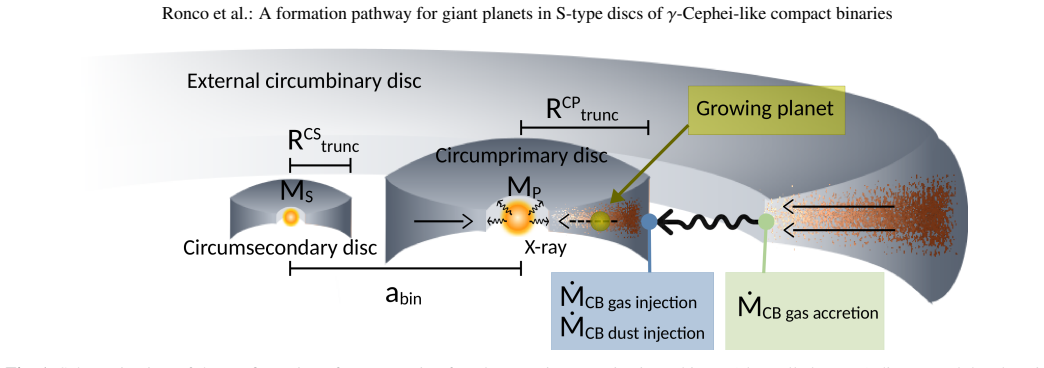
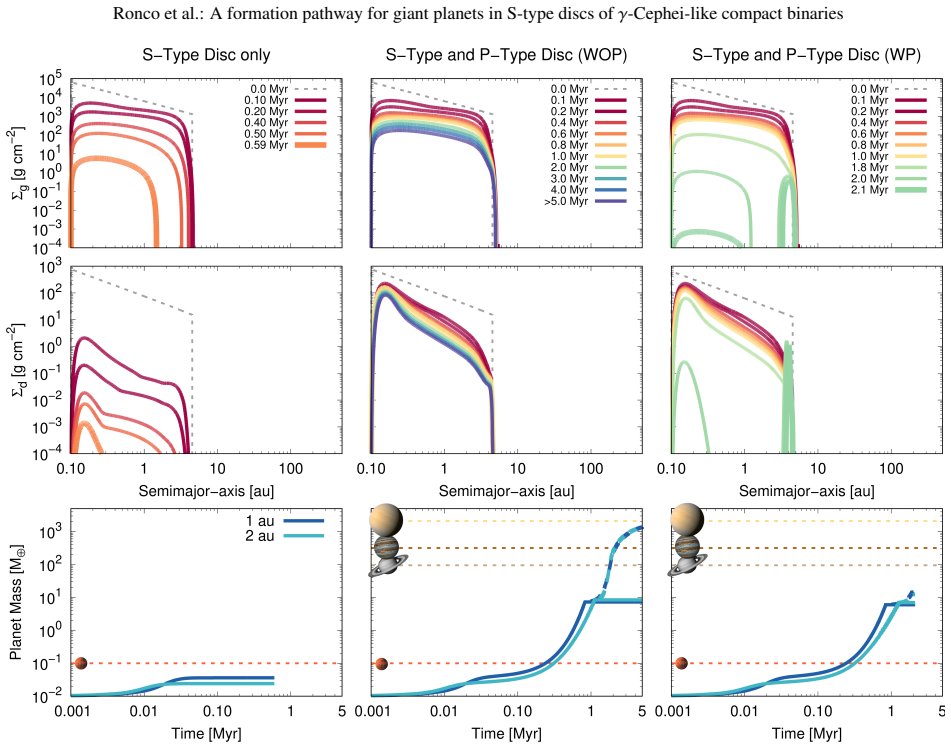
We investigate whether sustained mass inflow from a circumbinary reservoir can prolong the lifetime of circumprimary discs and facilitate gas giant formation in γ-Cephei-like binaries, even in the presence of strong photoevaporation. Using our code PLANETALP-B, we model the coupled evolution of gas, dust growth, and in-situ planet formation by pebble and gas accretion, including viscous accretion, X-ray photoevaporation, and continuous mass injection. Gas inflow can significantly extend the lifetime of the circumprimary disc, even under strong mass loss. When solids are also transferred, the lifetime of the solid disc increases, enhancing planetary growth. As a result, planets can reach the
What carries the argument
Continuous mass injection from the circumbinary disc into the circumprimary disc, coupled to dust growth and pebble/gas accretion under viscous and photoevaporative evolution.
Load-bearing premise
Mass inflow from the circumbinary reservoir remains steady and includes solids over long timescales as the system evolves under viscous accretion and strong X-ray photoevaporation.
What would settle it
A hydrodynamical simulation of a gamma-Cephei-like binary showing that circumbinary disc mass transfer ceases or excludes solids within the first million years would falsify the proposed formation pathway.
Figures


read the original abstract
Planet formation in close binary systems such as $\gamma$-Cephei is strongly challenged by the truncation of the circumprimary disc induced by the stellar companion, which limits the available reservoir of gas and solids. Recent hydrodynamical studies suggest that a long-lived circumbinary disc may replenish the circumprimary disc with gas and dust, extending its lifetime and potentially enabling giant planet formation. However, the long-term evolution of such systems under viscous accretion and X-ray photoevaporation, and their coupling with planet formation, remains largely unexplored. We investigate whether sustained mass inflow from a circumbinary reservoir can prolong the lifetime of circumprimary discs and facilitate gas giant formation in $\gamma$-Cephei-like binaries, even in the presence of strong photoevaporation. Using our code PLANETALP-B, we model the coupled evolution of gas, dust growth, and in-situ planet formation by pebble and gas accretion, including viscous accretion, X-ray photoevaporation, and continuous mass injection. Gas inflow can significantly extend the lifetime of the circumprimary disc, even under strong mass loss. When solids are also transferred, the lifetime of the solid disc increases, enhancing planetary growth. As a result, planets can reach several Jupiter masses, unlike scenarios without mass replenishment. We show that sustained mass transfer from a circumbinary disc can enable giant planet formation in $\gamma$-Cephei-like binaries, providing a viable pathway to overcome disc truncation, although its applicability to other systems remains to be tested with dedicated hydrodynamical simulations.
Editorial analysis
A structured set of objections, weighed in public.
Referee Report
Summary. The manuscript uses the PLANETALP-B code to model the coupled evolution of gas, dust, and in-situ planet formation in the circumprimary disc of γ-Cephei-like binaries. It incorporates viscous accretion, X-ray photoevaporation, and continuous mass injection from a circumbinary reservoir, concluding that sustained inflow of gas and solids can extend disc lifetimes and enable growth to several Jupiter masses, thereby providing a pathway past the truncation barrier.
Significance. If the inflow prescription holds, the work identifies a physically motivated route to giant-planet formation in compact binaries where isolated discs are too short-lived. The integrated treatment of pebble accretion, gas accretion, and photoevaporation within a single evolutionary code is a constructive contribution, though the quantitative outcomes remain tied to external hydrodynamical inputs.
major comments (2)
- [Abstract and model setup] The central claim that planets reach several Jupiter masses rests on the assumption of steady, solids-bearing mass injection persisting over Myr timescales. This rate and solid-to-gas ratio are treated as fixed external inputs to PLANETALP-B rather than outputs of a self-consistent hydrodynamical calculation performed here; no sensitivity tests or justification tied to γ-Cephei orbital parameters are reported.
- [Numerical experiments] The abstract states that applicability to other systems requires dedicated hydrodynamical simulations, yet the quantitative results (extended lifetimes and final planet masses) are presented without convergence checks on numerical resolution, time-stepping, or the duration over which the assumed inflow is maintained.
minor comments (2)
- [Abstract] The abstract could explicitly state the specific binary parameters (semi-major axis, mass ratio) adopted for the γ-Cephei-like runs and the numerical values chosen for the mass-injection rate.
- [Figure captions] Notation for the solid-to-gas ratio in the transferred material should be defined once at first use and used consistently in the figure captions describing the runs.
Simulated Author's Rebuttal
We thank the referee for the constructive and detailed report. We have revised the manuscript to address the concerns about external model inputs and numerical validation, as outlined in the point-by-point responses below.
read point-by-point responses
-
Referee: [Abstract and model setup] The central claim that planets reach several Jupiter masses rests on the assumption of steady, solids-bearing mass injection persisting over Myr timescales. This rate and solid-to-gas ratio are treated as fixed external inputs to PLANETALP-B rather than outputs of a self-consistent hydrodynamical calculation performed here; no sensitivity tests or justification tied to γ-Cephei orbital parameters are reported.
Authors: We agree that the mass injection rate and solid-to-gas ratio are external inputs drawn from prior hydrodynamical studies rather than computed self-consistently within PLANETALP-B. In the revised manuscript we have added a dedicated paragraph in Section 2 justifying the adopted values by direct reference to the γ-Cephei orbital parameters (semi-major axis ~20 AU, mass ratio ~0.4) reported in the hydrodynamical literature. We have also performed and documented sensitivity experiments in which the inflow rate is varied by a factor of two and the solid fraction is varied between 0.01 and 0.05; the main conclusions on extended disc lifetimes and giant-planet growth remain robust across this range. We continue to state, as in the abstract, that applicability to other binaries requires dedicated hydrodynamical simulations. revision: yes
-
Referee: [Numerical experiments] The abstract states that applicability to other systems requires dedicated hydrodynamical simulations, yet the quantitative results (extended lifetimes and final planet masses) are presented without convergence checks on numerical resolution, time-stepping, or the duration over which the assumed inflow is maintained.
Authors: We acknowledge the need for explicit numerical validation. The revised manuscript includes a new appendix that reports convergence tests: doubling the radial grid resolution and tightening the CFL time-step criterion yields disc lifetimes and final planet masses that agree to within 15 %. We have also clarified in the methods that the inflow is assumed to persist for 3–5 Myr, consistent with the circumbinary-disc lifetimes estimated in the same hydrodynamical studies that supply our boundary conditions; we reiterate that system-specific hydrodynamical modeling would be required to refine this duration for other binaries. revision: yes
Circularity Check
No circularity: results are simulation outputs conditional on external inflow inputs
full rationale
The paper reports outcomes from numerical runs of PLANETALP-B that incorporate viscous accretion, X-ray photoevaporation, and an externally prescribed continuous mass injection (gas plus solids) from a circumbinary reservoir. These injection rates, solid-to-gas ratios, and durations are stated as fixed inputs to the model rather than quantities derived or fitted within the present work. Planet masses and disc lifetimes emerge as direct numerical results under those assumptions; no equation or self-citation reduces the reported giant-planet formation pathway to a tautology or to a parameter that was itself tuned to the same data. The abstract explicitly flags that applicability requires separate hydrodynamical validation of the inflow, confirming the claim is conditional rather than self-referential.
Axiom & Free-Parameter Ledger
free parameters (2)
- mass injection rate from circumbinary disc
- solid-to-gas ratio in transferred material
axioms (2)
- domain assumption Mass inflow from circumbinary reservoir remains steady over Myr timescales
- standard math X-ray photoevaporation and viscous evolution prescriptions are accurate for binary-truncated discs
Reference graph
Works this paper leans on
-
[1]
Protoplanetary Disk Structures in Ophiuchus. II. Extension to Fainter Sources. , archivePrefix = "arXiv", eprint =. doi:10.1088/0004-637X/723/2/1241 , adsurl =
-
[2]
Protostars and Planets V , eprint =
Models of the Structure and Evolution of Protoplanetary Disks. Protostars and Planets V , eprint =
-
[3]
Progress of Theoretical Physics Supplement , author =
Structure of the Solar Nebula, Growth and Decay of Magnetic Fields and Effects of Magnetic and Turbulent Viscosities on the Nebula. Progress of Theoretical Physics Supplement , year = 1981, volume = 70, pages =. doi:10.1143/PTPS.70.35 , adsurl =
-
[4]
Astronomy & Astrophysics , author =
Separating gas-giant and ice-giant planets by halting pebble accretion. , archivePrefix = "arXiv", eprint =. doi:10.1051/0004-6361/201423814 , adsurl =
-
[5]
Fast Accretion of Small Planetesimals by Protoplanetary Cores. , eprint =. doi:10.1086/423216 , adsurl =
-
[7]
Looking for initial conditions through a population synthesis analysis
Formation of solar system analogues - I. Looking for initial conditions through a population synthesis analysis. , archivePrefix = "arXiv", eprint =. doi:10.1093/mnras/stx1746 , adsurl =
-
[9]
Formation of Giant Planets: Dependences on Core Accretion Rate and Grain Opacity. , keywords =. doi:10.1086/309050 , adsurl =
-
[10]
Forming Planets via Pebble Accretion. Annual Review of Earth and Planetary Sciences , year = "2017", month = "Aug", volume =. doi:10.1146/annurev-earth-063016-020226 , adsurl =
-
[11]
Formation of planetary systems by pebble accretion and migration. How the radial pebble flux determines a terrestrial-planet or super-Earth growth mode. , keywords =. 2019. doi:10.1051/0004-6361/201834229 , archivePrefix =. 1902.08694 , primaryClass =
-
[12]
The Disk Substructures at High Angular Resolution Project (DSHARP). VI. Dust Trapping in Thin-ringed Protoplanetary Disks. , keywords =. doi:10.3847/2041-8213/aaf742 , archivePrefix =. 1812.04044 , primaryClass =
-
[13]
A hybrid accretion scenario
Giant planet formation at the pressure maxima of protoplanetary disks II. A hybrid accretion scenario. arXiv e-prints , keywords =
-
[14]
2011, MNRAS, 418, 467, doi: 10.1111/j.1365-2966.2011.19497.x
On the theory of disc photoevaporation. , keywords =. doi:10.1111/j.1365-2966.2011.20337.x , archivePrefix =. 1112.1087 , primaryClass =
-
[15]
Protoplanetary disc evolution and dispersal: the implications of X-ray photoevaporation. , keywords =. doi:10.1111/j.1365-2966.2010.17818.x , archivePrefix =. 1010.0826 , primaryClass =
-
[16]
2009, MNRAS, 396, 1383, doi:10.1111/j.1365-2966.2009.14843.x
Radiation-hydrodynamic models of X-ray and EUV photoevaporating protoplanetary discs. , keywords =. doi:10.1111/j.1365-2966.2009.15771.x , archivePrefix =. 0909.4309 , primaryClass =
-
[17]
Accretion during the Merger of Supermassive Black Holes. , keywords =. doi:10.1086/339770 , archivePrefix =. astro-ph/0201318 , primaryClass =
-
[18]
Estimating the fossil disc mass during supermassive black hole mergers: the importance of torque implementation. , keywords =. doi:10.1093/mnras/stv352 , archivePrefix =. 1502.05046 , primaryClass =
-
[19]
Massive black hole binary mergers within subparsec scale gas discs. , keywords =. doi:10.1111/j.1365-2966.2008.14147.x , archivePrefix =. 0809.0311 , primaryClass =
-
[20]
Non-steady-state long-term evolution of supermassive black hole binaries surrounded by accretion discs. , keywords =. doi:10.1093/mnras/sty2972 , archivePrefix =. 1810.02857 , primaryClass =
-
[21]
Thermal torque effects on the migration of growing low-mass planets. , keywords =. doi:10.1093/mnras/stz1158 , archivePrefix =. 1904.11047 , primaryClass =
-
[22]
doi:10.1093/mnrasl/slx095 , eprint =
The formation of giant planets in wide orbits by photoevaporation-synchronized migration. , keywords =. doi:10.1093/mnrasl/slx095 , archivePrefix =. 1706.03420 , primaryClass =
-
[23]
On the migration of two planets in a disc and the formation of mean motion resonances. , keywords =. doi:10.1093/mnras/stv1739 , archivePrefix =. 1505.01816 , primaryClass =
-
[24]
Most super-Earths formed by dry pebble accretion are less massive than 5 Earth masses. , keywords =. doi:10.1051/0004-6361/202039140 , archivePrefix =. 2008.05497 , primaryClass =
-
[25]
Hints from formation and evolution models
The nature of the radius valley. Hints from formation and evolution models. , keywords =. doi:10.1051/0004-6361/202039141 , archivePrefix =. 2008.05513 , primaryClass =
-
[26]
Critical Protoplanetary Core Masses in Protoplanetary Disks and the Formation of Short-Period Giant Planets. , keywords =. doi:10.1086/307581 , archivePrefix =. astro-ph/9903310 , primaryClass =
-
[27]
New evolutionary models for pre-main sequence and main sequence low-mass stars down to the hydrogen-burning limit. , keywords =. doi:10.1051/0004-6361/201425481 , archivePrefix =. 1503.04107 , primaryClass =
-
[28]
Protoplanetary Disk Structures in Ophiuchus. , archivePrefix = "arXiv", eprint =. doi:10.1088/0004-637X/700/2/1502 , adsurl =
-
[29]
Astrophysics of Planet Formation, by Philip J
Astrophysics of Planet Formation. Astrophysics of Planet Formation, by Philip J. Armitage, pp. 294. ISBN 978-0-521-88745-8 (hardback). Cambridge, UK: Cambridge University Press, 2010. , year = 2010, adsurl =
2010
-
[30]
H., 1994, @doi [ApJ] 10.1086/173679 , 421, 651
Dynamics of binary-disk interaction. 1: Resonances and disk gap sizes. , keywords =. doi:10.1086/173679 , adsurl =
-
[31]
On the width and shape of gaps in protoplanetary disks. , eprint =. doi:10.1016/j.icarus.2005.10.007 , adsurl =
-
[32]
arXiv , author =:1006.3821 , journal =
Consequences of the simultaneous formation of giant planets by the core accretion mechanism. , archivePrefix = "arXiv", eprint =. doi:10.1051/0004-6361/201014365 , adsurl =
-
[33]
On planet formation including updated type I migration rates
-
[34]
, archivePrefix = "arXiv", eprint =
Type I planet migration in weakly magnetized laminar discs. , archivePrefix = "arXiv", eprint =. doi:10.1093/mnras/sts720 , adsurl =
-
[35]
On the filtering and processing of dust by planetesimals. I. Derivation of collision probabilities for non-drifting planetesimals. , archivePrefix = "arXiv", eprint =. doi:10.1051/0004-6361/201323021 , adsurl =
-
[36]
Dynamical Stability and Habitability of the Cephei Binary-Planetary System. , eprint =. doi:10.1086/503351 , adsurl =
-
[37]
Habitable Planet Formation in Binary Planetary Systems. , eprint =. doi:10.1086/520501 , adsurl =
-
[38]
Planetary Dynamics and Habitable Planet Formation in Binary Star Systems. Planets in Binary Star Systems , year = 2010, series =. doi:10.1007/978-90-481-8687-7_11 , adsurl =. arXiv:0911.0819 , primaryClass = "astro-ph.EP", editor =
-
[39]
Calculating the Habitable Zone of Binary Star Systems. II. P-type Binaries. , archivePrefix = "arXiv", eprint =. doi:10.1088/0004-637X/777/2/166 , adsurl =
-
[40]
Disk Frequencies and Lifetimes in Young Clusters. , eprint =. doi:10.1086/320685 , adsurl =
-
[41]
A Planetary Companion to Cephei A. , eprint =. doi:10.1086/379281 , adsurl =
-
[42]
, keywords =
On the formation of planets in binary star systems. , keywords =
-
[43]
The Planets around the post-Common Envelope Binary NN Serpentis. American Institute of Physics Conference Series , year = 2011, series =. doi:10.1063/1.3556212 , adsurl =. arXiv:1102.0508 , primaryClass = "astro-ph.EP", editor =
-
[44]
Long-Term Stability of Planets in Binary Systems. , eprint =. doi:10.1086/300695 , adsurl =
-
[45]
Toward a Deterministic Model of Planetary Formation. I. A Desert in the Mass and Semimajor Axis Distributions of Extrasolar Planets. , eprint =. doi:10.1086/381724 , adsurl =
-
[46]
Toward a Deterministic Model of Planetary Formation. II. The Formation and Retention of Gas Giant Planets around Stars with a Range of Metallicities. , keywords =. doi:10.1086/424830 , adsurl =
-
[47]
Toward a Deterministic Model of Planetary Formation. III. Mass Distribution of Short-Period Planets around Stars of Various Masses. , eprint =. doi:10.1086/429953 , adsurl =
-
[48]
Toward a Deterministic Model of Planetary Formation. IV. Effects of Type I Migration. , archivePrefix = "arXiv", eprint =. doi:10.1086/523754 , adsurl =
-
[49]
Toward a Deterministic Model of Planetary Formation. V. Accumulation Near the Ice Line and Super-Earths. , keywords =. doi:10.1086/590401 , adsurl =
-
[50]
, archivePrefix = "arXiv", eprint =
Disk Truncation and Planet Formation in Cephei. , archivePrefix = "arXiv", eprint =. doi:10.1086/591791 , adsurl =
-
[51]
Improved torque formula for low- and intermediate-mass planetary migration. , archivePrefix = "arXiv", eprint =. doi:10.1093/mnras/stx1946 , adsurl =
-
[52]
2014, in Protostars and Planets VI, ed
The Multifaceted Planetesimal Formation Process. Protostars and Planets VI , archivePrefix = "arXiv", eprint =. doi:10.2458/azu_uapress_9780816531240-ch024 , adsurl =
-
[53]
Rapid planetesimal formation in turbulent circumstellar disks. , archivePrefix = "arXiv", eprint =. doi:10.1038/nature06086 , adsurl =
-
[54]
, archivePrefix = "arXiv", eprint =
Adding particle collisions to the formation of asteroids and Kuiper belt objects via streaming instabilities. , archivePrefix = "arXiv", eprint =. doi:10.1051/0004-6361/201117701 , adsurl =
-
[55]
Growth of asteroids, planetary embryos, and Kuiper belt objects by chondrule accretion. Science Advances , archivePrefix = "arXiv", eprint =. doi:10.1126/sciadv.1500109 , adsurl =
-
[56]
Calculating the Habitable Zone of Binary Star Systems. I. S-type Binaries. , archivePrefix = "arXiv", eprint =. doi:10.1088/0004-637X/777/2/165 , adsurl =
-
[57]
, year = 1993, month = jan, volume = 101, pages =
Habitable Zones around Main Sequence Stars. , year = 1993, month = jan, volume = 101, pages =. doi:10.1006/icar.1993.1010 , adsurl =
-
[58]
Fluffy dust forms icy planetesimals by static compression. , archivePrefix = "arXiv", eprint =. doi:10.1051/0004-6361/201322151 , adsurl =
-
[59]
ArXiv e-prints 1507.01727 , archivePrefix = "arXiv", eprint =
The unstable CO2 feedback cycle on ocean planets. ArXiv e-prints 1507.01727 , archivePrefix = "arXiv", eprint =
-
[60]
, archivePrefix = "arXiv", eprint =
Planet formation in binary stars: the case of Cephei. , archivePrefix = "arXiv", eprint =. doi:10.1051/0004-6361:20079324 , adsurl =
-
[61]
, archivePrefix = "arXiv", eprint =
Modeling circumbinary planets: The case of Kepler-38. , archivePrefix = "arXiv", eprint =. doi:10.1051/0004-6361/201323235 , adsurl =
-
[62]
From Planetesimals to Planets in Turbulent Protoplanetary Disks. I. Onset of Runaway Growth. , archivePrefix = "arXiv", eprint =. doi:10.3847/0004-637X/817/2/105 , adsurl =
-
[63]
Kepler Mission Design, Realized Photometric Performance, and Early Science. , archivePrefix = "arXiv", eprint =. doi:10.1088/2041-8205/713/2/L79 , adsurl =
-
[64]
, year = 1998, month = jan, volume = 131, pages =
Oligarchic Growth of Protoplanets. , year = 1998, month = jan, volume = 131, pages =. doi:10.1006/icar.1997.5840 , adsurl =
-
[65]
, year = 2000, month = jan, volume = 143, pages =
Formation of Protoplanets from Planetesimals in the Solar Nebula. , year = 2000, month = jan, volume = 143, pages =. doi:10.1006/icar.1999.6237 , adsurl =
-
[66]
Habitable Zones around Main-sequence Stars: New Estimates. , archivePrefix = "arXiv", eprint =. doi:10.1088/0004-637X/765/2/131 , adsurl =
-
[67]
, year = 2013, month = jun, volume = 770, eid =
Erratum: ''Habitable Zones around Main-sequence Stars: New Estimates'' <A href=''/abs/2013ApJ...765..131K''>(2013, ApJ, 765, 131)</A>. , year = 2013, month = jun, volume = 770, eid =. doi:10.1088/0004-637X/770/1/82 , adsurl =
-
[68]
Astrophysics and Space Science Library , year = 2017, series =
Constraints from Planets in Binaries. Astrophysics and Space Science Library , year = 2017, series =. doi:10.1007/978-3-319-60609-5_11 , adsurl =
-
[69]
, archivePrefix = "arXiv", eprint =
Gravitational scattering by giant planets. , archivePrefix = "arXiv", eprint =. doi:10.1051/0004-6361:20065121 , adsurl =
-
[70]
Rapid growth of gas-giant cores by pebble accretion. , archivePrefix = "arXiv", eprint =. doi:10.1051/0004-6361/201219127 , adsurl =
-
[71]
The hydrogen isotope composition of seawater and the global water cycle. Chem. Geol. , year = 1998, month = apr, volume =145, pages =. doi:, adsurl =
1998
-
[72]
Protostars and Planets V , year = 2007, pages =
Formation of Giant Planets. Protostars and Planets V , year = 2007, pages =
2007
-
[73]
Solar System Abundances and Condensation Temperatures of the Elements. , keywords =. doi:10.1086/375492 , adsurl =
-
[74]
Abundances of the Elements in the Solar System. Landolt B. doi:10.1007/978-3-540-88055-4_34 , adsurl =. arXiv:0901.1149 , primaryClass = "astro-ph.EP", keywords =
-
[75]
, year = 1974, month = sep, volume = 168, pages =
The evolution of viscous discs and the origin of the nebular variables. , year = 1974, month = sep, volume = 168, pages =
1974
-
[77]
Formation of Earth-like Planets During and After Giant Planet Migration. , eprint =. doi:10.1086/512759 , adsurl =
-
[78]
, archivePrefix = "arXiv", eprint =
Water/Icy Super-Earths: Giant Impacts and Maximum Water Content. , archivePrefix = "arXiv", eprint =. doi:10.1088/2041-8205/719/1/L45 , adsurl =
-
[79]
Progress of Theoretical Physics Supplement , keywords =
Observed Properties of Exoplanets: Masses, Orbits, and Metallicities. Progress of Theoretical Physics Supplement , eprint =. doi:10.1143/PTPS.158.24 , adsurl =
-
[80]
, archivePrefix = "arXiv", eprint =
Transit probability of precessing circumstellar planets in binaries and exomoons. , archivePrefix = "arXiv", eprint =. doi:10.1093/mnras/stx122 , adsurl =
-
[81]
2012, Earth and Planetary Science Letters, 313, 56, doi: 10.1016/j.epsl.2011.10.040
The origins and concentrations of water, carbon, nitrogen and noble gases on Earth. Earth and Planetary Science Letters , keywords =. doi:10.1016/j.epsl.2011.10.040 , adsurl =
-
[82]
Planetesimal Evolution in Circumbinary Gaseous Disks: A Hybrid Model. , keywords =. doi:10.1086/588423 , adsurl =
-
[83]
, archivePrefix = "arXiv", eprint =
Eccentricity of radiative disks in close binary-star systems. , archivePrefix = "arXiv", eprint =. doi:10.1051/0004-6361/201118075 , adsurl =
discussion (0)
Sign in with ORCID, Apple, or X to comment. Anyone can read and Pith papers without signing in.