Recognition: unknown
Quantum gravitational contrast in creating Schr\"odinger cat state
Pith reviewed 2026-05-08 15:46 UTC · model grok-4.3
The pith
A Schrödinger cat state created in a matter-wave interferometer displaces the graviton vacuum into coherent states whose overlap defines the contrast between quantum geometries.
A machine-rendered reading of the paper's core claim, the machinery that carries it, and where it could break.
Core claim
In this setup Einstein gravity is treated via effective field theory by quantizing the massless spin-2 graviton in the presence of a quantum spatial superposition of matter. The matter-graviton coupling displaces the graviton vacuum analogously to a coherent state for each superposition branch. The contrast or overlap between the coherent states of the left and right matter positions defines a gravitational contrast, which is the overlap of the quantum geometries and is directly related to the entanglement generated between matter and the graviton field.
What carries the argument
The displacement of the graviton vacuum into coherent states by matter-graviton coupling, with the overlap between left and right coherent states serving as the gravitational contrast measuring quantum-geometry distinguishability.
If this is right
- The gravitational contrast falls with greater spatial separation or longer evolution time, directly reducing the visibility of the matter interference pattern.
- The degree of entanglement between matter and the graviton field is quantitatively tied to the value of this overlap.
- The same overlap calculation applies to other time-dependent bosonic systems, as shown by the explicit harmonic-oscillator example.
Where Pith is reading between the lines
- Precision matter-wave interferometers with increasing mass could eventually reach the regime where this gravitational contrast becomes measurable.
- The same mechanism may link to other low-energy quantum-gravity signatures such as gravity-induced decoherence in larger superpositions.
- Relaxing the non-relativistic assumption would require checking how relativistic corrections modify the coherent-state overlap.
Load-bearing premise
The perturbative effective-field-theory quantization of gravity remains valid together with the non-relativistic limit for matter when the superposition separation grows large enough for gravitational effects to appear.
What would settle it
A precision measurement of interference visibility in a matter-wave interferometer whose mass and arm separation are chosen so that the predicted graviton-state overlap produces a detectable reduction in contrast would confirm or refute the central claim.
Figures

read the original abstract
In this paper, we illustrate how a Schr\"odinger cat state created via a matter-wave interferometer can be viewed as the simplest quantum-gravity setup where we can treat both matter and gravity on an equal footing at a perturbative level. Here we treat Einstein's theory of general relativity using an effective field theory approach, quantising the massless spin-2 graviton in the presence of a quantum spatial superposition of matter that creates a matter-wave interferometer in the non-relativistic limit. We show that due to the matter-graviton coupling the graviton vacuum is displaced analogous to the coherent state. We study the contrast/overlap between the coherent states of the left and right superpositions in the matter-wave interferometer. We also study the entanglement between matter and the graviton in this setup and relate it to a gravitational contrast, or the overlap of the quantum geometries led by the coherent states. In the appendix, we provide an example of a time-dependent harmonic oscillator and study the contrast/overlap of such coherent states of the graviton.
Editorial analysis
A structured set of objections, weighed in public.
Referee Report
Summary. The paper claims that a Schrödinger cat state in a matter-wave interferometer can be treated as a perturbative quantum-gravity setup by quantizing linearized gravity via effective field theory and coupling it to non-relativistic matter in spatial superposition. The matter-graviton interaction displaces the graviton vacuum into coherent states for the left and right branches; the overlap between these states defines a gravitational contrast (overlap of quantum geometries) that is related to matter-graviton entanglement. An appendix illustrates the overlap calculation with a time-dependent harmonic oscillator.
Significance. If the central derivations hold, the work supplies a concrete perturbative framework linking laboratory-scale matter superpositions to quantized gravitational degrees of freedom, with the gravitational contrast providing a geometric interpretation of the entanglement generated by the coupling.
major comments (2)
- [Main text (sections describing the EFT quantization and coherent-state displacement)] The displacement of the graviton vacuum into coherent states and the subsequent overlap calculation are asserted in the abstract and main text but lack explicit derivations, mode expansions, or the interaction Hamiltonian used to obtain the displacement parameter. This is load-bearing for the gravitational-contrast claim.
- [Setup and results sections] No error estimates, limiting-case checks (e.g., vanishing superposition separation or infinite mass), or regime-of-validity analysis are provided for the joint assumptions of perturbative EFT gravity and the non-relativistic matter limit. The regime in which the contrast deviates appreciably from unity is precisely where these approximations are most questionable.
minor comments (1)
- [Appendix] The appendix example of the time-dependent harmonic oscillator is useful but would be strengthened by an explicit mapping of its parameters (frequency, driving term) onto the graviton modes and the interferometer geometry.
Simulated Author's Rebuttal
We thank the referee for their careful reading and constructive comments, which have helped us identify areas where the manuscript can be strengthened. We address each major comment below and will incorporate revisions to improve clarity and rigor.
read point-by-point responses
-
Referee: [Main text (sections describing the EFT quantization and coherent-state displacement)] The displacement of the graviton vacuum into coherent states and the subsequent overlap calculation are asserted in the abstract and main text but lack explicit derivations, mode expansions, or the interaction Hamiltonian used to obtain the displacement parameter. This is load-bearing for the gravitational-contrast claim.
Authors: We agree that the main text would benefit from explicit derivations of these central elements. In the revised version, we will add the interaction Hamiltonian arising from the effective-field-theory coupling of linearized gravity to non-relativistic matter in spatial superposition. We will include the mode expansion of the graviton field, derive the coherent-state displacement parameter for each branch of the interferometer, and present the overlap calculation step by step. The appendix example of the time-dependent harmonic oscillator will remain as an illustration, while the main text will contain the full derivation supporting the gravitational-contrast claim. revision: yes
-
Referee: [Setup and results sections] No error estimates, limiting-case checks (e.g., vanishing superposition separation or infinite mass), or regime-of-validity analysis are provided for the joint assumptions of perturbative EFT gravity and the non-relativistic matter limit. The regime in which the contrast deviates appreciably from unity is precisely where these approximations are most questionable.
Authors: We acknowledge the validity of this observation. In the revision we will insert a new subsection on the regime of validity that includes the requested limiting-case checks: vanishing separation (displacement vanishes and contrast approaches unity) and the large-mass limit (with discussion of the breakdown of the non-relativistic approximation). We will supply order-of-magnitude estimates for the perturbative parameter and delineate the parameter region where the leading-order EFT result remains reliable. We will also note explicitly that, for laboratory-scale parameters, the contrast deviation remains small enough that higher-order corrections are negligible at the level of the present analysis; a full non-perturbative treatment lies beyond the scope of this work. revision: partial
Circularity Check
No significant circularity; derivation computes overlap from EFT dynamics
full rationale
The paper quantizes linearized gravity via standard EFT, couples it to non-relativistic matter in spatial superposition, obtains displaced graviton vacua (coherent states) from the interaction Hamiltonian, and computes their overlap as a direct inner-product evaluation. This overlap is then labeled 'gravitational contrast' or 'overlap of quantum geometries,' but the numerical value follows from solving the model rather than being presupposed. No load-bearing self-citations, fitted parameters renamed as predictions, or ansatzes smuggled via prior work appear in the abstract or described chain. The appendix example is a standard time-dependent oscillator. The result is therefore self-contained within perturbative QFT and not equivalent to its inputs by construction.
Axiom & Free-Parameter Ledger
axioms (2)
- domain assumption Effective field theory quantization of the massless spin-2 graviton
- domain assumption Non-relativistic limit for the matter-wave interferometer
Reference graph
Works this paper leans on
-
[1]
We can ask a similar ques- tion about the overlap of the coherent state of the gravitons emitted during the oscillations
A similar analysis can be performed in a time-dependent case, where, for illustration, we consider ed a quantum harmonic oscillator in a Gaussian state that emits gravitational waves, see [ 17, 49]. We can ask a similar ques- tion about the overlap of the coherent state of the gravitons emitted during the oscillations. We have shown this computa - tion in...
-
[2]
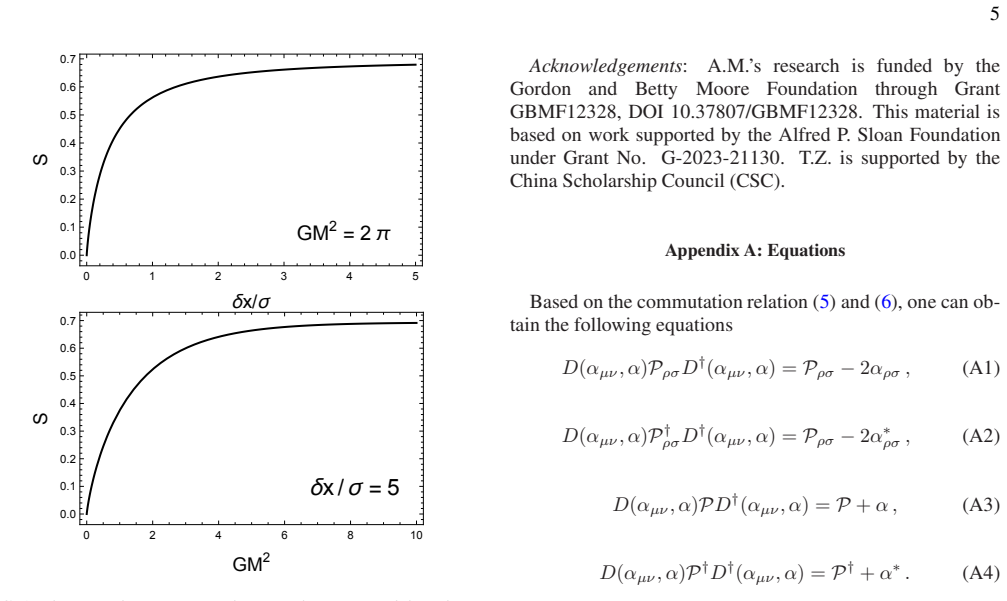
in a perturbative treatment of gravity. 5 GM2 = 2 π 0 1 2 3 4 5 0.0 0.1 0.2 0.3 0.4 0.5 0.6 0.7 δx/σ S δx / σ = 5 0 2 4 6 8 10 0.0 0.1 0.2 0.3 0.4 0.5 0.6 0.7 GM2 S FIG. 1. The entanglement entropy between the matter and the c oher- ent state of the graviton as a function of the superposition s ize δx and the mass M of the matter, where we set GM 2 = 2π a...
-
[3]
and (6), one can ob- tain the following equations D(α µν,α )PρσD†(α µν,α ) = Pρσ − 2α ρσ , (A1) D(α µν,α )P † ρσD†(α µν,α ) = Pρσ − 2α ∗ ρσ , (A2) D(α µν,α )PD†(α µν,α ) = P +α, (A3) D(α µν,α )P †D†(α µν,α ) = P † +α ∗. (A4) Then, we have DP † µν P µνD† =P † µν P µν − 2(α ∗ µν P µν +α µν P † µν ) + 4|α µν |2, (A5) DP †PD† = P †P + (α ∗ P +α P †) + |α |2, ...
-
[4]
+ikX0 cosθ(cos Ωt1 − cos Ωt2) − σ 2ω 2 k ] [ ∑ λ e11 λ (n)e11 λ (n)] = C2 ∫ t 0 dt′ 1dt′ 2 ∫ ∞ 0 dk ∫ π 0 dθ ∫ 2π 0 dφk2(sinθ)3 2ω k exp [ iω k(t′ 1 − t′
-
[5]
(B19) Similarly, we have ∫ dk ∑ λ |α − k,λ |2 = ∫ dk ∑ λ |α + k,λ |2
+ikX0 cosθ(cos Ωt1 − cos Ωt2) − σ 2ω 2 k ] = 4π C2 ∫ t 0 dt′ 1dt′ 2 ∫ ∞ 0 dk sin(kXt) − kXt cos(kXt) k2X 3 t eik(t′ 1− t′ 2)− σ 2k2 = 8π C2 ∫ t 0 dt′ 1 ∫ t′ 1 0 dt′ 2 ∫ ∞ 0 dk sin(kXt) − kXt cos(kXt) k2X 3 t cos[k(t′ 1 − t′ 2)]e− σ 2k2 (B16) whereθ is the angle between k and ˆx− axis and we have de- fined C2 ≡ GM 2 16π 5 Ω 4X 4 0, (B17) Xt ≡ X0(cos Ωt′ 1 −...
-
[6]
(B23) where the integral kernel K(k,t ′ 1,t ′
cos(k(t′ 1 − t′ 2))e− σ 2k2 ] . (B23) where the integral kernel K(k,t ′ 1,t ′
-
[7]
is defined by K(k,t ′ 1,t ′
-
[8]
(B24) Here, we focus on a special case in which the amplitude of the harmonic oscillation is much smaller than the wave lengt h of the gravitational waves, namely kX0 ≪ 1
= sin(kXt) − kXt cos(kXt) k2X 3 t − sin(kX ′ t) − kX ′ t cos(kX ′ t) k2(X ′ t)3 . (B24) Here, we focus on a special case in which the amplitude of the harmonic oscillation is much smaller than the wave lengt h of the gravitational waves, namely kX0 ≪ 1. In this case, the integral kernel (B24) is K(k,t ′ 1,t ′
-
[9]
≈ k3 30 [(X ′ t)2 − X 2 t ]. (B25) Therefore, one can compute the overlap between the coherent states of the gravitons when the matter wave trajectories ar e 8 closed, namelyt = 2π/ Ω , C(t = 2π/ Ω) ≈ exp [ − GM 2 30π 2 Ω 6X 6 0 ] . (B26) As we can see for a large superposition size ∼ X0 and mass ∼ M , the overlap between the coherent states of graviton o...
-
[10]
Colella, A
R. Colella, A. W. Overhauser, and S. A. Werner, Ob- servation of gravitationally induced quantum interferenc e, Phys. Rev. Lett. 34, 1472 (1975)
1975
-
[11]
S. A. Werner, J. L. Staudenmann, and R. Colella, EF- FECT OF EARTH’S ROTA TION ON THE QUAN- TUM MECHANICAL PHASE OF THE NEUTRON, Phys. Rev. Lett. 42, 1103 (1979)
1979
-
[12]
J. B. Fixler, G. T. Foster, J. M. McGuirk, and M. A. Kasevich, Atom interferometer measurement of the Newtonian constant of gravity, Science 315, 74 (2007)
2007
-
[13]
P . Asenbaum, C. Overstreet, T. Kovachy, D. D. Brown, J. M. Hogan, and M. A. Kasevich, Phase Shift in an Atom Interferometer due to Spacetime Curvature across its Wave Function, Phys. Rev. Lett. 118, 183602 (2017) , arXiv:1610.03832 [physics.atom-ph]
-
[14]
Schaff, T
J.-F. Schaff, T. Langen, and J. Schmiedmayer, Interferomet ry with atoms, La Rivista del Nuovo Cimento 37, 509 (2014)
2014
-
[15]
Kovachy, Quantum superposition at the half-metre scale, et.al, Nature 528, 530–533 (2015)
T. Kovachy, Quantum superposition at the half-metre scale, et.al, Nature 528, 530–533 (2015)
2015
-
[16]
Asenbaum, C
P . Asenbaum, C. Overstreet, T. Kovachy, D. D. Brown, J. M. Hogan, and M. A. Kasevich, Phase shift in an atom interfer- ometer due to spacetime curvature across its wave function, Physical review letters 118, 183602 (2017)
2017
-
[17]
Arndt, O
M. Arndt, O. Nairz, J. V os-Andreae, C. Keller, G. V an der Zouw, and A. Zeilinger, Wave–particle duality of c60 molecules, Nature 401, 680 (1999)
1999
-
[18]
S. Eibenberger, S. Gerlich, M. Arndt, M. Mayor, and J. T¨ uxen, Matter-wave interference with particles se- lected from a molecular library with masses exceeding 10000 amu, Phys. Chem. Chem. Phys. 15, 14696 (2013) , arXiv:1310.8343 [quant-ph]
-
[19]
P . Haslinger, N. D¨ orre, P . Geyer, J. Rodewald, S. Nimm- richter, and M. Arndt, A universal matter-wave interferom- eter with optical ionization gratings in the time domain, Nature Phys. 9, 144 (2014) , arXiv:1402.1364 [quant-ph]
-
[20]
Arndt and K
M. Arndt and K. Hornberger, Testing the limits of quantum me- chanical superpositions, Nature Physics 10, 271 (2014)
2014
-
[21]
Y . Y . Fein, P . Geyer, P . Zwick, F. Kiałka, S. Pedalino, M. Mayor, S. Gerlich, and M. Arndt, Quantum superposition of molecule s beyond 25 kDa, Nature Phys. 15, 1242 (2019)
2019
-
[22]
Pedalino, B
S. Pedalino, B. E. Ram´ ırez-Galindo, R. Ferstl, K. Horn- berger, M. Arndt, and S. Gerlich, Probing quantum mechanics with nanoparticle matter-wave interferometry, Nature 649, 866 (2026)
2026
-
[23]
Margalit, O
Y . Margalit, O. Dobkowski, Z. Zhou, O. Amit, Y . Japha, S. Moukouri, D. Rohrlich, A. Mazumdar, S. Bose, C. Henkel, et al. , Realization of a complete stern- gerlach interferometer: Toward a test of quantum gravity, Science advances 7, eabg2879 (2021)
2021
-
[24]
S. N. Gupta, Quantization of einstein’s gravitational field: General treatment, Proceedings of the Physical Society. Section A 65, 608 (1952)
1952
-
[25]
J. F. Donoghue, General relativity as an effec- tive field theory: The leading quantum corrections, Phys. Rev. D 50, 3874 (1994) , arXiv:gr-qc/9405057
work page Pith review arXiv 1994
-
[26]
Toroˇ s, A
M. Toroˇ s, A. Mazumdar, and S. Bose, Loss of co- herence and coherence protection from a graviton bath, Physical Review D 109, 084050 (2024)
2024
- [27]
-
[28]
S. Bose, A. Mazumdar, G. W. Morley, H. Ulbricht, M. Toroˇ s, M. Paternostro, A. Geraci, P . Barker, M. S. Kim, and G. Milburn, Spin Entanglement Witness for Quantum Gravity, Phys. Rev. Lett. 119, 240401 (2017) , arXiv:1707.06050 [quant-ph]
work page Pith review arXiv 2017
-
[29]
https://www.youtube.com/watch?v=0Fv-0k13s_k (2016), accessed 1/11/22
2016
-
[30]
Marletto and V
C. Marletto and V . V edral, Gravitationally induced entanglement between two massive particles is suf- ficient evidence of quantum effects in gravity, Phys. Rev. Lett. 119, 240402 (2017)
2017
-
[31]
A Spin-Based Pathway to Testing the Quantum Nature of Gravity,
S. Bose et al. , A Spin-Based Pathway to Testing the Quantum Nature of Gravity (2025) arXiv:2509.01586 [quant-ph]
-
[32]
R. J. Marshman, A. Mazumdar, and S. Bose, Locality and en- tanglement in table-top testing of the quantum nature of lin - earized gravity, Physical Review A 101, 052110 (2020)
2020
- [33]
-
[34]
U. K. Beckering Vinckers, ´A. De La Cruz- Dombriz, and A. Mazumdar, Quantum entanglement of masses with nonlocal gravitational interaction, Physical Review D 107, 124036 (2023)
2023
-
[35]
Belenchia et al
A. Belenchia et al. , Quantum Superposition of Massive Objects and the Quantization of Gravity, Phys. Rev. D 98, 126009 (2018)
2018
-
[36]
Christodoulou, A
M. Christodoulou, A. Di Biagio, M. Aspelmeyer, ˇC. Brukner, C. Rovelli, and R. Howl, Locally me- diated entanglement in linearized quantum gravity, Physical Review Letters 130, 100202 (2023)
2023
-
[37]
Christodoulou and C
M. Christodoulou and C. Rovelli, On the possibility of lab- oratory evidence for quantum superposition of geometries, Physics Letters B 792, 64 (2019)
2019
-
[38]
Newton, entanglement, and the graviton,
D. Carney, Newton, entanglement, and the graviton, Phys. Rev. D 105, 024029 (2022) , arXiv:2108.06320 [quant-ph]
-
[39]
Carney, P
D. Carney, P . C. E. Stamp, and J. M. Taylor, Table- top experiments for quantum gravity: a user’s manual, Class. Quant. Grav. 36, 034001 (2019)
2019
-
[40]
D. L. Danielson, G. Satishchandran, and R. M. Wald, Gravita- tionally mediated entanglement: Newtonian field versus gra vi- tons, Phys. Rev. D 105, 086001 (2022)
2022
- [41]
-
[42]
Chakraborty, A
S. Chakraborty, A. Mazumdar, and R. Pradhan, Distinguish- 9 ing jordan and einstein frames in gravity through entanglem ent, Physical Review D 108, L121505 (2023)
2023
- [43]
-
[44]
Englert, J
B. Englert, J. Schwinger, and M. O. Scully, Is spin co- herence like humpty-dumpty? i. simplified treatment, Foundations of Physics 18, 1045 (1988)
1988
-
[45]
Schwinger, M
J. Schwinger, M. O. Scully, and B. G. En- glert, Is spin coherence like Humpty-Dumpty?, Zeitschrift fur Physik D Atoms Molecules Clusters 10, 135 (1988)
1988
-
[46]
M. O. Scully, B.-G. Englert, and J. Schwinger, Spin co- herence and humpty-dumpty. iii. the effects of observation , Phys. Rev. A 40, 1775 (1989)
1989
-
[47]
Calzetta and B
E. Calzetta and B. L. Hu, Noise and fluctuations in semiclassi - cal gravity, Physical Review D 49, 6636–6655 (1994)
1994
-
[48]
Anastopoulos, Quantum theory of nonrelativistic parti- cles interacting with gravity, Phys
C. Anastopoulos, Quantum theory of nonrelativistic parti- cles interacting with gravity, Phys. Rev. D 54, 1600 (1996) , arXiv:gr-qc/9511004
-
[49]
C. Anastopoulos and B. L. Hu, A Master Equation for Gravitational Decoherence: Probing the Textures of Spacetime, Class. Quant. Grav. 30, 165007 (2013) , arXiv:1305.5231 [gr-qc]
-
[50]
M. P . Blencowe, Effective field theory approach to gravitati on- ally induced decoherence, Phys. Rev. Lett. 111, 021302 (2013)
2013
-
[51]
V . A. De Lorenci and L. H. Ford, Decoherence induced by long wavelength gravitons, Phys. Rev. D 91, 044038 (2015)
2015
-
[52]
Oniga and C
T. Oniga and C. H.-T. Wang, Quantum coherence, radiance, and resistance of gravitational systems, Phys. Rev. D 96, 084014 (2017)
2017
- [53]
- [54]
-
[55]
Parikh, F
M. Parikh, F. Wilczek, and G. Za- hariade, The noise of gravitons, International Journal of Modern Physics D 29, 2042001 (2020)
2020
-
[56]
M. Toroˇ s, T. W. V an De Kamp, R. J. Marshman, M. S. Kim, A. Mazumdar, and S. Bose, Relative acceleration noise mitigation for nanocrystal matter-wave interferome - try: Applications to entangling masses via quantum gravity , Phys. Rev. Res. 3, 023178 (2021) , arXiv:2007.15029 [gr-qc]
-
[57]
A. Biggs and J. Maldacena, Comparing the decoherence effects due to black holes versus ordinary matter (2024) arXiv:2405.02227 [hep-th]
-
[58]
De Sabbata and M
V . De Sabbata and M. Gasperini, Introduction to gravitation (World Scientific Publishing Company, 1986)
1986
- [59]
- [60]
-
[61]
S. Bose, A. Mazumdar, and M. Toroˇ s, Infrared scaling for a graviton condensate, Nuclear Physics B 977, 115730 (2022)
2022
-
[62]
S. Bose, A. Mazumdar, and M. Toroˇ s, Gravitons in a box, Physical Review D 104, 066019 (2021)
2021
-
[63]
Machluf, Y
S. Machluf, Y . Japha, and R. Folman, Coherent stern–gerlach momentum splitting on an atom chip, Nature Communications 4, 2424 (2013)
2013
-
[64]
O. Amit, Y . Margalit, O. Dobkowski, Z. Zhou, Y . Japha, M. Zimmermann, M. A. Efremov, F. A. Narducci, E. M. Rasel, W. P . Schleich, and R. Folman, T 3 stern-gerlach matter-wave interferometer, Phys. Rev. Lett. 123, 083601 (2019)
2019
-
[65]
C. Wan, M. Scala, G. Morley, A. Rahman, H. Ulbricht, J. Bateman, P . Barker, S. Bose, and M. Kim, Free nano- object Ramsey interferometry for large quantum superposi- tions, Phys. Rev. Lett. 117, 143003 (2016)
2016
-
[66]
C. Wan, M. Scala, S. Bose, A. C. Frangeskou, A. T. M. A. Rahman, G. W. Morley, P . F. Barker, and M. S. Kim, Toler- ance in the Ramsey interference of a trapped nanodiamond, Phys. Rev. A 93, 043852 (2016)
2016
-
[67]
J. S. Pedernales, G. W. Morley, and M. B. Plenio, Motional dy- namical decoupling for interferometry with macroscopic pa rti- cles, Phys. Rev. Lett. 125, 023602 (2020)
2020
- [68]
discussion (0)
Sign in with ORCID, Apple, or X to comment. Anyone can read and Pith papers without signing in.