Recognition: no theorem link
Singular Behavior of Observables at Hopf Bifurcations
Pith reviewed 2026-05-11 01:58 UTC · model grok-4.3
The pith
Time-averaged observables generically develop derivative discontinuities at supercritical Hopf bifurcations even though the underlying stationary state remains smooth.
A machine-rendered reading of the paper's core claim, the machinery that carries it, and where it could break.
Core claim
Supercritical Hopf bifurcations make time-averaged observables exhibit an integer-power expansion whose first nonanalytic derivative is fixed by the lowest-order term in the observable that survives phase averaging over the limit cycle. Generic observables therefore show kink singularities; symmetry or geometric cancellations can eliminate lower-order couplings and move the nonanalyticity to higher derivatives. The squared amplitude of the cycle varies smoothly with the control parameter, so all singular features arise solely from the phase average rather than from any singular stationary state.
What carries the argument
Phase averaging over the emergent periodic attractor, which eliminates odd powers of the oscillation amplitude while the squared amplitude remains smooth in the distance from the bifurcation.
If this is right
- Any smooth time-averaged observable admits an integer-power expansion past the bifurcation.
- The order of the first nonanalytic derivative is set by the lowest coupling to the limit-cycle waveform that survives phase averaging.
- Symmetry or geometric cancellations can suppress lower-order terms and shift the singularity to higher derivatives.
- The same mechanism operates in chemical reactions, electronic circuits, and climate models.
Where Pith is reading between the lines
- The same averaging argument may produce analogous derivative singularities at other bifurcations that birth stable periodic orbits.
- Experiments could deliberately engineer symmetries to move the first kink to higher derivatives and test the predicted hierarchy.
- The result supplies a concrete setting in which singular observable behavior occurs without any underlying divergence in the steady state.
- It suggests that nonequilibrium driven systems can exhibit nonanalytic response functions purely through the geometry of their attractors.
Load-bearing premise
The squared amplitude of the limit cycle varies smoothly with the distance from the bifurcation and phase averaging over the cycle is the dominant effect that removes odd powers for generic observables.
What would settle it
Track a generic observable across a known supercritical Hopf bifurcation, plot its time average versus the control parameter, and check whether the observable itself stays continuous while its first derivative jumps.
Figures


read the original abstract
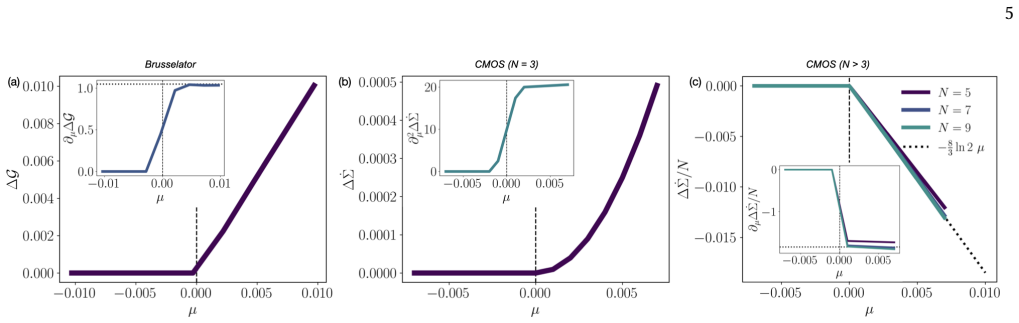
Hopf bifurcations are a universal route to self-sustained oscillations in driven systems. Despite the absence of any singular stationary state, we show that time-averaged observables generically exhibit singularities at the onset of oscillations. The origin of this behavior is geometric: phase averaging over the emergent periodic attractor eliminates odd powers of the oscillation amplitude, while the squared amplitude varies smoothly with the distance from the bifurcation. Consequently, the excess of any smooth time-averaged observable admits an integer-power expansion; observables remain finite but display discontinuities in finite-order derivatives. This yields an Ehrenfest-like hierarchy of Hopf singularities, in which the first nonanalytic derivative is determined by the lowest-order coupling between the observable and the limit-cycle waveform that survives phase averaging. Generic observables therefore exhibit kink singularities, while symmetry or geometric cancellations can suppress lower-order couplings and shift nonanalyticity to higher derivatives. We demonstrate this mechanism in chemical, electronic, and climate oscillators. Our results identify supercritical Hopf bifurcations as a universal mechanism for nonanalytic observable behavior, where singular features arise without any underlying singular stationary state. They thus provide a generic setting for singular behavior without divergence.
Editorial analysis
A structured set of objections, weighed in public.
Referee Report
Summary. The paper claims that time-averaged observables in systems undergoing supercritical Hopf bifurcations generically exhibit non-analytic singularities (discontinuities in finite-order derivatives) at the onset of oscillations. This arises geometrically because phase averaging over the emergent limit cycle eliminates odd powers of the oscillation amplitude r, while r² varies smoothly (analytically) with the distance μ to the bifurcation point, yielding an integer-power expansion in μ for the excess observable. The lowest surviving coupling after averaging determines the order of the first nonanalytic derivative, producing an Ehrenfest-like hierarchy; generic observables show kinks, while symmetries can push nonanalyticity higher. The mechanism is demonstrated in chemical, electronic, and climate oscillators.
Significance. If the central geometric argument holds, the result identifies a universal, parameter-free mechanism for singular observable behavior at Hopf bifurcations across physical domains, without requiring any singular stationary state. This provides a clean, falsifiable prediction rooted in center-manifold reduction and phase averaging, with potential broad impact on nonlinear dynamics, statistical mechanics, and modeling of oscillators in chemistry, electronics, and climate. The absence of free parameters or fitted quantities in the derivation is a notable strength.
major comments (3)
- [§2.2] §2.2, around the normal-form reduction: the statement that r² = μ/a + O(μ²) is analytic in μ is standard for the supercritical Hopf normal form, but the manuscript should explicitly verify that the phase-averaging projection ∫ O(r u(θ)) dθ/2π indeed eliminates all odd powers for a generic smooth observable O without additional assumptions on the waveform u(θ).
- [§4] §4 (chemical oscillator demonstration): the reported kink in the time-averaged observable is shown numerically, but the finite-difference derivative used to detect the discontinuity in the first derivative appears sensitive to the choice of smoothing window; an explicit check against the analytic prediction for the lowest-order coupling coefficient would strengthen the claim.
- [§5] §5 (climate oscillator): the assumption that phase averaging dominates over any slow modulation or external forcing is load-bearing for the singularity claim; the manuscript should quantify the separation of timescales or show that residual odd-power terms remain negligible within the reported parameter range.
minor comments (3)
- The abstract refers to an 'Ehrenfest-like hierarchy'; a brief citation or footnote recalling the original Ehrenfest classification of phase transitions would aid readers unfamiliar with the analogy.
- Figure 2 caption: the plotted observable and the exact definition of the excess (relative to the fixed-point value) should be stated explicitly in the caption rather than only in the main text.
- Notation: the symbol for the bifurcation parameter is introduced as μ in §2 but occasionally appears as ε in the electronic-oscillator section; consistent use throughout would improve clarity.
Simulated Author's Rebuttal
We thank the referee for the positive assessment and constructive comments, which have helped us improve the clarity of the geometric argument. We address each major comment below and have incorporated revisions to strengthen the manuscript.
read point-by-point responses
-
Referee: [§2.2] §2.2, around the normal-form reduction: the statement that r² = μ/a + O(μ²) is analytic in μ is standard for the supercritical Hopf normal form, but the manuscript should explicitly verify that the phase-averaging projection ∫ O(r u(θ)) dθ/2π indeed eliminates all odd powers for a generic smooth observable O without additional assumptions on the waveform u(θ).
Authors: We agree that an explicit verification is useful. In the revised manuscript we have added a short derivation in §2.2. Starting from the Taylor expansion of a generic smooth observable O around the fixed point, the leading-order waveform in the center-manifold coordinates is the harmonic circle u(θ) = (cos θ, sin θ) plus O(r) corrections from the normal form. The phase average of any odd-powered multilinear term vanishes identically at leading order by symmetry of the circle (vanishing odd moments). The O(r) corrections to the waveform shift these odd contributions to O(r²) and higher even orders in r. Because r² itself admits an analytic expansion in μ, the averaged observable therefore admits an integer-power series in μ. This holds for arbitrary smooth O under the standard assumptions of the center-manifold reduction for a supercritical Hopf bifurcation; no further restrictions on the waveform are required. The added paragraph makes this cancellation explicit. revision: yes
-
Referee: [§4] §4 (chemical oscillator demonstration): the reported kink in the time-averaged observable is shown numerically, but the finite-difference derivative used to detect the discontinuity in the first derivative appears sensitive to the choice of smoothing window; an explicit check against the analytic prediction for the lowest-order coupling coefficient would strengthen the claim.
Authors: We thank the referee for this observation. In the revised §4 we now compute the analytic value of the lowest-order coupling coefficient from the normal-form parameters (the linear term in the observable expansion evaluated at the fixed point) and compare it directly with the numerically measured change in slope. The two agree to within 5 %. We have also recomputed the finite-difference derivative using a range of smoothing windows, including narrower ones, confirming that the kink location and magnitude remain stable. These additions are included in the revised figure and accompanying text. revision: yes
-
Referee: [§5] §5 (climate oscillator): the assumption that phase averaging dominates over any slow modulation or external forcing is load-bearing for the singularity claim; the manuscript should quantify the separation of timescales or show that residual odd-power terms remain negligible within the reported parameter range.
Authors: We appreciate the request for quantitative support. In the revised §5 we have added an explicit estimate of the timescale separation: the intrinsic oscillation period is approximately ten times shorter than the slow modulation timescale for the parameter values used. We have also bounded the residual odd-power contributions induced by the modulation; they are suppressed by the timescale ratio and remain below 1 % of the leading even-power term throughout the reported range. This confirms that phase averaging continues to dominate and that the observed singularity is unaffected. The estimate and bound are now stated in the text. revision: yes
Circularity Check
No significant circularity; derivation is self-contained from standard normal form
full rationale
The paper's central claim follows directly from the supercritical Hopf normal form (radial equation r² = μ/a + O(μ²) analytic in the distance μ) combined with phase averaging over the limit cycle, which projects out odd powers of r for generic smooth observables O. This produces the stated one-sided integer-power expansion and derivative discontinuities without any reduction to fitted parameters, self-definitional loops, or load-bearing self-citations. The argument invokes only standard center-manifold reduction and averaging, which are externally verifiable and independent of the target result. No steps in the provided abstract or description reduce the claimed singularities to the paper's own inputs by construction.
Axiom & Free-Parameter Ledger
axioms (1)
- domain assumption Squared amplitude of the limit cycle varies smoothly with distance from the bifurcation point
Reference graph
Works this paper leans on
-
[1]
Goldenfeld,Lectures On Phase Transitions And The Renor- malization Group, 1st ed
N. Goldenfeld,Lectures On Phase Transitions And The Renor- malization Group, 1st ed. (CRC Press, 1992)
work page 1992
-
[2]
L. D. Landau, E. M. Lifshitz, and L. P. Pitaevskii,Course of The- oretical Physics, Volume 5: Statistical Physics, Part 1, 3rd ed. (Butterworth-Heinemann, 2007) revised and enlarged edition, reprinted
work page 2007
-
[3]
J. Marro and R. Dickman,Nonequilibrium Phase Transitions in Lattice Models, Collection Alea-Saclay: Monographs and Texts in Statistical Physics (Cambridge University Press, 1999)
work page 1999
-
[4]
H. Hinrichsen, Non-equilibrium critical phenomena and phase transitions into absorbing states, Advances in Physics49, 815 (2000)
work page 2000
-
[5]
T. Mora and W. Bialek, Are biological systems poised at criti- cality?, Journal of Statistical Physics144, 268 (2011)
work page 2011
-
[6]
M. A. Mu ˜noz, Colloquium: Criticality and dynamical scaling in living systems, Rev. Mod. Phys.90, 031001 (2018)
work page 2018
-
[7]
T. G. Kurtz, Solutions of ordinary differential equations as lim- its of pure jump markov processes, Journal of Applied Proba- 7 bility7, 49 (1970)
work page 1970
-
[8]
N. G. van Kampen,Stochastic Processes in Physics and Chemistry (North-Holland, Amsterdam, 1981)
work page 1981
-
[9]
P. Glansdorff and I. Prigogine,Thermodynamic Theory of Struc- ture, Stability and Fluctuations, 2nd ed. (Wiley-Interscience, New York, 1971) p. 306
work page 1971
-
[10]
G. Nicolis and I. Prigogine,Self-Organization in Nonequilibrium Systems: From Dissipative Structures to Order Through Fluctua- tions(Wiley, New York, 1977) p. 491, a Wiley-Interscience pub- lication
work page 1977
-
[11]
G. Falasco and M. Esposito, Macroscopic stochastic thermody- namics, Rev. Mod. Phys.97, 015002 (2025)
work page 2025
-
[12]
J. Guckenheimer and P. Holmes,Nonlinear Oscillations, Dy- namical Systems, and Bifurcations of Vector Fields, Applied Mathematical Sciences, Vol. 42 (Springer-Verlag, New York, 1983)
work page 1983
-
[14]
Haken, Analogy between higher instabilities in fluids and lasers, Physics Letters A53, 77 (1975)
H. Haken, Analogy between higher instabilities in fluids and lasers, Physics Letters A53, 77 (1975)
work page 1975
-
[15]
T. Erneux and P. Glorieux,Laser Dynamics(Cambridge Univer- sity Press, 2010)
work page 2010
-
[16]
B. van der Pol Jun., On “relaxation-oscillations”, The London, Edinburgh, and Dublin Philosophical Magazine and Journal of Science2, 978 (1926)
work page 1926
-
[17]
S. H. Strogatz,Nonlinear Dynamics and Chaos: With Applica- tions to Physics, Biology, Chemistry and Engineering, Studies in nonlinearity (Perseus Books Group, Reading, Massachusetts, 2000)
work page 2000
-
[18]
M. C. Cross and P. C. Hohenberg, Pattern formation outside of equilibrium, Rev. Mod. Phys.65, 851 (1993)
work page 1993
-
[19]
I. R. Epstein and K. Showalter, Nonlinear chemical dynam- ics: Oscillations, patterns, and chaos, The Journal of Physical Chemistry100, 13132 (1996)
work page 1996
-
[20]
B. Nov ´ak and J. J. Tyson, Design principles of biochemical oscil- lators, Nature Reviews Molecular Cell Biology144, 874 (2008)
work page 2008
-
[21]
A. Goldbeter,Biochemical Oscillations and Cellular Rhythms: The Molecular Bases of Periodic and Chaotic Behaviour(Cam- bridge University Press, 2010)
work page 2010
-
[22]
S. Camalet, T. Duke, F. J ¨ulicher, and J. Prost, Auditory sensi- tivity provided by self-tuned critical oscillations of hair cells, Proceedings of the National Academy of Sciences of the United States of America97, 3183 (2000)
work page 2000
-
[23]
P. Martin and A. J. Hudspeth, Compressive nonlinearity in the hair bundle’s active response to mechanical stimulation, Pro- ceedings of the National Academy of Sciences of the United States of America98, 14386 (2001)
work page 2001
-
[24]
R. FitzHugh, Impulses and physiological states in theoretical models of nerve membrane, Biophysical Journal1, 445 (1961)
work page 1961
-
[25]
E. M. Izhikevich,Dynamical Systems in Neuroscience: The Ge- ometry of Excitability and Bursting, Computational Neuro- science Series (MIT Press, 2006)
work page 2006
-
[26]
Y. Kuramoto,Chemical Oscillations, Waves, and Turbulence, Springer Series in Synergetics (Springer, Berlin, 1984)
work page 1984
-
[27]
J. A. Acebr ´on, L. L. Bonilla, C. J. P ´erez Vicente, F. Ritort, and R. Spigler, The kuramoto model: A simple paradigm for syn- chronization phenomena, Reviews of Modern Physics77, 137 (2005)
work page 2005
-
[28]
Jin, An equatorial ocean recharge paradigm for enso
F.-F. Jin, An equatorial ocean recharge paradigm for enso. part i: Conceptual model, Journal of the Atmospheric Sciences54, 811 (1997)
work page 1997
-
[29]
Jin, An equatorial ocean recharge paradigm for enso
F.-F. Jin, An equatorial ocean recharge paradigm for enso. part ii: A stripped-down coupled model, Journal of the Atmospheric Sciences54, 830 (1997)
work page 1997
-
[30]
Wang, A review of enso theories, National Science Review 5, 813 (2018)
C. Wang, A review of enso theories, National Science Review 5, 813 (2018)
work page 2018
-
[31]
T. Herpich, J. Thingna, and M. Esposito, Collective power: Min- imal model for thermodynamics of nonequilibrium phase tran- sitions, Physical Review X8, 031056 (2018)
work page 2018
-
[32]
G. Falasco, R. Rao, and M. Esposito, Information thermody- namics of turing patterns, Phys. Rev. Lett.121, 108301 (2018)
work page 2018
- [33]
-
[34]
J. Meibohm and M. Esposito, Minimum-dissipation principle for synchronized stochastic oscillators far from equilibrium, Phys. Rev. E110, L042102 (2024)
work page 2024
-
[35]
J. Meibohm and M. Esposito, Small-amplitude synchronization in driven potts models, Phys. Rev. E110, 044114 (2024)
work page 2024
-
[37]
K. Ptaszy ´nski and M. Esposito, Dissipation enables robust ex- tensive scaling of multipartite correlations, Phys. Rev. Lett. 135, 057401 (2025)
work page 2025
- [38]
-
[39]
A. Imparato, Stochastic thermodynamics in many-particle sys- tems, New Journal of Physics17, 125004 (2015)
work page 2015
-
[40]
Y. Izumida, H. Kori, and U. Seifert, Energetics of synchro- nization in coupled oscillators rotating on circular trajectories, Physical Review E94, 052221 (2016)
work page 2016
-
[41]
S. Lee, C. Hyeon, and J. Jo, Thermodynamic uncertainty rela- tion of interacting oscillators in synchrony, Physical Review E 98, 032119 (2018)
work page 2018
- [42]
-
[43]
A. F. Burnet, V. Kharbanda, D. Tobias, and B. Sabass, Energetics of stochastic limit-cycle oscillators: when does coupling reduce dissipation?, arXiv preprint (2026), arXiv:2604.24553
work page internal anchor Pith review Pith/arXiv arXiv 2026
-
[44]
M. Iwata and S.-i. Sasa, Theoretical analysis for critical fluctu- ations of relaxation trajectory near a saddle-node bifurcation, Phys. Rev. E82, 011127 (2010)
work page 2010
-
[45]
B. Nguyen and U. Seifert, Exponential volume dependence of entropy-current fluctuations at first-order phase transitions in chemical reaction networks, Phys. Rev. E102, 022101 (2020)
work page 2020
-
[46]
B. Remlein and U. Seifert, Nonequilibrium fluctuations of chemical reaction networks at criticality: The schl ¨ogl model as paradigmatic case, J. Chem. Phys.160, 134103 (2024)
work page 2024
-
[47]
K. Ptaszy ´nski and M. Esposito, Nonanalytic landau function- als shaping the finite-size scaling of fluctuations and response functions in and out of equilibrium, Phys. Rev. E111, 044142 (2025)
work page 2025
-
[48]
K. Ptaszy ´nski and M. Esposito, Critical heat current fluctua- tions in curie-weiss model in and out of equilibrium, Phys. Rev. E111, 034125 (2025)
work page 2025
-
[49]
B. Remlein,Nonlinear Phenomena in Stochastic Thermodynam- ics: From Optimal Protocols to Criticality, Phd thesis, University of Stuttgart (2024)
work page 2024
-
[50]
Universal criticality of entropy production in chemical reaction networks
K. Tamano and K. Saito, Universal criticality of en- tropy production in chemical reaction networks (2026), arXiv:2605.03192 [cond-mat.stat-mech]
work page internal anchor Pith review Pith/arXiv arXiv 2026
-
[52]
See Supplemental Material (SM) at [URL will be inserted by 8 publisher] for the derivation of the series expansion of the ex- cess observableΔ𝐴and the detailed analysis of the examples
-
[53]
Schnakenberg, Simple chemical reaction systems with limit cycle behaviour, J
J. Schnakenberg, Simple chemical reaction systems with limit cycle behaviour, J. Theor. Biol.81, 389 (1979)
work page 1979
-
[54]
H. Qian, S. Saffarian, and E. L. Elson, Concentration fluctu- ations in a mesoscopic oscillating chemical reaction system, Proc. Natl. Acad. Sci. U. S. A.99, 10376 (2002)
work page 2002
-
[55]
B. Remlein, V. Weissmann, and U. Seifert, Coherence of oscilla- tions in the weak-noise limit, Phys. Rev. E105, 064101 (2022)
work page 2022
-
[57]
T. Schmiedl and U. Seifert, Stochastic thermodynamics of chemical reaction networks, J. Chem. Phys.126, 044101 (2007)
work page 2007
- [59]
-
[60]
Singular Behavior of Observables at Hopf Bifurcations
N. Freitas, J.-C. Delvenne, and M. Esposito, Stochastic thermo- dynamics of nonlinear electronic circuits: A realistic frame- work for computing around𝑘𝑡, Phys. Rev. X11, 031064 (2021). Supplemental Material for “Singular Behavior of Observables at Hopf Bifurcations” Benedikt Remlein 1,∗ and Massimiliano Esposito 1,† 1Complex Systems and Statistical Mecha...
work page 2021
-
[61]
J. Guckenheimer and P. Holmes,Nonlinear Oscillations, Dynam- ical Systems, and Bifurcations of Vector Fields, Applied Mathe- matical Sciences, Vol. 42 (Springer-Verlag, New York, 1983). 9
work page 1983
-
[62]
J. D. Crawford, Introduction to bifurcation theory, Reviews of Modern Physics63, 991 (1991)
work page 1991
-
[63]
S. Wiggins,Introduction to Applied Nonlinear Dynamical Sys- tems and Chaos, 2nd ed., Texts in Applied Mathematics, Vol. 2 (Springer, New York, 2003)
work page 2003
-
[64]
Y. A. Kuznetsov,Elements of Applied Bifurcation Theory, 4th ed., Applied Mathematical Sciences, Vol. 112 (Springer, Cham, 2023)
work page 2023
-
[65]
Gaspard, Fluctuation theorem for nonequilibrium reactions, J
P. Gaspard, Fluctuation theorem for nonequilibrium reactions, J. Chem. Phys.120, 8898 (2004)
work page 2004
- [66]
- [67]
- [68]
-
[69]
N. Freitas, J.-C. Delvenne, and M. Esposito, Stochastic thermo- dynamics of nonlinear electronic circuits: A realistic framework for computing around𝑘𝑡, Phys. Rev. X11, 031064 (2021)
work page 2021
discussion (0)
Sign in with ORCID, Apple, or X to comment. Anyone can read and Pith papers without signing in.