Recognition: unknown
Mixed-Parity Altermagnetism in Collinear Spin-Orbital Magnets
Pith reviewed 2026-05-08 15:59 UTC · model grok-4.3
The pith
Collinear antiferromagnets with zero net magnetization can host mixed-parity spin splitting that is neither purely even nor odd in momentum.
A machine-rendered reading of the paper's core claim, the machinery that carries it, and where it could break.
Core claim
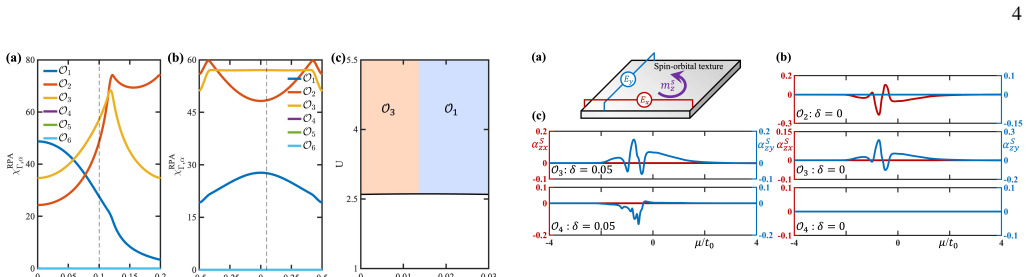
Collinear antiferromagnets with zero net magnetization host mixed-parity spin splitting when the two antiparallel spin sectors are related by a single mirror symmetry in two dimensions. In a two-sublattice two-orbital model, circularly polarized light induces mixed-parity altermagnetism at finite staggered potential and odd-parity spin-orbital altermagnetism at zero staggered potential, positioning mixed-parity altermagnetism as the intermediate spin-split regime between even- and odd-parity forms.
What carries the argument
The single mirror symmetry relating the two antiparallel spin sectors in a two-sublattice two-orbital model, which permits mixed-parity spin splitting under finite staggered potential.
If this is right
- Mixed-parity altermagnetism appears at finite staggered potential under circularly polarized light.
- Odd-parity spin-orbital altermagnetism appears at zero staggered potential.
- Mixed-parity altermagnetism serves as the intermediate state between even- and odd-parity altermagnetism.
- Spin-resolved orbital Edelstein effects provide an electrical probe of the spin-orbital order.
Where Pith is reading between the lines
- Light control may allow tuning between different parity regimes of altermagnetism in 2D materials.
- The mirror symmetry condition could enable hybrid spintronic responses that combine features of even- and odd-parity states.
- Similar mixed-parity effects might appear in other collinear magnetic systems with related symmetries.
Load-bearing premise
The two antiparallel spin sectors are related by a single mirror symmetry in two dimensions.
What would settle it
Observation of momentum-dependent spin splitting in a collinear antiferromagnet with zero net magnetization that is neither even nor odd under the mirror symmetry relating the spin sectors.
Figures


read the original abstract
Altermagnetism has so far mainly been understood in its even- and odd-parity forms. We show that collinear antiferromagnets with zero net magnetization can also host mixed-parity spin splitting, namely neither purely even nor purely odd in momentum. We identify the symmetry conditions for such mixed-parity altermagnetism and show that, in two dimensions, it can arise in spin-orbital magnets when the two antiparallel spin sectors are related by a single mirror symmetry. Using a two-sublattice two-orbital model, we demonstrate that circularly polarized light induces mixed-parity altermagnetism at finite staggered potential and odd-parity spin-orbital altermagnetism at zero staggered potential. Mixed-parity altermagnetism thereby emerges as the intermediate spin-split regime between even- and odd-parity altermagnetism when spin splitting and zero net magnetization are maintained. Spin-resolved orbital Edelstein effects provide a complementary electrical probe of the underlying spin-orbital order.
Editorial analysis
A structured set of objections, weighed in public.
Referee Report
Summary. The paper claims that collinear antiferromagnets with zero net magnetization can host mixed-parity spin splitting (neither purely even nor purely odd in momentum). It identifies symmetry conditions for mixed-parity altermagnetism and shows that, in two dimensions, this arises in spin-orbital magnets when the two antiparallel spin sectors are related by a single mirror symmetry. Using a two-sublattice two-orbital model, the authors demonstrate that circularly polarized light induces mixed-parity altermagnetism at finite staggered potential (and odd-parity spin-orbital altermagnetism at zero staggered potential). They propose spin-resolved orbital Edelstein effects as an electrical probe of the underlying order.
Significance. If the central claim holds, the work meaningfully extends the classification of altermagnets by identifying an intermediate mixed-parity regime that preserves collinear order and zero net magnetization. The light-induced transition between parity regimes and the proposed electrical probe constitute concrete, testable predictions. The symmetry-based construction and two-orbital model provide a clear route for material realization in spin-orbit coupled systems.
major comments (2)
- [Symmetry conditions] Symmetry conditions section: the assertion that relating the two antiparallel spin sectors by exactly one mirror symmetry permits an effective spin-splitting function f(k) containing both even and odd momentum components (while preserving zero net magnetization) is load-bearing. Standard mirror constraints (e.g., M k_x M^{-1} = -k_x) typically enforce definite parity in spin-orbit or exchange terms; the manuscript must explicitly derive the allowed Hamiltonian terms and show that mixed parity survives at finite staggered potential without inducing net magnetization or reducing to pure parity.
- [Two-sublattice two-orbital model] Two-sublattice two-orbital model and light-induction demonstration: the effective f(k) after including the staggered potential and circularly polarized light should be expanded to confirm mixed even-odd character. If the staggered potential or light term breaks the zero-magnetization constraint or forces the splitting to be purely even/odd, the mixed-parity claim does not hold. Explicit band-structure or analytic expansion of the spin-resolved dispersion is required to substantiate the intermediate-regime interpretation.
minor comments (1)
- [Introduction] The abstract refers to 'odd-parity spin-orbital altermagnetism' at zero staggered potential; a brief comparison table or sentence in the introduction clarifying how this reduces to the known odd-parity case would improve readability.
Simulated Author's Rebuttal
We thank the referee for the careful reading, positive assessment of the work's significance, and constructive comments that help clarify the presentation. We address each major comment below and have revised the manuscript accordingly to provide the requested explicit derivations and expansions.
read point-by-point responses
-
Referee: [Symmetry conditions] Symmetry conditions section: the assertion that relating the two antiparallel spin sectors by exactly one mirror symmetry permits an effective spin-splitting function f(k) containing both even and odd momentum components (while preserving zero net magnetization) is load-bearing. Standard mirror constraints (e.g., M k_x M^{-1} = -k_x) typically enforce definite parity in spin-orbit or exchange terms; the manuscript must explicitly derive the allowed Hamiltonian terms and show that mixed parity survives at finite staggered potential without inducing net magnetization or reducing to pure parity.
Authors: We agree that the symmetry argument is central and benefits from a more explicit derivation. In the revised manuscript we add a dedicated subsection that starts from the single-mirror symmetry relating the two antiparallel spin sectors and systematically enumerates the allowed spin-orbit and exchange terms in the Hamiltonian. We then construct the effective spin-splitting function f(k) and show analytically that it contains both even and odd momentum components. We further demonstrate that a finite staggered potential does not induce net magnetization (the collinear antiferromagnetic order is preserved by construction) and does not force f(k) to become purely even or purely odd; the mixed-parity character survives. This explicit expansion directly addresses the concern that standard mirror constraints might enforce definite parity. revision: yes
-
Referee: [Two-sublattice two-orbital model] Two-sublattice two-orbital model and light-induction demonstration: the effective f(k) after including the staggered potential and circularly polarized light should be expanded to confirm mixed even-odd character. If the staggered potential or light term breaks the zero-magnetization constraint or forces the splitting to be purely even/odd, the mixed-parity claim does not hold. Explicit band-structure or analytic expansion of the spin-resolved dispersion is required to substantiate the intermediate-regime interpretation.
Authors: We thank the referee for highlighting the need for explicit confirmation. In the revised version we provide the analytic expansion of the effective f(k) that incorporates both the staggered potential and the circularly polarized light term. The resulting expression explicitly contains mixed even-odd momentum components. We also derive the spin-resolved dispersion relations and include representative band-structure plots for finite and zero staggered potential. These additions confirm that neither the staggered potential nor the light term violates zero net magnetization or collapses the splitting to pure parity, thereby substantiating the intermediate mixed-parity regime between even- and odd-parity altermagnetism. revision: yes
Circularity Check
No circularity: symmetry identification and model demonstration are independent
full rationale
The paper identifies symmetry conditions allowing mixed-parity spin splitting in collinear antiferromagnets and demonstrates the effect in a two-sublattice two-orbital model under circularly polarized light and staggered potential. No equations, fitted parameters, or self-citations are referenced in the provided text that would reduce the central claim to a self-defined input or prior result by construction. The derivation relies on explicit symmetry analysis and explicit model construction rather than renaming, fitting, or load-bearing self-reference, making the result self-contained against external benchmarks.
Axiom & Free-Parameter Ledger
axioms (1)
- domain assumption Two antiparallel spin sectors related by a single mirror symmetry permit mixed-parity spin splitting while preserving zero net magnetization
Reference graph
Works this paper leans on
-
[1]
J. E. Hirsch, Spin-split states in metals, Phys. Rev. B41, 6820 (1990)
1990
-
[2]
Ikeda and Y
H. Ikeda and Y . Ohashi, Theory of unconventional spin density wave: A possible mechanism of the micromagnetism in u-based heavy fermion compounds, Phys. Rev. Lett.81, 3723 (1998)
1998
-
[3]
Wu and S.-C
C. Wu and S.-C. Zhang, Dynamic generation of spin-orbit cou- pling, Phys. Rev. Lett.93, 036403 (2004)
2004
-
[4]
C. Wu, K. Sun, E. Fradkin, and S.-C. Zhang, Fermi liquid in- stabilities in the spin channel, Phys. Rev. B75, 115103 (2007)
2007
-
[5]
Hayami, Y
S. Hayami, Y . Yanagi, and H. Kusunose, Momentum-dependent spin splitting by collinear antiferromagnetic ordering, Journal of the Physical Society of Japan88, 123702 (2019)
2019
-
[6]
Hayami, Y
S. Hayami, Y . Yanagi, and H. Kusunose, Bottom-up design of spin-split and reshaped electronic band structures in antiferro- magnets without spin-orbit coupling: Procedure on the basis of augmented multipoles, Phys. Rev. B102, 144441 (2020)
2020
-
[7]
Q. Liu, X. Dai, and S. Bl ¨ugel, Different facets of unconven- tional magnetism, Nature Physics21, 329 (2025)
2025
-
[8]
H. Chen, Q. Niu, and A. H. MacDonald, Anomalous hall effect arising from noncollinear antiferromagnetism, Phys. Rev. Lett. 112, 017205 (2014)
2014
-
[9]
Nakatsuji, N
S. Nakatsuji, N. Kiyohara, and T. Higo, Large anomalous hall effect in a non-collinear antiferromagnet at room temperature, Nature527, 212 (2015)
2015
-
[10]
ˇSmejkal, A
L. ˇSmejkal, A. H. MacDonald, J. Sinova, S. Nakatsuji, and T. Jungwirth, Anomalous Hall antiferromagnets, Nature Re- views Materials7, 482 (2022)
2022
-
[11]
A. Birk Hellenes, T. Jungwirth, R. Jaeschke-Ubiergo, A. Chakraborty, J. Sinova, and L. ˇSmejkal, P-wave magnets, arXiv e-prints , arXiv:2309.01607 (2023)
-
[12]
Brekke, P
B. Brekke, P. Sukhachov, H. G. Giil, A. Brataas, and J. Linder, Minimal Models and Transport Properties of Unconventional p-Wave Magnets, Phys. Rev. Lett.133, 236703 (2024)
2024
-
[13]
Y . P. Zhu, X. Chen, X. R. Liu, Y . Liu, P. Liu, H. Zha, G. Qu, C. Hong, J. Li, Z. Jiang, X. M. Ma, Y . J. Hao, M. Y . Zhu, W. Liu, M. Zeng, S. Jayaram, M. Lenger, J. Ding, S. Mo, K. Tanaka, M. Arita, Z. Liu, M. Ye, D. Shen, J. Wrachtrup, Y . Huang, R. H. He, S. Qiao, Q. Liu, and C. Liu, Observation of plaid-like spin splitting in a noncoplanar antiferrom...
2024
-
[14]
Y . Yu, M. B. Lyngby, T. Shishidou, M. Roig, A. Kreisel, M. Weinert, B. M. Andersen, and D. F. Agterberg, Odd-Parity Magnetism Driven by Antiferromagnetic Exchange, Phys. Rev. Lett.135, 046701 (2025)
2025
-
[15]
Q. Song, S. Stavri ´c, P. Barone, A. Droghetti, D. S. Anto- nenko, J. W. Venderbos, C. A. Occhialini, B. Ilyas, E. Ergec ¸en, N. Gedik, S. W. Cheong, R. M. Fernandes, S. Picozzi, and R. Comin, Electrical switching of a p-wave magnet, Nature642, 64 (2025)
2025
-
[16]
R. Yamada, M. T. Birch, P. R. Baral, S. Okumura, R. Nakano, 6 S. Gao, M. Ezawa, T. Nomoto, J. Masell, Y . Ishihara, K. K. Kolincio, I. Belopolski, H. Sagayama, H. Nakao, K. Ohishi, T. Ohhara, R. Kiyanagi, T. Nakajima, Y . Tokura, T. hisa Arima, Y . Motome, M. M. Hirschmann, and M. Hirschberger, Metallicp-wave magnet with commensurate spin helix (2025), ar...
-
[17]
Zhuang, D
Z.-Y . Zhuang, D. Zhu, Z. Wu, and Z. Yan, Cartesian nodal lines and magnetic kramers weyl nodes in spin-split antiferromag- nets, Newton , 100403 (2026)
2026
-
[18]
H.-Y . Ma, M. Hu, N. Li, J. Liu, W. Yao, J.-F. Jia, and J. Liu, Multifunctional antiferromagnetic materials with giant piezo- magnetism and noncollinear spin current, Nature Communica- tions12, 2846 (2021)
2021
-
[19]
ˇSmejkal, J
L. ˇSmejkal, J. Sinova, and T. Jungwirth, Emerging Research Landscape of Altermagnetism, Phys. Rev. X12, 040501 (2022)
2022
-
[20]
ˇSmejkal, J
L. ˇSmejkal, J. Sinova, and T. Jungwirth, Beyond Conventional Ferromagnetism and Antiferromagnetism: A Phase with Non- relativistic Spin and Crystal Rotation Symmetry, Phys. Rev. X 12, 031042 (2022)
2022
-
[21]
L.-D. Yuan, Z. Wang, J.-W. Luo, E. I. Rashba, and A. Zunger, Giant momentum-dependent spin splitting in centrosymmetric low-Zantiferromagnets, Phys. Rev. B102, 014422 (2020)
2020
-
[22]
L.-D. Yuan, Z. Wang, J.-W. Luo, and A. Zunger, Prediction of low-Z collinear and noncollinear antiferromagnetic compounds having momentum-dependent spin splitting even without spin- orbit coupling, Phys. Rev. Mater.5, 014409 (2021)
2021
-
[23]
P. Liu, J. Li, J. Han, X. Wan, and Q. Liu, Spin-Group Symme- try in Magnetic Materials with Negligible Spin-Orbit Coupling, Phys. Rev. X12, 021016 (2022)
2022
-
[24]
X. Chen, J. Ren, Y . Zhu, Y . Yu, A. Zhang, P. Liu, J. Li, Y . Liu, C. Li, and Q. Liu, Enumeration and Representation Theory of Spin Space Groups, Phys. Rev. X14, 031038 (2024)
2024
-
[25]
Jiang, Z
Y . Jiang, Z. Song, T. Zhu, Z. Fang, H. Weng, Z.-X. Liu, J. Yang, and C. Fang, Enumeration of spin-space groups: Toward a com- plete description of symmetries of magnetic orders, Phys. Rev. X14, 031039 (2024)
2024
-
[26]
Z. Xiao, J. Zhao, Y . Li, R. Shindou, and Z.-D. Song, Spin Space Groups: Full Classification and Applications, Phys. Rev. X14, 031037 (2024)
2024
-
[27]
Y . Liu, X. Chen, Y . Yu, J. Etxebarria, J. M. Perez-Mato, and Q. Liu, Symmetry classification of magnetic orders using ori- ented spin space groups, Nature652, 869 (2026)
2026
-
[28]
Osumi, S
T. Osumi, S. Souma, T. Aoyama, K. Yamauchi, A. Honma, K. Nakayama, T. Takahashi, K. Ohgushi, and T. Sato, Obser- vation of a giant band splitting in altermagnetic MnTe, Phys. Rev. B109, 115102 (2024)
2024
-
[29]
S. Lee, S. Lee, S. Jung, J. Jung, D. Kim, Y . Lee, B. Seok, J. Kim, B. G. Park, L. ˇSmejkal, C.-J. Kang, and C. Kim, Broken Kramers Degeneracy in Altermagnetic MnTe, Phys. Rev. Lett. 132, 036702 (2024)
2024
-
[30]
Krempask ´y, L
J. Krempask ´y, L. ˇSmejkal, S. W. D’Souza, M. Hajlaoui, G. Springholz, K. Uhl ´ıˇrov´a, F. Alarab, P. C. Constantinou, V . Strocov, D. Usanov, W. R. Pudelko, R. Gonz´alez-Hern´andez, A. Birk Hellenes, Z. Jansa, H. Reichlov´a, Z. ˇSob´aˇn, R. D. Gon- zalez Betancourt, P. Wadley, J. Sinova, D. Kriegner, J. Min ´ar, J. H. Dil, and T. Jungwirth, Altermagneti...
2024
-
[31]
Hajlaoui, S
M. Hajlaoui, S. Wilfred D’Souza, L. ˇSmejkal, D. Krieg- ner, G. Krizman, T. Zakusylo, N. Olszowska, O. Caha, J. Michaliˇcka, J. S´anchez-Barriga, A. Marmodoro, K. V´yborn´y, A. Ernst, M. Cinchetti, J. Minar, T. Jungwirth, and G. Springholz, Temperature dependence of relativistic valence band splitting induced by an altermagnetic phase transition, Ad- vanc...
2024
-
[32]
Reimers, L
S. Reimers, L. Odenbreit, L. ˇSmejkal, V . N. Strocov, P. Con- stantinou, A. B. Hellenes, R. Jaeschke Ubiergo, W. H. Campos, V . K. Bharadwaj, A. Chakraborty, T. Denneulin, W. Shi, R. E. Dunin-Borkowski, S. Das, M. Kl¨aui, J. Sinova, and M. Jourdan, Direct observation of altermagnetic band splitting in CrSb thin films, Nature Communications15, 2116 (2024)
2024
-
[33]
J. Ding, Z. Jiang, X. Chen, Z. Tao, Z. Liu, T. Li, J. Liu, J. Sun, J. Cheng, J. Liu, Y . Yang, R. Zhang, L. Deng, W. Jing, Y . Huang, Y . Shi, M. Ye, S. Qiao, Y . Wang, Y . Guo, D. Feng, and D. Shen, Large Band Splitting ing-Wave Altermagnet CrSb, Phys. Rev. Lett.133, 206401 (2024)
2024
-
[34]
G. Yang, Z. Li, S. Yang, J. Li, H. Zheng, W. Zhu, Z. Pan, Y . Xu, S. Cao, W. Zhao, A. Jana, J. Zhang, M. Ye, Y . Song, L.-H. Hu, L. Yang, J. Fujii, I. V obornik, M. Shi, H. Yuan, Y . Zhang, Y . Xu, and Y . Liu, Three-dimensional mapping of the altermag- netic spin splitting in CrSb, Nature Communications16, 1442 (2025)
2025
-
[35]
Zeng, M.-Y
M. Zeng, M.-Y . Zhu, Y .-P. Zhu, X.-R. Liu, X.-M. Ma, Y .-J. Hao, P. Liu, G. Qu, Y . Yang, Z. Jiang, K. Yamagami, M. Arita, X. Zhang, T.-H. Shao, Y . Dai, K. Shimada, Z. Liu, M. Ye, Y . Huang, Q. Liu, and C. Liu, Observation of Spin Splitting in Room-Temperature Metallic Antiferromagnet CrSb, Advanced Science11, 2406529 (2024)
2024
-
[36]
C. Li, M. Hu, Z. Li, Y . Wang, W. Chen, B. Thiagarajan, M. Le- andersson, C. Polley, T. Kim, H. Liu, C. Fulga, M. G. Vergniory, O. Janson, O. Tjernberg, and J. van den Brink, Topological Weyl altermagnetism in CrSb, Communications Physics8, 311 (2025)
2025
-
[37]
W. Lu, S. Feng, Y . Wang, D. Chen, Z. Lin, X. Liang, S. Liu, W. Feng, K. Yamagami, J. Liu, C. Felser, Q. Wu, and J. Ma, Signature of Topological Surface Bands in Altermagnetic Weyl Semimetal CrSb, Nano Letters25, 7343 (2025)
2025
-
[38]
Jiang, M
B. Jiang, M. Hu, J. Bai, Z. Song, C. Mu, G. Qu, W. Li, W. Zhu, H. Pi, Z. Wei, Y .-J. Sun, Y . Huang, X. Zheng, Y . Peng, L. He, S. Li, J. Luo, Z. Li, G. Chen, H. Li, H. Weng, and T. Qian, A metallic room-temperature d-wave altermagnet, Nature Physics 21, 754 (2025)
2025
-
[39]
Zhang, X
F. Zhang, X. Cheng, Z. Yin, C. Liu, L. Deng, Y . Qiao, Z. Shi, S. Zhang, J. Lin, Z. Liu, M. Ye, Y . Huang, X. Meng, C. Zhang, T. Okuda, K. Shimada, S. Cui, Y . Zhao, G. H. Cao, S. Qiao, J. Liu, and C. Chen, Crystal-symmetry-paired spin–valley lock- ing in a layered room-temperature metallic altermagnet candi- date, Nature Physics21, 760 (2025)
2025
-
[40]
ˇSmejkal, A
L. ˇSmejkal, A. B. Hellenes, R. Gonz´alez-Hern´andez, J. Sinova, and T. Jungwirth, Giant and Tunneling Magnetoresistance in Unconventional Collinear Antiferromagnets with Nonrelativis- tic Spin-Momentum Coupling, Phys. Rev. X12, 011028 (2022)
2022
-
[41]
Gonz ´alez-Hern´andez, L
R. Gonz ´alez-Hern´andez, L. ˇSmejkal, K. V ´yborn´y, Y . Yahagi, J. Sinova, T. c. v. Jungwirth, and J. ˇZelezn´y, Efficient electri- cal spin splitter based on nonrelativistic collinear antiferromag- netism, Phys. Rev. Lett.126, 127701 (2021)
2021
-
[42]
J. A. Ouassou, A. Brataas, and J. Linder, dc Josephson Effect in Altermagnets, Phys. Rev. Lett.131, 076003 (2023)
2023
-
[43]
H. Bai, Y . C. Zhang, Y . J. Zhou, P. Chen, C. H. Wan, L. Han, W. X. Zhu, S. X. Liang, Y . C. Su, X. F. Han, F. Pan, and C. Song, Efficient spin-to-charge conversion via altermagnetic spin splitting effect in antiferromagnetruo 2, Phys. Rev. Lett. 130, 216701 (2023)
2023
-
[44]
Y . Fang, J. Cano, and S. A. A. Ghorashi, Quantum Geometry Induced Nonlinear Transport in Altermagnets, Phys. Rev. Lett. 133, 106701 (2024)
2024
-
[45]
Zhu, Z.-Y
D. Zhu, Z.-Y . Zhuang, Z. Wu, and Z. Yan, Topological su- perconductivity in two-dimensional altermagnetic metals, Phys. Rev. B108, 184505 (2023). 7
2023
-
[46]
B. Lu, K. Maeda, H. Ito, K. Yada, and Y . Tanaka,φJoseph- son Junction Induced by Altermagnetism, Phys. Rev. Lett.133, 226002 (2024)
2024
-
[47]
Zhang, L.-H
S.-B. Zhang, L.-H. Hu, and T. Neupert, Finite-momentum Cooper pairing in proximitized altermagnets, Nature Commu- nications15, 1801 (2024)
2024
-
[48]
D. Zhu, D. Liu, Z.-Y . Zhuang, Z. Wu, and Z. Yan, Field- sensitive dislocation bound states in two-dimensionald-wave altermagnets, Phys. Rev. B110, 165141 (2024)
2024
-
[49]
S. A. A. Ghorashi, T. L. Hughes, and J. Cano, Altermagnetic Routes to Majorana Modes in Zero Net Magnetization, Phys. Rev. Lett.133, 106601 (2024)
2024
-
[50]
Z. Jin, Z. Zeng, Y . Cao, and P. Yan, Skyrmion Hall Effect in Altermagnets, Phys. Rev. Lett.133, 196701 (2024)
2024
-
[51]
L. Han, X. Fu, R. Peng, X. Cheng, J. Dai, L. Liu, Y . Li, Y . Zhang, W. Zhu, H. Bai, Y . Zhou, S. Liang, C. Chen, Q. Wang, X. Chen, L. Yang, Y . Zhang, C. Song, J. Liu, and F. Pan, Elec- trical 180◦ switching of N´eel vector in spin-splitting antiferro- magnet, Science Advances10, eadn0479 (2024)
2024
-
[52]
D. S. Antonenko, R. M. Fernandes, and J. W. F. Venderbos, Mirror Chern Bands and Weyl Nodal Loops in Altermagnets, Phys. Rev. Lett.134, 096703 (2025)
2025
-
[53]
J.-X. Hu, O. Matsyshyn, and J. C. W. Song, Nonlinear Su- perconducting Magnetoelectric Effect, Phys. Rev. Lett.134, 026001 (2025)
2025
-
[54]
M. Hu, X. Cheng, Z. Huang, and J. Liu, Catalog ofc-paired spin-momentum locking in antiferromagnetic systems, Phys. Rev. X15, 021083 (2025)
2025
-
[55]
X. Duan, J. Zhang, Z. Zhu, Y . Liu, Z. Zhang, I. ˇZuti´c, and T. Zhou, Antiferroelectric Altermagnets: Antiferroelectricity Alters Magnets, Phys. Rev. Lett.134, 106801 (2025)
2025
-
[56]
Lin, S.-B
H.-J. Lin, S.-B. Zhang, H.-Z. Lu, and X. C. Xie, Coulomb drag in altermagnets, Phys. Rev. Lett.134, 136301 (2025)
2025
-
[57]
Y . Chen, X. Liu, H.-Z. Lu, and X. C. Xie, Electrical Switching of Altermagnetism, Phys. Rev. Lett.135, 016701 (2025)
2025
-
[58]
Y .-P. Lin, Odd-parity altermagnetism through sublattice cur- rents: From Haldane-Hubbard model to general bipartite lat- tices, arXiv e-prints , arXiv:2503.09602 (2025)
- [59]
-
[60]
Odd-Parity Altermagnetism Originated from Orbital Orders
Z.-Y . Zhuang, D. Zhu, D. Liu, Z. Wu, and Z. Yan, Odd- parity altermagnetism originated from orbital orders (2025), arXiv:2508.18361 [cond-mat.mes-hall]
work page internal anchor Pith review Pith/arXiv arXiv 2025
- [61]
-
[62]
Floquet Spin Splitting and Spin Generation in Antiferromagnets
B. Li, D.-F. Shao, and A. A. Kovalev, Floquet Spin Split- ting and Spin Generation in Antiferromagnets, arXiv e-prints , arXiv:2507.22884 (2025)
work page internal anchor Pith review Pith/arXiv arXiv 2025
- [63]
-
[64]
Light-induced Odd-parity Magnetism in Conventional Collinear Antiferromagnets
S. Huang, Z. Qin, F. Zhan, D.-H. Xu, D.-S. Ma, and R. Wang, Light-induced Odd-parity Magnetism in Conventional Collinear Antiferromagnets, arXiv e-prints , arXiv:2507.20705 (2025)
work page internal anchor Pith review Pith/arXiv arXiv 2025
- [65]
-
[66]
B. Pan, P. Zhou, Y . Hu, S. Liu, B. Zhou, H. Xiao, X. Yang, and L. Sun, Floquet-induced altermagnetic transition ina-type antiferromagnetic bilayers, Phys. Rev. B112, 224430 (2025)
2025
- [67]
-
[68]
P. A. Frigeri, D. F. Agterberg, A. Koga, and M. Sigrist, Superconductivity without inversion symmetry: Mnsi versus cept3Si, Phys. Rev. Lett.92, 097001 (2004)
2004
-
[69]
Bauer, G
E. Bauer, G. Hilscher, H. Michor, C. Paul, E. W. Scheidt, A. Gribanov, Y . Seropegin, H. No ¨el, M. Sigrist, and P. Rogl, Heavy fermion superconductivity and magnetic order in non- centrosymmetriccept 3Si, Phys. Rev. Lett.92, 027003 (2004)
2004
-
[70]
Tokura and N
Y . Tokura and N. Nagaosa, Orbital physics in transition-metal oxides, science288, 462 (2000)
2000
-
[71]
V . Leeb, A. Mook, L.ˇSmejkal, and J. Knolle, Spontaneous For- mation of Altermagnetism from Orbital Ordering, Phys. Rev. Lett.132, 236701 (2024)
2024
-
[72]
M. Vila, V . Sunko, and J. E. Moore, Orbital-spin locking and its optical signatures in altermagnets, Phys. Rev. B112, L020401 (2025)
2025
-
[73]
Q. N. Meier, A. Carta, C. Ederer, and A. Cano, Net and com- pensated altermagnetism from staggered orbital order: Layer- dependent spin splitting insr n+1crno3n+1, Phys. Rev. Lett. 136, 116705 (2026)
2026
-
[74]
Giuli, C
S. Giuli, C. Mejuto-Zaera, and M. Capone, Altermagnetism from interaction-driven itinerant magnetism, Phys. Rev. B111, L020401 (2025)
2025
-
[75]
Z.-M. Wang, Y . Zhang, S.-B. Zhang, J.-H. Sun, E. Dagotto, D.- H. Xu, and L.-H. Hu, Spin-orbital altermagnetism, Phys. Rev. Lett.135, 176705 (2025)
2025
-
[76]
R. Jaeschke-Ubiergo, V .-K. Bharadwaj, W. Campos, R. Zarzuela, N. Biniskos, R. M. Fernandes, T. Jungwirth, J. Sinova, and L. ˇSmejkal, Atomic altermagnetism (2025), arXiv:2503.10797 [cond-mat.mtrl-sci]
-
[77]
d’Ornellas, V
P. d’Ornellas, V . Leeb, A. G. Grushin, and J. Knolle, Altermag- netism without crystal symmetry, Phys. Rev. B113, 024426 (2026)
2026
-
[78]
C. L. Kane and E. J. Mele, Quantum Spin Hall Effect in Graphene, Phys. Rev. Lett.95, 226801 (2005)
2005
-
[79]
B. A. Bernevig, T. L. Hughes, and S.-C. Zhang, Quantum Spin Hall Effect and Topological Phase Transition in HgTe Quantum Wells, Science314, 1757 (2006)
2006
-
[80]
Galitski and I
V . Galitski and I. B. Spielman, Spin–orbit coupling in quantum gases, Nature494, 49 (2013)
2013
discussion (0)
Sign in with ORCID, Apple, or X to comment. Anyone can read and Pith papers without signing in.