REVIEW 2 major objections 1 references
Concept steering in generative models is an affine problem: standard erasure is a special case of LEACE, and MidSteer gives directed minimal-disturbance control.
Reviewed by Pith at T0; open to challenge. T0 means a machine referee read the full paper against a public rubric. the ladder, T0–T4 →
T0 review · grok-4.5
2026-07-12 19:19 UTC pith:TGEBEKQL
load-bearing objection We only have the MidSteer abstract; the supplied body is a different paper (TSA), so the optimality claims cannot be audited. the 2 major comments →
MidSteer: Optimal Affine Framework for Steering Generative Models
The pith
A machine-rendered reading of the paper's core claim, the machinery that carries it, and where it could break.
Core claim
Standard concept-erasure steering is a special case of LEACE; under characterized assumptions LEACE-Switch is the optimal affine concept switch; and MidSteer is a more general optimal affine framework that enables directed, minimal-disturbance concept transformations and performs favorably on vision diffusion models and large language models.
What carries the argument
MidSteer (Minimal Disturbance concept Steering): an affine map on intermediate activations that performs directed concept changes while minimizing disturbance to the remaining representation, obtained by relaxing the assumptions that make LEACE-Switch optimal.
Load-bearing premise
Concept steering of generative-model intermediate representations is adequately captured by affine maps, and the assumptions that make LEACE-Switch optimal are the right ones to relax for real models.
What would settle it
On a held-out generative model and concept pair, apply MidSteer, LEACE-Switch, and standard steering; if MidSteer fails to achieve the intended concept change with smaller representation disturbance and equal or better generation quality, the claim that it is the preferable general affine framework fails.
If this is right
- Common post-hoc erasure of unwanted behaviors can be recovered exactly as a special case of closed-form affine LEACE.
- Under the paper’s assumptions, LEACE-Switch is the optimal affine way to switch one concept for another.
- MidSteer can redirect concepts with less collateral change to the representation than prior affine steering.
- The same affine optimality framework applies to both large language models and vision diffusion models.
- Post-deployment alignment and safety interventions gain a concrete minimal-disturbance criterion rather than ad-hoc vector addition.
Where Pith is reading between the lines
- If affine maps are sufficient, many existing steering-vector recipes could be re-derived or improved by solving the MidSteer objective instead of hand-chosen directions.
- Joint multi-concept or continuous-attribute control may be obtainable by applying the same minimal-disturbance criterion over several concept directions at once.
- Systematic failures of MidSteer on concepts that appear nonlinearly encoded would indicate that higher-order structure in activations is load-bearing for reliable control.
- Closed-form characterizations could let practitioners audit whether a deployed steering intervention is near-optimal among all affine maps of the same form.
Editorial analysis
A structured set of objections, weighed in public.
Referee Report
Summary. The abstract claims that concept steering of generative-model intermediate representations can be formalized via affine maps: standard unwanted-behavior removal is proved to be a special case of LEACE, LEACE-Switch is characterized as the optimal affine concept switch under stated assumptions, and MidSteer is introduced as a more general minimal-disturbance affine framework that relaxes those assumptions and yields directed transformations. Favorable empirical performance is asserted on vision diffusion models and large language models. The supplied full-manuscript body, however, is an entirely different paper (Token-Selective Attention / TSA, arXiv:2605.05222) on learned per-token residual gating; none of the MidSteer theorems, assumption statements, proofs, algorithms, or experimental tables appear.
Significance. If the MidSteer claims were substantiated, the work would supply a closed-form theoretical foundation for a widely used post-deployment control technique, linking it rigorously to affine concept erasure and offering a minimal-disturbance optimality criterion. That would be a genuine contribution to the theory of representation engineering and alignment. Because the manuscript body is the wrong paper, none of those results can be audited, so the significance remains purely hypothetical.
major comments (2)
- The full-text block provided under paper_id 2605.05220 is Adaptive Computation Depth via Learned Token Routing (TSA, arXiv 2605.05222). Consequently every load-bearing claim—special-case reduction of steering to LEACE, characterization of assumptions making LEACE-Switch optimal, definition and optimality argument for MidSteer, and all empirical results on diffusion models and LLMs—is simply absent. The abstract’s ladder of claims cannot be checked for internal consistency, hidden non-affine dependence, or experimental support.
- Without the actual MidSteer sections it is impossible to verify the weakest modeling assumption identified by the reader: that affine maps on intermediate activations adequately capture concept steering and that the (unstated) assumptions relaxed by MidSteer are the right ones. No equations, proofs, or ablations are available to test this.
Circularity Check
No circularity can be exhibited: the provided full manuscript is Token-Selective Attention (TSA), not MidSteer, so the claimed LEACE / LEACE-Switch / MidSteer derivation chain is absent.
full rationale
The abstract of MidSteer asserts a ladder of theoretical results (standard concept-erasure steering is a special case of LEACE; LEACE-Switch is optimal affine under characterized assumptions; MidSteer is a more general minimal-disturbance affine framework). Circularity analysis requires walking that derivation chain with equation-level quotes. The CACHEABLE full-text block, however, is an entirely different paper—Adaptive Computation Depth via Learned Token Routing / Token-Selective Attention (arXiv 2605.05222)—whose content concerns continuous residual gates, TLOps savings, and early-exit comparisons, with no mention of LEACE, concept erasure, affine steering, or MidSteer. Consequently no load-bearing step of MidSteer can be quoted or reduced to its inputs. The abstract alone contains no fitted constants renamed as predictions, no self-definitional identities, and no uniqueness theorems imported by self-citation. Per the hard rules, circularity is only claimed when a specific reduction can be exhibited from the paper’s own text; that is impossible here. Score 0 with empty steps is therefore the only honest outcome. (If the correct MidSteer body were supplied, the analysis would need to be re-run on its proofs and optimality claims.)
Axiom & Free-Parameter Ledger
axioms (3)
- domain assumption Concept manipulations of interest on generative-model intermediate representations can be realized (near-optimally) by affine maps.
- ad hoc to paper Standard unwanted-behavior removal via steering is mathematically a special case of LEACE.
- ad hoc to paper There exist characterizable assumptions under which LEACE-Switch is the optimal affine concept switch.
invented entities (2)
-
MidSteer (Minimal Disturbance concept Steering)
no independent evidence
-
LEACE-Switch
no independent evidence
read the original abstract
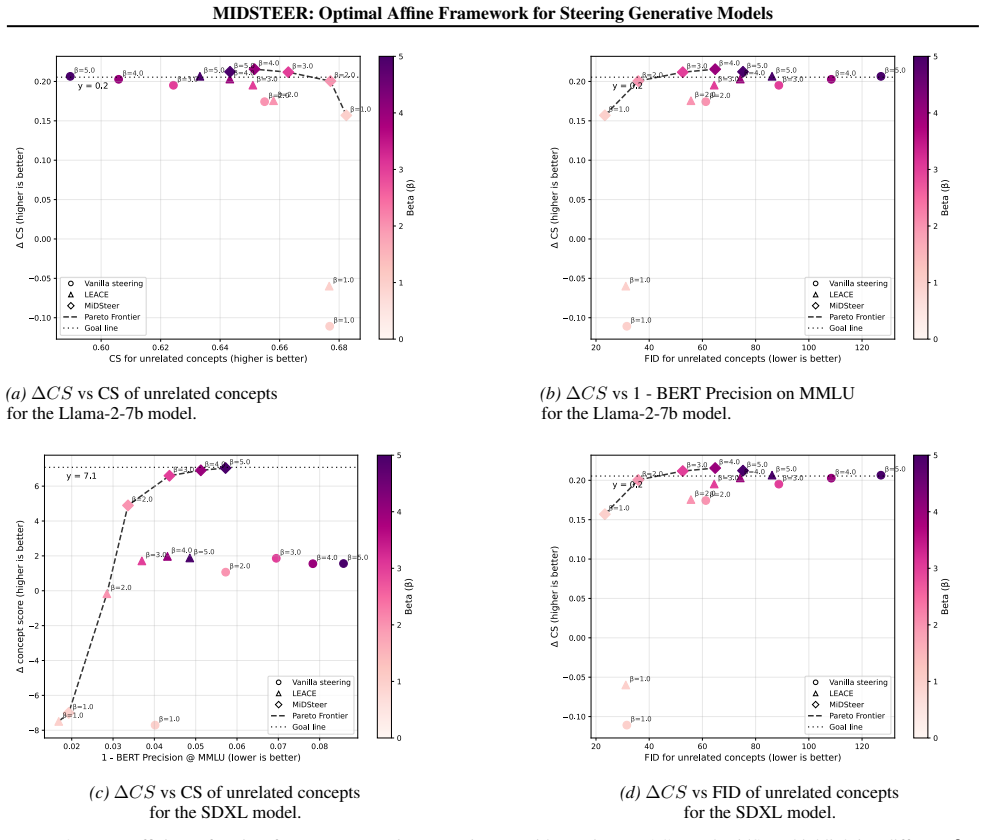
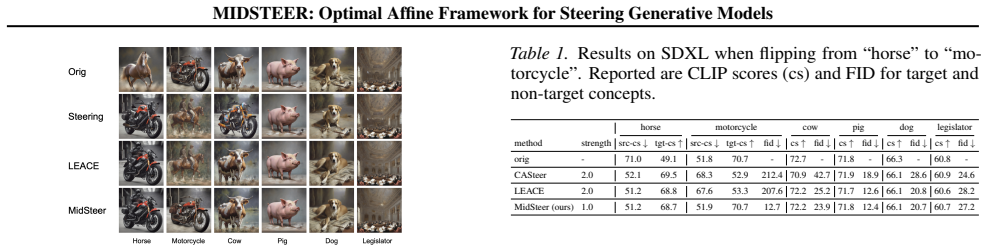
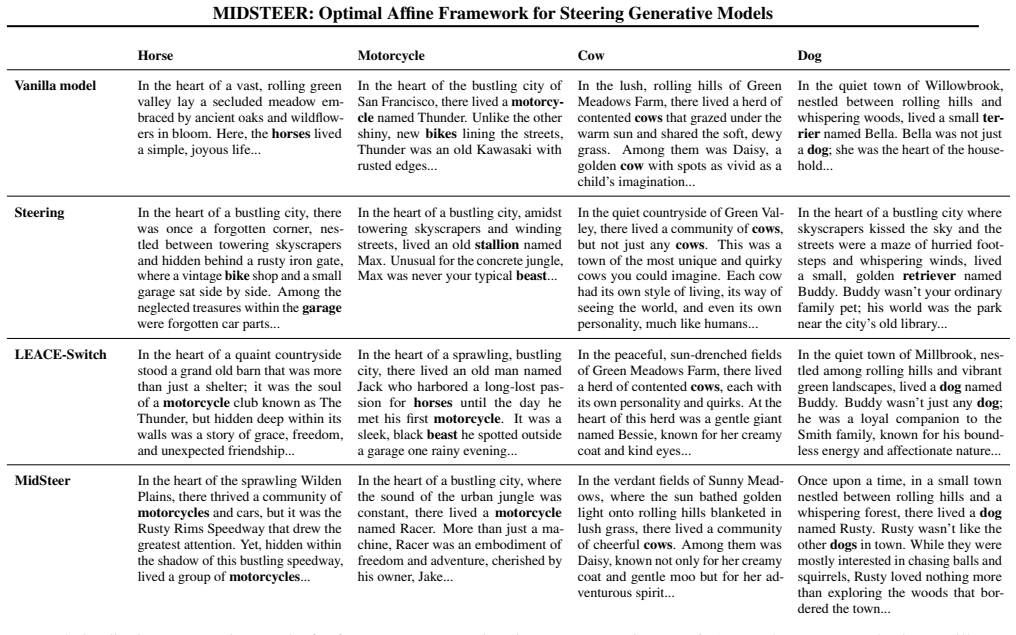
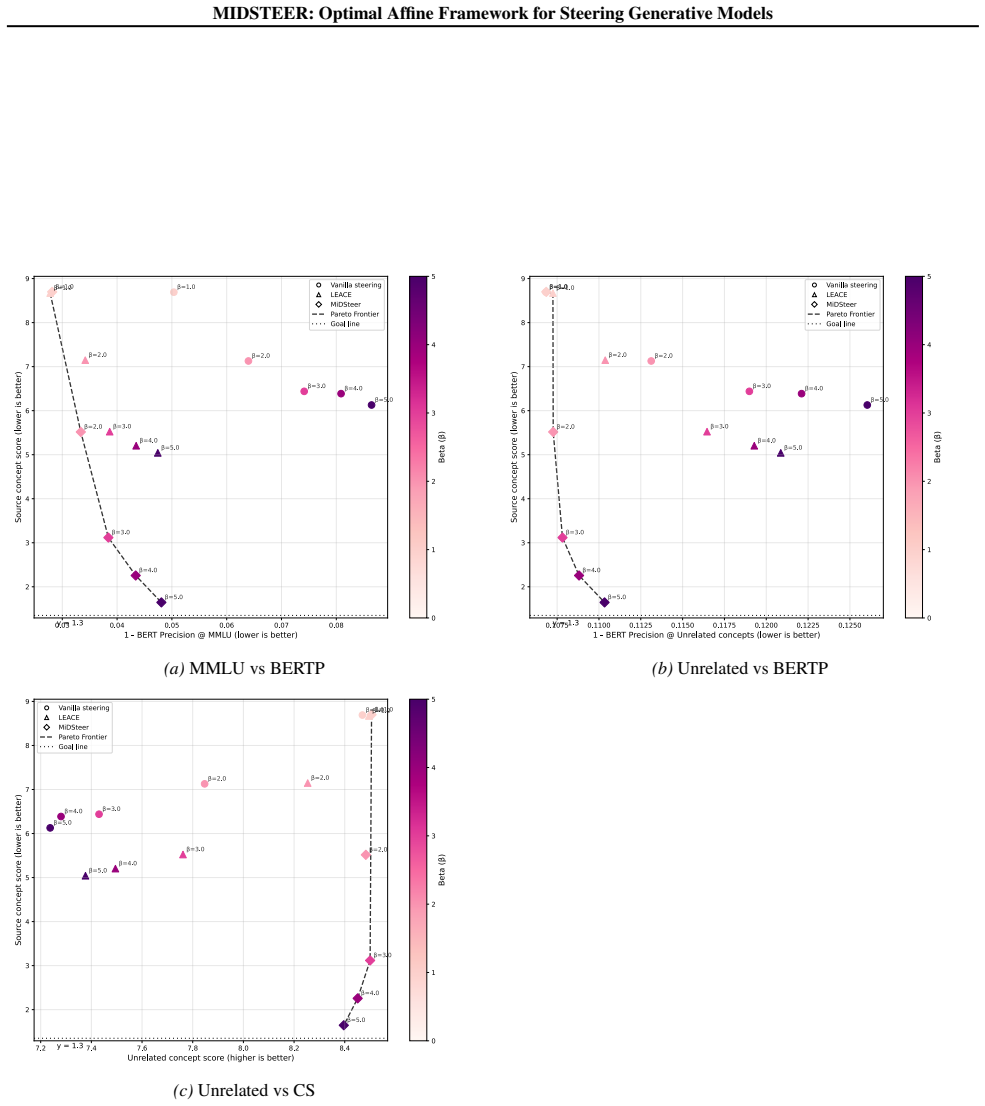
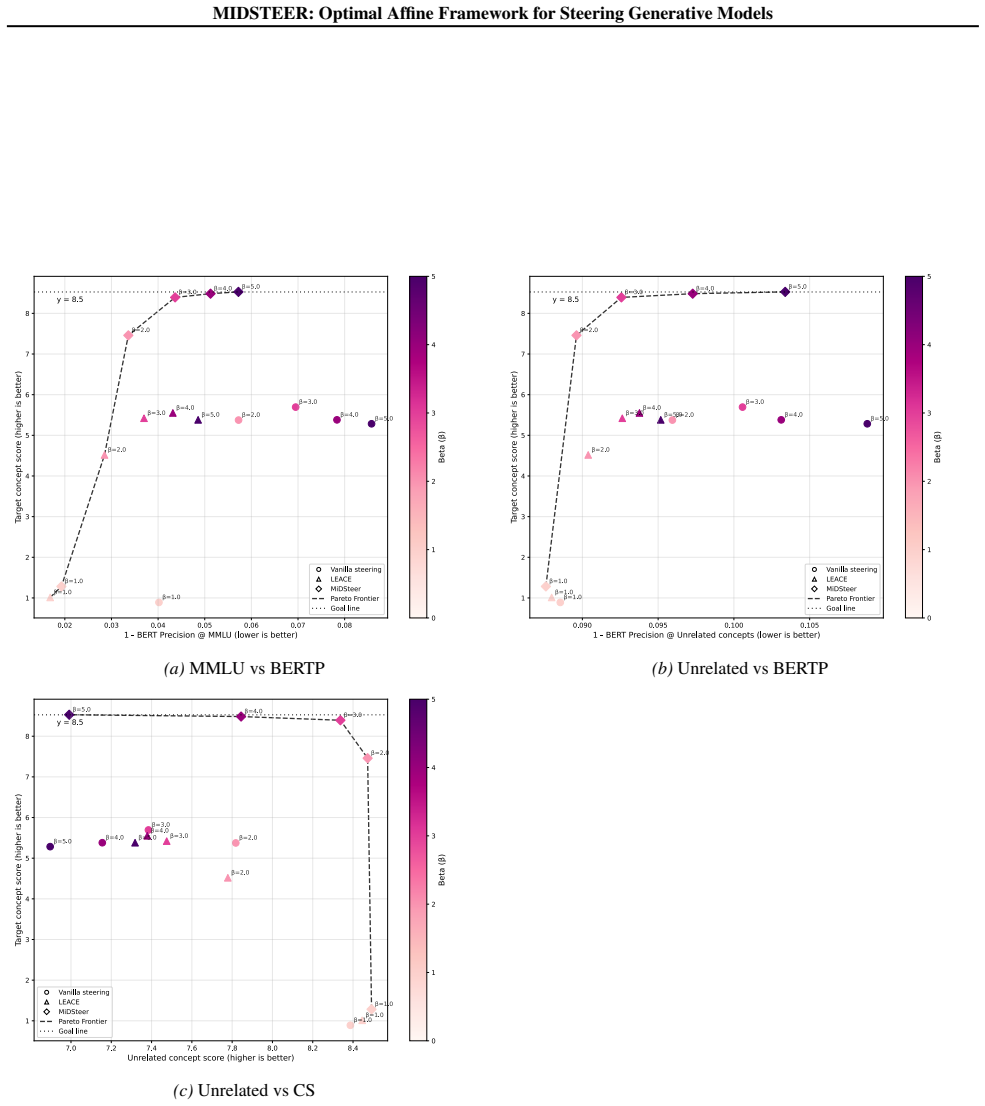
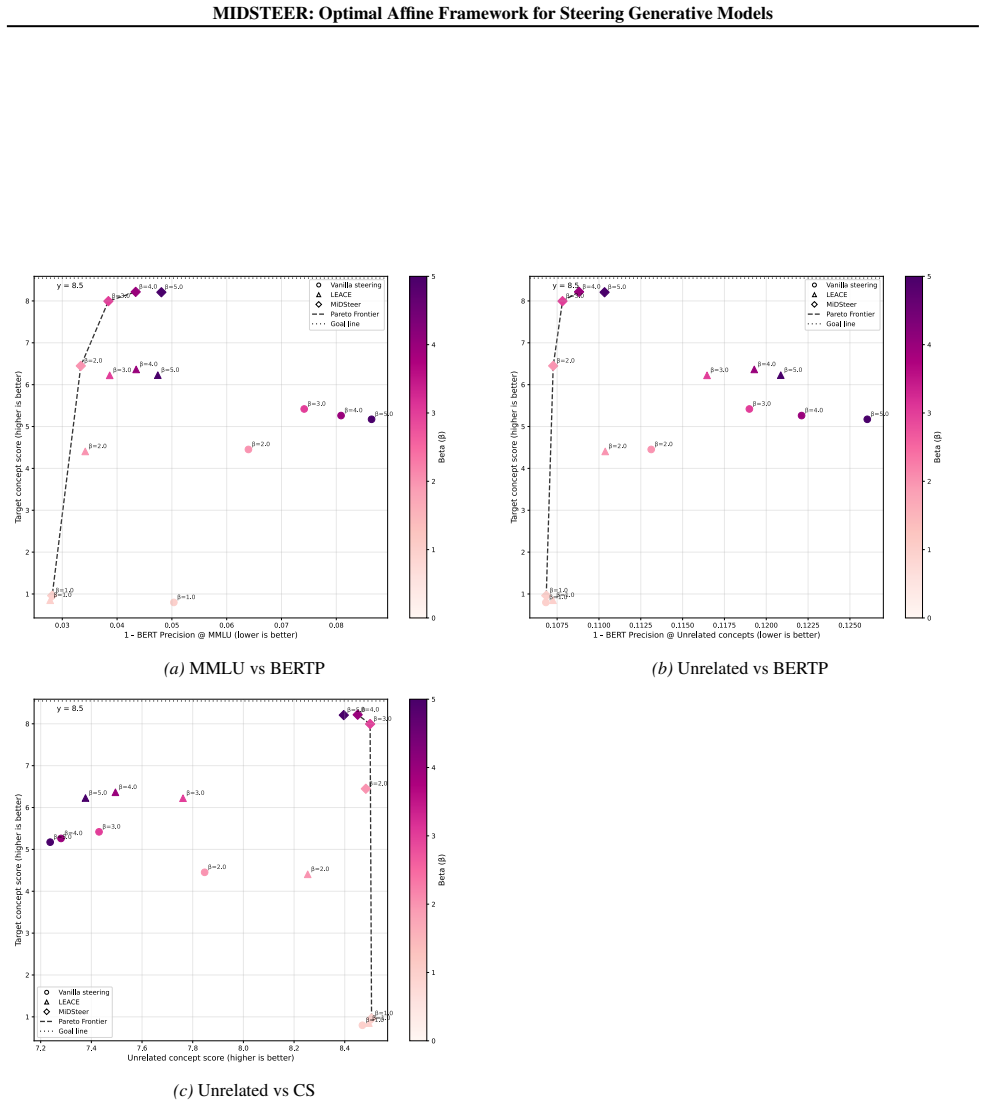
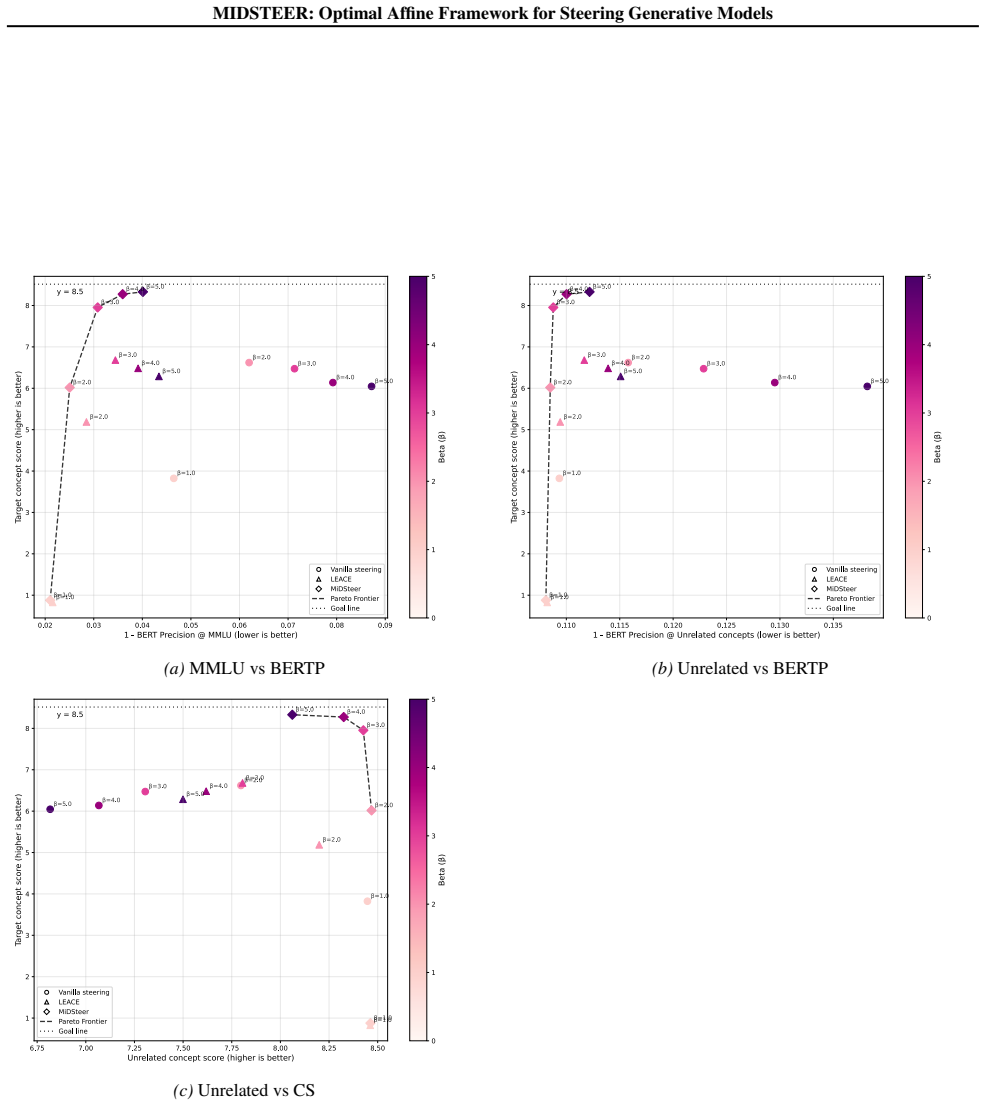
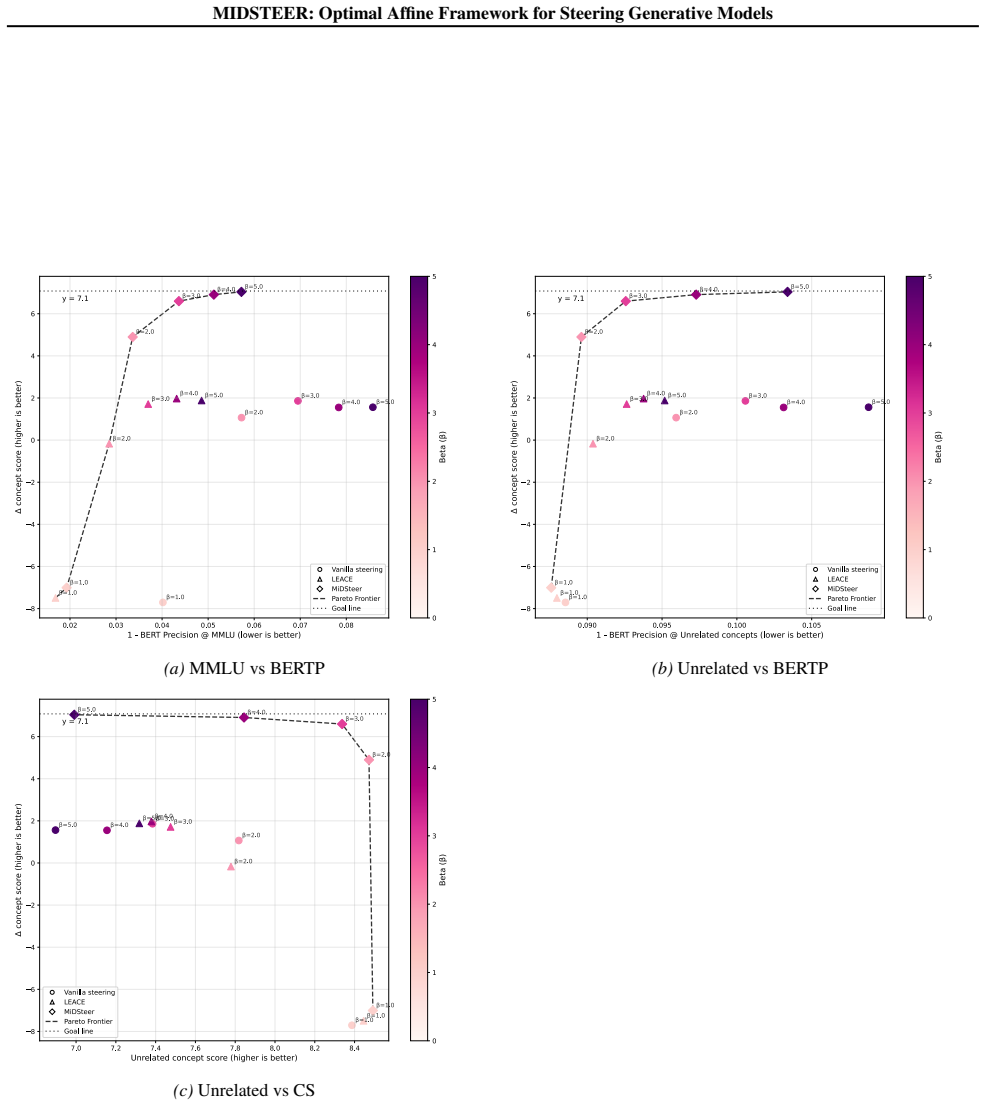
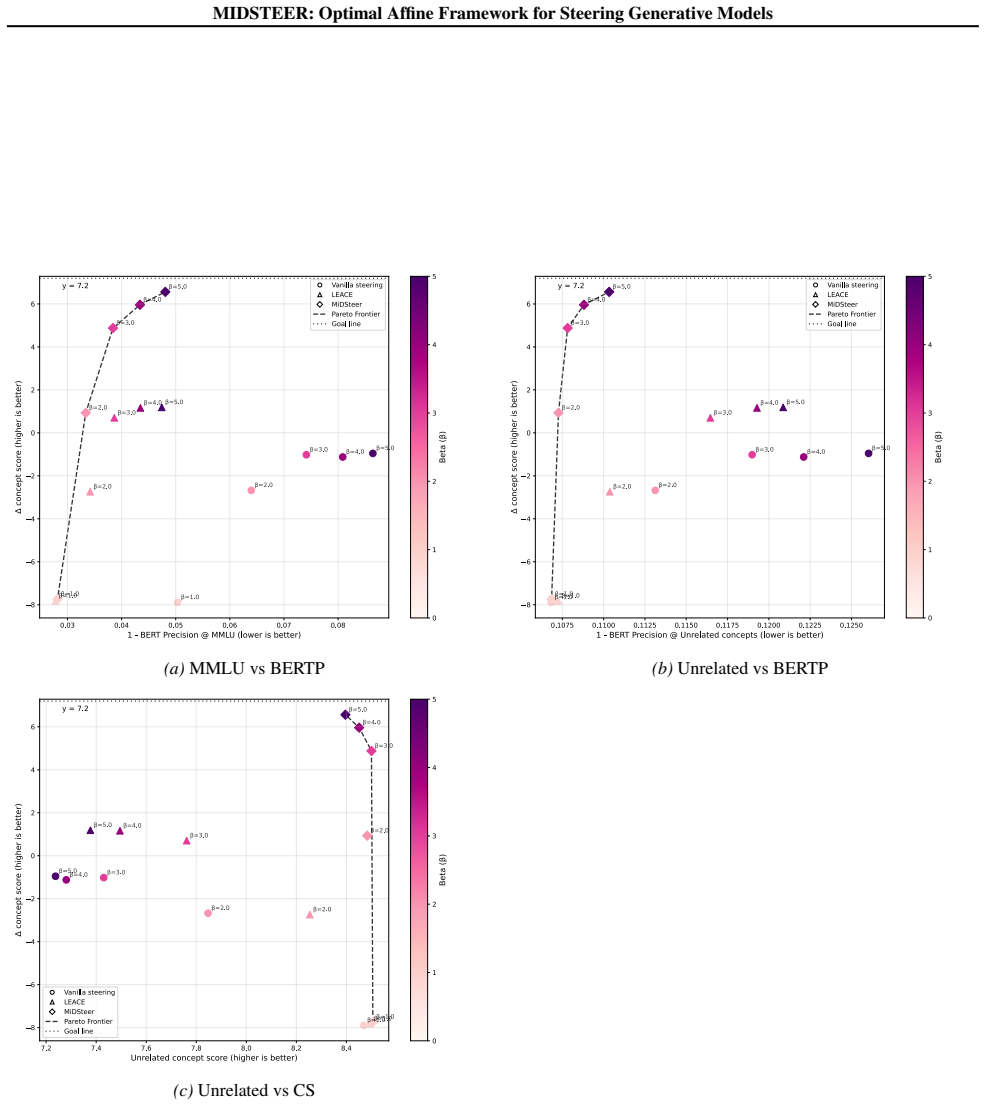
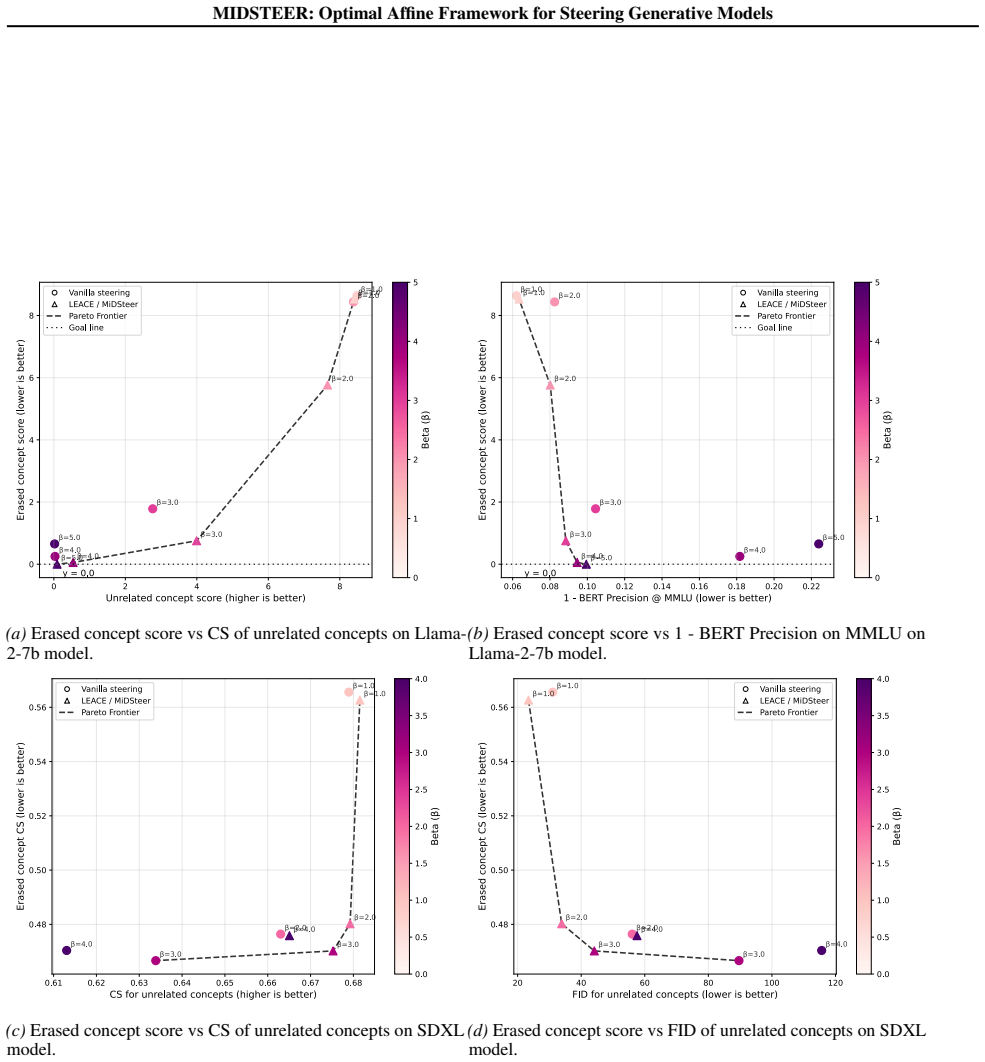
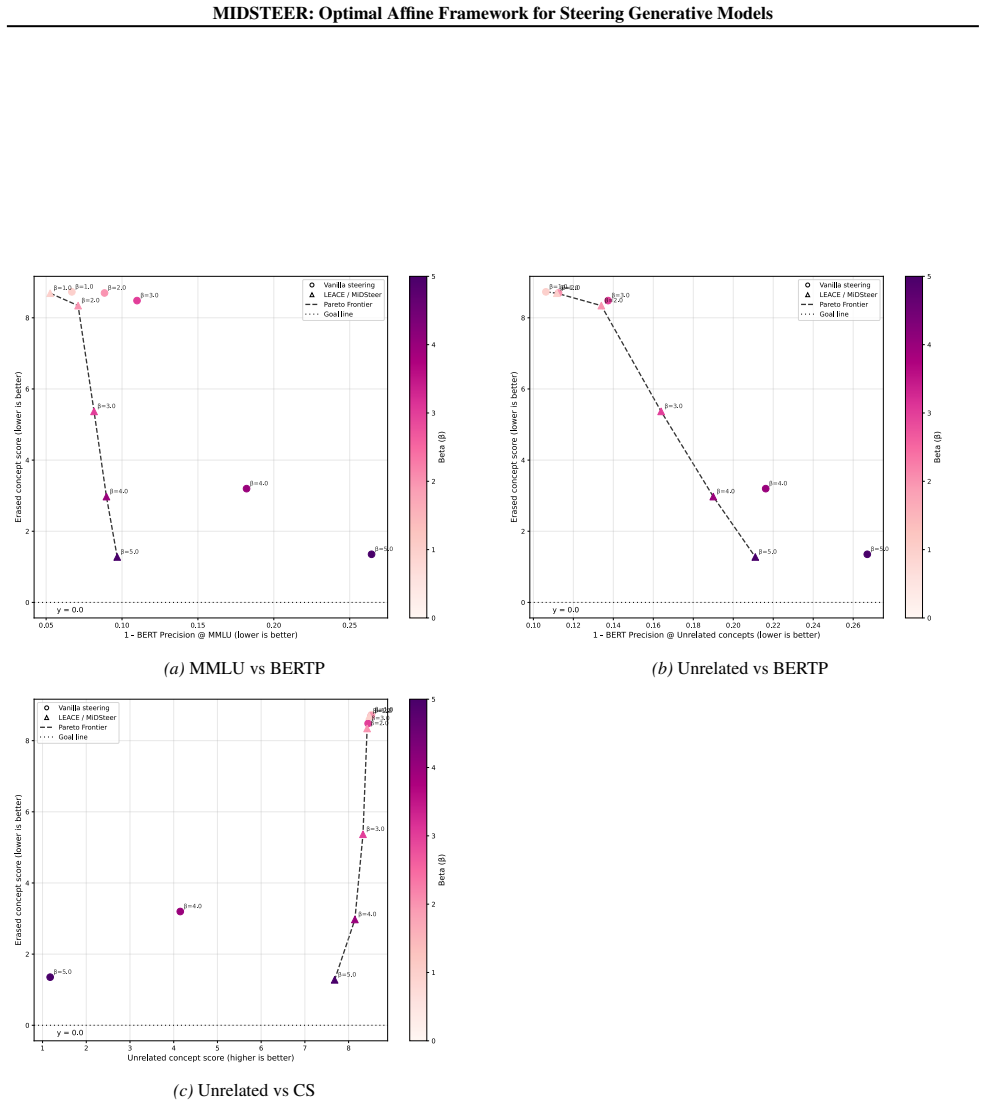
Steering intermediate representations has emerged as a powerful strategy for controlling generative models, particularly in post-deployment alignment and safety settings. However, despite its empirical success, it currently lacks a comprehensive theoretical framework. In this paper, we bridge this gap by formalizing the theory of concept steering. First, we establish a link between steering and affine concept erasure, proving that the standard approach for removing unwanted behaviors is a special case of LEACE (a closed-form method for affine erasure). Next, we formulate a principled theoretical framework for concept switching, LEACE-Switch, and characterize the assumptions under which it provides an optimal affine solution. Building on this analysis, we then introduce MidSteer (Minimal Disturbance concept Steering), a more general affine framework for concept manipulation that relaxes these assumptions and enables directed, minimal-disturbance transformations. We demonstrate that MidSteer performs favorably across a range of tasks, modalities, and architectures, including vision diffusion models and large language models.
Figures








Reference graph
Works this paper leans on
-
[1]
Adaptive Computation Depth via Learned Token Routing in Transformers Ahmed Abdelmuniem Abdalla Mohammed Independent Researcher ahmed.abdelmuniem@gmail.com ORCID: 0009-0008-7410-6621 Abstract Standard transformer architectures apply the same number of layers to every token regardless of contextual difficulty. We presentToken-Selective Attention (TSA), a le...
Pith/arXiv arXiv 2017
discussion (0)
Sign in with ORCID, Apple, or X to comment. Anyone can read and Pith papers without signing in.