Recognition: 3 theorem links
· Lean TheoremNegative refraction with absorption suppressed by electromagneticly induced transparency in a left-handed atomic system
Pith reviewed 2026-05-08 17:51 UTC · model grok-4.3
The pith
A dense four-level atomic system achieves negative refraction with absorption suppressed by electromagnetically induced transparency.
A machine-rendered reading of the paper's core claim, the machinery that carries it, and where it could break.
Core claim
Without the two equal transition frequencies responding to the probe field, the atomic system displays a negative refraction with the simultaneously negative permittivity and negative permeability. The response of the probe field is amplified and propagates transparency in some frequency extents.
What carries the argument
Electromagnetically induced transparency in a dense four-level atomic medium that simultaneously yields negative real parts of permittivity and permeability while suppressing probe absorption.
If this is right
- Negative refraction occurs with reduced absorption compared to conventional left-handed media.
- The probe field is amplified within transparency frequency windows.
- The primary limitation of dissipation in negative refractive materials is addressed in this atomic scheme.
- An increase in signal field intensity raises absorption near resonance.
Where Pith is reading between the lines
- The transparency windows could be tuned by varying the intensities of the driving fields.
- Atomic-density and coherence-time requirements would need verification to confirm scalability beyond the idealized model.
- The configuration might be adapted to other multilevel atomic or molecular systems for similar low-loss left-handed behavior.
Load-bearing premise
A dense four-level atomic medium can be prepared and driven such that EIT fully suppresses absorption while maintaining the required negative permittivity and permeability without additional decoherence or many-body effects dominating.
What would settle it
Measurement of simultaneously negative real permittivity and permeability together with positive transmission (transparency window) for the probe field in an experimentally prepared four-level atomic vapor.
Figures


read the original abstract
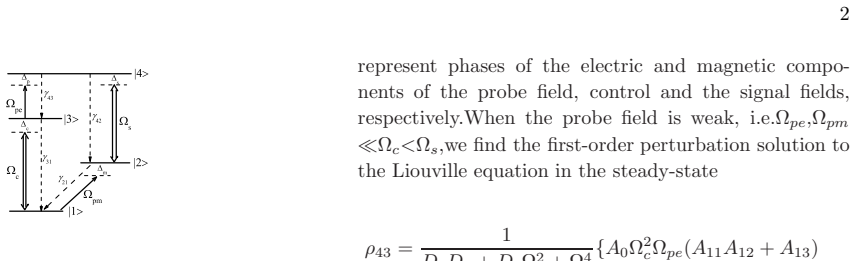
This paper intends to realize negative refraction with absorption suppressed by the electromagneticly induced transparency(EIT) in a dense four-level atomic system. Without the two equal transition frequencies responding to the probe field, the atomic system displays a negative refraction with the simultaneously negative permittivity and negative permeability(Left-handedness). The response of the probe field is amplified and propagates transparency in some frequency extents. Therefore, our aim for searching the low-loss negative refraction can be achieved in the scheme, given the main applied limitation of the negative refractive materials is the large amount of dissipation and absorption. However, an excessive signal field intensity would increase the absorption near the resonance in our scheme.
Editorial analysis
A structured set of objections, weighed in public.
Referee Report
Summary. The manuscript proposes realizing negative refraction in a dense four-level atomic vapor by driving the system with probe and coupling fields such that the real parts of both electric permittivity and magnetic permeability are simultaneously negative (left-handed behavior) while electromagnetically induced transparency (EIT) creates a transparency window that suppresses absorption for the probe. The scheme tunes the two transition frequencies responding to the probe to be unequal, yielding amplified probe response and propagation transparency over limited frequency intervals, thereby addressing the dissipation problem that limits practical negative-index materials.
Significance. If the linear-response calculation is valid, the work demonstrates an atomic-vapor route to low-loss negative refraction that combines standard EIT techniques with a magnetic response, potentially enabling compact, tunable negative-index devices. The explicit demonstration that unequal probe-transition frequencies can produce the required sign combination while maintaining a transparency window is a concrete, falsifiable prediction that could be tested in vapor-cell experiments.
major comments (1)
- [density-matrix calculation of susceptibilities] The linear-response derivation of the electric and magnetic susceptibilities (density-matrix equations for the four-level system) assumes an isolated-atom model. At the atomic densities required to obtain |Re(μ)| of order unity, the Lorentz local-field correction and resonant dipole-dipole interaction strength become comparable to the EIT two-photon linewidth, shifting the transparency window and introducing additional dephasing. The manuscript does not include these collective corrections, so the reported overlap between Re(ε)<0, Re(μ)<0 and Im(χ)≈0 rests on an unverified dilute-gas assumption that is load-bearing for the central claim.
minor comments (3)
- [abstract] The abstract contains a spelling error: 'electromagneticly' should read 'electromagnetically'.
- [results/discussion] The statement that 'an excessive signal field intensity would increase the absorption near the resonance' appears to contradict the claim of absorption suppression; the dependence of the transparency window on coupling-field strength should be shown explicitly in a figure or equation.
- [introduction] Notation for the probe and coupling Rabi frequencies and detunings is not defined in the abstract or early text; a compact table of symbols would improve readability.
Simulated Author's Rebuttal
We thank the referee for the careful reading of our manuscript and the constructive comment regarding the density-matrix calculation. We address this point below.
read point-by-point responses
-
Referee: [density-matrix calculation of susceptibilities] The linear-response derivation of the electric and magnetic susceptibilities (density-matrix equations for the four-level system) assumes an isolated-atom model. At the atomic densities required to obtain |Re(μ)| of order unity, the Lorentz local-field correction and resonant dipole-dipole interaction strength become comparable to the EIT two-photon linewidth, shifting the transparency window and introducing additional dephasing. The manuscript does not include these collective corrections, so the reported overlap between Re(ε)<0, Re(μ)<0 and Im(χ)≈0 rests on an unverified dilute-gas assumption that is load-bearing for the central claim.
Authors: We agree that the derivation presented in the manuscript employs the standard isolated-atom density-matrix formalism and does not incorporate Lorentz local-field corrections or resonant dipole-dipole interactions. At the densities required for |Re(μ)| of order unity these collective effects can indeed become comparable to the EIT linewidth and may shift the transparency window or add dephasing. In the revised manuscript we will add a dedicated paragraph (or short subsection) that estimates the critical density at which the dipole-dipole shift remains smaller than the two-photon EIT linewidth. Within this estimated regime we will show that the reported overlap of Re(ε)<0, Re(μ)<0 and low absorption continues to hold, while explicitly noting that a full many-body treatment lies beyond the scope of the present work. This addition will make the range of validity of the central claim transparent to readers. revision: partial
Circularity Check
No circularity: derivation follows directly from density-matrix solution without reduction to inputs by construction
full rationale
The paper solves the steady-state density-matrix equations for a four-level atomic system driven by probe, coupling, and signal fields to obtain the linear susceptibilities χ_e(ω) and χ_m(ω). Permittivity and permeability are then formed as ε = 1 + χ_e and μ = 1 + χ_m, and the refractive index is computed in the usual way. Frequency regions satisfying Re(ε) < 0, Re(μ) < 0 and low Im(χ) are identified by direct substitution of the solved coherences; no parameter is fitted to the target negative-index window and then relabeled as a prediction. The EIT transparency window arises from the two-photon resonance condition in the equations themselves rather than from an ansatz smuggled in by self-citation or from renaming a known empirical pattern. The calculation is self-contained once the Hamiltonian and decay rates are stated; external benchmarks or machine-checked results are not required for the internal consistency of this step.
Axiom & Free-Parameter Ledger
free parameters (2)
- atomic density
- probe and coupling field intensities
axioms (1)
- domain assumption The four-level atomic system can be described by a density-matrix formalism without significant many-body or collisional effects.
Lean theorems connected to this paper
-
IndisputableMonolith.Cost.FunctionalEquationwashburn_uniqueness_aczel unclear?
unclearRelation between the paper passage and the cited Recognition theorem.
we find the first-order perturbation solution to the Liouville equation in the steady-state ρ43 = ... ρ21 = ...
-
IndisputableMonolith.Foundation.AlphaDerivationExplicitAlphaProvenanceCert unclear?
unclearRelation between the paper passage and the cited Recognition theorem.
Ω s=14γ, 18 γ, 20 γ correspond to the solid, dotted and dashed curves... The detuning of the strong signal field is set as ∆ s = 0, and ∆ c = ∆ m = 0 . 005γ. The phase difference ... θ= 1/6 π.
-
IndisputableMonolith.Foundation.BlackBodyRadiationDeepBlackBodyRadiationDeepCert unclear?
unclearRelation between the paper passage and the cited Recognition theorem.
n(ω ) = − sqrt(ǫr(ω )µ r(ω ))
What do these tags mean?
- matches
- The paper's claim is directly supported by a theorem in the formal canon.
- supports
- The theorem supports part of the paper's argument, but the paper may add assumptions or extra steps.
- extends
- The paper goes beyond the formal theorem; the theorem is a base layer rather than the whole result.
- uses
- The paper appears to rely on the theorem as machinery.
- contradicts
- The paper's claim conflicts with a theorem or certificate in the canon.
- unclear
- Pith found a possible connection, but the passage is too broad, indirect, or ambiguous to say the theorem truly supports the claim.
Reference graph
Works this paper leans on
-
[1]
The electrodynamics of substances with simultaneously negative of ε and µ ,
V. G. Veselago, “The electrodynamics of substances with simultaneously negative of ε and µ ,” Sov. Phys. Usp , 10, 509–514, 1968
1968
-
[2]
Negative Refraction Makes a Perfect Lens,
J. B. Pendry, “Negative Refraction Makes a Perfect Lens,” Phys. Rev. Lett. , 85, 3966–3969, 2000
2000
-
[3]
Finite-size effects of a left- handed material slab on the image quality,
L. Chen, S. He, L. F. Shen, “Finite-size effects of a left- handed material slab on the image quality,” Phys. Rev. Lett., 92, 107404(1–4), 2004
2004
-
[4]
Subwavelength resolution with a negative-index metamaterial superlens,
K. Aydin, I. Bulu, E. Ozbay, “Subwavelength resolution with a negative-index metamaterial superlens,” Appl. Phys. Lett , 90, 254102(1–3), 2007
2007
-
[5]
Goos-H¨ anchen Shift in Negatively Re- fractive Media,
P. R. Berman, “Goos-H¨ anchen Shift in Negatively Re- fractive Media,” Phys. Rev. E , 66, 067603(1–3), 2002
2002
-
[6]
Quantum Interference Enhancement with Left-Handed Materials,
Y. P. Yang, J. P. Xu, H. Chen, S. Y. Zhu, “Quantum Interference Enhancement with Left-Handed Materials,” Phys. Rev. Lett. , 100, 043601(1–4), 2008
2008
-
[7]
Plasmon- Induced Enhancement of Quantum Interference near Metallic Nanostructures,
V. Yannopapas, E. Paspalakis, N. V. Vitanov, “Plasmon- Induced Enhancement of Quantum Interference near Metallic Nanostructures,” Phys. Rev. Lett. , 103, 063602(1–4), 2009
2009
-
[8]
Unusual photon tunneling in the presence of a layer with a negative refractive index,
Z. M. Zhang, C. J. Fu, “Unusual photon tunneling in the presence of a layer with a negative refractive index,” Appl. Phys. Lett. , 80, 1097–1099, 2002
2002
-
[9]
Experimental Verification of a Negative Index of Refraction,
R. A. Shelby, D. R. Smith, S. Schultz, “Experimental Verification of a Negative Index of Refraction,” Science, 292, 77–79, 2001
2001
-
[10]
Positively negative,
J. Pendry, “Positively negative,” Nature, 423, 22–23, 2003
2003
-
[11]
Electromagnetic waves: Negative Refrac- tion by Photonic Crystals,
E. Cubukcu, “Electromagnetic waves: Negative Refrac- tion by Photonic Crystals,” Nature, 423, 604–605, 2003
2003
-
[12]
Planar negative refractive index media using periodically L-C loaded transmission lines,
G. V. Eleftheriades, A. K. Iyer, P. C. Kremer, “Planar negative refractive index media using periodically L-C loaded transmission lines,” IEEE Trans. Microwave The- ory Tech., 50, 2702–2712, 2002
2002
-
[13]
Three- dimensional isotropic perfect lens based on LC-loaded transmission lines,
P. Alitalo, S. Maslovski, S. Tretyakov, “Three- dimensional isotropic perfect lens based on LC-loaded transmission lines,” J. Appl. Phys. , 99, 124910, 2006
2006
-
[14]
A Chiral Route to Negative Refraction,
J. B. Pendry, “A Chiral Route to Negative Refraction,” Science, 306, 1353–1355, 2004
2004
-
[15]
Negative index of refraction in artificial chiral materials,
V. Yannopapas, “Negative index of refraction in artificial chiral materials,” J. Phys.: Condens. Matter , 18, 6883– 6890, 2006
2006
-
[16]
Electromagnetically induced left handedness in optically excited four-level atomic me- dia,
Q. Thommen, P. Mandel, “Electromagnetically induced left handedness in optically excited four-level atomic me- dia,” Phys. Rev. Lett. , 96, 053601, 2006
2006
-
[17]
¨o Oktel, E
M. ¨o Oktel, E. ¨o M¨utecaplˇgu, Phys. Rev. A , 70, 053806, 2004
2004
-
[18]
Left-handedness in a four-level atomic system,
S. C. Zhao, Z. D. Liu, “Left-handedness in a four-level atomic system,” Int. J. Quant. Inf. , 7, 747–754, 2009
2009
-
[19]
Photonic-resonant left-handed medium,
J. Q. Shen, “Photonic-resonant left-handed medium,” Phys. Lett. A , 357, 54–60, 2006
2006
-
[20]
Dressed-state mixed-parity transitions for realizing negative refractive index,
C. M. Krowne, J. Q. Shen, “Dressed-state mixed-parity transitions for realizing negative refractive index,” Phys. Rev. A , 79, 023818(1–11), 2009
2009
-
[21]
C. M. Krowne, Waves in Random and Complex Media , 20, 223–250, 2010
2010
-
[22]
Optical negative-index metamaterials,
V. M. Shalaev, “Optical negative-index metamaterials,” Nat. Photonics , 1, 41–48, 2007
2007
-
[23]
Negative-index metamaterial at 780 nm wavelength,
G. Dolling, M. Wegener, C. M. Soukoulis, S. Linden, “Negative-index metamaterial at 780 nm wavelength,” Opt. Lett. , 32, 53–55, 2007
2007
-
[24]
Subwavelength imaging by a left- handed material superlens,
X. S. Rao, C. K. Ong, “Subwavelength imaging by a left- handed material superlens,” Phys. Rev. E , 68, 067601(1– 3), 2003
2003
-
[25]
Near field imaging with negative dielectric constant lenses,
J. T. Shen, P. M. Platzman, “Near field imaging with negative dielectric constant lenses,” Appl. Phys. Lett. , 80, 3286–3288, 2002
2002
-
[26]
Optical transmission and reflection of perfect lenses by left handed materials,
Z. Ye, “Optical transmission and reflection of perfect lenses by left handed materials,” Phys. Rev. B , 67, 193106(1–4), 2004
2004
-
[27]
Optical Conformal Mapping,
U. Leonhardt, “Optical Conformal Mapping,” Science, 312, 1777–1780, 2006
2006
-
[28]
Controlling elec- tromagnetic fields,
J. B. Pendry, D. Schurig, D. R. Smith, “Controlling elec- tromagnetic fields,” Science, 312, 1780–1782, 2006
2006
-
[29]
Metamaterial Electro- magnetic Cloak at Microwave Frequencies,
D. Schurig, J. J. Mock, B. J. Justice, S. A. Cummer, J. B. Pendry, A. F. Starr, D. R. Smith, “Metamaterial Electro- magnetic Cloak at Microwave Frequencies,” Science, 314, 977–980, 2006
2006
-
[30]
Limitations on subdiffrac- tion imaging with a negative refractive index slab,
D. R. Smith, D. Schurig, M. Rosenbluth, S. Schultz, S. A. Ramakrishna, J. B. Pendry, “Limitations on subdiffrac- tion imaging with a negative refractive index slab,” Appl. Phys. Lett. , 82, 1506–1508, 2003
2003
-
[31]
Erratum:
R. Merlin, “Erratum: ”Analytical solution of the almost- perfect-lens problem”,” Appl. Phys. Lett. , 84, 1290–1292, 2004
2004
-
[32]
Tunable Negative Refraction without Absorption via Electromagnetically Induced Chirality,
J. K¨astel, M. Fleischhauer, S. F. Yelin, R. L. Walsworth, “Tunable Negative Refraction without Absorption via Electromagnetically Induced Chirality,” Phys. Rev. Lett. , 99, 073602(1–4), 2007
2007
-
[33]
Low-loss negative refraction by laser-induced magneto- 7 electric cross coupling,
J. K¨astel, M. Fleischhauer, S. F. Yelin, R. L. Walsworth, “Low-loss negative refraction by laser-induced magneto- 7 electric cross coupling,” Phys. Rev. A , 79, 063818(1–13), 2009
2009
-
[34]
Low-Loss Metamaterials Based on Classical Electromagnetically Induced Transparency,
P. Tassin, L. Zhang, T. Koschny, E. N. Economou, C. M. Soukoulis, “Low-Loss Metamaterials Based on Classical Electromagnetically Induced Transparency,” Phys. Rev. Lett., 102, 053901(1–4), 2009
2009
-
[35]
Electromagnetic chirality-induced negative refraction via atomic coher- ence,
F. L. Li, A. P. Fang, M. Wang, “Electromagnetic chirality-induced negative refraction via atomic coher- ence,” J. Phys. B , 42, 199505(1–5), 2009
2009
-
[36]
J. D. Jackson, Classical Electrodynamics(3rd), NewYork: John Wiley & Sons, 159–162, 2001
2001
-
[37]
D. M. Cook, The Theory of the Electromagnetic Field , New Jersey: Prentice-Hall, Inc., 2001, Chap.11
2001
-
[38]
Metamaterial Analog of Electromagnetically Induced Transparency,
N. Papasimakis, V. A. Fedotov, N. I. Zheludev, S. L. Prosvirnin, “Metamaterial Analog of Electromagnetically Induced Transparency,” Phys. Rev. Lett. , 101, 253903(1– 4), 2008
2008
discussion (0)
Sign in with ORCID, Apple, or X to comment. Anyone can read and Pith papers without signing in.