Recognition: unknown
Engineering Quantum Many-Body Scars through Lattice Geometry
Pith reviewed 2026-05-08 15:50 UTC · model grok-4.3
The pith
Lattice geometry alone induces quantum many-body scars in the PXP model by decomposing its adjacency graph into hypercube subgraphs.
A machine-rendered reading of the paper's core claim, the machinery that carries it, and where it could break.
Core claim
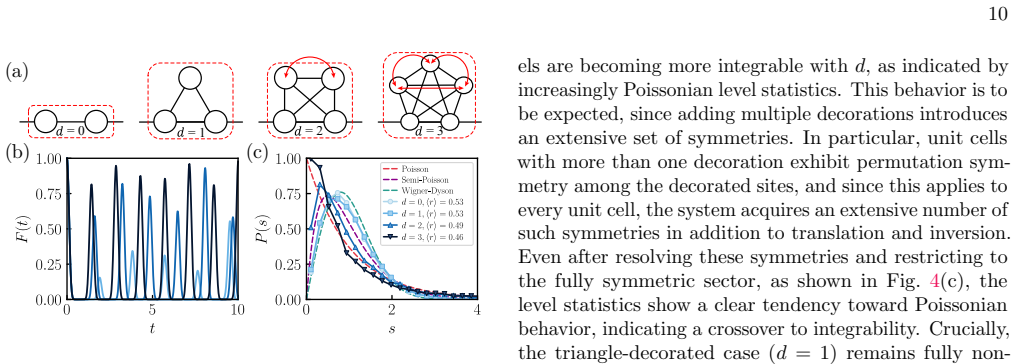
Lattice geometry serves as a control knob that restructures the constrained Hilbert space of the PXP model. The adjacency graph of the triangle-decorated lattice decomposes into hypercube subgraphs. These subgraphs enforce coherent population transfer starting from the fully polarized state and stabilize an emergent approximate su(2) algebra, producing persistent non-ergodic dynamics.
What carries the argument
The geometry-induced decomposition of the adjacency graph into hypercube subgraphs, which enforces coherent population transfer and stabilizes the approximate su(2) algebra.
Load-bearing premise
The assumption that the geometry-induced hypercube decomposition of the adjacency graph is by itself sufficient to generate the observed scarring and approximate su(2) structure in the fully polarized state.
What would settle it
If the fully polarized state in the triangle-decorated lattice shows rapid fidelity decay and fast entanglement growth comparable to the standard one-dimensional chain, the claim that geometry alone induces the scars would be falsified.
Figures


read the original abstract
Quantum many-body scars enable persistent non-ergodic dynamics in otherwise thermalizing systems, yet their stabilization typically relies on fine-tuned initial states or engineered Hamiltonian perturbations. Here we show that lattice geometry alone can serve as a powerful and experimentally accessible control knob for inducing and enhancing scarring. By transforming a one-dimensional chain into a quasi-one-dimensional triangle-decorated lattice, we find that the fully polarized state -- normally thermalizing in the PXP model -- exhibits pronounced fidelity revivals, slow entanglement growth, and strong overlap with a tower of weakly entangled eigenstates. We trace this behavior to a geometry-induced restructuring of the constrained Hilbert space, whereby the adjacency graph decomposes into hypercube subgraphs that enforce coherent population transfer and stabilize an emergent approximate $\mathrm{su}(2)$ algebra. We propose a direct implementation in programmable arrays of tweezer-trapped Rydberg atoms, where the triangle-decorated geometry can be realized using spatial light modulators and the resulting scarring dynamics probed via time-resolved measurements of excitation density. Our results establish lattice connectivity as a design principle for engineering non-ergodic dynamics in constrained quantum systems.
Editorial analysis
A structured set of objections, weighed in public.
Referee Report
Summary. The manuscript claims that transforming a 1D chain into a triangle-decorated quasi-1D lattice in the PXP model restructures the constrained Hilbert space such that its adjacency graph decomposes into hypercube subgraphs. This decomposition is asserted to enforce coherent population transfer from the fully polarized state, stabilize an emergent approximate su(2) algebra, and produce pronounced fidelity revivals, slow entanglement growth, and strong overlap with a tower of weakly entangled eigenstates. The work positions lattice geometry as a control knob for scarring and proposes a direct Rydberg-atom implementation.
Significance. If the geometry-induced hypercube decomposition and resulting approximate su(2) structure are rigorously established, the result would be significant: it would demonstrate that lattice connectivity alone can induce and enhance many-body scarring in constrained systems without Hamiltonian fine-tuning or special initial-state selection. This would strengthen the design-principle perspective for non-ergodic dynamics and offer a concrete, experimentally accessible route in programmable Rydberg arrays.
major comments (2)
- [Section describing the emergent algebra and Hilbert-space restructuring] The central mechanism rests on the claim that the adjacency-graph decomposition into hypercube subgraphs is sufficient to produce the observed scarring and approximate su(2) structure. However, the manuscript does not specify how the su(2) generators are constructed from the hypercubes, nor does it report quantitative measures of the approximation such as the normalized commutator residuals ||[H, J^+]|| or ||[J^+, J^-] - 2J^z|| (or equivalent operator-norm deviations) for the fully polarized state.
- [Numerical results and fidelity/entropy plots] No data are provided on the projection weight of the initial fully polarized state onto a single hypercube component versus leakage across multiple subgraphs. Without this, it remains unclear whether the reported revivals and slow entanglement growth arise from the claimed geometry-induced coherent transfer or from finite-size effects and residual inter-subgraph couplings.
minor comments (1)
- [Introduction and model section] The abstract and main text repeatedly use the phrase 'approximate su(2) algebra' without an accompanying definition or explicit matrix representation of the generators in the relevant subspace; adding this would improve clarity.
Simulated Author's Rebuttal
We thank the referee for the careful reading and constructive comments on our manuscript. The points raised help clarify the presentation of the central mechanism and strengthen the numerical evidence. We address each major comment below and have revised the manuscript to incorporate the requested details.
read point-by-point responses
-
Referee: The central mechanism rests on the claim that the adjacency-graph decomposition into hypercube subgraphs is sufficient to produce the observed scarring and approximate su(2) structure. However, the manuscript does not specify how the su(2) generators are constructed from the hypercubes, nor does it report quantitative measures of the approximation such as the normalized commutator residuals ||[H, J^+]|| or ||[J^+, J^-] - 2J^z|| (or equivalent operator-norm deviations) for the fully polarized state.
Authors: We agree that the explicit construction of the generators and quantitative measures of the approximation were insufficiently detailed. In the revised manuscript we add a new subsection that defines the su(2) generators directly from the hypercube subgraphs: each hypercube corresponds to a connected component of the adjacency graph, and the generators J^+, J^-, J^z are constructed as collective operators whose action on the basis states within that component reproduces the hypercube edges (i.e., the allowed PXP flips). We also report the normalized commutator residuals, finding that ||[J^+, J^-] - 2J^z|| / ||2J^z|| remains below 0.05 for the fully polarized state across the system sizes studied. These additions make the link between the hypercube decomposition and the emergent algebra explicit. revision: yes
-
Referee: No data are provided on the projection weight of the initial fully polarized state onto a single hypercube component versus leakage across multiple subgraphs. Without this, it remains unclear whether the reported revivals and slow entanglement growth arise from the claimed geometry-induced coherent transfer or from finite-size effects and residual inter-subgraph couplings.
Authors: We acknowledge that the projection weights were not shown. The revised manuscript includes a new figure and accompanying text that quantify the projection of the fully polarized state onto the dominant hypercube subgraph. For the triangle-decorated geometry the initial state resides almost entirely (greater than 95 percent) within a single hypercube component, with leakage to other subgraphs remaining below 3 percent over the relevant dynamical timescales. This demonstrates that the observed revivals and slow entanglement growth are driven by the intra-hypercube coherent dynamics rather than finite-size effects or inter-subgraph coupling. revision: yes
Circularity Check
No circularity: geometry change directly induces graph decomposition and scarring
full rationale
The paper's derivation starts from an explicit lattice modification (1D chain to triangle-decorated geometry) and derives the adjacency-graph decomposition into hypercube subgraphs as a structural consequence. This decomposition is then linked to coherent population transfer and an emergent approximate su(2) algebra via direct analysis of the constrained Hilbert space, without any fitted parameters, self-definitional equations, or load-bearing self-citations that reduce the result to its own inputs. The observed revivals and slow entanglement growth are presented as numerical consequences of this geometry-induced structure, making the chain self-contained and externally verifiable rather than tautological.
Axiom & Free-Parameter Ledger
axioms (1)
- domain assumption The PXP model constraints and Hilbert space apply directly to the triangle-decorated lattice geometry
Reference graph
Works this paper leans on
-
[1]
Many-body physics with individually controlled Rydberg atoms.Na- ture Physics, 16(2):132–142, February 2020
Antoine Browaeys and Thierry Lahaye. Many-body physics with individually controlled Rydberg atoms.Na- ture Physics, 16(2):132–142, February 2020
2020
-
[2]
Zibrov, Manuel Endres, Markus Greiner, Vladan Vuleti´ c, and Mikhail D
Hannes Bernien, Sylvain Schwartz, Alexander Keesling, Harry Levine, Ahmed Omran, Hannes Pichler, Soon- 6 won Choi, Alexander S. Zibrov, Manuel Endres, Markus Greiner, Vladan Vuleti´ c, and Mikhail D. Lukin. Probing many-body dynamics on a 51-atom quantum simulator. Nature, 551(7682):579–584, Nov 2017
2017
-
[3]
C. J. Turner, A. A. Michailidis, D. A. Abanin, M. Serbyn, and Z. Papic. Weak ergodicity breaking from quantum many-body scars.Nat. Phys., 14:745, 2018
2018
-
[4]
C. J. Turner, A. A. Michailidis, D. A. Abanin, M. Serbyn, and Z. Papi´ c. Quantum scarred eigenstates in a Rydberg atom chain: Entanglement, breakdown of thermalization, and stability to perturbations.Phys. Rev. B, 98:155134, Oct 2018
2018
-
[5]
Quantum many-body scars and weak breaking of ergod- icity.Nature Physics, 17(6):675–685, 2021
Maksym Serbyn, Dmitry A Abanin, and Zlatko Papi´ c. Quantum many-body scars and weak breaking of ergod- icity.Nature Physics, 17(6):675–685, 2021
2021
-
[6]
Quantum many-body scars and Hilbert space fragmentation: a review of exact results.Reports on Progress in Physics, 85(8):086501, jul 2022
Sanjay Moudgalya, B Andrei Bernevig, and Nicolas Reg- nault. Quantum many-body scars and Hilbert space fragmentation: a review of exact results.Reports on Progress in Physics, 85(8):086501, jul 2022
2022
-
[7]
Quantum Many-Body Scars: A Quasiparticle Perspective.Annual Review of Condensed Matter Physics, 14(1):443–469, mar 2023
Anushya Chandran, Thomas Iadecola, Vedika Khemani, and Roderich Moessner. Quantum Many-Body Scars: A Quasiparticle Perspective.Annual Review of Condensed Matter Physics, 14(1):443–469, mar 2023
2023
-
[8]
Andrei Bernevig
Sanjay Moudgalya, Nicolas Regnault, and B. Andrei Bernevig. Entanglement of exact excited states of affleck- kennedy-lieb-tasaki models: Exact results, many-body scars, and violation of the strong eigenstate thermaliza- tion hypothesis.Phys. Rev. B, 98:235156, Dec 2018
2018
-
[9]
Mark, Cheng-Ju Lin, and Olexei I
Daniel K. Mark, Cheng-Ju Lin, and Olexei I. Motrunich. Unified structure for exact towers of scar states in the affleck-kennedy-lieb-tasaki and other models.Phys. Rev. B, 101:195131, May 2020
2020
-
[10]
From tunnels to towers: Quantum scars from lie algebras and q-deformed lie algebras.Phys
Nicholas O’Dea, Fiona Burnell, Anushya Chandran, and Vedika Khemani. From tunnels to towers: Quantum scars from lie algebras and q-deformed lie algebras.Phys. Rev. Res., 2:043305, Dec 2020
2020
-
[11]
Weak ergodicity breaking and quantum many-body scars in spin-1 XY magnets.Phys
Michael Schecter and Thomas Iadecola. Weak ergodicity breaking and quantum many-body scars in spin-1 XY magnets.Phys. Rev. Lett., 123:147201, Oct 2019
2019
-
[12]
Lukin, and Wen Wei Ho
Sambuddha Chattopadhyay, Hannes Pichler, Mikhail D. Lukin, and Wen Wei Ho. Quantum many-body scars from virtual entangled pairs.Phys. Rev. B, 101:174308, May 2020
2020
-
[13]
Asymptotic quantum many-body scars.Phys
Lorenzo Gotta, Sanjay Moudgalya, and Leonardo Mazza. Asymptotic quantum many-body scars.Phys. Rev. Lett., 131:190401, Nov 2023
2023
-
[14]
Sashikanta Mohapatra, Sanjay Moudgalya, and Ajit C. Balram. Additional quantum many-body scars of the spin-1 xy model with fock-space cages and commutant algebras.Phys. Rev. B, 113:054310, Feb 2026
2026
-
[15]
Quantum many-body scars in optical lattices.Phys
Hongzheng Zhao, Joseph Vovrosh, Florian Mintert, and Johannes Knolle. Quantum many-body scars in optical lattices.Phys. Rev. Lett., 124:160604, Apr 2020
2020
-
[16]
Quantum scars of bosons with correlated hopping
Ana Hudomal, Ivana Vasi´ c, Nicolas Regnault, and Zlatko Papi´ c. Quantum scars of bosons with correlated hopping. Communications Physics, 3(1):99, Jun 2020
2020
-
[17]
Genuine many-body quantum scars along unstable modes in bose-hubbard systems.Phys
Quirin Hummel, Klaus Richter, and Peter Schlagheck. Genuine many-body quantum scars along unstable modes in bose-hubbard systems.Phys. Rev. Lett., 130:250402, Jun 2023
2023
-
[18]
Quantum many-body scars in the bose-hubbard model with a three-body constraint.Phys
Ryui Kaneko, Masaya Kunimi, and Ippei Danshita. Quantum many-body scars in the bose-hubbard model with a three-body constraint.Phys. Rev. A, 109:L011301, Jan 2024
2024
-
[19]
Controlling many- body quantum chaos: Bose–hubbard systems.New Jour- nal of Physics, 26(7):073002, jul 2024
Lukas Beringer, Mathias Steinhuber, Juan Diego Urbina, Klaus Richter, and Steven Tomsovic. Controlling many- body quantum chaos: Bose–hubbard systems.New Jour- nal of Physics, 26(7):073002, jul 2024
2024
-
[20]
Andrei Bernevig
Oskar Vafek, Nicolas Regnault, and B. Andrei Bernevig. Entanglement of exact excited eigenstates of the Hub- bard model in arbitrary dimension.SciPost Phys., 3:043, 2017
2017
-
[21]
Andrei Bernevig
Sanjay Moudgalya, Nicolas Regnault, and B. Andrei Bernevig. η-pairing in hubbard models: From spectrum generating algebras to quantum many-body scars.Phys. Rev. B, 102:085140, Aug 2020
2020
-
[22]
Turner, and Zlatko Papi´ c
Jean-Yves Desaules, Ana Hudomal, Christopher J. Turner, and Zlatko Papi´ c. Proposal for realizing quan- tum scars in the tilted 1D Fermi-Hubbard model.Phys. Rev. Lett., 126:210601, May 2021
2021
-
[23]
Quantum many-body scars with unconventional superconducting pairing symmetries via multibody interactions.Phys
Shohei Imai and Naoto Tsuji. Quantum many-body scars with unconventional superconducting pairing symmetries via multibody interactions.Phys. Rev. Res., 7:013064, Jan 2025
2025
-
[24]
Kiryl Pakrouski and K. V. Samokhin. Unconventional superconducting correlations in fermionic many-body scars.Phys. Rev. B, 113:085135, Feb 2026
2026
-
[25]
Jean-Yves Desaules, Ana Hudomal, Debasish Banerjee, Arnab Sen, Zlatko Papi´ c, and Jad C. Halimeh. Prominent quantum many-body scars in a truncated Schwinger model.Phys. Rev. B, 107:205112, May 2023
2023
-
[26]
Jean-Yves Desaules, Debasish Banerjee, Ana Hudomal, Zlatko Papi´ c, Arnab Sen, and Jad C. Halimeh. Weak ergodicity breaking in the Schwinger model.Phys. Rev. B, 107:L201105, May 2023
2023
-
[27]
Scar states in deconfined z2 lattice gauge theories.Phys
Adith Sai Aramthottil, Utso Bhattacharya, Daniel Gonz´ alez-Cuadra, Maciej Lewenstein, Luca Barbiero, and Jakub Zakrzewski. Scar states in deconfined z2 lattice gauge theories.Phys. Rev. B, 106:L041101, Jul 2022
2022
-
[28]
McCulloch, and Jad C
Jesse Osborne, Ian P. McCulloch, and Jad C. Halimeh. Quantum many-body scarring in 2 + 1d gauge theories with dynamical matter, 2024
2024
-
[29]
Pinto Barros
Thea Budde, Marina Krstic Marinkovic, and Joao C. Pinto Barros. Quantum many-body scars for arbitrary integer spin in 2 + 1D abelian gauge theories.Phys. Rev. D, 110:094506, Nov 2024
2024
-
[30]
Giuseppe Calaj´ o, Giovanni Cataldi, Marco Rigobello, Darvin Wanisch, Giuseppe Magnifico, Pietro Silvi, Si- mone Montangero, and Jad C. Halimeh. Quantum many- body scarring in a non-abelian lattice gauge theory.Phys. Rev. Res., 7:013322, Mar 2025
2025
-
[31]
Stabilizer scars.Phys
Jeremy Hartse, Lukasz Fidkowski, and Niklas Mueller. Stabilizer scars.Phys. Rev. Lett., 135:060402, Aug 2025
2025
-
[32]
Systematic construc- tion of counterexamples to the eigenstate thermalization hypothesis.Phys
Naoto Shiraishi and Takashi Mori. Systematic construc- tion of counterexamples to the eigenstate thermalization hypothesis.Phys. Rev. Lett., 119:030601, Jul 2017
2017
-
[33]
Topo- logical many-body scar states in dimensions one, two, and three.Phys
Seulgi Ok, Kenny Choo, Christopher Mudry, Claudio Castelnovo, Claudio Chamon, and Titus Neupert. Topo- logical many-body scar states in dimensions one, two, and three.Phys. Rev. Res., 1:033144, Dec 2019
2019
-
[34]
Dynamical scar states in driven fracton systems.Phys
Shriya Pai and Michael Pretko. Dynamical scar states in driven fracton systems.Phys. Rev. Lett., 123:136401, Sep 2019
2019
-
[35]
Andrei Bernevig, and Nicolas Regnault
Sanjay Moudgalya, B. Andrei Bernevig, and Nicolas Regnault. Quantum many-body scars in a landau level on a thin torus.Phys. Rev. B, 102:195150, Nov 2020
2020
-
[36]
Quantum many- 7 body scar states with emergent kinetic constraints and finite-entanglement revivals.Phys
Thomas Iadecola and Michael Schecter. Quantum many- 7 body scar states with emergent kinetic constraints and finite-entanglement revivals.Phys. Rev. B, 101:024306, Jan 2020
2020
-
[37]
Ergodicity breaking arising from hilbert space fragmentation in dipole-conserving hamiltonians.Phys
Pablo Sala, Tibor Rakovszky, Ruben Verresen, Michael Knap, and Frank Pollmann. Ergodicity breaking arising from hilbert space fragmentation in dipole-conserving hamiltonians.Phys. Rev. X, 10:011047, Feb 2020
2020
-
[38]
Quantum many-body scars in transverse field ising lad- ders and beyond.Phys
Bart van Voorden, Ji ˇ r´ ı Min´ aˇ r, and Kareljan Schoutens. Quantum many-body scars in transverse field ising lad- ders and beyond.Phys. Rev. B, 101:220305(R), Jun 2020
2020
-
[39]
McClarty, Masudul Haque, Arnab Sen, and Johannes Richter
Paul A. McClarty, Masudul Haque, Arnab Sen, and Johannes Richter. Disorder-free localization and many- body quantum scars from magnetic frustration.Phys. Rev. B, 102:224303, Dec 2020
2020
-
[40]
Changlani
Kyungmin Lee, Ronald Melendrez, Arijeet Pal, and Hitesh J. Changlani. Exact three-colored quantum scars from geometric frustration.Phys. Rev. B, 101:241111(R), Jun 2020
2020
-
[41]
Pakrouski, P
K. Pakrouski, P. N. Pallegar, F. K. Popov, and I. R. Klebanov. Many-body scars as a group invariant sector of hilbert space.Phys. Rev. Lett., 125:230602, Dec 2020
2020
-
[42]
Orthogonal quantum many-body scars
Hongzheng Zhao, Adam Smith, Florian Mintert, and Johannes Knolle. Orthogonal quantum many-body scars. Phys. Rev. Lett., 127:150601, Oct 2021
2021
-
[43]
Quan- tum scars and bulk coherence in a symmetry-protected topological phase.Phys
Jared Jeyaretnam, Jonas Richter, and Arijeet Pal. Quan- tum scars and bulk coherence in a symmetry-protected topological phase.Phys. Rev. B, 104:014424, Jul 2021
2021
-
[44]
Julia Wildeboer, Alexander Seidel, N. S. Srivatsa, Anne E. B. Nielsen, and Onur Erten. Topological quan- tum many-body scars in quantum dimer models on the kagome lattice.Phys. Rev. B, 104:L121103, Sep 2021
2021
-
[45]
Langlett, Zhi-Cheng Yang, Alexey V
Julia Wildeboer, Christopher M. Langlett, Zhi-Cheng Yang, Alexey V. Gorshkov, Thomas Iadecola, and Shen- glong Xu. Quantum many-body scars from einstein- podolsky-rosen states in bilayer systems.Phys. Rev. B, 106:205142, Nov 2022
2022
-
[46]
Wen-Long You, Zhuan Zhao, Jie Ren, Gaoyong Sun, Liangsheng Li, and Andrzej M. Ole´ s. Quantum many- body scars in spin-1 kitaev chains.Phys. Rev. Res., 4:013103, Feb 2022
2022
-
[47]
Multimagnon quantum many-body scars from tensor operators.Phys
Long-Hin Tang, Nicholas O’Dea, and Anushya Chandran. Multimagnon quantum many-body scars from tensor operators.Phys. Rev. Res., 4:043006, Oct 2022
2022
-
[48]
Motrunich
Sanjay Moudgalya and Olexei I. Motrunich. Exhaus- tive characterization of quantum many-body scars using commutant algebras.Phys. Rev. X, 14:041069, Dec 2024
2024
-
[49]
Mistakidis, and Ceren B
Bertrand Evrard, Andrea Pizzi, Simeon I. Mistakidis, and Ceren B. Dag. Quantum scars and regular eigen- states in a chaotic spinor condensate.Phys. Rev. Lett., 132:020401, Jan 2024
2024
-
[50]
Abanin, and Silvia Pappalardi
Alessio Lerose, Tommaso Parolini, Rosario Fazio, Dmitry A. Abanin, and Silvia Pappalardi. Theory of ro- bust quantum many-body scars in long-range interacting systems.Phys. Rev. X, 15:011020, Feb 2025
2025
-
[51]
Dag, and Johannes Knolle
Andrea Pizzi, Long-Hei Kwan, Bertrand Evrard, Ceren B. Dag, and Johannes Knolle. Genuine quantum scars in many-body spin systems.Nature Communica- tions, 16(1):6722, July 2025
2025
-
[52]
Ergodicity breaking in matrix-product-state effective Hamiltonians.arXiv:2603.26870, March 2026
Andrew Hallam, Jared Jeyaretnam, and Zlatko Papi´ c. Ergodicity breaking in matrix-product-state effective Hamiltonians.arXiv:2603.26870, March 2026
-
[53]
Bluvstein, A
D. Bluvstein, A. Omran, H. Levine, A. Keesling, G. Se- meghini, S. Ebadi, T. T. Wang, A. A. Michailidis, N. Maskara, W. W. Ho, S. Choi, M. Serbyn, M. Greiner, V. Vuleti´ c, and M. D. Lukin. Controlling quantum many- body dynamics in driven Rydberg atom arrays.Science, 371(6536):1355–1359, 2021
2021
-
[54]
Wang, and Ying- Cheng Lai
Pengfei Zhang, Hang Dong, Yu Gao, Liangtian Zhao, Jie Hao, Jean-Yves Desaules, Qiujiang Guo, Jiachen Chen, Jinfeng Deng, Bobo Liu, Wenhui Ren, Yunyan Yao, Xu Zhang, Shibo Xu, Ke Wang, Feitong Jin, Xuhao Zhu, Bing Zhang, Hekang Li, Chao Song, Zhen Wang, Fangli Liu, Zlatko Papi´ c, Lei Ying, H. Wang, and Ying- Cheng Lai. Many-body Hilbert space scarring on ...
2023
-
[55]
Halimeh, Zhen- Sheng Yuan, Zlatko Papi´ c, and Jian-Wei Pan
Guo-Xian Su, Hui Sun, Ana Hudomal, Jean-Yves De- saules, Zhao-Yu Zhou, Bing Yang, Jad C. Halimeh, Zhen- Sheng Yuan, Zlatko Papi´ c, and Jian-Wei Pan. Observa- tion of many-body scarring in a Bose-Hubbard quantum simulator.Phys. Rev. Res., 5:023010, Apr 2023
2023
-
[56]
Sengupta, and Subir Sachdev
Paul Fendley, K. Sengupta, and Subir Sachdev. Compet- ing density-wave orders in a one-dimensional hard-boson model.Phys. Rev. B, 69:075106, Feb 2004
2004
-
[57]
Interacting fi- bonacci anyons in a rydberg gas.Phys
Igor Lesanovsky and Hosho Katsura. Interacting fi- bonacci anyons in a rydberg gas.Phys. Rev. A, 86:041601(R), Oct 2012
2012
-
[58]
Turner, Hannes Pich- ler, Wen Wei Ho, Alexios A
Soonwon Choi, Christopher J. Turner, Hannes Pich- ler, Wen Wei Ho, Alexios A. Michailidis, Zlatko Papi´ c, Maksym Serbyn, Mikhail D. Lukin, and Dmitry A. Abanin. Emergent su(2) dynamics and perfect quan- tum many-body scars.Phys. Rev. Lett., 122:220603, Jun 2019
2019
-
[59]
Quantum scars as embeddings of weakly broken Lie algebra representations.Phys
Kieran Bull, Jean-Yves Desaules, and Zlatko Papi´ c. Quantum scars as embeddings of weakly broken Lie algebra representations.Phys. Rev. B, 101:165139, Apr 2020
2020
-
[60]
Wen Wei Ho, Soonwon Choi, Hannes Pichler, and Mikhail D. Lukin. Periodic orbits, entanglement, and quantum many-body scars in constrained models: Matrix product state approach.Phys. Rev. Lett., 122:040603, Jan 2019
2019
-
[61]
A. A. Michailidis, C. J. Turner, Z. Papi´ c, D. A. Abanin, and M. Serbyn. Slow quantum thermalization and many- body revivals from mixed phase space.Phys. Rev. X, 10:011055, Mar 2020
2020
-
[62]
Mistakidis, and Ceren B
Bertrand Evrard, Andrea Pizzi, Simeon I. Mistakidis, and Ceren B. Dag. Quantum many-body scars from unstable periodic orbits.Phys. Rev. B, 110:144302, Oct 2024
2024
-
[63]
Scarfinder: A detector of optimal scar trajectories in quantum many-body dynamics.PRX Quantum, 6:040332, Nov 2025
Jie Ren, Andrew Hallam, Lei Ying, and Zlatko Papi´ c. Scarfinder: A detector of optimal scar trajectories in quantum many-body dynamics.PRX Quantum, 6:040332, Nov 2025
2025
-
[64]
Eric J. Heller. Bound-state eigenfunctions of classically chaotic hamiltonian systems: Scars of periodic orbits. Phys. Rev. Lett., 53:1515–1518, Oct 1984
1984
-
[65]
Motrunich
Cheng-Ju Lin and Olexei I. Motrunich. Exact quantum many-body scar states in the rydberg-blockaded atom chain.Phys. Rev. Lett., 122:173401, Apr 2019
2019
-
[66]
Quantum many-body scars from magnon condensation
Thomas Iadecola, Michael Schecter, and Shenglong Xu. Quantum many-body scars from magnon condensation. Phys. Rev. B, 100:184312, Nov 2019
2019
-
[67]
Hypergrid subgraphs and the origin of scarred quantum walks in many-body Hilbert space
Jean-Yves Desaules, Kieran Bull, Aiden Daniel, and Zlatko Papi´ c. Hypergrid subgraphs and the origin of scarred quantum walks in many-body Hilbert space. Phys. Rev. B, 105:245137, Jun 2022. 8
2022
-
[68]
Surace, Paolo P
Federica M. Surace, Paolo P. Mazza, Giuliano Giudici, Alessio Lerose, Andrea Gambassi, and Marcello Dal- monte. Lattice gauge theories and string dynamics in Rydberg atom quantum simulators.Phys. Rev. X, 10:021041, May 2020
2020
-
[69]
Superdiffusive Energy Transport in Ki- netically Constrained Models.Phys
Marko Ljubotina, Jean-Yves Desaules, Maksym Serbyn, and Zlatko Papi´ c. Superdiffusive Energy Transport in Ki- netically Constrained Models.Phys. Rev. X, 13:011033, Mar 2023
2023
-
[70]
Quan- tum many-body scars and quantum criticality.Phys
Zhiyuan Yao, Lei Pan, Shang Liu, and Hui Zhai. Quan- tum many-body scars and quantum criticality.Phys. Rev. B, 105:125123, Mar 2022
2022
-
[71]
Ana Hudomal, Aiden Daniel, Tiago Santiago do Espirito Santo, Milan Kornjaˇ ca, Tommaso Macr` ı, Jad C. Halimeh, Guo-Xian Su, Antun Balaˇ z, and Zlatko Papi´ c. Ergodic- ity breaking meets criticality in a gauge-theory quantum simulator.arXiv e-prints, page arXiv:2512.23794, De- cember 2025
-
[72]
Joseph W. P. Wilkinson, Katja Klobas, Toma ˇ z Prosen, and Juan P. Garrahan. Exact solution of the floquet-pxp cellular automaton.Phys. Rev. E, 102:062107, Dec 2020
2020
-
[73]
Unraveling pxp many-body scars through floquet dynamics.Phys
Giuliano Giudici, Federica Maria Surace, and Hannes Pichler. Unraveling pxp many-body scars through floquet dynamics.Phys. Rev. Lett., 133:190404, Nov 2024
2024
-
[74]
Non- stabilizerness in kinetically constrained rydberg atom arrays.Phys
Ryan Smith, Zlatko Papi´ c, and Andrew Hallam. Non- stabilizerness in kinetically constrained rydberg atom arrays.Phys. Rev. B, 111:245148, Jun 2025
2025
-
[75]
Quantum many-body scars beyond the pxp model in rydberg simulators.Phys
Aron Kerschbaumer, Marko Ljubotina, Maksym Serbyn, and Jean-Yves Desaules. Quantum many-body scars beyond the pxp model in rydberg simulators.Phys. Rev. Lett., 134:160401, Apr 2025
2025
-
[76]
Discrete solitons in Ryd- berg atom chains.arXiv e-prints, page arXiv:2507.13196, July 2025
Aron Kerschbaumer, Jean-Yves Desaules, Marko Ljubotina, and Maksym Serbyn. Discrete solitons in Ryd- berg atom chains.arXiv e-prints, page arXiv:2507.13196, July 2025
-
[77]
Laumann, and Anushya Chan- dran
Vedika Khemani, Chris R. Laumann, and Anushya Chan- dran. Signatures of integrability in the dynamics of rydberg-blockaded chains.Phys. Rev. B, 99:161101, Apr 2019
2019
-
[78]
Motrunich
Cheng-Ju Lin, Anushya Chandran, and Olexei I. Motrunich. Slow thermalization of exact quantum many- body scar states under perturbations.Phys. Rev. Res., 2:033044, Jul 2020
2020
-
[79]
Vavilov, and Ivar Mar- tin
Ian Mondragon-Shem, Maxim G. Vavilov, and Ivar Mar- tin. Fate of quantum many-body scars in the presence of disorder.PRX Quantum, 2:030349, Sep 2021
2021
-
[80]
Sengupta
Bhaskar Mukherjee, Sourav Nandy, Arnab Sen, Dipti- man Sen, and K. Sengupta. Collapse and revival of quantum many-body scars via floquet engineering.Phys. Rev. B, 101:245107, Jun 2020
2020
discussion (0)
Sign in with ORCID, Apple, or X to comment. Anyone can read and Pith papers without signing in.