Recognition: unknown
Nonthermal leptogenesis via cosmological gravitational particle production is tested by inflationary gravitational waves
Pith reviewed 2026-05-08 16:38 UTC · model grok-4.3
The pith
Inflation models testable by future CMB experiments can generate enough right-handed neutrinos through gravitational production to explain the observed baryon asymmetry.
A machine-rendered reading of the paper's core claim, the machinery that carries it, and where it could break.
Core claim
Inflation models that will be tested by next-generation CMB experiments can produce right-handed neutrinos in sufficient abundance to explain the observed baryon asymmetry of the universe through nonthermal leptogenesis via cosmological gravitational particle production, with the mechanism testable by gravitational wave signatures from cosmic inflation.
What carries the argument
The coincidence of inflation and right-handed neutrino mass scales that enables nonthermal production of right-handed neutrinos by gravitational effects during and after inflation.
If this is right
- The baryon asymmetry arises without thermal production or equilibrium, relying solely on gravitational effects tied to inflation.
- Gravitational wave backgrounds from inflation serve as a direct probe of whether the leptogenesis mechanism operated at the right scale.
- Right-handed neutrino masses are fixed by the inflation scale, narrowing the parameter space in seesaw models.
- Different inflation potentials can be ranked by how well their gravitational production matches the observed asymmetry.
Where Pith is reading between the lines
- If the scale coincidence holds, similar gravitational production could apply to other heavy particles or different neutrino mass mechanisms.
- Future space-based gravitational wave detectors could search for the specific spectral features predicted alongside the CMB signals.
- The mechanism implies that any detection of inflationary gravitational waves would simultaneously constrain neutrino properties relevant to the asymmetry.
Load-bearing premise
The inflationary energy scale and right-handed neutrino masses must align closely enough that gravitational particle production yields the exact abundance needed to match the observed baryon asymmetry after neutrino decays.
What would settle it
Next-generation CMB data that exclude the specific inflationary models capable of producing the required neutrino abundance, or gravitational wave observations that fail to show the predicted inflationary signatures consistent with that abundance.
Figures

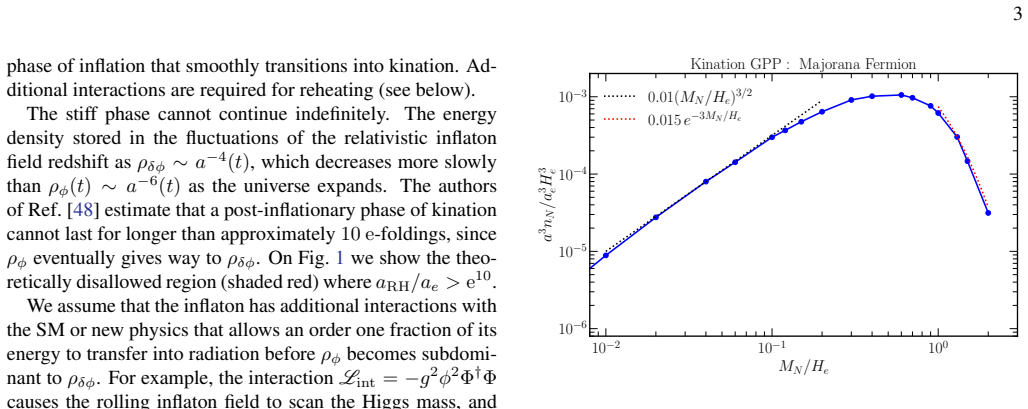

read the original abstract
We explore the coincidence of scales between cosmic inflation and right-handed neutrinos in seesaw models. We show that inflation models, which will be tested by next-generation CMB experiments, can produce right-handed neutrinos in sufficient abundance to explain the observed baryon asymmetry of the universe. The model can be tested by gravitational wave signatures from cosmic inflation and particle production.
Editorial analysis
A structured set of objections, weighed in public.
Referee Report
Summary. The manuscript explores the coincidence of scales between cosmic inflation and right-handed neutrino masses in seesaw models. It claims that inflation models testable by next-generation CMB experiments can produce right-handed neutrinos via cosmological gravitational particle production in sufficient abundance to explain the observed baryon asymmetry through nonthermal leptogenesis, with the scenario further testable via inflationary gravitational wave signatures.
Significance. If the central result holds without excessive parameter tuning, the work would establish a direct, testable connection between inflationary observables (such as the tensor-to-scalar ratio) and the baryon asymmetry, providing a nonthermal leptogenesis pathway that links neutrino physics to early-universe cosmology. This could constrain seesaw parameters using upcoming CMB and GW data, though its impact depends on the robustness of the production yield calculations.
major comments (1)
- [Abstract] The central claim requires that gravitational production yields n_N/s large enough for successful leptogenesis when m_N ~ H_inf. Standard Bogoliubov calculations for massive fermions show exponential suppression unless m_N is tuned within a factor of a few of the inflationary Hubble scale, yet seesaw models allow m_N to range over many orders of magnitude. The abstract states that viable CMB-testable inflation models (e.g., those with r > 0.001) can produce the required abundance, but the manuscript provides no explicit parameter scan over inflation potentials or analytic derivation demonstrating that the yield automatically matches the observed baryon asymmetry without tuning the scale coincidence. This makes the result rest on an unproven assumption rather than a generic prediction.
Simulated Author's Rebuttal
We thank the referee for their careful reading of our manuscript and for providing constructive comments. We address the major comment in detail below and have made revisions to clarify the key points.
read point-by-point responses
-
Referee: [Abstract] The central claim requires that gravitational production yields n_N/s large enough for successful leptogenesis when m_N ~ H_inf. Standard Bogoliubov calculations for massive fermions show exponential suppression unless m_N is tuned within a factor of a few of the inflationary Hubble scale, yet seesaw models allow m_N to range over many orders of magnitude. The abstract states that viable CMB-testable inflation models (e.g., those with r > 0.001) can produce the required abundance, but the manuscript provides no explicit parameter scan over inflation potentials or analytic derivation demonstrating that the yield automatically matches the observed baryon asymmetry without tuning the scale coincidence. This makes the result rest on an unproven assumption rather than a generic prediction.
Authors: We appreciate the referee's concern regarding the robustness of our central claim. Our manuscript does provide an analytic derivation of the gravitational particle production yield for right-handed neutrinos using the Bogoliubov coefficients in the regime where m_N is comparable to H_inf. We demonstrate that in this regime, the production is not exponentially suppressed and the resulting n_N/s is adequate for nonthermal leptogenesis to account for the observed baryon asymmetry. The scale coincidence m_N ~ H_inf is the central theme of the paper, and we show that for inflation models testable by next-generation CMB experiments (with r > 0.001), the corresponding H_inf values allow for m_N in the seesaw range to yield the correct asymmetry. While an exhaustive parameter scan over every possible inflation potential is not included, we present results for representative models and provide the general expressions that can be applied more broadly. We disagree that this rests on an unproven assumption; rather, it is a prediction under the explored coincidence. To strengthen the presentation, we will revise the abstract for clarity and include additional discussion or a figure illustrating the parameter space in the revised manuscript. revision: partial
Circularity Check
No significant circularity; derivation self-contained via independent gravitational production calculation.
full rationale
The paper calculates the yield of right-handed neutrinos from cosmological gravitational particle production using standard Bogoliubov techniques for a given inflationary Hubble scale and neutrino mass, then compares the resulting lepton asymmetry to the observed baryon asymmetry. This comparison is presented as a consistency check for specific inflation models whose tensor-to-scalar ratio is independently constrained by CMB observations, rather than a fit of parameters to the asymmetry itself. No load-bearing self-citations, self-definitional equations, or renaming of known results appear in the provided abstract and context; the scale coincidence is treated as an input to be explored, not derived by construction from the target asymmetry. The gravitational-wave testability is an external observable.
Axiom & Free-Parameter Ledger
Reference graph
Works this paper leans on
-
[1]
Drewes,The Phenomenology of Right Handed Neutrinos, Int
M. Drewes,The Phenomenology of Right Handed Neutrinos, Int. J. Mod. Phys. E22(2013) 1330019 [1303.6912]
-
[2]
A. D. Sakharov,Violation of CP Invariance, C asymmetry, and baryon asymmetry of the universe,Pisma Zh. Eksp. Teor. Fiz.5 (1967) 32
1967
-
[3]
Minkowski,µ→eγat a Rate of One Out of10 9 Muon Decays?,Phys
P. Minkowski,µ→eγat a Rate of One Out of10 9 Muon Decays?,Phys. Lett. B67(1977) 421
1977
-
[4]
R. N. Mohapatra and G. Senjanovic,Neutrino Mass and Spontaneous Parity Nonconservation,Phys. Rev. Lett.44 (1980) 912
1980
-
[5]
Yanagida,Horizontal gauge symmetry and masses of neutrinos,Conf
T. Yanagida,Horizontal gauge symmetry and masses of neutrinos,Conf. Proc. C7902131(1979) 95
1979
-
[6]
Yanagida,Horizontal Symmetry and Masses of Neutrinos, Prog
T. Yanagida,Horizontal Symmetry and Masses of Neutrinos, Prog. Theor. Phys.64(1980) 1103
1980
-
[7]
R. N. Mohapatra and G. Senjanovic,Neutrino Masses and Mixings in Gauge Models with Spontaneous Parity Violation, Phys. Rev. D23(1981) 165
1981
-
[8]
Schechter and J
J. Schechter and J. W. F. Valle,Neutrino Masses in SU(2) x U(1) Theories,Phys. Rev. D22(1980) 2227
1980
-
[9]
Georgi and S
H. Georgi and S. L. Glashow,Unity of All Elementary Particle 6 Forces,Phys. Rev. Lett.32(1974) 438
1974
-
[10]
Fukugita and T
M. Fukugita and T. Yanagida,Baryogenesis Without Grand Unification,Phys. Lett. B174(1986) 45
1986
-
[11]
R. Barbieri, P. Creminelli, A. Strumia and N. Tetradis, Baryogenesis through leptogenesis,Nucl. Phys. B575(2000) 61 [hep-ph/9911315]
-
[12]
W. Buchmuller, P. Di Bari and M. Plumacher,Leptogenesis for pedestrians,Annals Phys.315(2005) 305 [hep-ph/0401240]
work page Pith review arXiv 2005
-
[13]
Leptogenesis as the origin of matter
W. Buchmuller, R. D. Peccei and T. Yanagida,Leptogenesis as the origin of matter,Ann. Rev. Nucl. Part. Sci.55(2005) 311 [hep-ph/0502169]
work page Pith review arXiv 2005
-
[14]
B. Garbrecht,Why is there more matter than antimatter? Calculational methods for leptogenesis and electroweak baryogenesis,Prog. Part. Nucl. Phys.110(2020) 103727 [1812.02651]
-
[15]
Lazarides and Q
G. Lazarides and Q. Shafi,Origin of matter in the inflationary cosmology,Phys. Lett. B258(1991) 305
1991
- [16]
-
[17]
K. Kumekawa, T. Moroi and T. Yanagida,Flat potential for inflaton with a discrete R invariance in supergravity,Prog. Theor. Phys.92(1994) 437 [hep-ph/9405337]
-
[18]
Lazarides,Leptogenesis in supersymmetric hybrid inflation, Springer Tracts Mod
G. Lazarides,Leptogenesis in supersymmetric hybrid inflation, Springer Tracts Mod. Phys.163(2000) 227 [hep-ph/9904428]
- [19]
- [20]
-
[21]
R. Jeannerot, S. Khalil and G. Lazarides,Leptogenesis in smooth hybrid inflation,Phys. Lett. B506(2001) 344 [hep-ph/0103229]
- [22]
-
[23]
R. Allahverdi and A. Mazumdar,Nonthermal leptogenesis with almost degenerate superheavy neutrinos,Phys. Rev. D67 (2003) 023509 [hep-ph/0208268]
- [24]
-
[25]
F. Hahn-Woernle and M. Plumacher,Effects of reheating on leptogenesis,Nucl. Phys. B806(2009) 68 [0801.3972]
-
[26]
W. Buchmuller, V . Domcke, K. Kamada and K. Schmitz,A Minimal Supersymmetric Model of Particle Physics and the Early Universe,1309.7788
- [27]
- [28]
-
[29]
A. Ghoshal, R. Samanta and G. White,Bremsstrahlung high-frequency gravitational wave signatures of high-scale nonthermal leptogenesis,Phys. Rev. D108(2023) 035019 [2211.10433]
- [30]
- [31]
- [32]
-
[33]
D. Delepine and S. Khalil,Non-Thermal Leptogenesis in the BLSM with Inverse Seesaw Mechanism,2601.05186
-
[34]
N. Bostan, R. H. Dejrah, A. Ghoshal and Z. Lalak,Induced Multi-phase Inflation with Reheating: Leptogenesis and Dark Matter Production in Metric versus Palatini,2604.09843
work page internal anchor Pith review Pith/arXiv arXiv
- [35]
-
[36]
J. Garcia-Bellido and E. Ruiz Morales,Particle production from symmetry breaking after inflation,Phys. Lett. B536 (2002) 193 [hep-ph/0109230]
-
[37]
S. Antusch and K. Marschall,Non-thermal Leptogenesis after Majoron Hilltop Inflation,JCAP05(2018) 015 [1802.05647]
-
[38]
M. Cataldi and B. Shakya,Leptogenesis via bubble collisions, JCAP11(2024) 047 [2407.16747]
-
[39]
A. Ghoshal and P. Pal,Cosmic Collider Gravitational Waves sourced by Right-handed Neutrino production from Bubbles: Testing Seesaw, Leptogenesis and Dark Matter, 2601.02458
work page internal anchor Pith review Pith/arXiv arXiv
-
[40]
T. Kobayashi, M. Yamaguchi and J. Yokoyama,G-inflation: Inflation driven by the Galileon field,Phys. Rev. Lett.105 (2010) 231302 [1008.0603]
-
[41]
S. Hashiba and J. Yokoyama,Dark matter and baryon-number generation in quintessential inflation via hierarchical right-handed neutrinos,Phys. Lett. B798(2019) 135024 [1905.12423]
-
[42]
N. Bernal and C. S. Fong,Dark matter and leptogenesis from gravitational production,JCAP06(2021) 028 [2103.06896]
- [43]
-
[44]
K. Fujikura, S. Hashiba and J. Yokoyama,Generation of neutrino dark matter, baryon asymmetry, and radiation after quintessential inflation,Phys. Rev. D107(2023) 063537 [2210.05214]
- [45]
- [46]
-
[47]
Inflation at the End of 2025: Constraints onrandn s Using the Latest CMB and BAO Data,
L. Balkenhol et al.,Inflation at the End of 2025: Constraints onrandn s Using the Latest CMB and BAO Data, 2512.10613
-
[48]
C. Er ¨oncel, Y . Gouttenoire, R. Sato, G. Servant and P. Simakachorn,Universal Bound on the Duration of a Kination Era,Phys. Rev. Lett.135(2025) 101002 [2501.17226]
- [49]
-
[50]
Allyset al.(LiteBIRD), PTEP2023, 042F01 (2023), arXiv:2202.02773 [astro-ph.IM]
LITEBIRD collaboration, E. Allys et al.,Probing Cosmic Inflation with the LiteBIRD Cosmic Microwave Background Polarization Survey,PTEP2023(2023) 042F01 [2202.02773]
-
[51]
SIMONSOBSERVATORYcollaboration, I. Abril-Cabezas et al., 7 The Simons Observatory: forecasted constraints on primordial gravitational waves with the expanded array of Small Aperture Telescopes,2512.15833
- [52]
-
[53]
K. Hamaguchi, H. Murayama and T. Yanagida,Leptogenesis from N dominated early universe,Phys. Rev. D65(2002) 043512 [hep-ph/0109030]
-
[54]
A lower bound on the right-handed neutrino mass from leptogenesis
S. Davidson and A. Ibarra,A Lower bound on the right-handed neutrino mass from leptogenesis,Phys. Lett. B535(2002) 25 [hep-ph/0202239]
work page Pith review arXiv 2002
-
[55]
W. Buchmuller, P. Di Bari and M. Plumacher,The Neutrino mass window for baryogenesis,Nucl. Phys. B665(2003) 445 [hep-ph/0302092]
- [56]
-
[57]
J. A. Harvey and M. S. Turner,Cosmological Baryon and Lepton Number in the Presence of Electroweak Fermion Number Violation,Phys. Rev. D42(1990) 3344
1990
-
[58]
Y . Gouttenoire, G. Servant and P. Simakachorn,Kination cosmology from scalar fields and gravitational-wave signatures,2111.01150
- [59]
-
[60]
D. Bettoni and J. Rubio,Quintessential Inflation: A Tale of Emergent and Broken Symmetries,Galaxies10(2022) 22 [2112.11948]
-
[61]
J. de Haro and L. A. Sal ´o,A Review of Quintessential Inflation, Galaxies9(2021) 73 [2108.11144]
-
[62]
C. Armendariz-Picon, T. Damour and V . F. Mukhanov,k - inflation,Phys. Lett. B458(1999) 209 [hep-th/9904075]
- [63]
- [64]
- [65]
-
[66]
L. H. Ford,Gravitational Particle Creation and Inflation, Phys. Rev. D35(1987) 2955
1987
-
[67]
T. Kunimitsu and J. Yokoyama,Higgs condensation as an unwanted curvaton,Phys. Rev. D86(2012) 083541 [1208.2316]
-
[68]
T. Nakama and J. Yokoyama,Reheating through the Higgs amplified by spinodal instabilities and gravitational creation of gravitons,PTEP2019(2019) 033E02 [1803.07111]
-
[69]
Planck 2018 results. VI. Cosmological parameters
PLANCKcollaboration, N. Aghanim et al.,Planck 2018 results. VI. Cosmological parameters,Astron. Astrophys.641 (2020) A6 [1807.06209]
work page internal anchor Pith review arXiv 2018
- [70]
-
[71]
Parker,Quantized fields and particle creation in expanding universes
L. Parker,Quantized fields and particle creation in expanding universes. 1.,Phys. Rev.183(1969) 1057
1969
-
[72]
Parker,Quantized fields and particle creation in expanding universes
L. Parker,Quantized fields and particle creation in expanding universes. 2.,Phys. Rev. D3(1971) 346
1971
-
[73]
V . Kuzmin and I. Tkachev,Matter creation via vacuum fluctuations in the early universe and observed ultrahigh-energy cosmic ray events,Phys. Rev. D59(1999) 123006 [hep-ph/9809547]
- [74]
- [75]
- [76]
-
[77]
J. de Haro, S. Pan and L. Arest ´e Sal´o,Understanding gravitational particle production in quintessential inflation, JCAP06(2019) 056 [1903.01181]
-
[78]
J. Haro and L. Arest ´e Sal´o,Gravitational production of superheavy baryonic and dark matter in quintessential inflation: nonconformally coupled case,Phys. Rev. D100 (2019) 043519 [1906.02548]
- [79]
-
[80]
J. de Haro and L. Arest ´e Sal´o,Analytic formula to calculate the reheating temperature via gravitational particle production in smooth nonoscillating backgrounds,Phys. Rev. D107 (2023) 063542 [2212.01276]
discussion (0)
Sign in with ORCID, Apple, or X to comment. Anyone can read and Pith papers without signing in.