Recognition: unknown
Analytical Angle-Finding and Series Expansions for Quantum Signal Processing via Orthogonal Polynomial Theory
Pith reviewed 2026-05-08 17:07 UTC · model grok-4.3
The pith
Quantum signal processing rotation angles have explicit expressions for orthogonal polynomial families such as Hermite and Jacobi polynomials.
A machine-rendered reading of the paper's core claim, the machinery that carries it, and where it could break.
Core claim
The polynomials implemented by quantum signal processing are precisely those that are orthogonal or biorthogonal with respect to a linear functional that has an integral representation. This equivalence provides explicit formulas for the angles in standard families and shows that 2n+2 angles encode degree-n sequences in these families, which in turn permits logarithmic-cost block-encoding of smooth functions via Hermite expansions.
What carries the argument
Orthogonality or biorthogonality of the polynomial sequence with respect to a linear functional admitting an integral representation, which determines the achievable bases and solves for the angles
Load-bearing premise
That the standard sequence of rotations in QSP implements exactly the polynomials orthogonal or biorthogonal to the given linear functional without further restrictions from the unitary or block-encoding structure.
What would settle it
A direct computation for small n showing that the proposed explicit angles for Hermite polynomials fail to reproduce the expected sequence when inserted into the QSP protocol.
Figures


read the original abstract
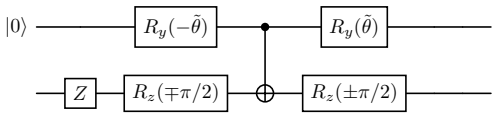
Quantum signal processing is a powerful framework in quantum algorithms, playing a central role in Hamiltonian simulation and related applications. The sequence of polynomials implemented at each step of this protocol provides a polynomial basis for block-encoding any polynomial of a unitary. We characterize the achievable polynomial bases in terms of their orthogonality or biorthogonality with respect to a linear functional admitting an integral representation. Explicit expressions for the quantum signal processing angles are derived for families of polynomial sequences, including Hermite, Jacobi, and Rogers-Szeg\H{o} polynomials. We show that $2n+2$ rotation angles are required to encode a sequence of polynomials in these classes up to degree $n$. We use this result to show that an $\epsilon$-approximation of a smooth function $f$ can be block-encoded using $O(\log(1/\epsilon))$ gates via its Hermite series expansion. The connections established with the theory of orthogonal and biorthogonal polynomials lead to a new method for solving the quantum signal processing angle-finding problem, yielding explicit expressions for the angles. They also provide a complete characterization of the polynomials achievable by $\mathrm{SU}(1,1)$-QSP in terms of their roots. Biorthogonality properties are shown to hold in the bivariate QSP setting, yielding a set of necessary conditions for achievable polynomials.
Editorial analysis
A structured set of objections, weighed in public.
Referee Report
Summary. The manuscript claims to characterize the polynomial bases achievable via quantum signal processing (QSP) and SU(1,1)-QSP in terms of orthogonality or biorthogonality with respect to linear functionals that admit integral representations. It derives explicit expressions for the QSP rotation angles for the Hermite, Jacobi, and Rogers-Szegő families, establishes that 2n+2 angles suffice to encode sequences of these polynomials up to degree n, and applies the Hermite case to obtain an O(log(1/ε)) gate complexity for block-encoding ε-approximations of smooth functions. The work also supplies a root-based characterization of achievable polynomials and demonstrates biorthogonality properties in the bivariate QSP setting.
Significance. If the central characterizations and explicit constructions hold, the paper supplies a valuable analytical toolkit for the QSP angle-finding problem, which is otherwise typically addressed numerically. Linking QSP to classical orthogonal-polynomial theory could streamline protocol design for Hamiltonian simulation and function approximation. The claimed O(log(1/ε)) scaling for Hermite-based encodings and the root-based completeness result would be concrete strengths, offering both practical efficiency gains and a falsifiable description of the achievable polynomial class.
major comments (2)
- [Abstract and main characterization] The core claim equating QSP-generated polynomials with the full class of orthogonal/biorthogonal polynomials w.r.t. integral-representable functionals (Abstract and the main characterization): the standard QSP product of phased rotations imposes a fixed three-term recurrence together with even-odd parity and normalization constraints arising from the interleaved signal and rotation operators. It is not immediate that arbitrary members of the cited orthogonal families satisfy these exact coefficients without further restrictions on the functional or the roots; explicit verification for Hermite, Jacobi, and Rogers-Szegő is required to underwrite the derived angle expressions and the root characterization.
- [Abstract] The O(log(1/ε)) gate-complexity statement for ε-approximations via Hermite series (Abstract): while 2n+2 angles are stated for degree-n sequences, the manuscript must specify the precise class of smooth functions for which the Hermite coefficients decay fast enough that n = O(log(1/ε)), and must confirm that the block-encoding overhead (including any additional controls or ancillae) preserves the asymptotic scaling.
minor comments (1)
- [Abstract] The abstract introduces biorthogonality in the bivariate QSP setting without defining the bivariate construction or the associated linear functional; a brief clarifying sentence or forward reference would improve readability for readers outside the orthogonal-polynomial community.
Simulated Author's Rebuttal
We thank the referee for their careful reading and constructive comments, which help clarify the scope and rigor of our characterizations. We respond to each major comment below and outline the revisions we will incorporate.
read point-by-point responses
-
Referee: [Abstract and main characterization] The core claim equating QSP-generated polynomials with the full class of orthogonal/biorthogonal polynomials w.r.t. integral-representable functionals (Abstract and the main characterization): the standard QSP product of phased rotations imposes a fixed three-term recurrence together with even-odd parity and normalization constraints arising from the interleaved signal and rotation operators. It is not immediate that arbitrary members of the cited orthogonal families satisfy these exact coefficients without further restrictions on the functional or the roots; explicit verification for Hermite, Jacobi, and Rogers-Szegő is required to underwrite the derived angle expressions and the root characterization.
Authors: We agree that the QSP framework imposes a three-term recurrence, parity, and normalization constraints, and that not every orthogonal polynomial family will automatically satisfy them. Our approach derives the QSP angles directly from the recurrence coefficients of the target families (Hermite, Jacobi, Rogers-Szegő), ensuring by construction that the resulting polynomials obey the QSP product structure. The integral representations of the associated linear functionals are chosen precisely so that the orthogonality relations are compatible with the even-odd parity enforced by the interleaved signal and rotation operators. In the revised manuscript we will add an explicit verification subsection (with low-degree examples and a general argument) showing that the derived angles reproduce the desired polynomials while satisfying the QSP constraints; we will also clarify that the characterization applies to those members of the families whose recurrence coefficients admit the required integral form and parity, rather than to arbitrary orthogonal polynomials. revision: yes
-
Referee: [Abstract] The O(log(1/ε)) gate-complexity statement for ε-approximations via Hermite series (Abstract): while 2n+2 angles are stated for degree-n sequences, the manuscript must specify the precise class of smooth functions for which the Hermite coefficients decay fast enough that n = O(log(1/ε)), and must confirm that the block-encoding overhead (including any additional controls or ancillae) preserves the asymptotic scaling.
Authors: We accept the need for greater precision on the function class and overhead. In the revised version we will state that the O(log(1/ε)) scaling holds for functions whose Hermite coefficients decay exponentially (e.g., entire functions of finite order or functions analytic in a strip containing the real line), for which the truncation error after degree n is O(exp(−c n)) and thus n = O(log(1/ε)) suffices for ε-accuracy. The block-encoding is realized by the standard QSP protocol: a sequence of 2n+2 phase rotations interleaved with the signal oracle, using no extra ancillae beyond those required by the signal oracle itself. The total gate count therefore remains linear in the number of angles and inherits the O(log(1/ε)) scaling; we will add a short paragraph confirming this in the applications section. revision: yes
Circularity Check
No significant circularity; derivations rely on external orthogonal polynomial theory
full rationale
The paper applies known recurrence relations, root characterizations, and integral representations from the classical theory of orthogonal and biorthogonal polynomials (Hermite, Jacobi, Rogers-Szegő) to obtain explicit QSP rotation angles and to characterize the polynomials realized by the standard phased-rotation product. These identities are imported as established external mathematics rather than fitted inside the paper or derived from a self-referential definition of the QSP sequence. The claim that 2n+2 angles suffice for degree-n sequences and the O(log(1/ε)) block-encoding result follow directly from the series-expansion properties of those families once the angle expressions are obtained; no step equates a prediction to a parameter that was itself tuned to the target quantity. The bivariate biorthogonality conditions are likewise presented as necessary consequences of the QSP matrix product, not as an assumption that is later re-used to justify the same product. The derivation chain therefore remains self-contained against external benchmarks.
Axiom & Free-Parameter Ledger
axioms (2)
- domain assumption QSP implements polynomial transformations of a unitary via a sequence of rotation angles whose values solve an angle-finding problem.
- domain assumption Achievable polynomials are characterized by orthogonality or biorthogonality with respect to a linear functional admitting an integral representation.
Reference graph
Works this paper leans on
-
[1]
Guang Hao Low and Isaac L. Chuang. Optimal Hamiltonian simulation by quantum signal processing.Physical Review Letters, 118(1):010501, 2017. doi.org/10.1103/PhysRevLett.118.010501
-
[2]
Guang Hao Low and Isaac L Chuang. Hamiltonian simulation by qubitization.Quantum, 3:163, 2019. doi.org/10.22331/q-2019-07-12-163
-
[3]
Toward Mixed Analog-Digital Quantum Signal Processing: Quantum AD/DA Conversion and the Fourier Transform.IEEE Transactions on Signal Processing,
Yuan Liu, John M Martyn, Jasmine Sinanan-Singh, Kevin C Smith, Steven M Girvin, and Isaac L Chuang. Toward Mixed Analog-Digital Quantum Signal Processing: Quantum AD/DA Conversion and the Fourier Transform.IEEE Transactions on Signal Processing,
-
[4]
doi.org/10.1109/TSP.2025.3599462
-
[5]
Shantanav Chakraborty, Andr´ as Gily´ en, and Stacey Jeffery. The Power of Block- Encoded Matrix Powers: Improved Regression Techniques via Faster Hamiltonian Sim- ulation. In46th International Colloquium on Automata, Languages, and Program- ming (ICALP 2019), pages 33–1. Schloss Dagstuhl–Leibniz-Zentrum f¨ ur Informatik, 2019. doi.org/10.4230/LIPIcs.ICAL...
-
[6]
Lin Lin and Yu Tong. Optimal polynomial based quantum eigenstate filtering with application to solving quantum linear systems.Quantum, 4:361, 2020. doi.org/10.22331/q-2020-11-11-361
-
[8]
Methodology of res- onant equiangular composite quantum gates.Physical Review X, 6(4):041067, 2016
Guang Hao Low, Theodore J Yoder, and Isaac L Chuang. Methodology of res- onant equiangular composite quantum gates.Physical Review X, 6(4):041067, 2016. doi.org/10.1103/PhysRevX.6.041067
-
[9]
Carlos Ortiz Marrero, Rui Jie Tang, and Nathan Wiebe. Encoded Quantum Signal Processing for Heisenberg-Limited Metrology.arXiv preprint, arXiv:2603.22798, 2026
-
[10]
Yulong Dong, Jonathan Gross, and Murphy Yuezhen Niu. Beyond Heisenberg limit quantum metrology through quantum signal processing.arXiv preprint, arXiv:2209.11207, 2022
-
[11]
Zane M. Rossi and Isaac L. Chuang. Multivariable Quantum Signal Processing (M-QSP): Prophecies of the Two-Headed Oracle.Quantum, 6:811, 2022. doi.org/10.22331/q-2022-09-20- 811. 47
-
[12]
Bal´ azs N´ emeth, Blanka K¨ ov´ er, Bogl´ arka Kulcs´ ar, Roland Botond Mikl´ osi, and Andr´ as Gily´ en. On Variants of Multivariate Quantum Signal Processing and Their Characterizations.arXiv preprint, arXiv:2312.09072, 2023
- [13]
-
[14]
On multivariate polynomials achievable with quantum signal processing.Quantum, 9:1641, 2025
Lorenzo Laneve and Stefan Wolf. On multivariate polynomials achievable with quantum signal processing.Quantum, 9:1641, 2025. doi.org/10.22331/q-2025-02-20-1641
-
[15]
Modular quantum signal processing in many variables.Quantum, 9:1776, 2025
Zane M Rossi, Jack L Ceroni, and Isaac L Chuang. Modular quantum signal processing in many variables.Quantum, 9:1776, 2025. doi.org/10.22331/q-2025-06-18-1776
-
[16]
Quantum Algorithm for Linear Systems of Equations,
Aram W. Harrow, Avinatan Hassidim, and Seth Lloyd. Quantum Algorithm for Linear Systems of Equations.Physical Review Letters, 103(15):150502, 2009. doi.org/10.1103/PhysRevLett.103.150502
-
[17]
Childs, Robin Kothari, and Rolando D
Andrew M Childs, Robin Kothari, and Rolando D Somma. Quantum algorithm for systems of linear equations with exponentially improved dependence on precision.SIAM Journal on Computing, 46(6):1920–1950, 2017. doi.org/10.1137/16M1087072
-
[18]
Hamiltonian Simulation Using Linear Combinations of Unitary Operations
Andrew M Childs and Nathan Wiebe. Hamiltonian Simulation Using Linear Combinations of Unitary Operations.Quant. Inf. Comput., 12:0901–0924, 2012. arXiv.1202.5822
work page Pith review arXiv 2012
-
[19]
Dominic W Berry, Andrew M Childs, Aaron Ostrander, and Guoming Wang. Quantum algo- rithm for linear differential equations with exponentially improved dependence on precision. Communications in Mathematical Physics, 356(3):1057–1081, 2017. doi.org/10.1007/s00220- 017-3002-y
-
[20]
Di Fang, Lin Lin, and Yu Tong. Time-marching based quantum solvers for time-dependent linear differential equations.Quantum, 7:955, 2023. doi.org/10.22331/q-2023-03-20-955
-
[21]
Dong An, Jin-Peng Liu, and Lin Lin. Linear Combination of Hamiltonian Simulation for Nonunitary Dynamics with Optimal State Preparation Cost.Physical Review Letters, 131(15):150603, 2023. doi.org/10.1103/PhysRevLett.131.150603
-
[22]
Dominic W. Berry, Andrew M. Childs, and Robin Kothari. Hamiltonian simulation with nearly optimal dependence on all parameters. In2015 IEEE 56th annual symposium on foundations of computer science, pages 792–809. IEEE, 2015. doi.org/10.1109/FOCS.2015.54
-
[23]
Exponential improvement in precision for simulating sparse hamiltonians
Dominic W Berry, Andrew M Childs, Richard Cleve, Robin Kothari, and Rolando D Somma. Exponential improvement in precision for simulating sparse hamiltonians. InProceedings of the forty-sixth annual ACM symposium on Theory of computing, pages 283–292, 2014. doi.org/10.1145/2591796.259185
-
[24]
Product Decomposition of Periodic Functions in Quantum Signal Processing,
Jeongwan Haah. Product decomposition of periodic functions in quantum signal processing. Quantum, 3:190, 2019. doi.org/10.22331/q-2019-10-07-190
-
[25]
Rui Chao, Dawei Ding, Andr´ as Gily´ en, Cupjin Huang, and Mario Szegedy. Finding an- gles for quantum signal processing with machine precision.arXiv preprint arXiv:2003.02831, arXiv:2003.02831, 2020. 48
-
[26]
Efficient phase-factor evaluation in quantum signal processing,
Yulong Dong, Xiang Meng, K Birgitta Whaley, and Lin Lin. Efficient Phase-Factor Evaluation in Quantum Signal Processing.Physical Review A, 103(4):042419, 2021. doi.org/10.1103/PhysRevA.103.042419
-
[27]
Generalized quantum signal processing,
Danial Motlagh and Nathan Wiebe. Generalized Quantum Signal Processing.PRX Quantum, 5(2):020368, 2024. doi.org/10.1103/PRXQuantum.5.020368
-
[28]
Zane M. Rossi, Victor M. Bastidas, William J. Munro, and Isaac L. Chuang. Quantum Signal Processing with Continuous Variables.arXiv preprint, arXiv:2304.14383, 2023
-
[29]
Paul Barry. Constant Coefficient Laurent Biorthogonal Polynomials, Riordan Arrays and Moment Sequences.arXiv preprint, arXiv:1906.06370, 2019
-
[30]
Courier Corporation, 2011
Theodore S Chihara.An introduction to orthogonal polynomials. Courier Corporation, 2011
2011
-
[31]
Biorthogonal Laurent Polynomials with Biorthogonal Derivatives.The Rocky Mountain Journal of Mathematics, pages 301–317, 1991
Erik Hendriksen and Olav Nj˚ astad. Biorthogonal Laurent Polynomials with Biorthogonal Derivatives.The Rocky Mountain Journal of Mathematics, pages 301–317, 1991
1991
-
[32]
Alexei Zhedanov. The “Classical” Laurent Biorthogonal Polynomials.Journal of Computa- tional and Applied Mathematics, 98(1):121–147, 1998. doi.org/10.1016/S0377-0427(98)00118-6
-
[33]
S Kamioka. Laurent biorthogonal polynomials, q-Narayana polynomials and domino tilings of the Aztec diamonds.Journal of Combinatorial Theory, Series A, 123(1):14–29, 2014. doi.org/10.1016/j.jcta.2013.11.002
-
[34]
American Mathematical Society, 2005
Barry Simon.Orthogonal Polynomials on the Unit Circle. American Mathematical Society, 2005. 49
2005
discussion (0)
Sign in with ORCID, Apple, or X to comment. Anyone can read and Pith papers without signing in.