Recognition: unknown
Primordial Magnetic Fields at Cosmic Dawn: 21-cm Forecasts with HERA and SKA
Pith reviewed 2026-05-08 16:14 UTC · model grok-4.3
The pith
Primordial magnetic fields can accelerate the formation of the first galaxies and leave measurable shifts in the 21-centimeter signal from cosmic dawn.
A machine-rendered reading of the paper's core claim, the machinery that carries it, and where it could break.
Core claim
Primordial magnetic fields source additional small-scale matter fluctuations that raise the abundance of low-mass halos during cosmic dawn. This enhancement accelerates Lyman-alpha coupling, X-ray heating, and reionization, producing correlated shifts in the global and fluctuating 21-centimeter signals. Extending the zeus21 framework to incorporate a PMF contribution to the linear matter power spectrum, with radiative damping before recombination and suppression below the magnetic Jeans scale, preserves computational speed while enabling forecasts across a range of field amplitudes for spectral index n_B = -2.9. When 21-centimeter forecasts from HERA and SKA are combined with external CMBpri
What carries the argument
The extension of the zeus21 analytic framework to add a physically motivated PMF term to the linear matter power spectrum, including radiative damping before recombination and magnetic-pressure suppression below the magnetic Jeans scale; this term directly increases the predicted abundance of low-mass halos and thereby shifts the timing of 21-centimeter features.
If this is right
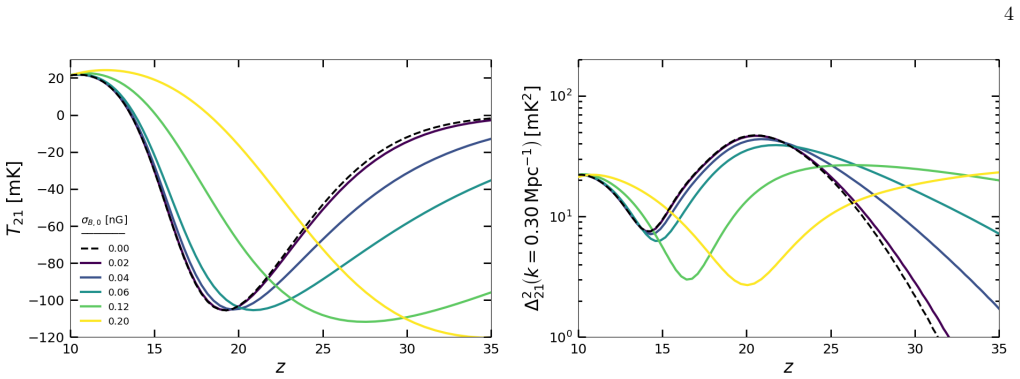
- For a spectral index of -2.9, stronger primordial magnetic fields produce progressively earlier Lyman-alpha coupling, X-ray heating, and reionization, shifting the peak and shape of the 21-centimeter global signal and increasing power on relevant scales.
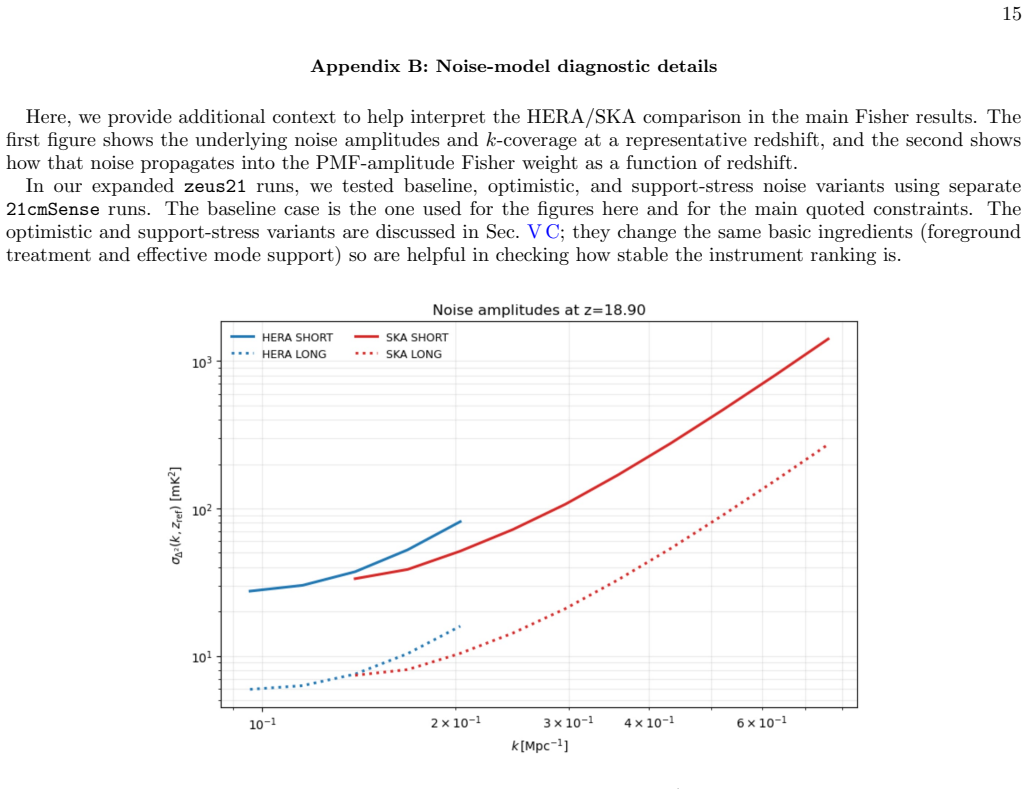
- The modified model generates concrete forecasts showing that HERA and SKA data can detect or place upper limits on magnetic field amplitudes through their effect on early structure.
- Combining the 21-centimeter forecasts with CMB priors yields constraints on primordial magnetic fields that are independent of those obtained from other cosmological probes.
- The extended framework keeps the original speed and modularity, allowing rapid scans over magnetic field parameters without new full simulations.
Where Pith is reading between the lines
- If the modeled effect holds, similar 21-centimeter shifts could help distinguish primordial magnetic fields from other early-universe modifications to small-scale power, such as warm dark matter.
- A positive detection would tighten limits on magnetogenesis scenarios operating before recombination and would motivate targeted searches in high-redshift galaxy surveys.
- The same modeling approach could be applied to other mechanisms that alter the small-scale matter spectrum to produce joint forecasts for multiple early-universe physics effects.
- Future refinements might incorporate the back-reaction of the enhanced halos on the magnetic field evolution itself.
Load-bearing premise
That adding a term for primordial magnetic fields to the linear matter power spectrum, with the included damping and suppression effects, correctly predicts the resulting increase in low-mass halos and the associated changes in 21-centimeter observables.
What would settle it
A measurement by HERA or SKA showing no earlier shift in the timing of Lyman-alpha coupling or X-ray heating in the 21-centimeter global signal or power spectrum, after the magnetic field strength has been limited by CMB data, would indicate that the modeled enhancement of small-scale structure does not occur.
Figures




read the original abstract
Primordial magnetic fields (PMFs) can enhance the abundance of low-mass halos during Cosmic Dawn by sourcing additional small-scale matter fluctuations. This enhanced small-scale power can accelerate early galaxy formation, shifting the timing of Lyman-$\alpha$ coupling, X-ray heating, and reionization toward earlier times and imprinting correlated signatures on the global and fluctuating 21-cm signals. We extend the fast analytic framework {\tt\string zeus21} to include a physically motivated PMF contribution to the linear matter power spectrum, including radiative damping before recombination and magnetic-pressure suppression below the magnetic Jeans scale. The implementation preserves the speed and modularity of {\tt\string zeus21}, enabling efficient exploration of PMF parameter space. For $n_B=-2.9$, we quantify the impact of PMFs on early structure formation and 21-cm observables across a range of fiducial magnetic amplitudes, and forecast detectability with \textit{HERA} and \textit{SKA}. Combining 21-cm forecasts with external CMB priors, we find that upcoming experiments can probe PMFs through their impact on small-scale structure, providing constraints complementary to existing cosmological probes.
Editorial analysis
A structured set of objections, weighed in public.
Referee Report
Summary. The paper extends the analytic semi-numerical code zeus21 to incorporate a PMF contribution to the linear matter power spectrum (including radiative damping before recombination and magnetic-pressure suppression below the magnetic Jeans scale). It then quantifies the resulting enhancement of low-mass halos at Cosmic Dawn for n_B = -2.9, the consequent shifts in Lyman-alpha coupling, X-ray heating and reionization timing, and the imprint on global and fluctuating 21-cm signals. Forecasts for detectability with HERA and SKA are presented, together with the claim that combining these with CMB priors yields complementary constraints on PMF amplitudes.
Significance. If the modeling assumptions hold, the work provides a practical, computationally efficient route to forecasting PMF constraints from upcoming 21-cm arrays via their effect on small-scale structure. The preservation of zeus21's speed and modularity is a clear strength for parameter-space exploration. The significance is limited, however, by the absence of any direct validation of the extended model against simulations that include non-linear gravitational collapse and baryonic physics at the relevant halo masses and redshifts.
major comments (2)
- [§3] §3 (Implementation of PMF term in zeus21): the central forecasts rest on the assumption that simply augmenting the linear P(k) with the PMF contribution (radiative damping plus magnetic Jeans suppression) and feeding it into the existing excursion-set halo mass function and mean-field radiative-transfer modules produces reliable shifts in star-formation rate density, Lyman-alpha coupling, and 21-cm observables. No quantitative test of this mapping is shown for M_halo ~ 10^6-10^8 M_sun at z ~ 15-25, where non-linear and baryonic effects are expected to be important.
- [§4] §4 (Forecasts and detectability): the claimed complementarity with CMB priors and the projected HERA/SKA constraints are derived directly from the unvalidated zeus21+PMF signals. Without an assessment of systematic uncertainty arising from the linear-P(k) approximation, the forecasted error bars and detection thresholds cannot be taken at face value.
minor comments (2)
- [Abstract] The abstract and introduction cite the fiducial spectral index n_B = -2.9 but do not explicitly state the range of magnetic amplitudes explored or the precise definition of the magnetic Jeans scale used in the implementation.
- [Figures] Figure captions and axis labels should clarify whether the plotted 21-cm power spectra include the full PMF-modified reionization history or only the linear power-spectrum rescaling.
Simulated Author's Rebuttal
We thank the referee for their constructive comments on the modeling assumptions and forecast robustness. We agree that the semi-analytic nature of the zeus21+PMF extension introduces limitations that warrant clearer discussion, and we have revised the manuscript accordingly to address these points while preserving the work's focus on efficient parameter-space exploration.
read point-by-point responses
-
Referee: [§3] §3 (Implementation of PMF term in zeus21): the central forecasts rest on the assumption that simply augmenting the linear P(k) with the PMF contribution (radiative damping plus magnetic Jeans suppression) and feeding it into the existing excursion-set halo mass function and mean-field radiative-transfer modules produces reliable shifts in star-formation rate density, Lyman-alpha coupling, and 21-cm observables. No quantitative test of this mapping is shown for M_halo ~ 10^6-10^8 M_sun at z ~ 15-25, where non-linear and baryonic effects are expected to be important.
Authors: We acknowledge that the implementation relies on modifying the linear power spectrum and propagating it through zeus21's existing excursion-set and mean-field modules without dedicated new simulations for validation at these halo masses and redshifts. This follows the standard semi-numerical methodology used in codes like 21cmFAST for exploring enhanced small-scale power (e.g., in warm dark matter or primordial non-Gaussianity studies). The relative enhancement from PMFs is captured at linear order, with absolute normalization tied to the no-PMF baseline. In the revised manuscript we have added a dedicated paragraph in §3.2 discussing expected uncertainties from non-linear collapse and baryonic feedback, citing available PMF simulation literature, and explicitly noting that full hydrodynamical validation lies beyond the current scope. revision: partial
-
Referee: [§4] §4 (Forecasts and detectability): the claimed complementarity with CMB priors and the projected HERA/SKA constraints are derived directly from the unvalidated zeus21+PMF signals. Without an assessment of systematic uncertainty arising from the linear-P(k) approximation, the forecasted error bars and detection thresholds cannot be taken at face value.
Authors: We agree that systematic uncertainties from the linear approximation should be assessed before the forecasts can be interpreted at face value. The revised §4 now includes a qualitative discussion of these systematics, emphasizing that the dominant PMF signature is a timing shift in the 21-cm milestones rather than a change in fluctuation amplitude, and that the quoted detection thresholds are therefore conservative. The claimed complementarity with CMB priors is retained because 21-cm data probe the integrated small-scale structure-formation response (orthogonal to CMB damping constraints on larger scales), but we have clarified throughout the text that the numerical constraints are model-dependent and indicative within the adopted framework. revision: partial
- Direct quantitative validation of the PMF-augmented halo mass function and 21-cm signals against N-body or hydrodynamical simulations that include non-linear gravitational collapse and baryonic physics at z~15-25 and M_halo~10^6-10^8 M_sun.
Circularity Check
No significant circularity; forecasts are forward predictions from an extended physical model
full rationale
The paper extends the zeus21 framework by adding a physically motivated PMF term to the linear matter power spectrum (with radiative damping and magnetic Jeans suppression). This is presented as an implementation choice, not a fit to the target 21-cm data. The forecasts for HERA/SKA detectability and combined CMB constraints are generated by propagating this modified P(k) through the existing zeus21 modules for halo abundance and radiative processes. No equations or steps in the provided text reduce the claimed results to fitted parameters, self-citations that bear the central load, or definitions that presuppose the output. The derivation chain remains self-contained against external benchmarks.
Axiom & Free-Parameter Ledger
free parameters (1)
- magnetic field amplitude
axioms (1)
- domain assumption Standard Lambda-CDM background cosmology with added PMF contribution to linear power spectrum
Reference graph
Works this paper leans on
-
[1]
A. Loeb and M. Zaldarriaga, Measuring the small - scale power spectrum of cosmic density fluctuations through 21 cm tomography prior to the epoch of structure for- mation, Phys. Rev. Lett.92, 211301 (2004), arXiv:astro- ph/0312134
-
[2]
R. Barkana and A. Loeb, A Method for separating the physics from the astrophysics of high-redshift 21 cm fluctuations, Astrophys. J. Lett.624, L65 (2005), arXiv:astro-ph/0409572
-
[3]
S. Furlanetto, S. P. Oh, and F. Briggs, Cosmology at Low Frequencies: The 21 cm Transition and the High-Redshift Universe, Phys. Rept.433, 181 (2006), arXiv:astro- ph/0608032
-
[4]
J. R. Pritchard and A. Loeb, 21-cm cosmology, Rept. Prog. Phys.75, 086901 (2012), arXiv:1109.6012 [astro- ph.CO]
work page Pith review arXiv 2012
- [5]
-
[6]
Fragoset al., X-ray Binary Evolution Across Cos- mic Time, Astrophys
T. Fragoset al., X-ray Binary Evolution Across Cos- mic Time, Astrophys. J.764, 41 (2013), arXiv:1206.2395 [astro-ph.HE]
- [7]
-
[8]
Reionization and the Cosmic Dawn with the Square Kilometre Array
G. Mellemaet al., Reionization and the Cosmic Dawn with the Square Kilometre Array, Exper. Astron.36, 235 (2013), arXiv:1210.0197 [astro-ph.CO]
work page Pith review arXiv 2013
-
[9]
A. R. Parsons, J. C. Pober, J. E. Aguirre, C. L. Carilli, D. C. Jacobs, and D. F. Moore, A per-baseline, delay- spectrum technique for accessing the 21 cm cosmic reion- ization signature, The Astrophysical Journal756, 165 (2012)
2012
- [10]
-
[11]
H. Tashiro and N. Sugiyama, The early reionization with the primordial magnetic fields, Mon. Not. Roy. Astron. Soc.368, 965 (2006), arXiv:astro-ph/0512626
-
[12]
A. Fialkov and R. Barkana, The rich complexity of 21-cm fluctuations produced by the first stars, Mon. Not. Roy. Astron. Soc.445, 213 (2014), arXiv:1409.3992 [astro- ph.CO]
- [13]
-
[14]
P. P. Kronberg, Extragalactic magnetic fields, Reports on Progress in Physics57, 325 (1994)
1994
- [15]
-
[16]
F. Govoni and L. Feretti, Magnetic field in clusters of galaxies, Int. J. Mod. Phys. D13, 1549 (2004), arXiv:astro-ph/0410182
-
[17]
Neronov and I
A. Neronov and I. Vovk, Evidence for strong extragalac- tic magnetic fields from fermi observations of tev blazars, Science328, 73 (2010)
2010
-
[18]
A. M. Taylor, I. Vovk, and A. Neronov, Extragalactic magnetic fields constraints from simultaneous gev–tev observations of blazars, Astronomy & Astrophysics529, A144 (2011)
2011
-
[19]
Beck and R
R. Beck and R. Wielebinski, Magnetic fields in galaxies, inPlanets, Stars & Stellar Systems, Vol. 5, edited by T. D. Oswalt and G. Gilmore (Springer Dordrecht, 2013) pp. 641–671
2013
-
[20]
D. Grasso and H. R. Rubinstein, Magnetic fields in the early universe, Phys. Rept.348, 163 (2001), arXiv:astro- ph/0009061
- [21]
-
[22]
A. Kandus, K. E. Kunze, and C. G. Tsagas, Pri- mordial magnetogenesis, Phys. Rept.505, 1 (2011), arXiv:1007.3891 [astro-ph.CO]
work page Pith review arXiv 2011
-
[23]
Cosmological Magnetic Fields: Their Generation, Evolution and Observation
R. Durrer and A. Neronov, Cosmological Magnetic Fields: Their Generation, Evolution and Observation, Astron. Astrophys. Rev.21, 62 (2013), arXiv:1303.7121 [astro-ph.CO]
work page Pith review arXiv 2013
-
[24]
The origin, evolution and signatures of primordial magnetic fields
K. Subramanian, The origin, evolution and signatures of primordial magnetic fields, Rept. Prog. Phys.79, 076901 (2016), arXiv:1504.02311 [astro-ph.CO]
work page Pith review arXiv 2016
-
[25]
Vachaspati, Progress on cosmological magnetic fields, Rept
T. Vachaspati, Progress on cosmological magnetic fields, Rept. Prog. Phys.84, 074901 (2021), arXiv:2010.10525 [astro-ph.CO]
-
[26]
T. Kahniashvili, Y. Maravin, and A. Kosowsky, Fara- day rotation limits on a primordial magnetic field from Wilkinson Microwave Anisotropy Probe five-year data, Phys. Rev. D80, 023009 (2009), arXiv:0806.1876 [astro- ph]
-
[27]
P. A. R. Adeet al.(Planck), Planck 2015 results. XIX. Constraints on primordial magnetic fields, Astron. Astro- phys.594, A19 (2016), arXiv:1502.01594 [astro-ph.CO]
work page Pith review arXiv 2015
-
[28]
K. Jedamzik and A. Saveliev, Stringent Limit on Primor- dial Magnetic Fields from the Cosmic Microwave Back- ground Radiation, Phys. Rev. Lett.123, 021301 (2019), arXiv:1804.06115 [astro-ph.CO]
-
[29]
D. Paoletti and F. Finelli, Constraints on primordial magnetic fields from magnetically-induced perturbations: current status and future perspectives with LiteBIRD and future ground based experiments, JCAP11, 028, arXiv:1910.07456 [astro-ph.CO]
-
[30]
D. Paoletti, J. Chluba, F. Finelli, and J. A. Rubi˜ no- Martin, Constraints on primordial magnetic fields from their impact on the ionization history with Planck 2018, Mon. Not. Roy. Astron. Soc.517, 3916 (2022), 12 arXiv:2204.06302 [astro-ph.CO]
- [31]
-
[32]
Minoda, S
T. Minoda, S. Saga, T. Takahashi, H. Tashiro, D. Yamauchi, S. Yokoyama, and S. Yoshiura, Probing the primordial universe with 21-cm line from cosmic dawn/epoch of reionization, Publications of the Astro- nomical Society of Japan75, S154 (2022)
2022
-
[33]
T. Venumadhav, A. Oklopcic, V. Gluscevic, A. Mishra, and C. M. Hirata, New probe of magnetic fields in the prereionization epoch. I. Formalism, Phys. Rev. D95, 083010 (2017), arXiv:1410.2250 [astro-ph.CO]
-
[34]
V. Gluscevic, T. Venumadhav, X. Fang, C. Hirata, A. Oklopcic, and A. Mishra, New probe of magnetic fields in the pre-reionization epoch. II. Detectability, Phys. Rev. D95, 083011 (2017), arXiv:1604.06327 [astro- ph.CO]
-
[35]
Wasserman, On the origins of galaxies, galactic angu- lar momenta, and galactic magnetic fields, Astrophysical Journal224, 337 (1978)
I. Wasserman, On the origins of galaxies, galactic angu- lar momenta, and galactic magnetic fields, Astrophysical Journal224, 337 (1978)
1978
- [36]
- [37]
-
[38]
S. K. Sethi, B. B. Nath, and K. Subramanian, Primor- dial magnetic fields and formation of molecular hydro- gen, Mon. Not. Roy. Astron. Soc.387, 1589 (2008), arXiv:0804.3473 [astro-ph]
work page Pith review arXiv 2008
- [39]
-
[40]
D. R. G. Schleicher, R. Banerjee, S. Sur, T. G. Arshakian, R. S. Klessen, R. Beck, and M. Spaans, Small-scale dy- namo action during the formation of the first stars and galaxies: I. the ideal mhd limit, Astronomy & Astro- physics522, A115 (2010)
2010
-
[41]
K. L. Pandey and S. K. Sethi, Probing primordial mag- netic fields using lyαclouds, The Astrophysical Journal 762, 15 (2012)
2012
- [42]
-
[43]
D. R. G. Schleicher and F. Miniati, Primordial magnetic field constraints from the end of reionization, Monthly Notices of the Royal Astronomical Society: Letters418, L143 (2011)
2011
-
[44]
Miralda-Escude, The dark age of the universe, Science 300, 1904 (2003), arXiv:astro-ph/0307396
J. Miralda-Escude, The dark age of the universe, Science 300, 1904 (2003), arXiv:astro-ph/0307396
- [45]
-
[46]
Y. Dubois and R. Teyssier, Cosmological MHD simula- tion of a cooling flow cluster, Astron. Astrophys.482, L13 (2008), arXiv:0802.0490 [astro-ph]
-
[47]
F. Marinacci, M. Vogelsberger, P. Mocz, and R. Pak- mor, The large-scale properties of simulated cosmological magnetic fields, Mon. Not. Roy. Astron. Soc.453, 3999 (2015), arXiv:1506.00005 [astro-ph.CO]
- [48]
- [49]
- [50]
- [51]
- [52]
-
[53]
Jedamzik, V
K. Jedamzik, V. c. v. Katalini´ c, and A. V. Olinto, Damp- ing of cosmic magnetic fields, Phys. Rev. D57, 3264 (1998)
1998
-
[54]
Subramanian and J
K. Subramanian and J. D. Barrow, Magnetohydrody- namics in the early universe and the damping of nonlinear alfv´ en waves, Phys. Rev. D58, 083502 (1998)
1998
-
[55]
T. Kahniashvili, A. G. Tevzadze, and B. Ratra, Phase Transition Generated Cosmological Magnetic Field at Large Scales, Astrophys. J.726, 78 (2011), arXiv:0907.0197 [astro-ph.CO]
-
[56]
The Cosmic Linear Anisotropy Solving System (CLASS) I: Overview
J. Lesgourgues, The cosmic linear anisotropy solving system (class) i: Overview (2011), arXiv:1104.2932, arXiv:1104.2932 [astro-ph.IM]
work page Pith review arXiv 2011
-
[57]
D. Blas, J. Lesgourgues, and T. Tram, The Cosmic Linear Anisotropy Solving System (CLASS) II: Approximation schemes, JCAP07, 034, arXiv:1104.2933 [astro-ph.CO]
work page internal anchor Pith review arXiv
-
[58]
The Cosmic Linear Anisotropy Solving System ( CLASS) III: Comparison with CAMB for LambdaCDM,
J. Lesgourgues, The cosmic linear anisotropy solving sys- tem (class) iii: Comparison with camb forλcdm (2011), arXiv:1104.2934, arXiv:1104.2934 [astro-ph.CO]
-
[59]
The Cosmic Linear Anisotropy Solving System (CLASS) IV: efficient implementation of non-cold relics,
J. Lesgourgues and T. Tram, The Cosmic Lin- ear Anisotropy Solving System (CLASS) IV: efficient implementation of non-cold relics, JCAP09, 032, arXiv:1104.2935 [astro-ph.CO]
-
[60]
R. K. Sheth and G. Tormen, Large scale bias and the peak background split, Mon. Not. Roy. Astron. Soc.308, 119 (1999), arXiv:astro-ph/9901122
work page Pith review arXiv 1999
-
[61]
Mesinger, S
A. Mesinger, S. Furlanetto, and R. Cen, 21cmfast: a fast, seminumerical simulation of the high-redshift 21-cm sig- nal: 21cmfast, Monthly Notices of the Royal Astronomi- cal Society411, 955 (2010)
2010
- [62]
-
[63]
Bromm, Formation of the First Stars, Rept
V. Bromm, Formation of the First Stars, Rept. Prog. Phys.76, 112901 (2013), arXiv:1305.5178 [astro-ph.CO]
-
[64]
A. Fialkov, R. Barkana, and E. Visbal, The observable signature of late heating of the Universe during cosmic reionization, Nature506, 197 (2014), arXiv:1402.0940 [astro-ph.CO]
-
[65]
J. C. Pober, A. R. Parsons, D. R. DeBoer, P. McDon- ald, M. McQuinn, J. E. Aguirre, Z. Ali, R. F. Bradley, T.-C. Chang, and M. F. Morales, The Baryon Acoustic Oscillation Broadband and Broad-beam Array: Design 13 Overview and Sensitivity Forecasts, Astron. J.145, 65 (2013), arXiv:1210.2413 [astro-ph.CO]
- [66]
-
[67]
Planck 2018 results. VI. Cosmological parameters
N. Aghanimet al.(Planck), Planck 2018 results. VI. Cosmological parameters, Astron. Astrophys.641, A6 (2020), [Erratum: Astron.Astrophys. 652, C4 (2021)], arXiv:1807.06209 [astro-ph.CO]
work page internal anchor Pith review arXiv 2018
- [68]
- [69]
-
[70]
M. Kuhlen and C. A. Faucher-Giguere, Concordance models of reionization: implications for faint galaxies and escape fraction evolution, Mon. Not. Roy. Astron. Soc. 423, 862 (2012), arXiv:1201.0757 [astro-ph.CO]
-
[71]
J. H. Wise, V. G. Demchenko, M. T. Halicek, M. L. Nor- man, M. J. Turk, T. Abel, and B. D. Smith, The birth of a galaxy – III. Propelling reionization with the faintest galaxies, Mon. Not. Roy. Astron. Soc.442, 2560 (2014), arXiv:1403.6123 [astro-ph.CO]. 14 Appendix A: F ull Fisher Constraint T ables This appendix collects the full marginalized 1σconstrai...
discussion (0)
Sign in with ORCID, Apple, or X to comment. Anyone can read and Pith papers without signing in.