Recognition: unknown
Kinetically constrained superradiance
Pith reviewed 2026-05-08 16:41 UTC · model grok-4.3
The pith
Configuration-dependent shifts split superradiance into selective decay channels that trap finite-momentum spin waves and generate entanglement through dissipation alone.
A machine-rendered reading of the paper's core claim, the machinery that carries it, and where it could break.
Core claim
Interactions that create configuration-dependent energy shifts on optical transitions split Dicke superradiance into multiple frequency-resolved collective decay channels. Each channel radiates selectively from distinct many-body spin configurations, generating a hierarchy of dissipative timescales and sequential relaxation. This kinetic constraint traps finite-momentum spin-wave excitations and stabilizes long-lived entanglement generated purely by dissipation in the absence of entangling coherent dynamics.
What carries the argument
Configuration-dependent energy shifts on optical transitions that split collective decay into selective, frequency-resolved channels.
If this is right
- Finite-momentum spin waves remain trapped rather than decaying to the ground state.
- Long-lived entanglement forms solely through the dissipative channels.
- A hierarchy of decay timescales produces sequential rather than simultaneous relaxation.
- Modern superradiant experiments become scalable resources for dissipative state engineering.
Where Pith is reading between the lines
- The selective channels could be used to prepare states with controlled momentum distributions in cavity systems.
- Frequency-resolved emission spectra would directly reveal the configuration-selective decay rates.
- Similar constraints might appear in other collective emission setups when interactions are made state-dependent.
Load-bearing premise
Interactions can be engineered to produce configuration-dependent energy shifts on the optical transitions without adding unwanted coherent dynamics or extra decoherence channels.
What would settle it
In an experiment with tuned interactions that create the predicted frequency shifts, the system reaches a steady state containing trapped finite-momentum spin waves and measurable entanglement, whereas the same setup without the shifts relaxes only to the trivial all-down state.
Figures


read the original abstract
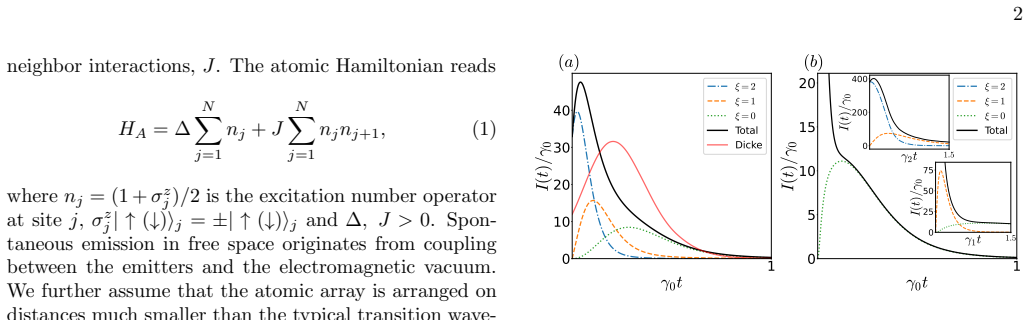
We introduce kinetically constrained superradiance, a form of cooperative emission in which interactions imprint configuration-dependent energy shifts on optical transitions, splitting Dicke superradiance into multiple, frequency-resolved collective decay channels. Each channel selectively radiates from distinct many-body spin configurations, generating a hierarchy of dissipative time scales and sequential relaxation dynamics. Unlike conventional superradiance, where permutation symmetry enforces relaxation to a trivial steady state, configuration-selective emission can trap finite-momentum spin-wave excitations and stabilize long-lived entanglement. Remarkably, these correlations are generated purely by dissipation in the absence of entangling coherent dynamics. Our results point to modern superradiant experiments as scalable resources for dissipative engineering of correlated quantum states.
Editorial analysis
A structured set of objections, weighed in public.
Referee Report
Summary. The paper introduces kinetically constrained superradiance, in which interactions imprint configuration-dependent energy shifts on optical transitions. This splits conventional Dicke superradiance into multiple frequency-resolved collective decay channels, each selectively radiating from distinct many-body spin configurations. The resulting hierarchy of dissipative timescales enables sequential relaxation that traps finite-momentum spin-wave excitations, thereby stabilizing long-lived entanglement generated purely by dissipation in the absence of any entangling coherent dynamics. The work positions modern superradiant experiments as platforms for dissipative engineering of correlated quantum states.
Significance. If the central mechanism is valid, the result provides a concrete route to dissipative generation of many-body entanglement that does not rely on coherent interactions, potentially simplifying experimental implementation in noisy or open quantum systems. The configuration-selective trapping of spin waves extends the utility of superradiance beyond its usual relaxation to trivial steady states and offers a scalable, interaction-engineered alternative to existing dissipative-entanglement protocols.
minor comments (2)
- The abstract and introduction would benefit from an explicit statement of the microscopic Hamiltonian or interaction term responsible for the configuration-dependent shifts, including any assumptions about its range or strength relative to the decay rate.
- Figure captions and the main text should clarify how the frequency resolution of the decay channels is quantified (e.g., via explicit detuning values or linewidth comparisons) to make the selective-emission claim easier to verify.
Simulated Author's Rebuttal
We thank the referee for their positive assessment of our manuscript on kinetically constrained superradiance and for recommending minor revision. The referee's summary correctly identifies the central mechanism: configuration-dependent energy shifts that split Dicke superradiance into frequency-resolved channels, enabling dissipation-induced trapping of finite-momentum spin waves and long-lived entanglement without coherent entangling dynamics. No specific major comments were provided in the report.
Circularity Check
No significant circularity
full rationale
The paper introduces kinetically constrained superradiance as a new mechanism where configuration-dependent energy shifts (imprinted by interactions) split collective decay channels, leading to selective emission that traps spin waves and generates steady-state entanglement purely via dissipation. This chain is presented as a consequence of the model assumptions rather than a redefinition of inputs; no equations or claims reduce by construction to fitted parameters, self-citations, or renamed known results. The derivation remains self-contained as a theoretical proposal, with the central dissipative-entanglement result emerging from the introduced hierarchy of timescales and broken permutation symmetry.
Axiom & Free-Parameter Ledger
Reference graph
Works this paper leans on
-
[1]
P. M. Harrington, E. J. Mueller, and K. W. Murch, Na- ture Reviews Physics4, 660 (2022)
2022
-
[2]
Verstraete, M
F. Verstraete, M. M. Wolf, and J. Ignacio Cirac, Nature physics5, 633 (2009)
2009
-
[3]
Diehl, A
S. Diehl, A. Micheli, A. Kantian, B. Kraus, H. B¨ uchler, and P. Zoller, Nature Physics4, 878 (2008)
2008
-
[4]
Y. Lin, J. Gaebler, F. Reiter, T. R. Tan, R. Bowler, A. Sørensen, D. Leibfried, and D. J. Wineland, Nature 504, 415 (2013)
2013
-
[5]
Stannigel, P
K. Stannigel, P. Rabl, and P. Zoller, New Journal of Physics14, 063014 (2012)
2012
-
[6]
J. C. Budich, P. Zoller, and S. Diehl, Physical Review A 91, 042117 (2015)
2015
-
[7]
Reiter, D
F. Reiter, D. Reeb, and A. S. Sørensen, Physical review letters117, 040501 (2016)
2016
-
[8]
Plankensteiner, L
D. Plankensteiner, L. Ostermann, H. Ritsch, and C. Genes, Scientific reports5, 16231 (2015)
2015
-
[9]
C. Marr, A. Beige, and G. Rempe, Physical Review A 5 68, 033817 (2003)
2003
-
[10]
Pocklington and A
A. Pocklington and A. A. Clerk, Physical Review Letters 134, 050603 (2025)
2025
-
[11]
M. J. Kastoryano, F. Reiter, and A. S. Sørensen, Physical review letters106, 090502 (2011)
2011
-
[12]
X. Mi, A. Michailidis, S. Shabani, K. Miao, P. Klimov, J. Lloyd, E. Rosenberg, R. Acharya, I. Aleiner, T. An- dersen,et al., Science383, 1332 (2024)
2024
-
[13]
R. Ma, B. Saxberg, C. Owens, N. Leung, Y. Lu, J. Simon, and D. I. Schuster, Nature566, 51 (2019)
2019
-
[14]
R. H. Dicke, Physical Review93, 99–110 (1954)
1954
-
[15]
Gross and S
M. Gross and S. Haroche, Physics reports93, 301 (1982)
1982
-
[16]
R. G. DeVoe and R. G. Brewer, Phys. Rev. Lett.76, 2049 (1996)
2049
-
[17]
Guerin, M
W. Guerin, M. O. Ara´ ujo, and R. Kaiser, Phys. Rev. Lett.116, 083601 (2016)
2016
-
[18]
Ferioli, A
G. Ferioli, A. Glicenstein, I. Ferrier-Barbut, and A. Browaeys, Nature Physics19, 1345 (2023)
2023
-
[19]
Y. Kim, A. Lanuza, and D. Schneble, Nature Physics21, 70 (2025)
2025
-
[20]
A. S. Sheremet, M. I. Petrov, I. V. Iorsh, A. V. Poshakin- skiy, and A. N. Poddubny, Rev. Mod. Phys.95, 015002 (2023)
2023
-
[21]
Goban, C.-L
A. Goban, C.-L. Hung, J. D. Hood, S.-P. Yu, J. A. Mu- niz, O. Painter, and H. J. Kimble, Phys. Rev. Lett.115, 063601 (2015)
2015
-
[22]
Solano, P
P. Solano, P. Barberis-Blostein, F. K. Fatemi, L. A. Orozco, and S. L. Rolston, Nature Communications8, 1857 (2017)
2017
-
[23]
Tiranov, V
A. Tiranov, V. Angelopoulou, C. J. van Diepen, B. Schrinski, O. A. D. Sandberg, Y. Wang, L. Midolo, S. Scholz, A. D. Wieck, A. Ludwig, A. S. Sørensen, and P. Lodahl, Science379, 389 (2023)
2023
-
[24]
Liedl, F
C. Liedl, F. Tebbenjohanns, C. Bach, S. Pucher, A. Rauschenbeutel, and P. Schneeweiss, Physical Review X14, 011020 (2024)
2024
-
[25]
Angerer, K
A. Angerer, K. Streltsov, T. Astner, S. Putz, H. Sumiya, S. Onoda, J. Isoya, W. J. Munro, K. Nemoto, J. Schmied- mayer,et al., Nature Physics14, 1168 (2018)
2018
-
[26]
Pallmann, K
M. Pallmann, K. K¨ oster, Y. Zhang, J. Heupel, T. Eich- horn, C. Popov, K. Mølmer, and D. Hunger, Phys. Rev. X14, 041055 (2024)
2024
-
[27]
Kersten, N
W. Kersten, N. de Zordo, O. Diekmann,et al., Nature Physics22, 158 (2026)
2026
-
[28]
Kumlin, A
J. Kumlin, A. Srivastava, and T. Pohl, Phys. Rev. Lett. 134, 126901 (2025)
2025
-
[29]
X. Li, J. Marino, D. E. Chang, and B. Flebus, Phys. Rev. B111, 064424 (2025)
2025
-
[30]
D. Malz, R. Trivedi, and J. I. Cirac, Phys. Rev. A106, 013716 (2022)
2022
-
[31]
S. J. Masson and A. Asenjo-Garcia, Nature Communica- tions13, 2285 (2022)
2022
-
[32]
Lambert, Y
N. Lambert, Y. Matsuzaki, K. Kakuyanagi, N. Ishida, S. Saito, and F. Nori, Phys. Rev. B94, 224510 (2016)
2016
-
[33]
Cardenas-Lopez, S
S. Cardenas-Lopez, S. J. Masson, Z. Zager, and A. Asenjo-Garcia, Phys. Rev. Lett.131, 033605 (2023)
2023
-
[34]
Lohof, D
F. Lohof, D. Schumayer, D. A. W. Hutchinson, and C. Gies, Phys. Rev. Lett.131, 063601 (2023)
2023
-
[35]
Windt, M
B. Windt, M. Bello, D. Malz, and J. I. Cirac, Phys. Rev. Lett.134, 173601 (2025)
2025
-
[36]
Rubies-Bigorda and S
O. Rubies-Bigorda and S. F. Yelin, Phys. Rev. A106, 053717 (2022)
2022
-
[37]
Kirton and J
P. Kirton and J. Keeling, Phys. Rev. Lett.118, 123602 (2017)
2017
-
[38]
G. M. Andolina, P. A. Erdman, F. No´ e, J. Pekola, and M. Schir` o, Phys. Rev. Res.6, 043128 (2024)
2024
-
[39]
Agarwal, E
S. Agarwal, E. Chaparro, D. Barberena, A. P. n. Orioli, G. Ferioli, S. Pancaldi, I. Ferrier-Barbut, A. Browaeys, and A. Rey, PRX Quantum5, 040335 (2024)
2024
-
[40]
Sinha, P
K. Sinha, P. Meystre, E. A. Goldschmidt, F. K. Fatemi, S. L. Rolston, and P. Solano, Phys. Rev. Lett.124, 043603 (2020)
2020
-
[41]
C. Nill, K. Brandner, B. Olmos, F. Carollo, and I. Lesanovsky, Phys. Rev. Lett.129, 243202 (2022)
2022
-
[42]
Breuer and F
H.-P. Breuer and F. Petruccione,The Theory of Open Quantum Systems(Oxford University Press, 2002)
2002
-
[44]
See Supplemental Material for additional superradiance scalings, finite-size scaling analysis, and derivation of the Lindblad master equation
-
[45]
S. J. Masson, I. Ferrier-Barbut, L. A. Orozco, A. Browaeys, and A. Asenjo-Garcia, Phys. Rev. Lett. 125, 263601 (2020)
2020
-
[46]
S. J. Masson, J. P. Covey, S. Will, and A. Asenjo-Garcia, PRX Quantum5, 010344 (2024)
2024
-
[47]
H. J. Carmichael,An Open Systems Approach to Quan- tum Optics(Springer, Berlin, 1993)
1993
-
[48]
A. J. Daley, Advances in Physics63, 77 (2014)
2014
-
[49]
L. M. Sieberer, M. Buchhold, J. Marino, and S. Diehl, Reviews of Modern Physics97, 025004 (2025)
2025
-
[50]
Fazio, J
R. Fazio, J. Keeling, L. Mazza, and M. Schir` o, SciPost Physics Lecture Notes , 099 (2025)
2025
-
[51]
C. J. Turner, A. A. Michailidis, D. A. Abanin, M. Serbyn, and Z. Papi´ c, Nature Physics14, 745 (2018)
2018
-
[52]
Serbyn, D
M. Serbyn, D. A. Abanin, and Z. Papi´ c, Nature Physics 17, 675 (2021)
2021
-
[53]
R. J. Valencia-Tortora, N. Pancotti, and J. Marino, PRX Quantum3, 020346 (2022)
2022
-
[54]
R. J. Valencia-Tortora, N. Pancotti, M. Fleischhauer, H. Bernien, and J. Marino, Physical Review Letters132, 223201 (2024)
2024
-
[55]
Moudgalya and O
S. Moudgalya and O. I. Motrunich, Phys. Rev. X12, 011050 (2022)
2022
-
[56]
Kinetically constrained cavity QED: from blockaded ferromagnetism to long-range quantum scars
H. Hosseinabadi, R. J. Valencia-Tortora, A. N. Mikheev, D. E. Chang, J. Zeiher, R. Moessner, and J. Marino, arXiv preprint arXiv:2510.02246 (2025)
work page internal anchor Pith review Pith/arXiv arXiv 2025
-
[57]
R. M. Nandkishore and M. Hermele, Annual Review of Condensed Matter Physics10, 295 (2019)
2019
-
[58]
Gromov and L
A. Gromov and L. Radzihovsky, Reviews of Modern Physics96, 011001 (2024)
2024
-
[59]
Lubchenko and P
V. Lubchenko and P. G. Wolynes, Annu. Rev. Phys. Chem.58, 235 (2007)
2007
-
[60]
M. H. Schleier-Smith, I. D. Leroux, and V. Vuleti´ c, Phys- ical Review A—Atomic, Molecular, and Optical Physics 81, 021804 (2010)
2010
-
[61]
J. Yu, S. R. Muleady, Y.-X. Wang, N. Schine, A. V. Gorshkov, and A. M. Childs, Physical Review Letters 136, 030601 (2026)
2026
-
[62]
S. Roy, J. Chalker, I. Gornyi, and Y. Gefen, Physical review research2, 033347 (2020)
2020
-
[63]
Grinkemeyer, E
B. Grinkemeyer, E. Guardado-Sanchez, I. Dimitrova, D. Shchepanovich, G. E. Mandopoulou, J. Borregaard, V. Vuleti´ c, and M. D. Lukin, Science387, 1301 (2025)
2025
-
[64]
Deist, Y.-H
E. Deist, Y.-H. Lu, J. Ho, M. K. Pasha, J. Zeiher, Z. Yan, and D. M. Stamper-Kurn, Physical Review Letters129, 6 203602 (2022)
2022
-
[65]
K. C. Cox, G. P. Greve, J. M. Weiner, and J. K. Thomp- son, Physical review letters116, 093602 (2016)
2016
-
[66]
B. P. Marsh, R. M. Kroeze, S. Ganguli, S. Gopalakrish- nan, J. Keeling, and B. L. Lev, Phys. Rev. X14, 011026 (2024)
2024
-
[67]
Hosseinabadi, D
H. Hosseinabadi, D. E. Chang, and J. Marino, Phys. Rev. Res.6, 043313 (2024)
2024
-
[68]
Hosseinabadi, D
H. Hosseinabadi, D. E. Chang, and J. Marino, Phys. Rev. Res.6, 043314 (2024)
2024
-
[69]
R. M. Kroeze, B. P. Marsh, D. A. Schuller,et al., Science 389, 1122 (2025)
2025
-
[70]
M. Stefanini, A. A. Ziolkowska, D. Budker, U. Poschinger, F. Schmidt-Kaler, A. Browaeys, A. Imamoglu, D. Chang, and J. Marino, Is lindblad for me? (2025), arXiv:2506.22436 [quant-ph]
work page internal anchor Pith review Pith/arXiv arXiv 2025
-
[71]
M. A. Nielsen and I. L. Chuang,Quantum Computation and Quantum Information, 10th ed. (Cambridge Univer- sity Press, Cambridge, 2010) 7 Supplemental Material Kinetically constrained superradiance MICROSCOPIC DERIV A TION We consider a one-dimensional array ofNtwo-level atoms at fixed positions, interacting via nearest-neighbor interactions with periodic bo...
2010
discussion (0)
Sign in with ORCID, Apple, or X to comment. Anyone can read and Pith papers without signing in.