Recognition: unknown
Axial-vector Current and General Unpolarized Electroweak Single-nucleon Responses
Pith reviewed 2026-05-08 15:37 UTC · model grok-4.3
The pith
The axial-vector current matrix element is developed in full to yield the complete set of unpolarized electroweak VV, AA and VA response functions.
A machine-rendered reading of the paper's core claim, the machinery that carries it, and where it could break.
Core claim
The axial-vector single-nucleon current matrix element is derived in detail and joined to the vector current to produce the general forms of the VV, AA and VA response functions; approximation schemes are introduced and tested numerically to identify the kinematic domains where they remain reliable, thereby supplying the basis for understanding the roles of the various single-nucleon form factors in weak reactions on free nucleons and in nuclei.
What carries the argument
The axial-vector single-nucleon current matrix element, which together with the vector current generates the full set of electroweak response functions.
If this is right
- The individual contributions of the weak form factors to free-nucleon reactions become transparent.
- The standard nuclear prescription can be applied to bound-nucleon responses with quantified reliability limits.
- Kinematic regions are identified where simpler approximations suffice for practical calculations.
- The unpolarized baseline is established for future polarized extensions.
Where Pith is reading between the lines
- The same machinery could be used to reassess neutrino-nucleus scattering models that rely on the same free-nucleon inputs.
- Experimental tests in muon-capture or beta-decay kinematics would directly probe the axial-vector approximations.
- Extension to polarized targets would follow the pattern already laid out for the vector case.
Load-bearing premise
The chosen approximation schemes remain valid across the kinematic regimes of interest and the standard nuclear-physics prescription maps free-nucleon responses onto bound nucleons without large uncontrolled corrections.
What would settle it
A direct numerical comparison of the approximated response functions against exact calculations or measured cross sections at momentum transfers where the approximations are expected to degrade.
Figures




read the original abstract
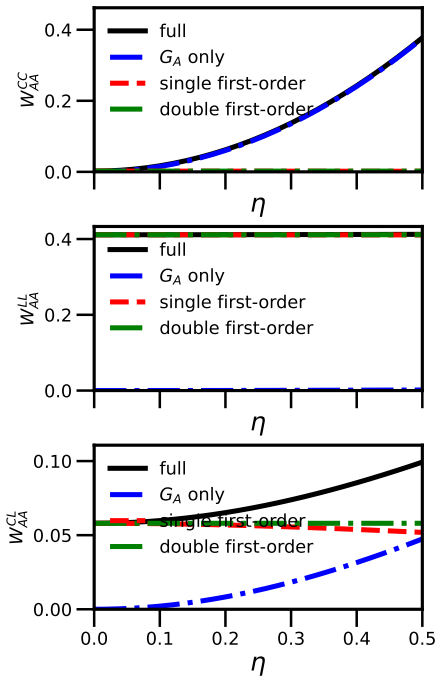
The present study provides an extension to our recent work on the vector (V) electromagnetic single-nucleon current and associated response functions, both for unpolarized situations and in situations where the target nucleon is polarized. Here the axial-vector (A) single-nucleon current matrix element is developed in detail and the full set of vector and axial-vector currents used to obtain the electroweak VV, AA and VA response functions. Only the unpolarized case is studied in the present work. The general forms for all of these elements are developed together with various approximation schemes in which numerical studies are provided to indicate where these approximations may be expected to be valid. The results of this work provide the basis for a deeper understanding of the roles played by the various single-nucleon form factors in weak interaction reactions on free nucleons and when using the standard ``prescription for nuclear physics'' in reactions involving nucleons in nuclei.
Editorial analysis
A structured set of objections, weighed in public.
Referee Report
Summary. The manuscript extends the authors' prior vector-current treatment to the axial-vector sector, deriving the general Lorentz-covariant matrix element of the axial-vector current for a free nucleon. This is combined with the vector current to obtain the complete set of unpolarized electroweak response functions (VV, AA, and VA). General expressions are presented together with controlled approximation schemes whose ranges of validity are explored through numerical examples; the results are intended to clarify the roles of individual single-nucleon form factors in free-nucleon weak processes and under the standard nuclear-physics prescription for bound nucleons.
Significance. If the central derivations are free of algebraic error, the work supplies a systematic, reference-grade framework for electroweak single-nucleon responses that can be directly inserted into nuclear calculations. The explicit separation of form-factor contributions, the controlled approximations, and the accompanying numerical diagnostics constitute a clear advance over piecemeal treatments in the literature and should be useful for neutrino-nucleus scattering and related electroweak observables.
major comments (1)
- [§4] §4 (or equivalent section containing the response-function definitions): the mapping from the free-nucleon responses to the nuclear case via the standard prescription is stated without a quantitative estimate of the size of the corrections that arise from Fermi motion, binding, or final-state interactions; because this mapping is central to the claimed utility for nuclear reactions, an explicit error budget or reference to a controlled test case would be required to support the final sentence of the abstract.
minor comments (2)
- The notation for the axial form factors (G_A, G_P, etc.) should be cross-referenced to the vector form-factor conventions used in the earlier vector-only paper to avoid reader confusion.
- Figure captions for the numerical studies should state the precise kinematic cuts and the value of the axial mass employed, rather than leaving these details only in the text.
Simulated Author's Rebuttal
We thank the referee for the careful reading of the manuscript and the positive overall assessment. We address the single major comment below.
read point-by-point responses
-
Referee: [§4] §4 (or equivalent section containing the response-function definitions): the mapping from the free-nucleon responses to the nuclear case via the standard prescription is stated without a quantitative estimate of the size of the corrections that arise from Fermi motion, binding, or final-state interactions; because this mapping is central to the claimed utility for nuclear reactions, an explicit error budget or reference to a controlled test case would be required to support the final sentence of the abstract.
Authors: We agree that the abstract's reference to the standard nuclear-physics prescription would be strengthened by explicit context on its limitations. The central aim of the present work is the derivation of the general unpolarized VV, AA, and VA response functions together with controlled approximations at the free-nucleon level; the nuclear prescription is invoked only as the conventional bridge to bound-nucleon applications. To address the concern, we will revise the manuscript by adding a concise paragraph (in the conclusions or a dedicated subsection) that references existing literature quantifying the typical sizes of Fermi-motion, binding, and final-state-interaction corrections in electroweak nuclear processes. This addition will support the abstract without changing the core single-nucleon results or requiring new calculations. revision: yes
Circularity Check
Minor self-citation to prior vector-current work; axial derivation independent
full rationale
The paper extends the authors' recent vector-current treatment by deriving the axial-vector single-nucleon current matrix element from standard Lorentz-covariant decomposition and electroweak form-factor parametrizations. VV, AA, and VA responses are then assembled from the combined currents, with approximation schemes whose validity is checked numerically. The self-citation is confined to the vector sector and is not load-bearing for the axial results or the claimed basis for understanding form-factor roles. No step reduces by construction to a fitted input, self-definition, or unverified self-citation chain.
Axiom & Free-Parameter Ledger
free parameters (1)
- single-nucleon form factors
axioms (2)
- standard math Standard Lorentz-covariant decomposition of nucleon currents into vector and axial-vector form factors
- domain assumption Validity of the impulse approximation when embedding free-nucleon responses into nuclei
Reference graph
Works this paper leans on
-
[1]
The functionsν 0,etc.are all real and have been derived previously in [1]
(u′ 2 ·σ)u ′ 1},(18) and accordingly V 0 =ν 0 +iν ′ 0σ2′ (19) V 1′ =ν 1 +iν ′ 1σ2′ (20) V 2′ =−i h ν′ 2σ1′ +ν ′′ 2 σ3′ i (21) V 3′ = λ κ V 0,(22) the last arising from the continuity equation. The functionsν 0,etc.are all real and have been derived previously in [1]. They are ν0 = κ√τ GE + µ1µ2 2(1 +τ) τ GM δ2 ν′ 0 = κ√1 +τ µ1GM − 1 2 µ2GE δ ν1 = 1√1 +τ µ...
-
[2]
= 2 κ2 τ λ κ G′2 A +G 2 Aδ2 W T AA =f 2 0 [(γ2 2 +γ ′2 2 ) + (γ′2 1 +γ ′2 3 )] = [2(1 +τ) +δ 2]G2 A W T T AA =f 2 0 [(γ2 2 +γ ′2 2 )−(γ ′2 1 +γ ′2 3 )] cos 2ϕ=−δ 2G2 A cos 2ϕ W T C AA ≡2 √ 2W 01 AA = 2 √ 2f 2 0 (β′ 1γ′ 1 +β ′ 3γ′
-
[3]
cosϕ= 2 √ 2¯ϵG2 Aδcosϕ W T L AA ≡2 √ 2W 31 AA = 2 √ 2f 2 0 (β′′ 1 γ′ 1 +β ′′ 3 γ′
-
[4]
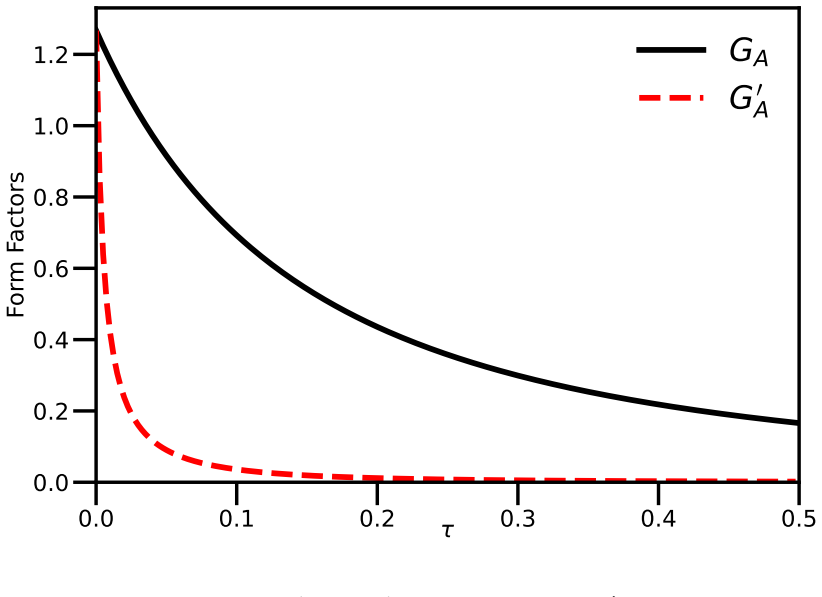
In this sense the choice ofG ′ A made above is analogous to the definition of the Sachs form factors
cosϕ= 2 √ 2 λ κ ¯ϵG2 Aδcosϕ.(55) Note that only the combinationsG 2 A andG ′2 A occur here with no interference terms pro- portional toG AG′ A; a similar situation was found in discussing the purely vector current 17 operators (see above), where in that case only contributions proportional toG 2 E andG 2 M enter with no interference terms proportional toG...
-
[5]
sinϕ = 2 √ 2Im(W 20 V A) sinϕ= 2 √ 2f 2 0 (ν′ 2β′ 1 +ν ′′ 2 β′′
-
[6]
sinϕ = 2 √ 2κGM GAδsinϕ W T L′ V A ≡ −2 √ 2Im(W 32 V A) sinϕ= λ κ W T C′ V A = 2 √ 2Im(W 23 V A) sinϕ= 2 √ 2f 2 0 (ν′ 2β′′ 1 +ν ′′ 2 β′′
-
[7]
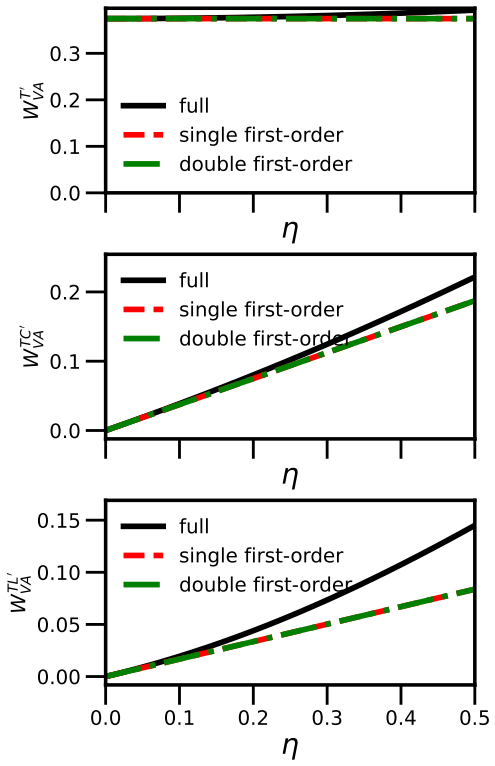
full results
sinϕ = 2 √ 2λGM GAδsinϕ .(56) The other terms,W T ′ AV ,W T C′ AV andW T L′ AV are easily obtained either directly or using the sym- metry in the tensors. Here only the combinationG M GA occurs, with no terms proportional toG M G′ A,G EGA orG EG′ A. All other responses are zero (see [11, 12] for some discussions of TRE/TRO responses; here only TRE respons...
-
[8]
standard prescription for nuclear physics
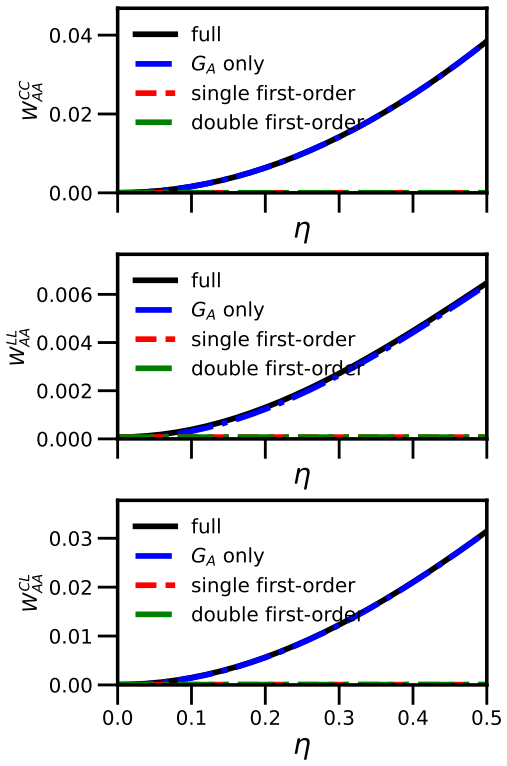
The responsesW CC AA , W LL AA andW CL AA now have a distinct difference between theG A-only and full result. This difference is particularly pronounced for the two latter responses. In the expression forW LL AA ,G ′2 A appears by itself, whereasG A is multiplied not just byδ 2, but also by the factor (λ/κ)2, which is less than one for spacelike kinematic...
-
[9]
Jeschonnek and T
S. Jeschonnek and T. W. Donnelly, Phys. Rev. C57, 2438-2452 (1998)
1998
-
[10]
T. W. Donnelly and S. Jeschonnek, Phys. Rev. C110, no.5, 055501 (2024) doi:10.1103/PhysRevC.110.055501 [arXiv:2409.00757 [nucl-th]]
-
[11]
J. E. Amaro, M. B. Barbaro, J. A. Caballero, T. W. Donnelly, R. Gonzalez-Jimenez, G. D. Megias and I. Ruiz Simo, Eur. Phys. J. ST230, no.24, 4321-4338 (2021) doi:10.1140/epjs/s11734-021-00289-5 [arXiv:2106.02857 [hep-ph]]
-
[12]
T. W. Donnelly and R. D. Peccei, Phys. Rept.50, 1 (1979)
1979
-
[13]
J. D. Walecka inMuon Physics,Vol. II, eds. V. W. Hughes and C. S. Wu, Academic Press , New York, 113 (1975)
1975
-
[14]
Moreno, T
O. Moreno, T. W.Donnelly, R. Gonzalez-Jimenez and J. A. Caballero, J. Phys. G42, 034006 (2015)
2015
-
[15]
M. J. Musolf, T. W. Donnelly, J. Dubach, S. J. Pollock, S. Kowalski and E. J. Beise, Phys. Rept.239, 1-178 (1994)
1994
-
[16]
T. W. Donnelly and J. D. Walecka, Annu. Rev. Nucl. Sci.25, 329 (1975)
1975
-
[17]
T. W. Donnelly and J. D. Walecka, Phys. Lett.41B, 275 (1972)
1972
-
[18]
O. Moreno, T. W. Donnelly, J. W. Van Orden and W. P. Ford, Phys. Rev. D90, no.1, 013014 (2014) doi:10.1103/PhysRevD.90.013014 [arXiv:1406.4494 [hep-th]]
-
[19]
T. W. Donnelly, S. Jeschonnek and J. W. Van Orden, Annals Phys.448, 169174 (2023)
2023
- [20]
-
[21]
W. M. Alberico, A. Molinari, T. W. Donnelly, E. L. Kronenberg and J. W. Van Orden, Phys. Rev. C38, 1801 (1988)
1988
-
[22]
T. W. Donnelly, A. S. Raskin, Annals Phys.169, 247 (1986)
1986
-
[23]
A. S. Raskin, T. W. Donnelly, Annals Phys. 191,78(1989) [Erratum: Annals Phys. 197, 202 (1990)]. 35
1989
-
[24]
J. D. Bjorken, S. D. Drell,Relativistic Quantum Mechanics, International Series In Pure and Applied Physics, McGraw-Hill, New York, 1965. 36
1965
discussion (0)
Sign in with ORCID, Apple, or X to comment. Anyone can read and Pith papers without signing in.