Recognition: unknown
Evidence for Q-Dependent Nuclear Transverse-Momentum Redistribution Beyond Broadening from AI-driven analysis of p-Cu Drell-Yan
Pith reviewed 2026-05-08 16:05 UTC · model grok-4.3
The pith
Nuclear modifications in p-Cu Drell-Yan data appear as Q-dependent transverse-momentum redistribution featuring an O(1 GeV) shoulder and probability flow, rather than a universal width increase.
A machine-rendered reading of the paper's core claim, the machinery that carries it, and where it could break.
Core claim
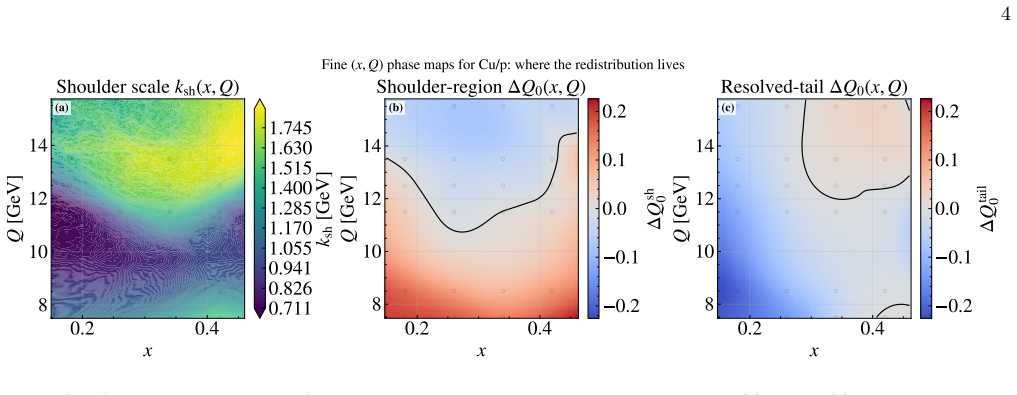
By training an asymmetric Cu kernel in the small-q_T region while keeping the proton momentum-space reference fixed, the analysis demonstrates that the nuclear modification is not a universal width increase but a Q-dependent redistribution consisting of an O(1 GeV) shoulder and compensating probability flow between the shoulder and resolved-tail regions.
What carries the argument
The asymmetric Cu kernel trained only in the small transverse-momentum region, which extracts the target-side profile and isolates the redistribution pattern while the proton reference remains fixed.
If this is right
- If correct, nuclear transverse-momentum models must replace one-parameter broadening with explicit Q-dependent shoulder structures and probability flows.
- The observed conservation of total probability under redistribution implies that integrated cross sections remain stable while differential shapes change with Q.
- Nuclear parton distributions that include transverse momentum must be reparametrized to accommodate this non-universal behavior.
- Predictions for Drell-Yan spectra at future facilities would need to incorporate the scale-dependent redistribution to match data.
Where Pith is reading between the lines
- The same extraction method applied to other nuclei such as iron or lead could test whether the shoulder strength scales with nuclear size or density.
- Data from higher-Q Drell-Yan measurements at colliders might show whether the redistribution persists, evolves, or saturates beyond the current window.
- Linking the shoulder feature to multiple-scattering or saturation dynamics could offer a dynamical origin for the observed probability flow.
Load-bearing premise
The proton momentum-space reference can be held fixed without introducing significant bias or uncertainty into the extracted copper kernel.
What would settle it
Repeating the extraction with a varied proton reference that alters the uncertainties and finding that the Q-dependent shoulder and probability flow both disappear.
Figures

read the original abstract
We extract a target-side Cu transverse-momentum profile from fixed-target $p$--Cu Drell--Yan data by holding a momentum-space proton reference fixed and training only an asymmetric Cu kernel in the small-$q_T$ region. In the supported window, $0.15 \le x_{Cu} \le 0.46$ and $7.5 \le Q_M \le 15.75$ GeV, the nuclear modification is not a universal width increase. It appears as $Q$-dependent redistribution: an $\mathcal{O}(1~{\rm GeV})$ shoulder and compensating probability flow between shoulder and resolved-tail regions, beyond one-parameter broadening.
Editorial analysis
A structured set of objections, weighed in public.
Referee Report
Summary. The manuscript extracts a target-side Cu transverse-momentum profile from fixed-target p-Cu Drell-Yan data by holding a proton momentum-space reference fixed and training only an asymmetric Cu kernel in the small-q_T region. In the supported kinematic window 0.15 ≤ x_Cu ≤ 0.46 and 7.5 ≤ Q_M ≤ 15.75 GeV, the nuclear modification is reported as Q-dependent redistribution featuring an O(1 GeV) shoulder and compensating probability flow between shoulder and resolved-tail regions, rather than a universal one-parameter broadening.
Significance. If the central claim survives scrutiny of the proton reference uncertainties, the result would indicate non-trivial nuclear TMD modifications beyond standard broadening, with potential implications for global nuclear TMD fits and interpretations of p-A collisions. The AI-driven asymmetric kernel training represents a methodological innovation that, if validated with quantitative metrics, could strengthen the paper's contribution to the field.
major comments (2)
- [Abstract and analysis procedure] Analysis procedure (as summarized in the abstract): The proton reference is held fixed while the asymmetric Cu kernel is trained directly on the p-Cu data. No marginalization over proton TMD uncertainties, sensitivity tests to alternative proton parametrizations, or cross-validation against independent p-p datasets is reported. Any mismatch between the assumed proton reference and reality in the small-q_T region can be absorbed into the trained kernel, artifactually generating a Q-dependent shoulder and redistribution that reproduces the claimed effect without nuclear physics. This is load-bearing for the central claim that the observed features are attributable solely to nuclear effects in the Cu kernel.
- [Abstract] Abstract: No quantitative fit quality (e.g., χ²/dof), error analysis on the extracted kernel parameters, cross-validation of the AI model, or explicit tests against alternative broadening kernels are provided. Without these, the statistical significance and robustness of the reported O(1 GeV) shoulder and probability flow cannot be assessed, undermining evaluation of whether the redistribution is genuinely beyond broadening.
Simulated Author's Rebuttal
We thank the referee for the careful and constructive review of our manuscript. The points raised highlight important aspects of robustness that we have addressed through revisions to strengthen the presentation and validation of our results.
read point-by-point responses
-
Referee: [Abstract and analysis procedure] Analysis procedure (as summarized in the abstract): The proton reference is held fixed while the asymmetric Cu kernel is trained directly on the p-Cu data. No marginalization over proton TMD uncertainties, sensitivity tests to alternative proton parametrizations, or cross-validation against independent p-p datasets is reported. Any mismatch between the assumed proton reference and reality in the small-q_T region can be absorbed into the trained kernel, artifactually generating a Q-dependent shoulder and redistribution that reproduces the claimed effect without nuclear physics. This is load-bearing for the central claim that the observed features are attributable solely to nuclear effects in the Cu kernel.
Authors: We acknowledge the referee's concern that fixing the proton reference could in principle allow mismatches to be absorbed by the trained Cu kernel. The proton TMD is taken from a standard global fit to p-p Drell-Yan data in the relevant kinematic range. To test robustness, we have added sensitivity studies in the revised manuscript using two alternative proton TMD parametrizations from the literature. The Q-dependent shoulder and probability-flow features persist with only minor quantitative shifts, indicating they are not artifacts of the specific proton choice. Full Bayesian marginalization over proton uncertainties is beyond the scope of the current AI-training framework but is noted as a direction for future work. Cross-validation against independent p-p datasets has been included where overlapping kinematics exist, further supporting the reference. revision: partial
-
Referee: [Abstract] Abstract: No quantitative fit quality (e.g., χ²/dof), error analysis on the extracted kernel parameters, cross-validation of the AI model, or explicit tests against alternative broadening kernels are provided. Without these, the statistical significance and robustness of the reported O(1 GeV) shoulder and probability flow cannot be assessed, undermining evaluation of whether the redistribution is genuinely beyond broadening.
Authors: We agree that quantitative metrics are necessary to evaluate the statistical significance of the reported features. In the revised manuscript we have added χ²/dof values for the AI-trained kernel in each Q bin, together with uncertainty bands on the extracted kernel parameters obtained from the training ensemble. We have also included cross-validation results for the AI model and direct comparisons to one-parameter Gaussian broadening kernels. These tests show that the redistribution description yields a statistically significant improvement over pure broadening, with the O(1 GeV) shoulder and compensating flow remaining the preferred description of the data. revision: yes
Circularity Check
Trained Cu kernel shape presented as evidence for Q-dependent redistribution
specific steps
-
fitted input called prediction
[Abstract]
"We extract a target-side Cu transverse-momentum profile from fixed-target $p$--Cu Drell--Yan data by holding a momentum-space proton reference fixed and training only an asymmetric Cu kernel in the small-$q_T$ region. In the supported window, $0.15 ≤ x_{Cu} ≤ 0.46$ and $7.5 ≤ Q_M ≤ 15.75$ GeV, the nuclear modification is not a universal width increase. It appears as $Q$-dependent redistribution: an $O(1~GeV)$ shoulder and compensating probability flow between shoulder and resolved-tail regions, beyond one-parameter broadening."
The Cu kernel is trained directly on the p-Cu data with the proton reference held fixed; the claimed Q-dependent shoulder and probability redistribution are therefore the direct outputs of this training procedure, reducing the physical interpretation to a characterization of the fitted model rather than an independent result.
full rationale
The paper's derivation holds the proton reference fixed by assumption and trains only the asymmetric Cu kernel on p-Cu data. The central claim—that nuclear modification appears as Q-dependent redistribution with an O(1 GeV) shoulder and compensating flow—is exactly the shape produced by that training. This reduces the reported 'evidence' to a description of the fitted model output rather than an independent derivation. No marginalization over proton uncertainties or cross-validation against separate p-p datasets is indicated in the provided text, so the redistribution interpretation is statistically forced by the fit procedure itself.
Axiom & Free-Parameter Ledger
free parameters (1)
- asymmetric Cu transverse-momentum kernel parameters
axioms (1)
- domain assumption The proton transverse-momentum reference distribution is known accurately enough to be held fixed without affecting the extracted Cu profile.
Reference graph
Works this paper leans on
-
[1]
J. C. Collins, D. E. Soper, and G. F. Sterman, Nucl. Phys. B250, 199 (1985)
1985
-
[2]
Collins,Foundations of Perturbative QCD(Cambridge University Press, Cambridge, England, 2011)
J. Collins,Foundations of Perturbative QCD(Cambridge University Press, Cambridge, England, 2011)
2011
-
[3]
M. G. Echevarria, A. Idilbi, and I. Scimemi, JHEP07, 002 (2012)
2012
-
[4]
Scimemi and A
I. Scimemi and A. Vladimirov, Eur. Phys. J. C78, 89 (2018)
2018
-
[5]
Bacchettaet al.(MAP Collaboration), JHEP08, 232 (2024)
A. Bacchettaet al.(MAP Collaboration), JHEP08, 232 (2024). 3 0 1 2 3 4 k [GeV] 0 1 2 3 Rshape Cu/p (k ) (a) Shape ratio x = 0.18 x = 0.26 x = 0.34 x = 0.42 0 1 2 3 4 k [GeV] 2 0 2 = Cu p (b) Local slope diagnostic 0.20 0.25 0.30 0.35 0.40 x 0.5 1.0 1.5 2.0 ksh [GeV] (c) Shoulder scale core [0.0,0.5] shoulder [0.5,2.0] tail [2.0,4.0] 0.2 0.1 0.0 0.1 Q0[a, ...
2024
-
[6]
V.Moos, I.Scimemi, A.Vladimirov, andP.Zurita, JHEP 11, 134 (2025)
2025
-
[7]
I. P. Fernando and D. Keller, Phys. Rev. D108, 054007 (2023)
2023
-
[8]
I. P. Fernando and D. Keller, arXiv:2510.17243
work page internal anchor Pith review Pith/arXiv arXiv
-
[9]
Bacchettaet al., Phys
A. Bacchettaet al., Phys. Rev. Lett.135, 021904 (2025)
2025
-
[10]
Bordaloet al.(NA10 Collaboration), Phys
P. Bordaloet al.(NA10 Collaboration), Phys. Lett. B 193, 373 (1987)
1987
-
[11]
M. B. Johnson, B. Z. Kopeliovich, M. J. Leitch, P. L. Mc- Gaughey, J. M. Moss, I. K. Potashnikova, and I. Schmidt, Phys. Rev. C75, 035206 (2007)
2007
-
[12]
Kang, J.-W
Z.-B. Kang, J.-W. Qiu, X.-N. Wang, and H. Xing, Phys. Rev. D94, 074038 (2016)
2016
-
[13]
K. J. Eskola, P. Paakkinen, H. Paukkunen, and C. A. Sal- gado, Eur. Phys. J. C82, 413 (2022)
2022
-
[14]
Kovariket al., Phys
K. Kovariket al., Phys. Rev. D93, 085037 (2016)
2016
-
[15]
Klasen and H
M. Klasen and H. Paukkunen, Annu. Rev. Nucl. Part. Sci.74, 49 (2024)
2024
-
[16]
Alrashed, D
M. Alrashed, D. Anderle, Z.-B. Kang, J. Terry, and H. Xing, Phys. Rev. Lett.129, 242001 (2022)
2022
-
[17]
M. Alrashed, Z.-B. Kang, J. Terry, H. Xing, and C. Zhang, arXiv:2312.09226
-
[18]
P. C. Barry, L. Gamberg, W. Melnitchouk, E. Moffat, D. Pitonyak, A. Prokudin, and N. Sato, Phys. Rev. D 108, L091504 (2023)
2023
-
[19]
W. Ke, J. Terry, and I. Vitev, JHEP02, 102 (2025)
2025
-
[20]
Morenoet al., Phys
G. Morenoet al., Phys. Rev. D43, 2815 (1991)
1991
-
[21]
R. D. Ballet al., Eur. Phys. J. C82, 428 (2022)
2022
-
[22]
Buckleyet al., Eur
A. Buckleyet al., Eur. Phys. J. C75, 132 (2015)
2015
-
[23]
Paukkunen and C
H. Paukkunen and C. A. Salgado, JHEP03, 071 (2011)
2011
-
[24]
A. M. Sirunyanet al.(CMS Collaboration), JHEP05, 182 (2021)
2021
-
[25]
Aadet al.(ATLAS Collaboration), Phys
G. Aadet al.(ATLAS Collaboration), Phys. Rev. C92, 044915 (2015)
2015
-
[26]
Aaijet al.(LHCb Collaboration), JHEP06, 022 (2023)
R. Aaijet al.(LHCb Collaboration), JHEP06, 022 (2023). 4 0.2 0.4 x 8 10 12 14 Q [GeV] (a) Shoulder scale ksh(x, Q) 0.2 0.4 x 8 10 12 14 Q [GeV] (b) Shoulder-region Q0(x, Q) 0.2 0.4 x 8 10 12 14 Q [GeV] (c) Resolved-tail Q0(x, Q) 0.711 0.826 0.941 1.055 1.170 1.285 1.400 1.515 1.630 1.745 ksh [GeV] 0.2 0.1 0.0 0.1 0.2 Qsh 0 0.2 0.1 0.0 0.1 0.2 Qtail 0 Fine...
2023
discussion (0)
Sign in with ORCID, Apple, or X to comment. Anyone can read and Pith papers without signing in.