Recognition: unknown
Breakdown of Emergent Chiral Order and Defect Chaos in Nonreciprocal Flocks
Pith reviewed 2026-05-08 15:37 UTC · model grok-4.3
The pith
Chiral order in nonreciprocal flocks collapses under proliferating topological defects.
A machine-rendered reading of the paper's core claim, the machinery that carries it, and where it could break.
Core claim
Chiral order in two-dimensional nonreciprocal flocking mixtures is generically unstable. Rotating chiral states emerging from antisymmetric couplings are destroyed by the proliferation of topological defects, resulting in spatiotemporally chaotic dynamics with a finite correlation length that diverges as nonreciprocity vanishes. On smaller scales, fluctuations remain scale-free with nonuniversal exponents due to the coupling between density and orientational order, where topological defects act as persistent sources of nonlinear fluctuations.
What carries the argument
Proliferation of topological defects coupled to density fluctuations, driven by antisymmetric nonreciprocal interactions.
Load-bearing premise
The coarse-grained continuum equations accurately describe the long-wavelength behavior of the underlying microscopic agent-based model without introducing artifacts.
What would settle it
Large-scale simulations or experiments showing stable chiral order persisting without defect proliferation in strongly nonreciprocal regimes, or a correlation length that remains finite even as nonreciprocity approaches zero.
Figures

read the original abstract
We show that chiral order in two-dimensional nonreciprocal flocking mixtures is generically unstable. Combining large-scale agent-based simulations with a coarse-grained continuum description, we demonstrate that rotating chiral states emerging from antisymmetric couplings are destroyed by the proliferation of topological defects. The resulting dynamics is spatiotemporally chaotic and characterized by a finite correlation length that diverges as nonreciprocity vanishes. On length scales below this cutoff, density and orientational order fluctuations remain scale-free, but the associated scaling exhibits nonuniversal exponents. We attribute this atypical behavior to the coupling between density and order, which causes topological defects to act as persistent sources of nonlinear fluctuations.
Editorial analysis
A structured set of objections, weighed in public.
Referee Report
Summary. The manuscript claims that chiral order in two-dimensional nonreciprocal flocking mixtures is generically unstable. Using large-scale agent-based simulations combined with a coarse-grained continuum description, it shows that rotating chiral states arising from antisymmetric couplings are destroyed by proliferating topological defects, yielding spatiotemporally chaotic dynamics with a finite correlation length that diverges as nonreciprocity vanishes. Below this scale, density and orientational fluctuations remain scale-free but exhibit nonuniversal exponents due to density-order coupling.
Significance. If the central claim is substantiated, the work advances understanding of order breakdown in nonreciprocal active matter by linking antisymmetric interactions to defect-driven chaos. The use of large-scale simulations alongside a hydrodynamic model is a clear strength, providing both microscopic evidence and a continuum explanation for the instability and the divergence of the correlation length.
major comments (2)
- [sections describing the hydrodynamic derivation and simulation-continuum comparison] The central claim that chiral order is generically unstable in the microscopic agent-based model rests on the continuum equations faithfully capturing long-wavelength dynamics, yet no quantitative matching is provided between the two (e.g., defect density, correlation-length scaling, or fluctuation spectra). This directly affects the assertion that the instability is not an artifact of coarse-graining.
- [abstract and results on correlation length] The abstract and results sections state that the correlation length diverges as nonreciprocity vanishes and that the dynamics is characterized by a finite cutoff, but no error bars, number of independent runs, or explicit comparison of fitted versus predicted exponents are reported, leaving the support for generic instability and nonuniversal scaling under-quantified.
minor comments (2)
- [model definition sections] Notation for the nonreciprocity strength parameter and its relation to the microscopic coupling should be clarified consistently between the agent-based rules and the continuum equations.
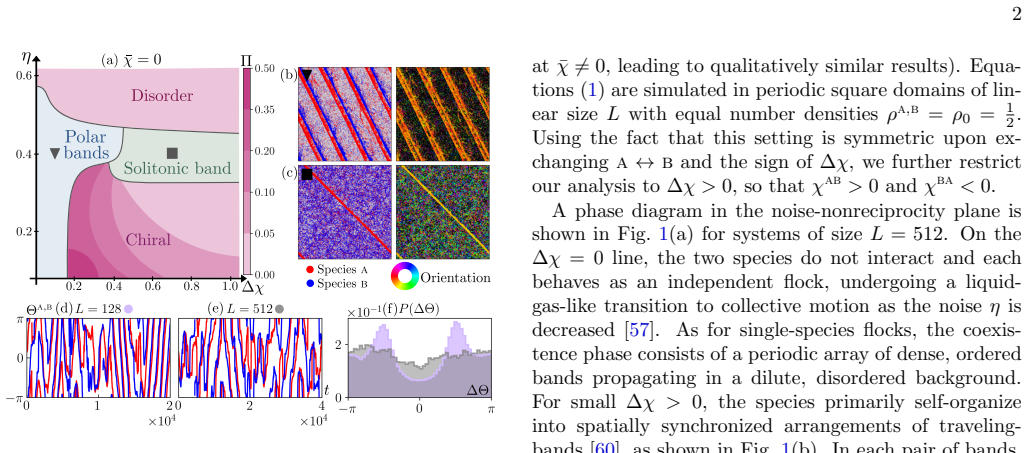
- [figures showing spatiotemporal chaos] Figure captions for the defect proliferation and chaotic states would benefit from explicit labels indicating the value of nonreciprocity strength used in each panel.
Simulated Author's Rebuttal
We thank the referee for their thorough review and constructive feedback on our manuscript. We address each of the major comments below and have made revisions to improve the quantitative support for our claims.
read point-by-point responses
-
Referee: The central claim that chiral order is generically unstable in the microscopic agent-based model rests on the continuum equations faithfully capturing long-wavelength dynamics, yet no quantitative matching is provided between the two (e.g., defect density, correlation-length scaling, or fluctuation spectra). This directly affects the assertion that the instability is not an artifact of coarse-graining.
Authors: We appreciate the referee's concern regarding the connection between the microscopic simulations and the continuum description. The primary evidence for the instability comes from the agent-based simulations, which directly show the proliferation of topological defects leading to the destruction of chiral order. The continuum model, derived from the microscopic dynamics, provides the theoretical framework for understanding why this occurs. To address the lack of quantitative matching, we have added new figures and analysis in the revised manuscript comparing the defect density and the scaling of the correlation length with the nonreciprocity parameter between the two approaches. These show good agreement, supporting that the instability is not an artifact of coarse-graining. We have also included a brief discussion of the fluctuation spectra. revision: yes
-
Referee: The abstract and results sections state that the correlation length diverges as nonreciprocity vanishes and that the dynamics is characterized by a finite cutoff, but no error bars, number of independent runs, or explicit comparison of fitted versus predicted exponents are reported, leaving the support for generic instability and nonuniversal scaling under-quantified.
Authors: We agree that providing more details on the statistical analysis would strengthen the presentation. In the revised manuscript, we have included error bars on the plots of correlation length versus nonreciprocity, specified the number of independent runs (we used 10 independent simulations for each value of the nonreciprocity parameter), and added a direct comparison of the fitted exponents to the predicted values from the continuum theory. These revisions better quantify the divergence of the correlation length and the nonuniversal scaling behavior. revision: yes
Circularity Check
No significant circularity: derivation remains independent of target results.
full rationale
The paper derives a coarse-grained hydrodynamic description from the underlying microscopic nonreciprocal flocking rules and then analyzes its stability properties, with direct agent-based simulations serving as independent numerical support. No load-bearing step reduces by construction to a fitted parameter, self-definition, or self-citation chain; the instability of chiral order and defect proliferation follow from the structure of the derived equations and observed dynamics rather than from quantities defined in terms of the final observables. The continuum approximation is presented as an approximation whose fidelity is checked against simulations, not assumed by tautology.
Axiom & Free-Parameter Ledger
free parameters (1)
- nonreciprocity strength
axioms (1)
- domain assumption The continuum limit of the microscopic dynamics exists and is well-described by a hydrodynamic equation with density-orientation coupling.
Reference graph
Works this paper leans on
-
[1]
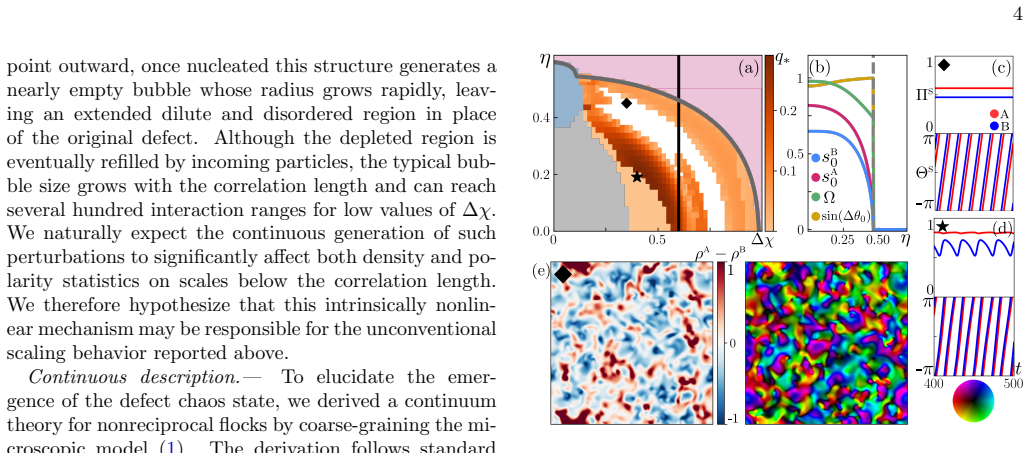
rotating at a uniform fre- quency Ω and where the two species display a constant phase shift ∆θ 0 =θ b 0 −θ a 0 [Fig. 3(c)]. Since both Ω and sin ∆θ0 are generallyO(1), they undergo a discontinu- ous jump at the ordering threshold [Fig. 3(b)], such that the odd terms and their even counterparts in Eqs. (2) FIG. 3. Phenomenology of the continuum model. (a)...
-
[2]
N. D. Mermin and H. Wagner, Phys. Rev. Lett.17, 1133 (1966)
1966
-
[3]
P. C. Hohenberg, Phys. Rev.158, 383 (1967)
1967
-
[4]
Vicsek, A
T. Vicsek, A. Czir´ ok, E. Ben-Jacob, I. Cohen, and O. Shochet, Phys. Rev. Lett.75, 1226 (1995)
1995
-
[5]
Toner and Y
J. Toner and Y. Tu, Phys. Rev. Lett.75, 4326 (1995)
1995
-
[6]
Toner and Y
J. Toner and Y. Tu, Phys. Rev. E58, 4828 (1998)
1998
-
[7]
Toner, Phys
J. Toner, Phys. Rev. E86, 031918 (2012)
2012
-
[8]
Mahault, F
B. Mahault, F. Ginelli, and H. Chat´ e, Phys. Rev. Lett. 123, 218001 (2019)
2019
-
[9]
Chat´ e and A
H. Chat´ e and A. Solon, Phys. Rev. Lett.132, 268302 (2024)
2024
-
[10]
Jentsch and C
P. Jentsch and C. F. Lee, Phys. Rev. Lett.133, 128301 (2024)
2024
- [11]
-
[12]
Ginelli, F
F. Ginelli, F. Peruani, M. B¨ ar, and H. Chat´ e, Phys. Rev. Lett.104, 184502 (2010)
2010
-
[13]
Mahault and H
B. Mahault and H. Chat´ e, Phys. Rev. Lett.127, 048003 (2021)
2021
-
[14]
L. P. Dadhichi, J. Kethapelli, R. Chajwa, S. Ramaswamy, and A. Maitra, Phys. Rev. E101, 052601 (2020)
2020
-
[15]
S. A. M. Loos, S. H. L. Klapp, and T. Martynec, Phys. Rev. Lett.130, 198301 (2023)
2023
-
[16]
Dopierala, H
D. Dopierala, H. Chat´ e, X.-q. Shi, and A. Solon, Phys. Rev. Lett.135, 088302 (2025)
2025
-
[17]
Pisegna, S
G. Pisegna, S. Saha, and R. Golestanian, Proc. Natl. Acad. Sci. U.S.A.121, e2407705121 (2024)
2024
-
[18]
Keta and S
Y.-E. Keta and S. Henkes, Soft Matter21, 5710 (2025)
2025
-
[19]
Codina, B
J. Codina, B. Mahault, H. Chat´ e, J. Dobnikar, I. Pago- nabarraga, and X.-q. Shi, Phys. Rev. Lett.128, 218001 (2022)
2022
-
[20]
Besse, H
M. Besse, H. Chat´ e, and A. Solon, Phys. Rev. Lett.129, 268003 (2022)
2022
-
[21]
Benvegnen, O
B. Benvegnen, O. Granek, S. Ro, R. Yaacoby, H. Chat´ e, Y. Kafri, D. Mukamel, A. Solon, and J. Tailleur, Phys. Rev. Lett.131, 218301 (2023)
2023
-
[22]
Woo and J
C.-U. Woo and J. D. Noh, Phys. Rev. Lett.133, 188301 (2024)
2024
-
[23]
Popli, A
P. Popli, A. Maitra, and S. Ramaswamy, Phys. Rev. Lett. 135, 088303 (2025)
2025
-
[24]
M. J. Bowick, N. Fakhri, M. C. Marchetti, and S. Ra- maswamy, Phys. Rev. X12, 010501 (2022)
2022
-
[25]
M. Fruchart and V. Vitelli, Nonreciprocal many-body physics (2026), arXiv:2602.11111 [cond-mat.stat-mech]
-
[26]
S. Saha, J. Agudo-Canalejo, and R. Golestanian, Phys. Rev. X10, 041009 (2020)
2020
-
[27]
Z. You, A. Baskaran, and M. C. Marchetti, Proc. Natl. Acad. Sci. USA.117, 19767 (2020)
2020
-
[28]
Fruchart, R
M. Fruchart, R. Hanai, P. B. Littlewood, and V. Vitelli, Nature592, 363 (2021)
2021
-
[29]
Agudo-Canalejo and R
J. Agudo-Canalejo and R. Golestanian, Phys. Rev. Lett. 123, 018101 (2019)
2019
-
[30]
Frohoff-H¨ ulsmann, J
T. Frohoff-H¨ ulsmann, J. Wrembel, and U. Thiele, Phys. Rev. E103, 042602 (2021)
2021
-
[31]
Y. Duan, J. Agudo-Canalejo, R. Golestanian, and B. Ma- hault, Phys. Rev. Lett.131, 148301 (2023)
2023
-
[32]
Dinelli, J
A. Dinelli, J. O’Byrne, A. Curatolo, Y. Zhao, P. Sollich, and J. Tailleur, Nat. Commun.14, 7035 (2023)
2023
-
[33]
Brauns and M
F. Brauns and M. C. Marchetti, Phys. Rev. X14, 021014 (2024)
2024
-
[34]
Rana and R
N. Rana and R. Golestanian, Phys. Rev. Lett.133, 078301 (2024)
2024
-
[35]
Y. Duan, J. Agudo-Canalejo, R. Golestanian, and B. Ma- hault, Phys. Rev. Res.7, 013234 (2025)
2025
-
[36]
Greve, G
D. Greve, G. Lovato, T. Frohoff-H¨ ulsmann, and 6 U. Thiele, Phys. Rev. Lett.134, 018303 (2025)
2025
-
[37]
Saha and R
S. Saha and R. Golestanian, Nat. Commun.16, 7310 (2025)
2025
-
[38]
Hanai, Phys
R. Hanai, Phys. Rev. X14, 011029 (2024)
2024
-
[39]
K. L. Kreienkamp and S. H. L. Klapp, Phys. Rev. Lett. 133, 258303 (2024)
2024
-
[40]
K. L. Kreienkamp and S. H. L. Klapp, Phys. Rev. E110, 064135 (2024)
2024
-
[41]
Guislain and E
L. Guislain and E. Bertin, Phys. Rev. E109, 034131 (2024)
2024
-
[42]
Guislain and E
L. Guislain and E. Bertin, J. Stat. Mech.: Theory Exp. 2024(9), 093210
2024
-
[43]
J. Chen, X. Lei, Y. Xiang, M. Duan, X. Peng, and H. Zhang, Phys. Rev. Lett.132, 118301 (2024)
2024
-
[44]
K. L. Kreienkamp and S. H. L. Klapp, Commun. Phys. 8, 307 (2025)
2025
-
[45]
Y. Avni, M. Fruchart, D. Martin, D. Seara, and V. Vitelli, Phys. Rev. Lett.134, 117103 (2025)
2025
-
[46]
Y. Avni, M. Fruchart, D. Martin, D. Seara, and V. Vitelli, Phys. Rev. E111, 034124 (2025)
2025
-
[47]
Martin, D
D. Martin, D. Seara, Y. Avni, M. Fruchart, and V. Vitelli, Phys. Rev. X15, 041015 (2025)
2025
-
[48]
K. Blom, U. Thiele, and A. Godec, Phys. Rev. E111, 024207 (2025)
2025
-
[49]
Kardar, G
M. Kardar, G. Parisi, and Y.-C. Zhang, Phys. Rev. Lett. 56, 889 (1986)
1986
-
[50]
Grinstein, D
G. Grinstein, D. Mukamel, R. Seidin, and C. H. Bennett, Phys. Rev. Lett.70, 3607 (1993)
1993
-
[51]
Chat´ e, G
H. Chat´ e, G. Grinstein, and L.-H. Tang, Phys. Rev. Lett. 74, 912 (1995)
1995
-
[52]
Maitra, Annu
A. Maitra, Annu. Rev. Condens. Matter Phys.16, 275 (2025)
2025
-
[53]
Daviet, C
R. Daviet, C. P. Zelle, A. Asadollahi, and S. Diehl, Phys. Rev. Lett.135, 047101 (2025)
2025
-
[54]
Canet, H
L. Canet, H. Chat´ e, B. Delamotte, and N. Wschebor, Phys. Rev. Lett.104, 150601 (2010)
2010
-
[55]
Wachtel, L
G. Wachtel, L. M. Sieberer, S. Diehl, and E. Altman, Phys. Rev. B94, 104520 (2016)
2016
-
[56]
Deligiannis, Q
K. Deligiannis, Q. Fontaine, D. Squizzato, M. Richard, S. Ravets, J. Bloch, A. Minguzzi, and L. Canet, Phys. Rev. Res.4, 043207 (2022)
2022
-
[57]
C. Myin and B. Mahault, Nonreciprocity as a generic mechanism for demixing in flocking mixtures (2026), arXiv:2510.25377
-
[58]
Chat´ e, Annu
H. Chat´ e, Annu. Rev. Condens. Matter Phys.11, 189 (2020)
2020
-
[59]
Maitra, M
A. Maitra, M. Lenz, and R. Voituriez, Phys. Rev. Lett. 125, 238005 (2020)
2020
-
[60]
See Supplemental Material at [URL will be inserted by publisher] for further details
-
[61]
For ¯χ >0 and ¯χ <0, polar and anti- polar homogeneous ordered phases, respectively, may be found at sufficiently small ∆χ, see [59]
For ¯χ= 0, the two species never form a homogeneous ordered phase. For ¯χ >0 and ¯χ <0, polar and anti- polar homogeneous ordered phases, respectively, may be found at sufficiently small ∆χ, see [59]
-
[62]
Bertin, M
E. Bertin, M. Droz, and G. Gr´ egoire, Phys. Rev. E74, 022101 (2006)
2006
-
[63]
Peshkov, E
A. Peshkov, E. Bertin, F. Ginelli, and H. Chat´ e, Eur. Phys. J. Spec. Top.223, 1315 (2014)
2014
-
[64]
Chat´ e and B
H. Chat´ e and B. Mahault, inActive Matter and Nonequi- librium Statistical Physics: Lecture Notes of the Les Houches Summer School: Volume 112, September 2018 (Oxford University Press, 2022)
2018
-
[65]
In the grey region, located far from the ordering thresh- old, the assumption of small global order underlying the derivation of the continuum model is not verified
-
[66]
(2) are generally unstable
Polar solutions of Eqs. (2) are generally unstable
-
[67]
Alert, J
R. Alert, J. Casademunt, and J.-F. Joanny, Annu. Rev. Condens. Matter Phys.13, 143 (2022)
2022
-
[68]
Kloss, L
T. Kloss, L. Canet, and N. Wschebor, Phys. Rev. E86, 051124 (2012)
2012
-
[69]
Mahault, X.-c
B. Mahault, X.-c. Jiang, E. Bertin, Y.-q. Ma, A. Patelli, X.-q. Shi, and H. Chat´ e, Phys. Rev. Lett.120, 258002 (2018)
2018
-
[70]
Chardac, L
A. Chardac, L. A. Hoffmann, Y. Poupart, L. Giomi, and D. Bartolo, Phys. Rev. X11, 031069 (2021)
2021
-
[71]
C. Myin, S. Saha, and B. Mahault, in preparation
-
[72]
G. E. Santoro, Lecture Notes (2019). 7 End Matter FIG. A1. This figure corresponds to Fig. 2 of the main text, but with global order, correlation functions and correlation length extracted from speciesbwithη= 0.2. (a) Time-averaged polar order parameter associated with speciesbas a function of system size for various values of ∆χ. (b,c) Polarity (b) and d...
2019
-
[73]
We solve these equations numerically fors a 0,s b 0,θ b 0 and Ω by fixing θa 0 = 0 without loss of generality
andS 0 = sin(θb 0 −θ a 0). We solve these equations numerically fors a 0,s b 0,θ b 0 and Ω by fixing θa 0 = 0 without loss of generality. In particular, we have checked that Eqs. (S6) always admit degenerate solutions symmetric under the transformation (s a 0, sb 0, θb 0,Ω)↔(s a 0, sb 0,−θ b 0,−Ω). As mentioned in the main text, the homogeneous part of Eq...
2048
discussion (0)
Sign in with ORCID, Apple, or X to comment. Anyone can read and Pith papers without signing in.