Recognition: unknown
Finding Alien Worlds in Queensland -- A Decade of MINERVA-Australis
Pith reviewed 2026-05-08 15:28 UTC · model grok-4.3
The pith
MINERVA-Australis has contributed to the discovery of 40 new exoplanets since beginning operations in 2018.
A machine-rendered reading of the paper's core claim, the machinery that carries it, and where it could break.
Core claim
MINERVA-Australis is the southern hemisphere's only dedicated exoplanet detection and characterisation facility. Funded in 2015 and operational since 2018, it has contributed to the discovery of 40 new exoplanets through follow-up of TESS candidates and has continued the legacy of radial velocity data collection from the Anglo-Australian Planet Search program.
What carries the argument
The MINERVA-Australis telescope array, which performs precise radial velocity measurements to confirm and characterise exoplanet candidates discovered by TESS.
If this is right
- Dedicated ground-based radial velocity facilities are required to confirm the existence of planets initially detected by space missions like TESS.
- Long-term monitoring at sites such as Mt Kent can extend historical data sets and support ongoing exoplanet searches.
- Southern hemisphere coverage ensures that TESS candidates across the full sky can receive necessary follow-up observations.
Where Pith is reading between the lines
- Similar dedicated arrays in other locations could increase the overall confirmation rate for future space-based planet surveys.
- The accumulated radial velocity data may allow refinement of orbital parameters or detection of additional planets in the same systems over longer timescales.
- Continued operation of the facility could help address the challenge of confirming smaller or longer-period planets that are harder to detect with current methods.
Load-bearing premise
The 40 planets can be accurately attributed to MINERVA-Australis observations without overcounting contributions from other facilities or prior data.
What would settle it
A complete re-analysis of the 40 planets that shows the majority were confirmed using data from other telescopes or pre-existing surveys would falsify the stated level of contribution.
Figures

read the original abstract
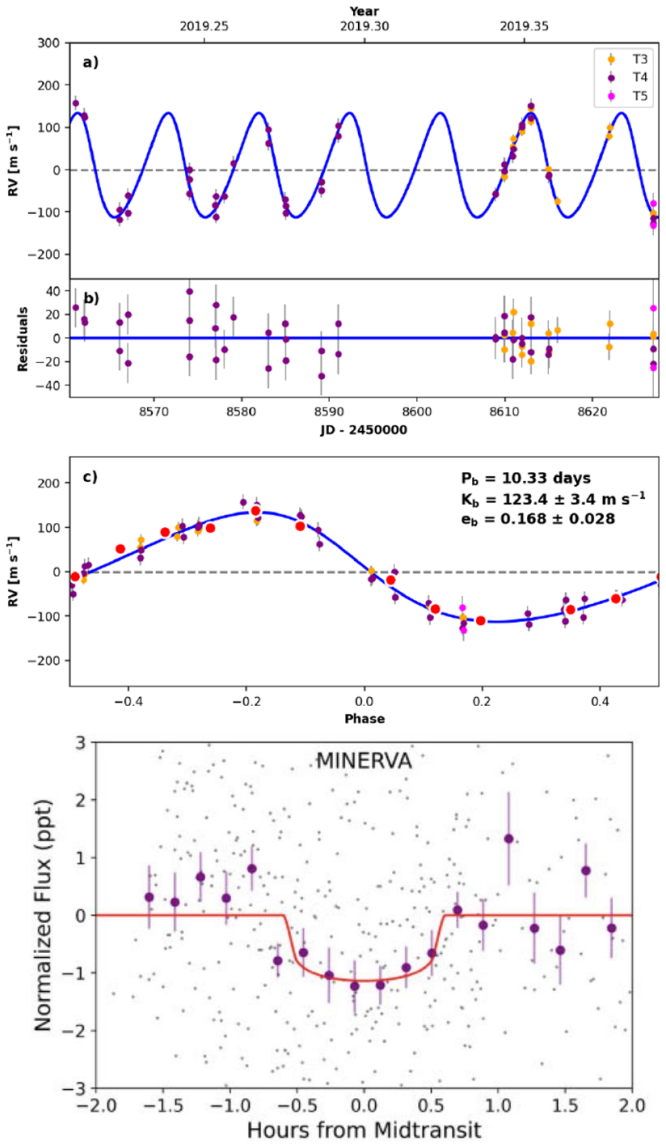
Three decades ago, humanity entered the Exoplanet Era, with the discovery of the first planets orbiting other stars. Today, more than 6000 exoplanets are known - a tally recently bolstered by NASA's TESS spacecraft. Whilst TESS is an exceptional planet finding machine, dedicated follow-up observations from the ground are required to confirm the existence of the planets it discovers. To achieve this, we constructed the southern hemisphere's only dedicated exoplanet detection and characterisation facility, MINERVA-Australis, at the University of Southern Queensland's Mt Kent Observatory. Funded in 2015, MINERVA-Australis saw first light in 2018, in time for the launch of TESS. MINERVA-Australis has since been scouring the skies, working to confirm and characterise the incredible harvest of planets detected by TESS. To date, the facility has contributed to the discovery of 40 new exoplanets, and continued the legacy of radial velocity data from the Anglo-Australian Planet Search program.
Editorial analysis
A structured set of objections, weighed in public.
Referee Report
Summary. The manuscript describes the construction, operations, and scientific contributions of the MINERVA-Australis exoplanet detection and characterization facility at Mt Kent Observatory, emphasizing its role in TESS follow-up observations since first light in 2018 and its continuation of radial velocity work from the Anglo-Australian Planet Search; the central claim is that the facility has contributed to the discovery of 40 new exoplanets.
Significance. If the attribution of the 40 planets can be substantiated with traceable details, the paper would document the impact of a dedicated southern-hemisphere RV facility during the TESS era, providing context on the value of ground-based follow-up for confirming and characterizing transiting planets and preserving legacy survey data.
major comments (1)
- [Abstract] Abstract: The statement that MINERVA-Australis 'has contributed to the discovery of 40 new exoplanets' is presented as a factual headline result but supplies no error bars, selection criteria, attribution method, list of planets, or references to the discovery papers. This leaves the central quantitative claim without visible support and prevents assessment of whether contributions are limited to RV confirmation, mass measurements, or orbit refinement, or whether multi-facility cases have been overcounted.
minor comments (1)
- [Title] Title: The phrase 'A Decade of MINERVA-Australis' is used, yet the abstract states funding in 2015 and first light in 2018; the manuscript should explicitly define the timeline covered to avoid mismatch with the operational history described.
Simulated Author's Rebuttal
We thank the referee for their constructive review and for highlighting the need to better substantiate the central claim in the abstract. We address this point below and will revise the manuscript to incorporate the requested details.
read point-by-point responses
-
Referee: [Abstract] Abstract: The statement that MINERVA-Australis 'has contributed to the discovery of 40 new exoplanets' is presented as a factual headline result but supplies no error bars, selection criteria, attribution method, list of planets, or references to the discovery papers. This leaves the central quantitative claim without visible support and prevents assessment of whether contributions are limited to RV confirmation, mass measurements, or orbit refinement, or whether multi-facility cases have been overcounted.
Authors: We agree that the abstract would benefit from additional supporting information to make the claim traceable. In the revised manuscript we will (1) briefly define 'contributed to the discovery' in the abstract as cases in which MINERVA-Australis radial-velocity data were used in the published orbital solution or confirmation, (2) add a reference to a new table (or appendix) that enumerates all 40 planets together with their discovery papers and the specific MINERVA-Australis contribution (RV confirmation, mass measurement, or orbit refinement), and (3) note how multi-facility systems are attributed to avoid double-counting. Because the number 40 is a direct tally of published results rather than a statistical estimate, error bars are not applicable; we will instead state the selection criteria explicitly. These additions will allow readers to verify each attribution directly from the literature. revision: yes
Circularity Check
No circularity: purely descriptive observational report with no derivations or predictions
full rationale
The paper is a facility status report describing the construction, operation, and exoplanet follow-up contributions of MINERVA-Australis. It contains no equations, no fitted parameters, no predictions, and no derivation chain of any kind. The headline claim of contributing to 40 exoplanets is presented as a factual summary rather than the output of any internal calculation or self-referential logic. No self-citations are used to justify uniqueness theorems or ansatzes, and the text does not rename known results or smuggle assumptions via prior work. The derivation chain is empty; the manuscript is self-contained as a straightforward observational narrative.
Axiom & Free-Parameter Ledger
Reference graph
Works this paper leans on
-
[1]
Discovery of a shell around alpha Lyrae
[1]. Aumann, H. H., et al., “Discovery of a shell around alpha Lyrae”, Astrophysical Journal, 1984, 278, L23-L27 [2]. Smith, B. A. and Terrile, R. J., “A Circumstellar Disk around β Pictoris”, Science, 1984, 226, 4681, 1421-1424 [3]. Aumann, H. H., “IRAS Observations of Nearby Main -Sequence Dwarfs”, Bulletin of the American Astronomical Society, 1984, 16...
1984
-
[2]
Kepler Planet-Detection Mission: Introduction and First Results
[12]. Borucki, W. J. et al., “Kepler Planet-Detection Mission: Introduction and First Results”, Science, 2010, 327, 5968, 977 [13]. Christiansen, J. L. et al. , “The NASA Exoplanet Archive and Exoplanet Follow -up Observing Program: Data, Tools, and Usage”, Planetary Science Journal, 2025, 6, 8, 186, [14]. Borucki, W. J. et al., “Characteristics of Planet...
discussion (0)
Sign in with ORCID, Apple, or X to comment. Anyone can read and Pith papers without signing in.