Recognition: unknown
Resolving magnetic-sublevel structure in Rydberg Autler-Townes spectra with arbitrary RF polarization
Pith reviewed 2026-05-08 15:21 UTC · model grok-4.3
The pith
Elliptical RF polarization couples multiple magnetic sublevels in Rydberg atoms, requiring a multi-level Hamiltonian that produces up to four peaks in Autler-Townes spectra.
A machine-rendered reading of the paper's core claim, the machinery that carries it, and where it could break.
Core claim
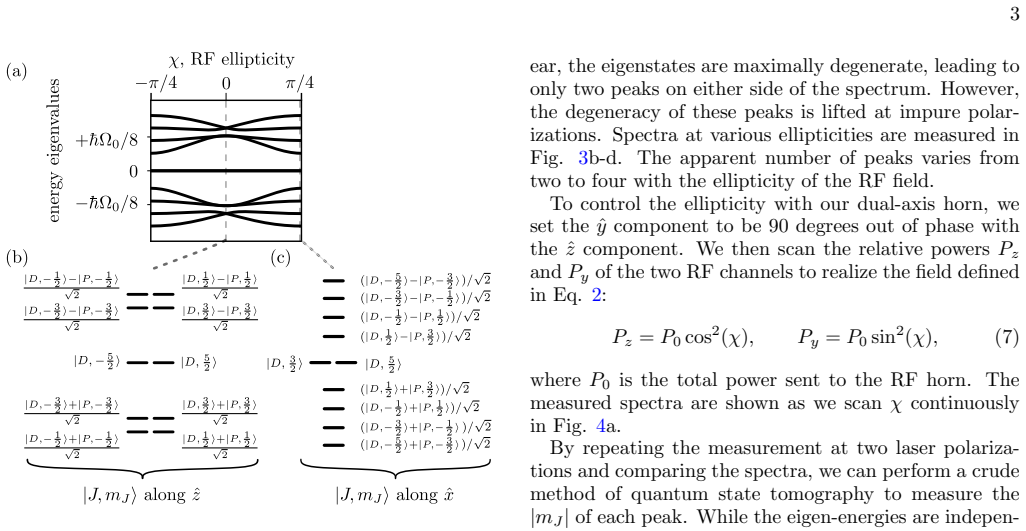
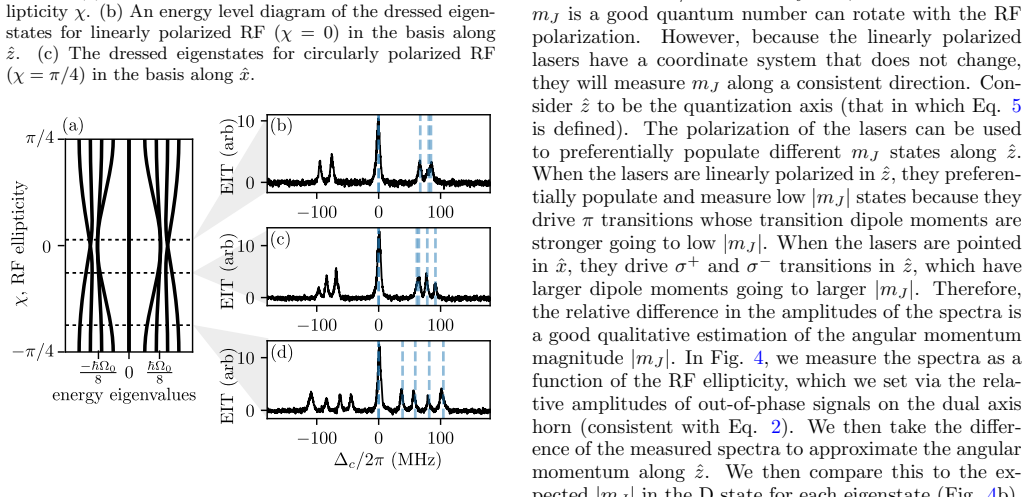
We show that these arise from elliptical RF polarization, which coherently couples multiple magnetic sublevels and requires a full multi-level treatment. We develop and diagonalize a Hamiltonian including all coupled mJ sublevels, predicting polarization-dependent degeneracies that produce two, three, or four resolved peaks. Using long-wavelength transitions and an anechoic environment we realize homogeneous RF fields that for the first time enable complete resolution of the mJ-dependent dressed states. We observe excellent agreement with theory as the RF ellipticity is varied.
What carries the argument
The multi-level Hamiltonian containing all coupled mJ sublevels, diagonalized to obtain the energies of the polarization-dependent dressed states.
Load-bearing premise
The RF field is homogeneous enough and free of other broadening mechanisms that the distinct mJ-dependent dressed states can be fully resolved.
What would settle it
Varying RF ellipticity produces no change in the number or spacing of spectral peaks, or the observed peaks fail to match the degeneracies calculated from the multi-level Hamiltonian.
Figures



read the original abstract
We investigate the role of magnetic sublevels in Autler-Townes spectra of Rydberg atoms driven by radio-frequency (RF) fields with arbitrary polarization. While conventional treatments predict two symmetric sidebands from independent mJ transitions, experiments have reported additional unexplained spectral features. We show that these arise from elliptical RF polarization, which coherently couples multiple magnetic sublevels and requires a full multi-level treatment. We develop and diagonalize a Hamiltonian including all coupled mJ sublevels, predicting polarization-dependent degeneracies that produce two, three, or four resolved peaks. Using long-wavelength transitions and an anechoic environment we realize homogeneous RF fields that for the first time enable complete resolution of the mJ-dependent dressed states. We observe excellent agreement with theory as the RF ellipticity is varied. These results demonstrate that RF polarization fundamentally modifies Autler-Townes spectra and provide a consistent framework for interpreting magnetic-sublevel structure, with implications for Rydberg-based RF electrometry and polarimetry.
Editorial analysis
A structured set of objections, weighed in public.
Referee Report
Summary. The paper claims that unexplained features in Rydberg Autler-Townes spectra arise from elliptical RF polarization coherently coupling multiple m_J sublevels, which requires a full multi-level Hamiltonian treatment rather than independent two-level models. Diagonalization of the Hamiltonian including all relevant Delta-m couplings predicts polarization-dependent degeneracies that produce two, three, or four resolved peaks. Using long-wavelength transitions in an anechoic chamber to realize homogeneous RF fields, the authors experimentally resolve the m_J-dependent dressed states and report excellent agreement with theory as RF ellipticity is varied.
Significance. If the central claim holds, the work supplies a necessary framework for interpreting magnetic-sublevel structure in Rydberg RF electrometry and polarimetry, where polarization effects have previously led to unexplained spectral features. The experimental resolution of the dressed-state multiplicities under controlled ellipticity variation demonstrates a practical route to more accurate sensing applications.
minor comments (3)
- The abstract states 'excellent agreement with theory' but the results section should include quantitative metrics (e.g., RMS residuals or chi-squared values) for the spectral fits across the range of ellipticities shown in Figure 4.
- Section 3 (Hamiltonian construction): explicitly state the truncation of the m_J basis and confirm that all Delta-m = 0, +/-1, +/-2 couplings from the three RF field components are retained for the chosen Rydberg transition.
- Figure 3: the color scale and axis labels for the theoretical spectra should be aligned with the experimental data panels to facilitate direct visual comparison of peak multiplicities.
Simulated Author's Rebuttal
We thank the referee for the positive assessment of our manuscript and the recommendation for minor revision. The referee's summary correctly identifies the central claim that elliptical RF polarization requires a multi-level treatment to explain additional features in Rydberg Autler-Townes spectra.
Circularity Check
No significant circularity; derivation is self-contained
full rationale
The paper constructs a multi-level interaction Hamiltonian that incorporates all Delta-m couplings for arbitrary RF polarization, then diagonalizes it to obtain the dressed-state eigenvalues and degeneracies. This is a direct, first-principles application of the Jaynes-Cummings or dressed-atom formalism with no fitted parameters renamed as predictions and no reduction of the output spectrum to the input assumptions by construction. Experimental tests vary RF ellipticity independently in a homogeneous field and observe the predicted 2/3/4-peak structures, supplying external confirmation rather than circular validation. No load-bearing self-citations, uniqueness theorems, or smuggled ansatzes appear in the derivation chain.
Axiom & Free-Parameter Ledger
axioms (1)
- domain assumption Rydberg atoms can be treated as a multi-level system where RF polarization coherently couples magnetic sublevels mJ.
Reference graph
Works this paper leans on
-
[1]
Schlossberger, N
N. Schlossberger, N. Prajapati, S. Berweger, A. P. Ro- tunno, A. B. Artusio-Glimpse, M. T. Simons, A. A. Sheikh, E. B. Norrgard, S. P. Eckel, and C. L. Holloway, Rydberg states of alkali atoms in atomic vapour as SI- traceable field probes and communications receivers, Na- ture Reviews Physics6, 606 (2024)
2024
-
[2]
C. T. Fancher, D. R. Scherer, M. C. S. John, and B. L. S. Marlow, Rydberg atom electric field sensors for commu- nications and sensing, IEEE Transactions on Quantum Engineering2, 1 (2021)
2021
-
[3]
J. A. Sedlacek, A. Schwettmann, H. K¨ ubler, and J. P. Shaffer, Atom-based vector microwave electrometry us- ing rubidium Rydberg atoms in a vapor cell, Phys. Rev. Lett.111, 063001 (2013)
2013
-
[4]
Talashila, W
R. Talashila, W. J. Watterson, B. L. Moser, J. A. Gor- don, A. B. Artusio-Glimpse, N. Prajapati, N. Schloss- berger, M. T. Simons, and C. L. Holloway, Determining angle of arrival of radio-frequency fields using subwave- length, amplitude-only measurements of standing waves in a Rydberg atom sensor, Journal of Applied Physics 138, 114402 (2025)
2025
-
[5]
Cloutman, M
M. Cloutman, M. Chilcott, A. Elliott, J. S. Otto, A. B. Deb, and N. Kjærgaard, Rydberg atomic polarimetry of radio-frequency fields (2026)
2026
-
[6]
D. A. Anderson, R. E. Sapiro, and G. Raithel, A self- calibrated SI-traceable Rydberg atom-based radio fre- quency electric field probe and measurement instrument, IEEE Transactions on Antennas and Propagation69, 5931 (2021)
2021
-
[7]
S. H. You, M. H. Cai, H. A. Zhang, Z. F. Song, and H. Liu, Rf spectra induced by different polarized mi- crowave, AIP Advances14, 015245 (2024)
2024
-
[8]
Schlossberger, A
N. Schlossberger, A. P. Rotunno, A. B. Artusio-Glimpse, N. Prajapati, S. Berweger, D. Shylla, M. T. Simons, and C. L. Holloway, Zeeman-resolved Autler-Townes splitting in Rydberg atoms with tunable resonances and a single transition dipole moment, Phys. Rev. A109, L021702 (2024). 6
2024
-
[9]
A. P. Rotunno, C. L. Holloway, N. Prajapati, S. Berweger, A. B. Artusio-Glimpse, R. Brown, M. Si- mons, A. K. Robinson, B. N. Kayim, M. A. Viray, J. F. Jones, B. C. Sawyer, R. Wyllie, T. Walker, R. W. Ziolkowski, S. R. Jefferts, S. Geibel, J. Wheeler, and E. Imhof, Investigating electromagnetically induced transparency spectral lineshape distortion due to...
2023
-
[10]
C. L. Holloway, N. Prajapati, A. B. Artusio-Glimpse, S. Berweger, M. T. Simons, Y. Kasahara, A. Al` u, and R. W. Ziolkowski, Rydberg atom-based field sensing en- hancement using a split-ring resonator, Applied Physics Letters120, 204001 (2022)
2022
-
[11]
H. Fan, S. Kumar, J. Sheng, J. P. Shaffer, C. L. Hol- loway, and J. A. Gordon, Effect of vapor-cell geometry on Rydberg-atom-based measurements of radio-frequency electric fields, Phys. Rev. Appl.4, 044015 (2015)
2015
-
[12]
Schlossberger, N
N. Schlossberger, N. Prajapati, E. B. Norrgard, S. P. Eckel, and C. L. Holloway, Population-resolved measure- ment of an avoided crossing of light-dressed states, Phys. Rev. A112, 053716 (2025)
2025
-
[13]
J. A. Sedlacek, A. Schwettmann, H. K¨ ubler, R. L¨ ow, T. Pfau, and J. P. Shaffer, Microwave electrometry with Rydberg atoms in a vapour cell using bright atomic res- onances, Nature Physics8, 819 (2012)
2012
-
[14]
Edmonds,Angular Momentum in Quantum Mechan- ics, Investigations in Physics Series (Princeton University Press, 1996)
A. Edmonds,Angular Momentum in Quantum Mechan- ics, Investigations in Physics Series (Princeton University Press, 1996)
1996
-
[15]
N. Schlossberger, Data associated with “Resolv- ing magnetic-sublevel structure in Rydberg Autler- Townes spectra with arbitrary RF polarization” Na- tional Institute of Standards and Technology (2026) DOI:10.18434/mds2-4157,
discussion (0)
Sign in with ORCID, Apple, or X to comment. Anyone can read and Pith papers without signing in.