Recognition: unknown
Exact solution and Classical tests of New General Relativity
Pith reviewed 2026-05-08 15:46 UTC · model grok-4.3
The pith
New General Relativity admits an exact two-parameter static spherically symmetric vacuum solution whose extra parameter is constrained by classical tests.
A machine-rendered reading of the paper's core claim, the machinery that carries it, and where it could break.
Core claim
We present an exact static spherically symmetric vacuum solution of the New General Relativity field equations characterized by two parameters and use the classical tests of relativistic gravity to derive a more stringent constraint on the second parameter compared to prior work.
What carries the argument
The two-parameter exact static spherically symmetric vacuum metric that solves the NGR field equations.
If this is right
- The second parameter must satisfy a narrower range of values to remain consistent with all four classical tests.
- New General Relativity can reproduce observed weak-field gravity while allowing an extra degree of freedom in the vacuum solution.
- The solution can be used to model isolated objects or black-hole candidates in NGR without immediate conflict with solar-system data.
Where Pith is reading between the lines
- Strong-field observations such as black-hole shadows or gravitational-wave ringdown could further restrict or rule out the second parameter.
- Similar two-parameter extensions might appear in rotating or time-dependent solutions within the same theory.
Load-bearing premise
The derived two-parameter metric is the physically relevant vacuum solution and the classical tests apply to it directly without extra assumptions about matter or higher-order behavior.
What would settle it
A high-precision measurement of Mercury's perihelion precession or light deflection by the Sun that falls outside the range allowed by the tighter bound on the second parameter would show the solution does not match observations.
Figures


read the original abstract
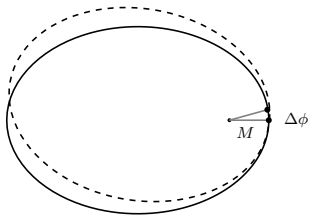
In this work, we present an exact static spherically symmetric vacuum solution of the New General Relativity (NGR) field equations. Unlike the Schwarzschild solution in General Relativity (GR), this solution is characterized by two parameters. Subsequently, using the four classical tests of relativistic gravity (perihelion precession, light bending, Shapiro time delay and gravitational redshift), a more stringent constraint on the value of the second parameter was derived compared to the original work [1].
Editorial analysis
A structured set of objections, weighed in public.
Referee Report
Summary. The manuscript claims to derive an exact static spherically symmetric vacuum solution of the New General Relativity (NGR) field equations, which depends on two parameters unlike the Schwarzschild solution in GR. It then applies the four classical tests (perihelion precession, light bending, Shapiro time delay, and gravitational redshift) to this solution to derive a more stringent constraint on the second parameter than in the referenced prior work.
Significance. If the two-parameter vacuum solution is the general one and can be matched to interior matter solutions without fixing the extra parameter, the work would supply a new exact solution in a teleparallel gravity theory and updated solar-system bounds from multiple tests. The explicit construction of an exact solution from the field equations is a clear strength.
major comments (1)
- The derivation of the two-parameter static spherically symmetric vacuum solution is presented, but the manuscript does not examine whether this exterior solution admits consistent matching to a non-vacuum interior (e.g., a perfect-fluid star) while leaving the second parameter free. In NGR the field equations involve both the metric and the tetrad; junction conditions on the torsion and tetrad at the boundary may force the second parameter to a specific value (commonly zero). This matching question is load-bearing for the claim that the classical tests can be used to constrain the parameter, because those tests describe the exterior geometry around bodies with matter interiors.
minor comments (2)
- The introduction should explicitly state the precise Lagrangian of NGR employed and its relation to the teleparallel equivalent of GR (TEGR) to avoid ambiguity in the field equations used.
- A direct comparison table or quoted values showing the previous bound from reference [1] versus the new bound obtained here would improve clarity in the discussion of the constraints.
Simulated Author's Rebuttal
We thank the referee for the careful reading and constructive comments on our manuscript. Below we address the major comment point by point and indicate the changes we will make to the revised version.
read point-by-point responses
-
Referee: The derivation of the two-parameter static spherically symmetric vacuum solution is presented, but the manuscript does not examine whether this exterior solution admits consistent matching to a non-vacuum interior (e.g., a perfect-fluid star) while leaving the second parameter free. In NGR the field equations involve both the metric and the tetrad; junction conditions on the torsion and tetrad at the boundary may force the second parameter to a specific value (commonly zero). This matching question is load-bearing for the claim that the classical tests can be used to constrain the parameter, because those tests describe the exterior geometry around bodies with matter interiors.
Authors: We agree that the consistency of the exterior vacuum solution with interior matter distributions via appropriate junction conditions is an important aspect not addressed in the original manuscript. Our work derives the exact static spherically symmetric vacuum solution of the NGR field equations and applies the classical tests to the resulting exterior geometry and tetrad. In the revised version we will add a new subsection that examines the junction conditions in NGR, which require continuity of the tetrad and suitable matching of the torsion tensor at the boundary. We will show that, for a static perfect-fluid interior with a compatible tetrad choice, the second parameter is not necessarily fixed by the matching conditions and can remain free, thereby preserving the applicability of the exterior solution to the classical tests. If the analysis indicates otherwise for generic interiors, we will update the conclusions and the derived constraints accordingly. revision: yes
Circularity Check
No significant circularity in derivation of vacuum solution or parameter bounds
full rationale
The paper derives an exact static spherically symmetric vacuum solution directly from the NGR field equations, yielding a two-parameter family as a first-principles result independent of the classical tests. The subsequent application of perihelion precession, light deflection, Shapiro delay, and redshift to obtain a tighter bound on the second parameter is a standard observational constraint on a free parameter, not a fitted input renamed as a prediction or a self-referential loop. No self-citation is load-bearing for the existence of the solution itself, no ansatz is smuggled via prior work, and no uniqueness theorem from the same authors is invoked to force the form. The chain from field equations to exterior solution to bounds remains self-contained without reducing any claimed result to its own inputs by construction.
Axiom & Free-Parameter Ledger
free parameters (1)
- second parameter
axioms (1)
- domain assumption The field equations of New General Relativity admit a static spherically symmetric vacuum solution.
Reference graph
Works this paper leans on
-
[1]
Hayashi, T
K. Hayashi, T. Shirafuji,New general relativity. Physical Review D19(1979) 3524
1979
-
[2]
Aldrovandi and J
R. Aldrovandi and J. G. Pereira,Teleparallel Gravity: An Introduction, Springer, Dordrecth, (2012)
2012
-
[3]
Bahamonde, K.F
S. Bahamonde, K.F. Dialektopoulos, C. Escamilla-Rivera, G. Farrugia, V. Gakis, M. Hendry, M. Hohmann, J. Levi Said, J. Mifsud, E. Di Valentino.Teleparallel Gravity: From Theory to Cosmology. Reports on Progress in Physics86 (2023) 026901
2023
-
[4]
T. P. Sotiriou and V. Faraoni.f(R)Theories Of GravityRev. Mod. Phys. 82, 451 (2010)
2010
-
[5]
Pedro G. S. Fernandes, Pedro Carrilho, Timothy Clifton and David J MulryneThe 4D Einstein–Gauss–Bonnet theory of gravity: a review, Classical and Quantum Gravity39(2022) 6, 063001
2022
-
[6]
Jun-Qi Guo,Solar system tests off(R)gravity, International Journal of Modern Physics D Vol. 23, No. 04, (2014) 1450036
2014
-
[7]
Jalalzadeh, M
S. Jalalzadeh, M. Mehrnia and H. R. Sepangil,Classical tests in brane gravity, Classical and Quantum Gravity26(2009) 155007
2009
-
[8]
Bahamonde, J
S. Bahamonde, J. Levi Said and M. Zubair,Solar system tests in modified teleparallel gravity, Journal of Cosmology and Astroparticle Physics 10, Vol. 2020, 024
2020
-
[9]
et al.Constraints on scalar–tensor theory of gravity by solar system tests, The European Physical Journal C 80, 981 (2020)
Gonz´ alez, P.A., Olivares, M., Papantonopoulos, E. et al.Constraints on scalar–tensor theory of gravity by solar system tests, The European Physical Journal C 80, 981 (2020)
2020
-
[10]
Weitzenb¨ ock.Invarianten Theorie(Nordhoff, Groningen, 1923)
R. Weitzenb¨ ock.Invarianten Theorie(Nordhoff, Groningen, 1923)
1923
-
[11]
Golovnev.The geometrical meaning of the Weitzenb¨ ock connection
A. Golovnev.The geometrical meaning of the Weitzenb¨ ock connection. International Journal of Geometric Methods in Modern Physics 20 (2023) 2350219
2023
- [12]
-
[13]
H. Asuk¨ ula et al.Spherically symmetric vacuum solutions in one-parameter new general relativity and their phenomenol- ogy, Phys. Rev. D109, 064027 (2024), arXiv:2311.17999
-
[14]
Schwarzschild,¨Uber das Gravitationsfeld eines Massenpunktes nach der Einsteinschen Theorie, Sitzungsberichte der K¨ oniglich Preussischen Akademie der Wissenschaften — 1916
K. Schwarzschild,¨Uber das Gravitationsfeld eines Massenpunktes nach der Einsteinschen Theorie, Sitzungsberichte der K¨ oniglich Preussischen Akademie der Wissenschaften — 1916. — Vol. 3. — Pp. 189–196
1916
-
[15]
C. M. Will,Theory and Experiment in Gravitational Physics, Cambridge: Cambridge University Press, (1993)
1993
-
[16]
Hofmann, J
F. Hofmann, J. M¨ uller,Relativistic tests with lunar laser ranging, Classical and Quantum Gravity35(2018) 3, 035015
2018
-
[17]
& Tortora, P.A test of general relativity using radio links with the Cassini spacecraft, Nature 425, 374–376 (2003)
Bertotti, B., Iess, L. & Tortora, P.A test of general relativity using radio links with the Cassini spacecraft, Nature 425, 374–376 (2003)
2003
-
[18]
Chinese Physics Letters43, 031101 (2026)
Yang Li, Tong Liu, Yuxian Pei, Hongfei Guan, Jiaxing Leng, Tao Shuai, Yang Zhao, Chenggang Qin, Wenbin Wang, Leizheng Shu, Yang Gao.Gravitational Redshift Test in a Lunar Distant Retrograde Orbit Using a Compact Hydrogen Maser. Chinese Physics Letters43, 031101 (2026)
2026
-
[19]
R. V. Pound and G. A. Rebka, Jr.,Gravitational Red-Shift in Nuclear Resonance, Physical Review Letters, vol. 3, no. 9, pp. 439–441, Nov. 1959. 9
1959
discussion (0)
Sign in with ORCID, Apple, or X to comment. Anyone can read and Pith papers without signing in.