Recognition: unknown
Rigorous ultimate scaling in rapidly rotating steady convection
Pith reviewed 2026-05-08 06:25 UTC · model grok-4.3
The pith
Single-mode solutions in rapidly rotating convection achieve diffusivity-free ultimate scaling for heat transport with logarithmic corrections.
A machine-rendered reading of the paper's core claim, the machinery that carries it, and where it could break.
Core claim
For suitable horizontal wavenumbers, the single-mode solutions attain the diffusivity-free ultimate scalings for the Nusselt and Reynolds numbers, with additional enhancing logarithmic corrections, as obtained from a matched asymptotic analysis of the bulk and boundary-layer structure in the high-Rayleigh-number limit.
What carries the argument
Matched asymptotic analysis applied to exact steady single-mode solutions, which separates the bulk flow from the boundary layers to derive the scaling laws.
If this is right
- For suitable wavenumbers, the Nusselt number becomes independent of thermal diffusivity.
- The Reynolds number follows a similar diffusivity-free scaling with logarithmic enhancements.
- Coherent columnar structures with well-defined horizontal scales can approach ultimate heat transport.
- The scaling laws depend explicitly on the chosen horizontal wavenumber.
Where Pith is reading between the lines
- This implies that ultimate scaling may not require turbulent multi-mode interactions if coherent structures dominate.
- Natural rotating convection systems could select wavenumbers that enable this ultimate regime.
- High-resolution simulations could test the predicted logarithmic corrections at extreme Rayleigh numbers.
Load-bearing premise
The matched asymptotic analysis in the high-Rayleigh-number limit accurately captures the bulk and boundary-layer structure without significant interference from higher-order terms or multi-mode interactions.
What would settle it
If numerical simulations at sufficiently high Rayleigh numbers show that the Nusselt number scaling deviates from the predicted diffusivity-free form including the logarithmic corrections for those wavenumbers, the claim would be falsified.
Figures


read the original abstract
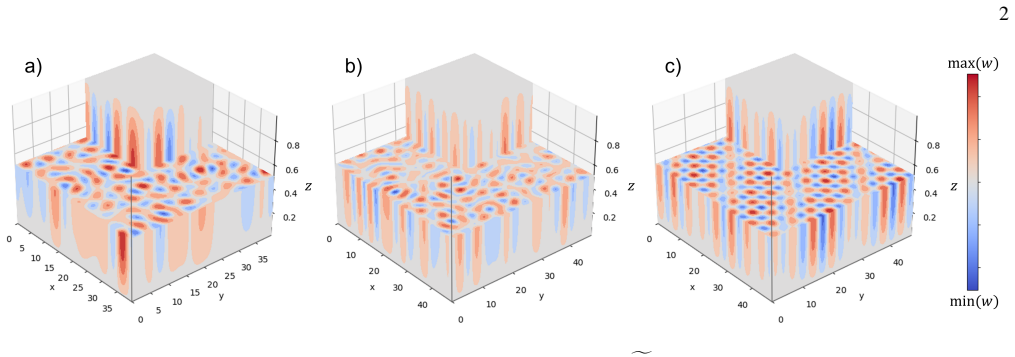
Rapidly rotating Rayleigh-B\'enard convection admits a class of exact steady single-mode solutions describing high-amplitude convection cells. Using a matched asymptotic analysis in the high-Rayleigh-number limit, we obtain a rigorous characterization of their bulk and boundary-layer structure, yielding explicit scaling laws for the Nusselt and Reynolds numbers, including their dependence on the horizontal wavenumber. We show that, for suitable wavenumbers, these solutions attain the diffusivity-free ultimate scalings frequently assumed for geophysical and astrophysical convection, with additional enhancing logarithmic corrections. This reveals a specific mechanism through which rapidly rotating convection can approach ultimate heat transport via coherent columnar structures with well-defined horizontal scales.
Editorial analysis
A structured set of objections, weighed in public.
Referee Report
Summary. The manuscript analyzes exact steady single-mode solutions of the rapidly rotating Rayleigh-Bénard convection equations. It applies a matched asymptotic analysis in the high-Rayleigh-number limit to characterize the bulk and boundary-layer structure, deriving explicit scaling laws for the Nusselt number Nu(Ra, k) and Reynolds number Re(Ra, k) that include logarithmic corrections. The central claim is that, for suitable horizontal wavenumbers k, these solutions attain the diffusivity-free ultimate scalings (Nu ~ Ra^{1/2} with log enhancements) assumed for geophysical and astrophysical convection.
Significance. If the asymptotic results hold, the work is significant because it supplies a concrete, wavenumber-dependent mechanism—coherent columnar structures—for reaching the ultimate heat-transport regime in rapidly rotating convection without relying on phenomenological assumptions. The grounding in exact single-mode solutions (rather than approximate models) and the explicit derivation of log corrections are strengths that could guide reduced-order modeling and targeted simulations in the field.
major comments (1)
- [§4] §4 (Matched asymptotic analysis): The derivation of the diffusivity-free ultimate scalings rests on formal matched asymptotics without explicit remainder estimates or bounds showing that higher-order viscous/thermal diffusion terms do not alter the leading-order exponents. This is load-bearing for the abstract's claim that the solutions 'rigorously attain' the ultimate regime; the current truncation leaves the result conditional on the validity of the leading-order balance.
minor comments (1)
- [Abstract] Abstract: The phrasing 'rigorous characterization' and 'rigorous ultimate scaling' in the title and abstract could be clarified to specify that the rigor applies to the exact single-mode solutions while the high-Ra limit is obtained via formal asymptotics.
Simulated Author's Rebuttal
We thank the referee for their careful reading and constructive feedback on our manuscript. We address the single major comment below and outline the revisions we will make to clarify the scope of our analysis.
read point-by-point responses
-
Referee: [§4] §4 (Matched asymptotic analysis): The derivation of the diffusivity-free ultimate scalings rests on formal matched asymptotics without explicit remainder estimates or bounds showing that higher-order viscous/thermal diffusion terms do not alter the leading-order exponents. This is load-bearing for the abstract's claim that the solutions 'rigorously attain' the ultimate regime; the current truncation leaves the result conditional on the validity of the leading-order balance.
Authors: We agree that the analysis in §4 relies on formal matched asymptotics: we construct leading-order balances in the bulk and boundary layers, match them, and obtain the explicit scalings (including logarithmic corrections) without supplying remainder estimates or a priori bounds on the neglected higher-order viscous and thermal diffusion terms. The single-mode solutions are exact for the governing equations at any finite Ra and k, but the asymptotic characterization of their structure as Ra → ∞ is formal. Consequently, the statement that these solutions 'attain' the diffusivity-free ultimate regime holds at leading order under the assumption that higher-order corrections remain subdominant, which is not proven here. We will revise the abstract to replace 'rigorous characterization' with 'systematic asymptotic characterization' and add a clarifying paragraph at the end of §4 noting the formal nature of the expansion and the absence of error bounds. These changes make the claims precise while preserving the central result on the leading-order scalings and their wavenumber dependence. revision: partial
Circularity Check
No circularity: scalings derived forward from exact single-mode solutions via matched asymptotics
full rationale
The paper begins with exact steady single-mode solutions admitted by the governing equations under the single-mode ansatz. Matched asymptotic analysis is then applied in the high-Rayleigh-number limit to extract the bulk and boundary-layer structure, from which explicit Nu(Ra, k) and Re(Ra, k) scalings (including logarithmic corrections) are obtained as outputs. These scalings are shown to attain diffusivity-free ultimate behavior for suitable wavenumbers. No parameters are fitted to data and then relabeled as predictions, no self-citations form the load-bearing justification for the central result, and the derivation does not reduce any claimed outcome to an input by definition or renaming. The analysis is self-contained against the governing PDEs and the single-mode restriction.
Axiom & Free-Parameter Ledger
axioms (2)
- domain assumption Rapidly rotating Rayleigh-Bénard convection admits a class of exact steady single-mode solutions describing high-amplitude convection cells.
- domain assumption Matched asymptotic analysis is valid for characterizing bulk and boundary-layer structure in the high-Rayleigh-number limit.
Reference graph
Works this paper leans on
-
[1]
E. A. Spiegel, Convection in Stars I. Basic Boussinesq Con- vection, Annual Review of Astronomy and Astrophysics9, 323 (1971)
1971
-
[2]
D. J. Stevenson, Turbulent thermal convection in the presence of rotation and a magnetic field: A heuristic theory, Geophysi- cal & Astrophysical Fluid Dynamics12, 139 (1979)
1979
-
[3]
Marshall and F
J. Marshall and F. Schott, Open-ocean convection: Observa- tions, theory, and models, Reviews of Geophysics37, 1 (1999)
1999
-
[4]
Aurnou, M
J. Aurnou, M. Calkins, J. Cheng, K. Julien, E. King, D. Nieves, K. M. Soderlund, and S. Stellmach, Rotating convective turbu- lence in Earth and planetary cores, Physics of the Earth and Planetary Interiors246, 52 (2015)
2015
-
[5]
G. M. Vasil, K. Julien, and N. A. Featherstone, Rotation sup- presses giant-scale solar convection, Proceedings of the Na- tional Academy of Sciences118, e2022518118 (2021)
2021
-
[6]
Chandrasekhar,Hydrodynamic and hydromagnetic stability (1961)
S. Chandrasekhar,Hydrodynamic and hydromagnetic stability (1961)
1961
-
[7]
Rossby, A study of Bénard convection with and without ro- tation, Journal of Fluid Mechanics36, 309 (1969)
H. Rossby, A study of Bénard convection with and without ro- tation, Journal of Fluid Mechanics36, 309 (1969)
1969
-
[8]
E. M. King, S. Stellmach, and J. M. Aurnou, Heat transfer by rapidly rotating Rayleigh–Bénard convection, Journal of Fluid Mechanics691, 568 (2012)
2012
-
[9]
R. E. Ecke and O. Shishkina, Turbulent rotating rayleigh–bénard convection, Annual Review of Fluid Me- chanics55, 603 (2023)
2023
-
[10]
Julien, E
K. Julien, E. Knobloch, and J. Werne, A new class of equa- tions for rotationally constrained flows, Theoretical and com- putational fluid dynamics11, 251 (1998)
1998
-
[11]
Julien and E
K. Julien and E. Knobloch, Reduced models for fluid flows with strong constraints, Journal of Mathematical physics48(2007)
2007
-
[12]
Julien, E
K. Julien, E. Knobloch, A. M. Rubio, and G. M. Vasil, Heat transport in low-Rossby-number Rayleigh-Bénard convection, Physical review letters109, 254503 (2012)
2012
-
[13]
Julien, J
K. Julien, J. M. Aurnou, M. A. Calkins, E. Knobloch, P. Marti, S. Stellmach, and G. M. Vasil, A nonlinear model for rotation- ally constrained convection with Ekman pumping, Journal of Fluid Mechanics798, 50 (2016)
2016
-
[14]
Julien, A
K. Julien, A. Van Kan, B. Miquel, E. Knobloch, and G. Vasil, Rescaled equations for well-conditioned direct numerical simu- lations of rapidly rotating convection, Journal of Computational Physics , 114274 (2025)
2025
-
[15]
Maffei, M
S. Maffei, M. J. Krouss, K. Julien, and M. A. Calkins, On the inverse cascade and flow speed scaling behaviour in rapidly ro- tating Rayleigh–Bénard convection, Journal of Fluid Mechanics 913, A18 (2021)
2021
-
[16]
Sprague, K
M. Sprague, K. Julien, E. Knobloch, and J. Werne, Numerical simulation of an asymptotically reduced system for rotationally constrained convection, Journal of Fluid Mechanics551, 141 (2006)
2006
-
[17]
A. P. Bassom and K. Zhang, Strongly nonlinear convection cells in a rapidly rotating fluid layer, Geophysical & Astrophysical Fluid Dynamics76, 223 (1994)
1994
-
[18]
Julien and E
K. Julien and E. Knobloch, Fully nonlinear three-dimensional convection in a rapidly rotating layer, Physics of Fluids11, 1469 (1999)
1999
-
[19]
Grooms, Asymptotic behavior of heat transport for a class of exact solutions in rotating Rayleigh–Bénard convection, Geo- physical & Astrophysical Fluid Dynamics109, 145 (2015)
I. Grooms, Asymptotic behavior of heat transport for a class of exact solutions in rotating Rayleigh–Bénard convection, Geo- physical & Astrophysical Fluid Dynamics109, 145 (2015)
2015
-
[20]
Matthews, Asymptotic solutions for nonlinear magnetocon- vection, Journal of Fluid Mechanics387, 397 (1999)
P. Matthews, Asymptotic solutions for nonlinear magnetocon- vection, Journal of Fluid Mechanics387, 397 (1999)
1999
-
[21]
R. H. Kraichnan, Turbulent thermal convection at arbitrary Prandtl number, The Physics of Fluids5, 1374 (1962)
1962
-
[22]
Grossmann and D
S. Grossmann and D. Lohse, Scaling in thermal convection: a unifying theory, Journal of Fluid Mechanics407, 27 (2000)
2000
-
[23]
J. M. Aurnou, S. Horn, and K. Julien, Connections between nonrotating, slowly rotating, and rapidly rotating turbulent con- vection transport scalings, Physical Review Research2, 043115 (2020)
2020
-
[24]
Hassanzadeh, G
P. Hassanzadeh, G. Chini, and C. Doering, Wall to wall optimal transport, Journal of Fluid Mechanics751, 627 (2014)
2014
-
[25]
Motoki, G
S. Motoki, G. Kawahara, and M. Shimizu, Maximal heat trans- fer between two parallel plates, Journal of Fluid Mechanics851, R4 (2018)
2018
-
[26]
Motoki, G
S. Motoki, G. Kawahara, and M. Shimizu, Optimal heat transfer enhancement in plane Couette flow, Journal of Fluid Mechanics 835, 1157 (2018)
2018
-
[27]
Motoki, G
S. Motoki, G. Kawahara, and M. Shimizu, Multi-scale steady solution for Rayleigh–Bénard convection, Journal of Fluid Me- chanics914, A14 (2021)
2021
-
[28]
Kooloth, D
P. Kooloth, D. Sondak, and L. M. Smith, Coherent solutions and transition to turbulence in two-dimensional Rayleigh-Bénard convection, Physical Review Fluids6, 013501 (2021)
2021
-
[29]
B. Wen, D. Goluskin, and C. R. Doering, Steady Rayleigh–Bénard convection between no-slip boundaries, Journal of Fluid Mechanics933, R4 (2022)
2022
-
[30]
Deguchi, On high-Taylor-number Taylor vortices, Journal of Fluid Mechanics967, A11 (2023)
K. Deguchi, On high-Taylor-number Taylor vortices, Journal of Fluid Mechanics967, A11 (2023)
2023
-
[31]
X. He, S. Motoki, K. Deguchi, and G. Kawahara, High- Rayleigh-number asymptotic classical scaling in three- dimensional steady natural convection, J. Fluid Mech1028, A5 (2026)
2026
-
[32]
E. A. Spiegel and G. Veronis, On the Boussinesq Approxima- tion for a Compressible Fluid., The Astrophysical Journal131, 442 (1960)
1960
-
[33]
A. J. Barker, A. M. Dempsey, and Y . Lithwick, Theory and sim- ulations of rotating convection, The Astrophysical Journal791, 13 (2014)
2014
-
[34]
Bouillaut, B
V . Bouillaut, B. Miquel, K. Julien, S. Aumaître, and B. Gallet, Experimental observation of the geostrophic turbulence regime of rapidly rotating convection, Proceedings of the National Academy of Sciences118, e2105015118 (2021)
2021
-
[35]
J. Song, O. Shishkina, and X. Zhu, Scaling regimes in rapidly rotating thermal convection at extreme Rayleigh numbers, Jour- nal of Fluid Mechanics984, A45 (2024)
2024
-
[36]
Hadjerci, V
G. Hadjerci, V . Bouillaut, B. Miquel, and B. Gallet, Rapidly ro- tating radiatively driven convection: experimental and numer- ical validation of the ‘geostrophic turbulence’ scaling predic- tions, Journal of Fluid Mechanics998, A9 (2024)
2024
-
[37]
Hadjerci, V
G. Hadjerci, V . Bouillaut, B. Miquel, S. Aumaître, and B. Gal- let, Radiatively driven convection: diffusivity-free regimes of geophysical and astrophysical flows in the laboratory, Comptes Rendus. Physique25, 1 (2024)
2024
-
[38]
Kannan, J
V . Kannan, J. Song, O. Shishkina, and X. Zhu, Beyond Nus- selt number: assessing Reynolds and length scalings in rotat- ing convection under stress-free boundary conditions, Journal of Fluid Mechanics1016, A3 (2025)
2025
-
[39]
Miquel, Coral: A parallel spectral solver for fluid dynam- ics and partial differential equations, Journal of Open Source Software6, 2978 (2021)
B. Miquel, Coral: A parallel spectral solver for fluid dynam- ics and partial differential equations, Journal of Open Source Software6, 2978 (2021)
2021
-
[40]
R. M. Corless, G. H. Gonnet, D. E. Hare, D. J. Jeffrey, and D. E. Knuth, On the Lambert W function, Advances in Compu- tational mathematics5, 329 (1996). 7
1996
-
[41]
van Kan, K
A. van Kan, K. Julien, B. Miquel, and E. Knobloch, Bridging the Rossby number gap in rapidly rotating thermal convection, Journal of Fluid Mechanics1010, A42 (2025)
2025
discussion (0)
Sign in with ORCID, Apple, or X to comment. Anyone can read and Pith papers without signing in.