Recognition: no theorem link
Proton probing measurements of filamentary electromagnetic structure in laser ablation of solids
Pith reviewed 2026-05-12 05:07 UTC · model grok-4.3
The pith
Laser ablation experiments show filamentary electromagnetic fields grow mainly from a secondary instability following the expansion-driven Weibel instability.
A machine-rendered reading of the paper's core claim, the machinery that carries it, and where it could break.
Core claim
The central claim is that the anomalous filamentary structures observed in proton radiographs of laser-ablated solids are produced by electric and magnetic fields generated by a secondary instability that arises from the expansion-driven Weibel instability, and that the growth of these features is dominated by incident laser energy and target atomic number Z rather than other parameters.
What carries the argument
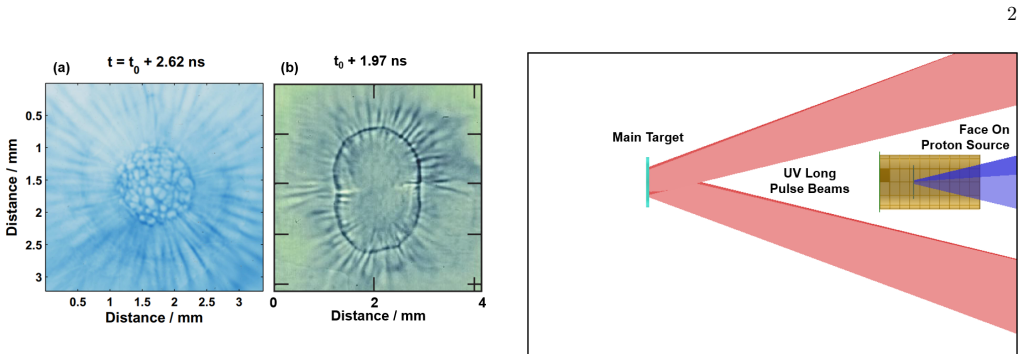
The expansion-driven Weibel instability together with its secondary instability, which together generate the filamentary electromagnetic fields detected through dual-axis proton radiography and optical probing.
If this is right
- Field growth increases with higher incident laser energy.
- Higher atomic number targets produce stronger development of the filamentary structures.
- The fields act as an energy sink and extend throughout the ablation corona.
- Pulse shape and intensity variations have secondary effects on growth compared with energy and Z.
Where Pith is reading between the lines
- Similar filamentary fields observed in spherical implosions could be reduced by selecting lower-Z target materials.
- Inertial confinement fusion modeling should incorporate this secondary instability to predict energy coupling losses more accurately.
- Planar proton radiography offers a controlled platform to isolate and measure Weibel-related instabilities without spherical geometry complications.
Load-bearing premise
The filamentary structures in the proton radiographs are produced by the electric or magnetic fields of the proposed secondary Weibel instability rather than by other hydrodynamic or laser-plasma effects not excluded by the parameter variations.
What would settle it
An experiment using a low-Z target or pulse shape expected to suppress the expansion-driven Weibel instability that nevertheless produces identical filamentary radiographic features would falsify the claim that the secondary instability is the primary driver.
Figures






read the original abstract
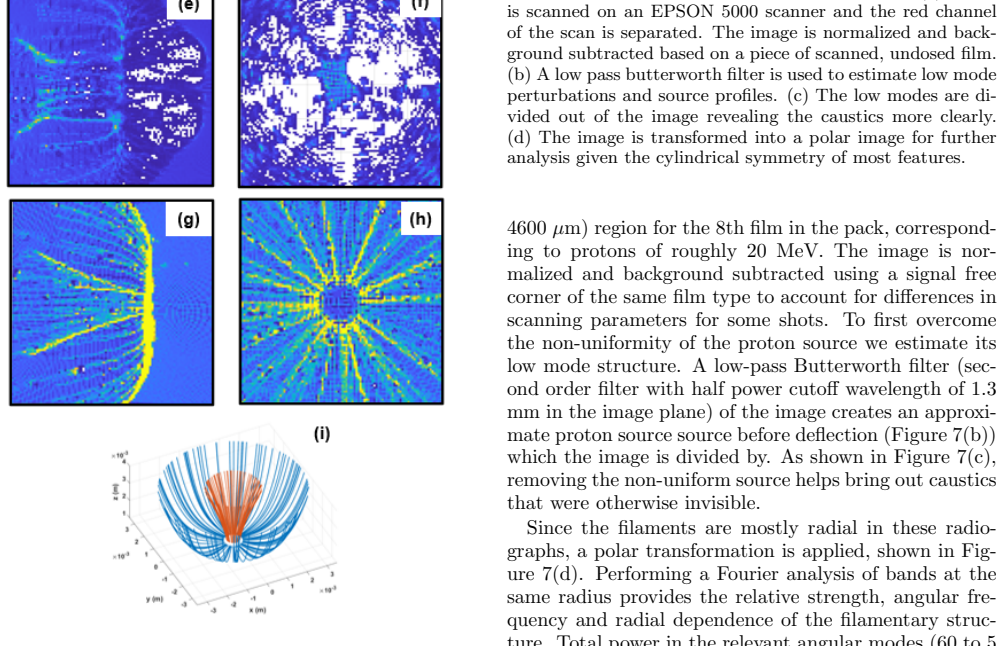
Proton radiography of laser direct-drive spherical implosions has shown anomalous structures that correspond to strong electric or magnetic fields extending throughout the corona. These fields have the ability to affect laser-target interactions and act as an energy sink. To better understand the these fields, simplified experiments were conducted in planar geometry on the OMEGA EP laser at the Laboratory for Laser Energetics. Varying target material, target size, pulse shape, and intensity, and measured the field structure using dual-axis proton radiography and a 4w probe. Proton radiographs were analyzed and quantitatively demonstrate that the growth of these features is dominated by laser energy and target Z. The data strongly supports that a secondary instability as a consequence of the expansion driven Weibel instability in these interactions is the primary driver for these fields.
Editorial analysis
A structured set of objections, weighed in public.
Referee Report
Summary. The manuscript reports proton radiography experiments on planar laser ablation targets using the OMEGA EP laser. By varying target material (Z), size, pulse shape, and intensity, and employing dual-axis proton radiography plus a 4ω optical probe, the authors analyze filamentary structures in the radiographs. They claim that quantitative analysis demonstrates the growth of these electromagnetic field structures is dominated by laser energy and target Z, and interpret the data as strong support for a secondary instability arising from the expansion-driven Weibel instability as the primary driver of the observed fields.
Significance. If the mechanism attribution holds, the work would contribute useful experimental constraints on filamentary field generation in laser-plasma interactions, with potential relevance to energy coupling and instability seeding in inertial confinement fusion. The parameter-variation approach to identify scalings with energy and Z is a positive feature, though the manuscript does not yet provide the level of mechanistic isolation (e.g., via simulations or additional diagnostics) needed to make the interpretation definitive.
major comments (2)
- [Abstract] Abstract: The statement that 'quantitative analysis of radiographs demonstrates dominance by laser energy and target Z' is presented without error bars, data exclusion criteria, statistical measures, or direct comparison to hydrodynamic or laser-imprint simulations. This makes it impossible to assess whether the observed Z and energy scalings uniquely support the Weibel secondary instability over competing Z-dependent plasma or ablation-front effects.
- [Abstract] Abstract and results discussion: The central claim that the filamentary proton-radiograph features arise specifically from E/B fields of the expansion-driven Weibel secondary instability is not isolated from alternatives. Parameter variations show Z and energy dependence, but no wavelength matching, polarization signatures from dual-axis imaging, or comparison to Weibel dispersion relations are reported to exclude hydrodynamic modulations, laser imprint, or other Z-dependent effects.
minor comments (2)
- [Abstract] Abstract contains a grammatical error: 'To better understand the these fields' should read 'these fields'.
- [Abstract] The abstract refers to 'simplified experiments... in planar geometry' but does not specify how the planar results map quantitatively to the spherical implosion context mentioned in the opening sentence.
Simulated Author's Rebuttal
We thank the referee for their careful and constructive review of our manuscript. We have addressed the concerns regarding the abstract's presentation of quantitative claims and the isolation of the proposed mechanism from alternatives. Below we respond point by point, indicating where revisions will be made to improve clarity and rigor.
read point-by-point responses
-
Referee: [Abstract] Abstract: The statement that 'quantitative analysis of radiographs demonstrates dominance by laser energy and target Z' is presented without error bars, data exclusion criteria, statistical measures, or direct comparison to hydrodynamic or laser-imprint simulations. This makes it impossible to assess whether the observed Z and energy scalings uniquely support the Weibel secondary instability over competing Z-dependent plasma or ablation-front effects.
Authors: We agree that the abstract is highly condensed and omits these supporting details. The full manuscript reports error bars on the quantitative metrics (derived from multiple shots and image-analysis uncertainties) in the results figures, specifies data-exclusion criteria based on radiograph quality and signal-to-noise thresholds in the methods, and includes statistical measures such as standard deviations across the parameter scan. Direct comparisons to hydrodynamic and laser-imprint simulations are presented in the discussion to demonstrate that the observed scalings exceed those attributable to ablation-front or imprint effects alone. To address the referee's point, we will revise the abstract to include a brief qualifier on the statistical robustness of the analysis and will add an explicit cross-reference to the simulation comparisons. revision: yes
-
Referee: [Abstract] Abstract and results discussion: The central claim that the filamentary proton-radiograph features arise specifically from E/B fields of the expansion-driven Weibel secondary instability is not isolated from alternatives. Parameter variations show Z and energy dependence, but no wavelength matching, polarization signatures from dual-axis imaging, or comparison to Weibel dispersion relations are reported to exclude hydrodynamic modulations, laser imprint, or other Z-dependent effects.
Authors: The dual-axis proton radiography was employed to establish the three-dimensional character of the filaments, but extracting polarization signatures for E versus B discrimination is not straightforward in this diagnostic and was not performed. Explicit wavelength matching or dispersion-relation comparisons were not included because the study prioritizes empirical parameter scalings over detailed linear-theory fitting. The 4ω optical probe data show no corresponding density modulations at the observed filament scales, which helps rule out purely hydrodynamic interpretations. The pronounced dependence on target Z is more consistent with the ion-mass and charge dependence expected for the Weibel mechanism than with hydrodynamic or laser-imprint alternatives. We will expand the discussion section to explicitly enumerate and address the competing mechanisms, explaining why the combined energy, Z, and probe data favor the secondary instability following the expansion-driven Weibel instability. We note that a full dispersion-relation analysis would require additional modeling work beyond the scope of this experimental report. revision: partial
Circularity Check
No circularity: experimental data interpretation with independent parameter variations
full rationale
This is an experimental paper reporting proton radiography measurements in planar laser ablation. The central claim interprets observed filamentary structures as arising from a secondary instability following the expansion-driven Weibel instability, based on scaling with laser energy and target Z across varied shots. No equations, derivations, or fitted parameters are described that reduce the result to inputs defined by the same data. The analysis uses dual-axis imaging and quantitative scaling from independent experimental variations, which constitutes external evidence rather than self-referential construction. No self-citations or ansatzes are invoked as load-bearing steps in the provided text.
Axiom & Free-Parameter Ledger
Reference graph
Works this paper leans on
-
[1]
M. Borghesi, D. H. Campbell, A. Schiavi, M. G. Haines, O. Willi, A. J. MacKinnon, P. Patel, L. A. Gizzi, M. Galimberti, R. J. Clarke, F. Pegoraro, H. Ruhl, S. Bulanov; Electric field detection in laser-plasma in- teraction experiments via the proton imaging tech- nique, Phys. Plasmas 1 May 2002; 9 (5): 2214–2220. https://doi.org/10.1063/1.1459457
-
[2]
C. K. Li, F. H. S´ eguin, J. A. Frenje, M. Manuel, R. D. Petrasso, V. A. Smalyuk, R. Betti, J. Delet- trez, J. P. Knauer, F. Marshall, D. D. Meyerhofer, D. Shvarts, C. Stoeckl, W. Theobald, J. R. Rygg, O. L. Landen, R. P. J. Town, P. A. Amendt, C. A. Back and J. D. Kilkenny; Study of direct-drive capsule im- plosions in inertial confinement fusion with pr...
-
[3]
J. R. Rygg, F. H. S´ eguin, C. K. Li, J. A. Frenje, M. J.-E. Manuel, R. D. Petrasso, R. Betti, J. A. Delet- trez, O. V. Gotchev, J. P. Knauer, D. D. Meyer- hofer, F. J. Marshall, C. Stoeckl, and W. Theobald; Proton Radiography of Inertial Fusion Implosions, Sci- ence, 29 Feb 2008, Vol 319, Issue 5867, pp. 1223-1225. https://doi.org/10.1126/science.1152640
-
[4]
F. H. S´ eguin, C. K. Li, M. J.-E. Manuel, H. G. Rinderknecht, N. Sinenian, J. A. Frenje, J. R. Rygg, D. G. Hicks, R. D. Petrasso, J. Delettrez, R. Betti, F. J. Marshall, V. A. Smalyuk; Time evolution of filamentation and self-generated fields in the coronae of directly driven inertial-confinement fusion capsules, Phys. Plasmas 19, 012701 (2012). https://...
-
[5]
A. B. Zylstra, C. K. Li, H. G. Rinderknecht, F. H. S´ eguin, R. D. Petrasso, C. Stoeckl, D. D. Meyerhofer, P. Nil- son, T. C. Sangster, S. Le Pape, A. Mackinnon, P. Patel; Using high-intensity laser-generated energetic protons to radiograph directly driven implosions, Rev. Sci. Instrum. 83, 013511 (2012). https://doi.org/10.1063/1.3680110
-
[6]
M. J.-E. Manuel, C. K. Li, F. H. S´ eguin, N. Sine- nian, J. A. Frenje, D. T. Casey, R. D. Petrasso, J. D. Hager, R. Betti, S. X. Hu, J. Delettrez, D. D. Meyer- hofer; Instability-driven electromagnetic fields in coronal plasmas. Phys. Plasmas 1 May 2013; 20 (5): 056301. https://doi.org/10.1063/1.4801515
- [7]
-
[8]
L. Gao; Measurements of Magneto-Hydrodynamic Ef- fects in Ablatively-Driven High Energy Density Systems, University of Rochester ProQuest Dissertations Theses,
-
[9]
P. Nilson, Magnetic Reconnection in the High-Energy- Density Regime, American Physical Society Division of Plasma Physics Meeting 2019
work page 2019
-
[10]
I. V. Igumenshchev, A. B. Zylstra, C. K. Li, P. M. Nilson, V. N. Goncharov, R. D. Petrasso; Self-generated magnetic fields in direct-drive implo- sion experiments, Phys. Plasmas 21, 062707 (2014). https://doi.org/10.1063/1.4883226
-
[11]
P. V. Heuer, J. L. Peebles, J. Kunimune, H. G. Rinderknecht, J. R. Davies, V. Gopalaswamy, J. Frelier, M. Scott, J. Roberts, R. B. Brannon, H. McClow, R. Fairbanks, S. P. Regan, J. A. Frenje, M. Gatu John- son, F. H. S´ eguin, A. J. Crilly, B. D. Appelbe, M. Farrell, J. Stutz; Distortions in charged-particle images of laser direct-drive inertial confineme...
-
[12]
Roth, Ion Acceleration—Target Normal Sheath Ac- celeration, Vol
M. Roth, Ion Acceleration—Target Normal Sheath Ac- celeration, Vol. 1 (2016): Proceedings of the 2014 CAS- CERN Accelerator School: Plasma Wake Acceleration https://doi.org/10.5170/CERN-2016-001.231
-
[13]
D. H. Froula, R. Boni, M. Bedzyk, R. S. Craxton, F. Ehrne, S. Ivancic, R. Jungquist, M. J. Shoup, W. Theobald, D. Weiner, N. L. Kugland, M. C. Rushford; Optical diagnostic suite (schlieren, interferometry, and grid image refractometry) on OMEGA EP using a 10- ps, 263-nm probe beam, Rev. Sci. Instrum. 83, 10E523 (2012). https://doi.org/10.1063/1.4733739
-
[14]
T. Filkins, M. J. Rosenberg, R. E. Bahr, J. Katz, and S. T. Ivancic; Calibration of the sub-aperture backscatter 11 TABLE I. Shot parameters for entire dataset. Shots without a Distributed Phase Plate (DPP) were focused to 750 um diameter. # of Beams Pulse Length) Energy Intensity DPP Target Mat Target Size Probe Time (ns) (J) 10 14(W/cm2) (Thicknessµm) (...
-
[15]
N. L. Kugland, D. D. Ryutov, C. Plechaty, J. S. Ross, H.-S. Park; Invited Article: Relation between elec- tric and magnetic field structures and their proton- beam images, Rev. Sci. Instrum. 83, 101301 (2012). https://doi.org/10.1063/1.4750234
-
[16]
D. A. Tidman, R. A. Shanny; Field-generating ther- mal instability in laser-heated plasmas, Phys. Fluids 17, 1207–1210 (1974). https://doi.org/10.1063/1.1694866
-
[17]
F. Garc´ ıa-Rubio, R. Betti, J. Sanz, H. Aluie; The- ory of the magnetothermal instability in coronal plasma flows, Phys. Plasmas 29, 092106 (2022). https://doi.org/10.1063/5.0109877
-
[18]
E. S. Weibel; Spontaneously growing transverse waves in a plasma due to an anisotropic veloc- ity distribution, Phys. Rev. Lett. 2, 83–84 (1959). https://doi.org/10.1103/PhysRevLett.2.83
-
[19]
P. E. Masson-Laborde, W. Rozmus, Z. Peng, D. Pesme, S. H´ uller, M. Casanova, V. Yu. Bychenkov, T. Chap- man, P. Loiseau, Phys. Plasmas 17 092704 (2010). https://doi.org/10.1063/1.3474619
-
[20]
T. Silva, K. Schoeffler, J. Vieira, M. Hoshino, R. A. Fon- seca1, and L. O. Silva; Anisotropic heating and magnetic field generation due to Raman scattering in laser-plasma interactions, Phys. Rev. Research 2 023080 (2020). https://doi.org/10.1103/PhysRevResearch.2.023080
-
[21]
Z. Zhao, S. He, H. An, Z. Lei, Y. Xie, W. Yuan, J. Jiao, K. Zhou, Y. Zhang, J. Ye, Z. Xie, J. Xiong, Z. Fang, X. He, W. Wang, W. Zhou, B. Zhang, S. Zhu, and B. Qiao; Laboratory evidence of Weibel magnetogenesis driven by temperature gradient using three-dimensional synchronous proton radiogra- phy, Science Advances, 3 Apr 2024 Vol 10, Issue 14 https://doi...
-
[22]
Y. Z. Zhou, C. Y. Zheng, Z. J. Liu and L. H. Cao; Weibel instability induced by kinetic stimulated Ra- man scattering in unmagnetized and magnetized plas- mas, Plasma Phys. Control. Fusion 64 045009 (2022). https://doi.org/10.1088/1361-6587/ac4bcf
-
[23]
K. M. Schoeffler, N. F. Loureiro, R. A. Fonseca, and L. O. Silva; Magnetic-Field Generation and Amplification in an Expanding Plasma, Phys. Rev. Lett. 112, 175001 (2014). https://doi.org/10.1103/PhysRevLett.112.175001
-
[24]
K. M. Schoeffler, L. O. Silva; Effects of col- lisions on the generation and suppression of temperature anisotropies and the Weibel insta- bility, Phys. Rev. Research 2, 033233 (2020). https://doi.org/10.1103/PhysRevResearch.2.033233
-
[25]
K. V. Lezhnin, S. R. Totorica, J. Griff-McMahon, M. Medvedev, H. Landsberger, A. Diallo, W. Fox; Expansion-driven self-magnetization of high-energy- density plasmas, APS-DPP Meeting November 2025, Long Beach CA
work page 2025
-
[26]
K. V. Lezhnin, S. R. Totorica, J. Griff-McMahon, M. Medvedev, H. Landsberger, A. Diallo, W. Fox; Simulations of self-magnetization in expanding high- energy-density plasmas, arXiv:2503.15624, March 2023. 12 https://doi.org/10.48550/arXiv.2503.15624
work page internal anchor Pith review Pith/arXiv arXiv doi:10.48550/arxiv.2503.15624 2023
-
[27]
C. Thaury, P. Mora, A. H´ eron, and J. C. Adam; Self- generation of megagauss magnetic fields during the ex- pansion of a plasma, Phys. Rev. E 82, 016408 (2010). https://doi.org/10.1103/PhysRevE.82.016408
-
[28]
V. V. Kocharovsky, A. A. Nechaev, M. A. Garasev; Electron Weibel instability and quasi- magnetostatic structures in an expanding collisionless plasma, Rev. Mod. Plasma Phys. 8, 17 (2024). https://doi.org/10.1007/s41614-024-00157-4
-
[29]
G. Kalman, C. Montes, and D. Quemada; Anisotropic Temperature Instabilities, Phys. Fluids 11, 1797–1808 (1968). https://doi.org/10.1063/1.1692198
-
[30]
A. Stockem, M. E. Dieckmann and R. Schlickeiser; PIC simulations of the thermal anisotropy-driven Weibel in- stability: field growth and phase space evolution upon saturation, Plasma Phys. Control. Fusion 51 075014 (2009). http://stacks.iop.org/PPCF/51/075014
work page 2009
-
[31]
K. A. Taggart, B. B. Godrey, C. E. Rhoades, Jr., and H. C. Ives; Second-Order Effects in the Weibel Instability, Phys. Rev. Lett. 29, 1729 (1972). https://doi.org/10.1103/PhysRevLett.29.1729
-
[32]
B. Du, H. B. Cai, W. S. Zhang, J. M. Tian, E. H. Zhang, S. Y. Zou, J. Chen and S. P. Zhu; Distinguish- ing and diagnosing the spontaneous electric and mag- netic fields of Weibel instability through proton radiog- raphy, Plasma Phys. Control. Fusion 62 (2020) 025017. https://doi.org/10.1088/1361-6587/ab57ed
-
[33]
D. Del Sarto, A. Ghizzo, M. Sarrat; Nonlinear coupling of electromagnetic and electrostatic modes via density and pressure fluctuations: The case of Weibel instabilities, Phys. Plasmas 31, 072113 (2024). https://doi.org/10.1063/5.0207974
-
[34]
M. E. Dieckmann; The filamentation instability driven by warm electron beams: statistics and electric field gen- eration, Plasma Phys. Control. Fusion 51 124042 (2009). https://doi.org/10.1088/0741-3335/51/12/124042
-
[35]
P. V. Heuer, L. S. Leal, J. R. Davies, E. C. Hansen, D. H. Barnak, J. L. Peebles, F. Garc´ ıa-Rubio, B. Pollock, J. Moody, A. Birkel, F. H. Seguin; Diagnosing magnetic fields in cylindrical implosions with oblique proton ra- diography, Phys. Plasmas 1 July 2022; 29 (7): 072708. https://doi.org/10.1063/5.0092652
-
[36]
W. M. Manheimer, D. G. Colombant, J. H. Gardner; Steady-state planar ablative flow, Phys. Fluids 25, 1644 (1982) https://doi.org/10.1063/1.863956
discussion (0)
Sign in with ORCID, Apple, or X to comment. Anyone can read and Pith papers without signing in.