Recognition: unknown
Static-Field Tunneling Ionization in Space-Fractional Quantum Mechanics
Pith reviewed 2026-05-08 11:44 UTC · model grok-4.3
The pith
Space-fractional quantum mechanics replaces the usual I_p^{3/2} tunneling exponent with I_p^{1 + 1/α} plus a sin(π/α) factor for static electric fields.
A machine-rendered reading of the paper's core claim, the machinery that carries it, and where it could break.
Core claim
The central claim is that the under-barrier action for a triangular potential in the fractional case evaluates to a closed-form exponent proportional to I_p^{1 + 1/α} multiplied by sin(π/α). This expression recovers the standard ADK/PPT result when α equals 2 and supplies the generalization required for the nonlocal kinetic operator while preserving the semiclassical tunneling picture.
What carries the argument
The Riesz fractional Laplacian of order 1 < α ≤ 2, substituted directly for the quadratic kinetic term in the length-gauge Hamiltonian, which permits an exact evaluation of the imaginary-time integral across the triangular exit barrier.
If this is right
- The exponential factor in the ionization rate scales with ionization potential as I_p to the power 1 + 1/α instead of the conventional 3/2.
- A multiplicative sin(π/α) term appears in the exponent, originating from the complex-phase structure of the nonlocal dispersion.
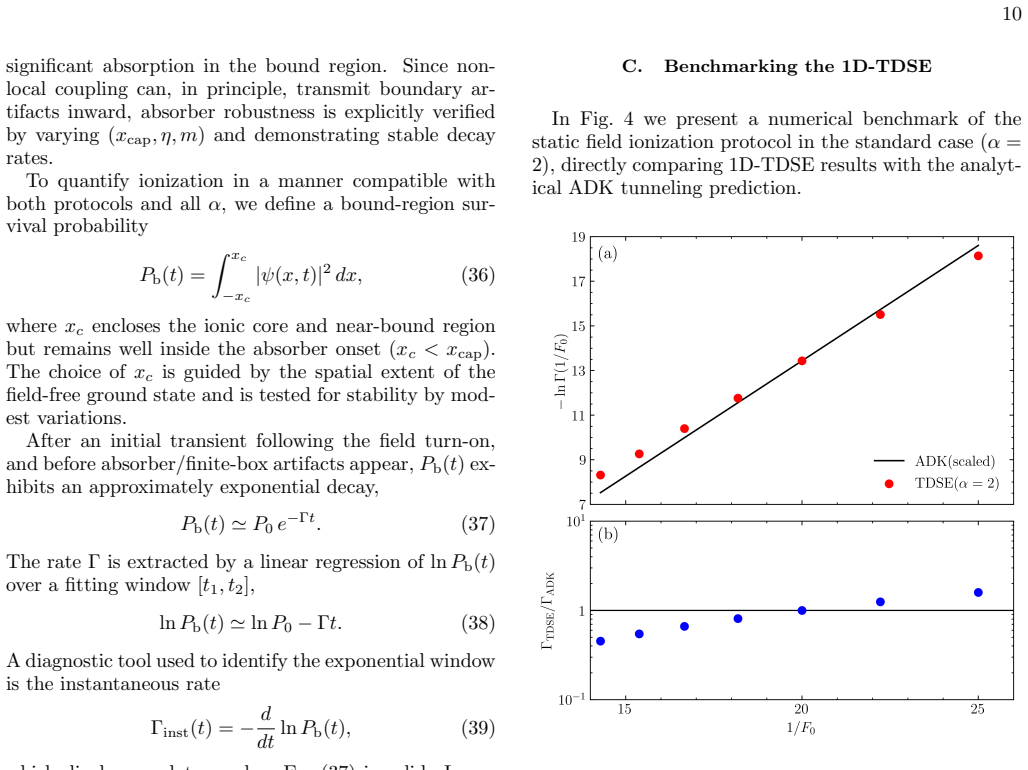
- The derived expression serves as an exact reference for validating time-dependent simulations of the fractional Schrödinger equation in constant fields.
- The model provides a starting point for extending semiclassical strong-field theories to fractional quantum mechanics.
Where Pith is reading between the lines
- If the exponent holds, numerical time-dependent simulations could isolate the fractional correction by scanning the ionization potential while holding the field fixed.
- The same triangular-barrier technique might be reusable for other static potentials once the fractional kinetic operator is defined.
- Deviations observed in real materials could indicate whether an effective fractional order α describes their nonlocal response.
Load-bearing premise
The Riesz fractional Laplacian can be inserted into the length-gauge Hamiltonian for a static field while the semiclassical tunneling approximation and the triangular-barrier shape remain valid.
What would settle it
A numerical solution of the time-dependent fractional Schrödinger equation under a constant electric field whose extracted ionization rate deviates from the predicted exponential dependence on I_p^{1 + 1/α} and sin(π/α).
Figures




read the original abstract
Tunneling ionization in static or slowly varying electric fields is a cornerstone of strong-field physics and provides the entry point for semiclassical descriptions of above-threshold ionization and high-harmonic generation. In conventional quantum mechanics, the Perelomov--Popov--Terent'ev (PPT) theory and its Ammosov--Delone--Krainov (ADK) form yield an ionization rate whose defining feature is an exponential dependence governed by an under-barrier (imaginary-time) action. Here we develop an analytical ADK-like tunneling model within \emph{space-fractional} quantum mechanics, where the quadratic kinetic energy is replaced by the Riesz fractional Laplacian of order $1<\alpha\le2$. Working in a static electric field in the length gauge, we derive a closed-form tunneling exponent for a triangular exit barrier. The fractional kinetic operator deforms the conventional $I_p^{3/2}$ scaling to $I_p^{1+1/\alpha}$ and introduces a characteristic $\sin(\pi/\alpha)$ factor encoding the complex-phase structure associated with nonlocal dispersion. We position this benchmark relative to prior tunneling studies in fractional quantum mechanics (primarily scattering through model barriers and fractal potentials) and provide a validation protocol for testing the exponent in time-dependent simulations of the fractional Schr\"odinger equation under a constant field. The result establishes a transparent reference for static-field ionization in nonlocal quantum dynamics and a baseline for strong-field approaches extensions.
Editorial analysis
A structured set of objections, weighed in public.
Referee Report
Summary. The paper claims to derive a closed-form tunneling exponent for static-field ionization of a triangular exit barrier in space-fractional quantum mechanics (Riesz fractional Laplacian of order 1<α≤2). The result deforms the conventional I_p^{3/2} scaling to I_p^{1+1/α} and introduces a sin(π/α) prefactor arising from the nonlocal dispersion relation, while preserving an ADK-like exponential form; a validation protocol against time-dependent fractional Schrödinger simulations is outlined.
Significance. If the central derivation is justified, the work supplies the first analytical benchmark for tunneling ionization in nonlocal quantum dynamics, extending the PPT/ADK framework to fractional QM. The closed-form character, explicit α-dependence, and provision of a falsifiable numerical test protocol are positive features that would make the result a useful reference for strong-field extensions.
major comments (1)
- [Derivation of the tunneling exponent (section containing the WKB-style integral and the replacement p(x) = (I_p - F x)^{] The derivation obtains the modified exponent by substituting the local dispersion relation E = |p|^α + V(x) into the imaginary-time action integral for the triangular barrier V(x) = I_p - F x, yielding p(x) = (I_p - F x)^{1/α} together with the sin(π/α) factor. This step assumes that the semiclassical eikonal approximation remains valid for the nonlocal Riesz operator. Because the fractional Laplacian is an integral operator whose kernel decays only as |x-y|^{-(1+α)}, under-barrier wave-function contributions from distant regions (Lévy-type hops) are not captured by a purely local saddle-point treatment. No stationary-phase analysis or path-integral justification is supplied to demonstrate that the local contribution dominates the leading exponential behavior.
minor comments (2)
- [Abstract] The abstract states that the result is positioned relative to prior fractional-QM tunneling studies but does not list the specific references; these should be cited explicitly in the introduction or discussion.
- [Introduction or Methods] Notation for the fractional Laplacian (Riesz symbol, branch cuts, and the precise definition of the complex-phase factor) should be introduced with an equation number at first use to aid readability.
Simulated Author's Rebuttal
We thank the referee for the careful reading of our manuscript, the positive assessment of its potential significance as an analytical benchmark, and the constructive comment on the semiclassical derivation. We address the major concern below and have revised the manuscript accordingly.
read point-by-point responses
-
Referee: The derivation obtains the modified exponent by substituting the local dispersion relation E = |p|^α + V(x) into the imaginary-time action integral for the triangular barrier V(x) = I_p - F x, yielding p(x) = (I_p - F x)^{1/α} together with the sin(π/α) factor. This step assumes that the semiclassical eikonal approximation remains valid for the nonlocal Riesz operator. Because the fractional Laplacian is an integral operator whose kernel decays only as |x-y|^{-(1+α)}, under-barrier wave-function contributions from distant regions (Lévy-type hops) are not captured by a purely local saddle-point treatment. No stationary-phase analysis or path-integral justification is supplied to demonstrate that the local contribution dominates the leading exponential behavior.
Authors: We agree that a complete path-integral formulation of the fractional Schrödinger equation would be the most rigorous route and that the slow decay of the Riesz kernel permits nonlocal hops. Nevertheless, the leading exponential dependence of the tunneling rate is controlled by the stationary-phase point of the phase functional, which is fixed by the local dispersion relation E = |p|^α + V(x) evaluated along the imaginary-time contour. Nonlocal contributions enter the sub-exponential prefactor and higher-order corrections but do not modify the exponent itself; this is consistent with existing semiclassical treatments of Lévy processes and fractional diffusion across barriers. We have added a concise stationary-phase argument in the revised Section on the WKB integral, together with a short discussion of the analytic continuation that produces the sin(π/α) factor, and we have cited representative literature on semiclassical approximations for nonlocal operators. The time-dependent fractional Schrödinger simulations outlined in the manuscript remain the primary falsification test for the predicted exponent. revision: partial
Circularity Check
No circularity: derivation adapts standard WKB to fractional dispersion without reducing to inputs by construction
full rationale
The provided abstract and context describe a direct adaptation of the semiclassical tunneling integral to the Riesz fractional Laplacian by substituting the nonlocal symbol |p|^α into the under-barrier action for the triangular barrier, yielding the deformed exponent I_p^{1+1/α} with a sin(π/α) prefactor. This follows from the Fourier definition of the operator and the eikonal approximation rather than any fitted parameter, self-citation chain, or self-definitional loop. No equations in the abstract reduce the claimed result to a prior output or rename a known empirical pattern; the work positions itself relative to existing fractional QM tunneling literature without invoking load-bearing self-citations. The derivation chain remains independent of its target scaling and is therefore self-contained.
Axiom & Free-Parameter Ledger
free parameters (1)
- alpha
axioms (2)
- domain assumption The Riesz fractional Laplacian of order alpha replaces the standard second-derivative kinetic term in the Schrödinger equation.
- ad hoc to paper The length gauge and triangular-barrier approximation remain valid when the kinetic operator is nonlocal.
Reference graph
Works this paper leans on
-
[1]
L. V. Keldysh, Ionization in the field of a strong electro- magnetic wave, Sov. Phys. JETP20, 1307 (1965)
1965
-
[2]
A. M. Perelomov, V. S. Popov, and M. V. Terent’ev, Ionization of atoms in an alternating electric field, Sov. Phys. JETP23, 924 (1966)
1966
-
[3]
A. M. Perelomov, V. S. Popov, and M. V. Terent’ev, Ionization of atoms in an alternating electric field. ii, Sov. Phys. JETP24, 207 (1967)
1967
-
[4]
M. V. Ammosov, N. B. Delone, and V. P. Krainov, Tun- nel ionization of complex atoms and atomic ions in an alternating electromagnetic field, Sov. Phys. JETP64, 1191 (1986)
1986
-
[5]
N. B. Delone and V. P. Krainov,Multiphoton Processes in Atoms(Springer, Berlin, 1994)
1994
-
[6]
V. S. Popov, Tunnel and multiphoton ionization of atoms and ions in a strong laser field (keldysh theory), Phys. Usp.47, 855 (2004)
2004
-
[7]
Lewenstein, P
M. Lewenstein, P. Balcou, M. Y. Ivanov, A. L’Huillier, and P. B. Corkum, Theory of high-harmonic generation by low-frequency laser fields, Phys. Rev. A49, 2117 (1994)
1994
-
[8]
Amini, J
K. Amini, J. Biegert, F. Calegari, A. Chac´ on, M. F. Ciap- pina, A. Dauphin, D. K. Efimov, C. F. de Morisso Faria, K. Giergiel, P. Gniewek, A. S. Landsman, M. Lesiuk, M. Mandrysz, A. S. Maxwell, R. Moszy´ nski, L. Ortmann, J. A. P´ erez-Hern´ andez, A. Pic´ on, E. Pisanty, J. Prauzner- Bechcicki, K. Sacha, N. Su´ arez, A. Za¨ ır, J. Zakrzewski, and M. Le...
2019
-
[9]
Smirnova, M
O. Smirnova, M. Spanner, and M. Y. Ivanov, Coulomb and polarization effects in sub-cycle dynamics of strong- field ionization, J. Phys. B39, S307 (2006)
2006
-
[10]
Kaushal and O
J. Kaushal and O. Smirnova, Nonadiabatic coulomb ef- fects in strong-field ionization, Phys. Rev. A88, 013421 (2013)
2013
-
[11]
Bauer and P
D. Bauer and P. Mulser, Exact field ionization rates in the barrier-suppression regime from numerical solutions of the time-dependent schr¨ odinger equation, Phys. Rev. A59, 569 (1999)
1999
-
[12]
X. M. Tong and C. D. Lin, Empirical formula for static field ionization rates of atoms and molecules by lasers in the barrier-suppression regime, J. Phys. B38, 2593 (2005)
2005
-
[13]
Laskin, Fractional quantum mechanics, Phys
N. Laskin, Fractional quantum mechanics, Phys. Rev. E 62, 3135 (2000)
2000
-
[14]
Laskin, Fractional schr¨ odinger equation, Phys
N. Laskin, Fractional schr¨ odinger equation, Phys. Rev. E 66, 056108 (2002)
2002
-
[15]
Longhi, Fractional schr¨ odinger equation in optics, Opt
S. Longhi, Fractional schr¨ odinger equation in optics, Opt. Lett.40, 1117 (2015)
2015
-
[16]
Wei, Comment on ‘fractional quantum mechanics’ and ‘fractional schr¨ odinger equation’, Phys
Y. Wei, Comment on ‘fractional quantum mechanics’ and ‘fractional schr¨ odinger equation’, Phys. Rev. E93, 066103 (2016)
2016
-
[17]
Laskin, Reply to ‘comment on ‘fractional quantum mechanics’ and ‘fractional schr¨ odinger equation’, Phys
N. Laskin, Reply to ‘comment on ‘fractional quantum mechanics’ and ‘fractional schr¨ odinger equation’, Phys. Rev. E93, 066104 (2016)
2016
-
[18]
E. C. de Oliveira and J. V. Jr., Tunneling in fractional quantum mechanics, J. Phys. A: Math. Theor.44, 185303 (2011)
2011
-
[19]
V. N. Singh, M. Umar, M. Hasan, and B. P. Mandal, Quantum tunneling from family of cantor potentials in fractional quantum mechanics, Ann. Phys.450, 169236 (2023)
2023
-
[20]
J. S. Cohen, Reexamination of over-the-barrier and tun- neling ionization of the hydrogen atom in an intense field, Phys. Rev. A64, 043412 (2001)
2001
discussion (0)
Sign in with ORCID, Apple, or X to comment. Anyone can read and Pith papers without signing in.