Recognition: unknown
Scalar-Field Reconstruction of Ricci--Gauss--Bonnet Dark Energy in Hov{r}ava--Lifshitz Cosmology
Pith reviewed 2026-05-08 07:35 UTC · model grok-4.3
The pith
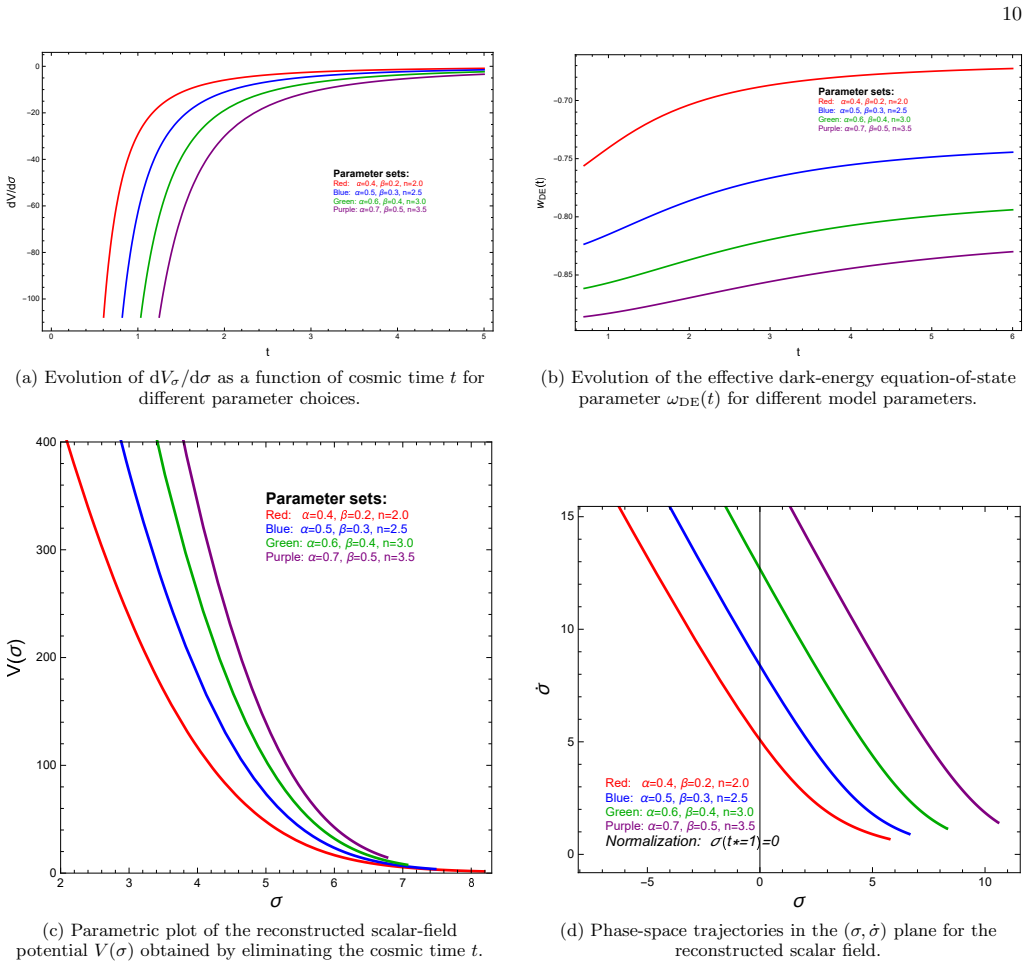
A scalar-field reconstruction of Ricci-Gauss-Bonnet dark energy in Hořava-Lifshitz cosmology produces analytic expressions that describe late-time acceleration while satisfying stability and thermodynamic conditions for suitable parameters.
A machine-rendered reading of the paper's core claim, the machinery that carries it, and where it could break.
Core claim
In a spatially flat FRW background with power-law scale factor, the Ricci-Gauss-Bonnet dark energy component of Hořava-Lifshitz cosmology admits a scalar-field reconstruction in which the effective equation-of-state parameter evolves toward a cosmological-constant value, the squared sound speed remains positive inside a stable region of parameter space, and the total entropy variation at the apparent horizon stays non-negative, thereby furnishing a viable model for late-time acceleration.
What carries the argument
The scalar-field reconstruction that equates the effective dark energy density and pressure arising from the Ricci-Gauss-Bonnet combination to the energy density and pressure of a canonical scalar field, performed under the power-law scale-factor ansatz in the Hořava-Lifshitz action.
Load-bearing premise
The assumption of a spatially flat FRW background together with a power-law scale factor, which is required to obtain closed-form expressions for the scalar-field quantities and the equation-of-state evolution.
What would settle it
A calculation that evaluates the squared sound speed for the specific parameter values producing late-time acceleration and finds it negative at some redshift, or a direct check that the total entropy at the apparent horizon decreases.
Figures


read the original abstract
This paper reports a Ricci-Gauss-Bonnet (RGB) dark energy model within the framework of Ho\v{r}ava-Lifshitz cosmology and presents a scalar-field reconstruction of the effective dark energy sector. In a spatially flat FRW background with a power-law scale factor, we derive analytical expressions for cosmological parameters, scalar field kinetic term, and the reconstructed potential. The reconstructed EoS parameter exhibits smooth transition toward a cosmological-constant-like regime at late times for suitable choices of the model parameters. The classical stability of the model is analyzed through the squared sound speed, and stable regions of the parameter space are identified. Finally, the generalized second law of thermodynamics is investigated at the apparent horizon, and it is shown that the total entropy variation remains non-negative in this model. From these results it can be concluded that the model provides a theoretically consistent description of late-time acceleration, with physical viability maintained within a specific range of the model parameters.
Editorial analysis
A structured set of objections, weighed in public.
Referee Report
Summary. The paper presents a scalar-field reconstruction of a Ricci-Gauss-Bonnet dark energy model embedded in Hořava-Lifshitz cosmology. Assuming a spatially flat FRW metric with power-law scale factor a(t)=t^n, it derives closed-form expressions for the scalar kinetic term, potential, and equation-of-state parameter w. The reconstructed w exhibits a smooth late-time approach to -1 for suitable parameter choices. Classical stability is assessed via the squared sound speed, stable parameter regions are identified, and the generalized second law is verified at the apparent horizon with non-negative total entropy production. The conclusion is that the model furnishes a theoretically consistent description of late-time acceleration within a restricted range of the model parameters.
Significance. If the results hold, the work supplies an explicit analytic reconstruction of dark energy in Hořava-Lifshitz gravity that incorporates both Ricci and Gauss-Bonnet curvature terms, together with concrete checks of classical stability and thermodynamic consistency. The identification of viable parameter intervals via the sound-speed criterion is a concrete, falsifiable output that can guide further model-building.
major comments (2)
- [Sec. 3 (reconstruction) and Sec. 4 (stability)] The power-law ansatz a(t)=t^n is imposed at the outset of the reconstruction (see the setup preceding Eq. (12) and the derivations in Sec. 3) rather than obtained as a dynamical solution of the modified Friedmann and scalar-field equations. Consequently, the reported w→−1 transition, the regions of positive c_s², and the non-negative entropy production are demonstrated only inside this fixed background; no attractor analysis or linear stability check around the power-law solution is supplied.
- [Conclusion and parameter-range statements in Sec. 4] The claim that the model remains physically viable “within a specific range of the model parameters” (abstract and conclusion) is therefore conditional on the ansatz. Without a demonstration that the same intervals remain stable when the scale factor is allowed to evolve freely, the load-bearing viability statement cannot be regarded as general.
minor comments (2)
- [Abstract] The abstract states that “analytical expressions are derived” but does not quote the explicit ranges of the power-law index n or the Gauss-Bonnet coupling strength that were actually scanned; adding these intervals would improve reproducibility.
- [Sec. 2 and Sec. 3] Notation for the Hořava-Lifshitz coupling constants (λ, μ, etc.) and the RGB coupling functions should be cross-checked for consistency between the Lagrangian in Sec. 2 and the reconstructed quantities in Sec. 3.
Simulated Author's Rebuttal
We thank the referee for the careful reading and constructive comments on our manuscript. The points raised concern the scope of the power-law ansatz and the generality of the viability claims. We address each major comment below and indicate the revisions we will implement.
read point-by-point responses
-
Referee: [Sec. 3 (reconstruction) and Sec. 4 (stability)] The power-law ansatz a(t)=t^n is imposed at the outset of the reconstruction (see the setup preceding Eq. (12) and the derivations in Sec. 3) rather than obtained as a dynamical solution of the modified Friedmann and scalar-field equations. Consequently, the reported w→−1 transition, the regions of positive c_s², and the non-negative entropy production are demonstrated only inside this fixed background; no attractor analysis or linear stability check around the power-law solution is supplied.
Authors: We acknowledge that the power-law form a(t)=t^n is introduced as an ansatz to enable closed-form reconstruction of the scalar-field quantities, which is a standard approach in the literature for obtaining analytic expressions in modified gravity cosmologies. All results in Sections 3 and 4, including the late-time w→−1 behavior, positive c_s² regions, and non-negative entropy production, are derived and verified explicitly for this background. We do not perform an attractor or linear stability analysis of the power-law solution within the full autonomous system. We will add a clarifying paragraph in the conclusion stating that the reported features hold under the adopted power-law ansatz and noting that a complete dynamical stability study would constitute a valuable follow-up investigation. revision: partial
-
Referee: [Conclusion and parameter-range statements in Sec. 4] The claim that the model remains physically viable “within a specific range of the model parameters” (abstract and conclusion) is therefore conditional on the ansatz. Without a demonstration that the same intervals remain stable when the scale factor is allowed to evolve freely, the load-bearing viability statement cannot be regarded as general.
Authors: We agree that the viability statements, including the identification of stable parameter intervals, are demonstrated specifically for the power-law background. To correct any potential overstatement of generality, we will revise the abstract and the final paragraph of the conclusion to explicitly qualify that the model furnishes a consistent description of late-time acceleration, with stable parameter ranges, under the assumed power-law expansion a(t)=t^n. This adjustment ensures the claims accurately reflect the scope of the analysis. revision: yes
Circularity Check
No significant circularity detected
full rationale
The paper explicitly states its use of a spatially flat FRW background with power-law scale factor a(t) = t^n to obtain closed-form expressions for the scalar kinetic term, potential, and EoS parameter. This is an upfront modeling choice that restricts the analysis to analytic tractability rather than a hidden reduction of the target results to the inputs by construction. The late-time w → −1 behavior is reported only for suitable parameter choices within the assumed background, which constitutes standard parameter-space exploration rather than a fitted-input-called-prediction or self-definitional loop. No load-bearing self-citations, uniqueness theorems imported from prior author work, or ansatzes smuggled via citation appear in the abstract or described derivation chain. The viability claims are therefore conditional on the stated assumptions and remain self-contained without circularity.
Axiom & Free-Parameter Ledger
free parameters (1)
- model parameters controlling Gauss-Bonnet coupling and power-law index
axioms (1)
- domain assumption Spatially flat FRW background with power-law scale factor
Reference graph
Works this paper leans on
-
[1]
Cosmological parameters fr om supernovae: Two groups’ results agree,
S. Perlmutter and A. Riess, “Cosmological parameters fr om supernovae: Two groups’ results agree,” AIP Conf. Proc. 478, no.1, 129–142 (1999). https://doi.org/10.1063/1.59382
-
[2]
Snapshot distances to Type Ia supernovae: All in ‘One’ night’s work,
A. G. Riess, P. Nugent, A. V. Filippenko, R. P. Kirshner an d S. Perlmutter, “Snapshot distances to Type Ia supernovae: All in ‘One’ night’s work,” Astrophys. J. 504, 935 (1998). https://doi.org/10.1086/306106
-
[3]
R. J. Foley, A. V. Filippenko, D. C. Leonard, A. G. Riess, P . Nugent and S. Perlmutter, “A definitive measurement of time dilation in the spectral evolution of the moderate-red shift Type Ia supernova 1997ex,” Astrophys. J. Lett. 626, L11 (2005). https://doi.org/10.1086/431241
-
[4]
X. Wang et al. , “Evidence for Type Ia supernova diversity from ultraviole t observations with the Hubble Space Telescope,” Astrophys. J. 749, 126 (2012). https://iopscience.iop.org/article/10.1088/0004-637X/749/2/126/meta
-
[5]
doi:10.1093/mnras/stw641 , adsurl =
Dark Energy Survey Collaboration, Abbott, T., Abdalla, F. B., Aleksi´ c, J., Allam, S., Amara, A., Bacon, D., Balbino t, E., Banerji, M., Bechtol, K., Benoit-L´ evy, A. et al., “The Dark Energy Survey: more than dark energy—an overview,” Mon. Not. R. Astron. Soc. 460(2), 1270–1299 (2016). https://doi.org/10.1093/mnras/stw641
-
[6]
E. J. Copeland, M. Sami and S. Tsujikawa, “Dynamics of dar k energy,” Int. J. Mod. Phys. D 15(11), 1753–1935 (2006). https://doi.org/10.1142/S021827180600942X
-
[7]
Dark energy an d the accelerating universe,
J. A. Frieman, M. S. Turner and D. Huterer, “Dark energy an d the accelerating universe,” Annu. Rev. Astron. Astrophys. 46(1), 385–432 (2008). https://doi.org/10.1146/annurev.astro.46.060407.145243
-
[8]
P. J. E. Peebles and B. Ratra, “The cosmological constant and dark energy,” Rev. Mod. Phys. 75(2), 559–606 (2003). https://doi.org/10.1103/RevModPhys.75.559
-
[9]
2013, Frontiers of Physics, 8, 828, doi: 10.1007/s11467-013-0300-5
M. Li, X.-D. Li, S. Wang and Y. Wang, “Dark energy: A brief r eview,” Front. Phys. 8(6), 828–846 (2013). https://doi.org/10.1007/s11467-013-0300-5
-
[10]
Theoretical models of dark ener gy,
J. Yoo and Y. Watanabe, “Theoretical models of dark ener gy,” Int. J. Mod. Phys. D 21(12), 1230002 (2012). https://doi.org/10.1142/S0218271812300029
-
[11]
V. Sahni and A. A. Starobinsky, “Reconstructing dark en ergy,” Int. J. Mod. Phys. D 15(12), 2105–2132 (2006). https://doi.org/10.1142/S0218271806009704 17
-
[12]
Brief review of recent advances in understandi ng dark matter and dark energy,
E. Oks, “Brief review of recent advances in understandi ng dark matter and dark energy,” New Astron. Rev. 93, 101632 (2021).https://doi.org/10.1016/j.newar.2021.101632
-
[13]
Dark energy cons traints using gamma-ray burst correla- tions with DESI 2024 data,
A. C. Alfano, O. Luongo and M. Muccino, “Dark energy cons traints using gamma-ray burst correla- tions with DESI 2024 data,” J. High Energy Astrophys. 46, 100348 (2025) (arXiv:2411.04878 [astro-ph.CO]) https://doi.org/10.1016/j.jheap.2025.100348
-
[14]
Dark energy and dark matter from an additional adiabatic fluid,
P. K. S. Dunsby, O. Luongo and L. Reverberi, “Dark energy and dark matter from an additional adiabatic fluid,” Phys. Rev. D 94, 083525 (2016) (arXiv:1604.06908 [gr-qc]) https://doi.org/10.1103/PhysRevD.94.083525
-
[15]
Kinematic and sta tistical inconsistencies of Hoˇ rava–Lifshitz cosmology,
O. Luongo, M. Muccino and H. Quevedo, “Kinematic and sta tistical inconsistencies of Hoˇ rava–Lifshitz cosmology, ” https://doi.org/10.48550/arXiv.1811.05227
-
[16]
P. K. Dunsby, O. Luongo and M. Muccino (2024). Unifying t he dark sector through a single matter fluid with nonzero pressure. Physical Review D , 109(2), 023510. (arXiv:2308.15776 [gr-qc]) https://doi.org/10.1103/PhysRevD.109.023510
-
[17]
Cosmological tests of modified gravity,
K. Koyama, “Cosmological tests of modified gravity,” Rep. Prog. Phys. 79(4), 046902 (2016). https://iopscience.iop.org/article/10.1088/0034-4885/79/4/046902/meta
-
[18]
Dark energy vers us modified gravity,
A. Joyce, L. Lombriser and F. Schmidt, “Dark energy vers us modified gravity,” Annu. Rev. Nucl. Part. Sci. 66(1), 95–122 (2016). https://doi.org/10.1146/annurev-nucl-102115-044553
-
[19]
T. Clifton, P. G. Ferreira, A. Padilla and C. Skordis, “M odified gravity and cosmology,” Phys. Rep. 513(1–3), 1–189 (2012). https://doi.org/10.1016/j.physrep.2012.01.001
-
[21]
Petrov, J
A. Petrov, J. R. Nascimento and P. Porf ´ ırio, Introduction to Modified Gravity , Springer Nature, Cham (2023)
2023
-
[22]
S. Nojiri, S. D. Odintsov and V. K. Oikonomou, “Modified g ravity theories on a nutshell: Inflation, bounce and late-ti me evolution,” Phys. Rep. 692, 1–104 (2017). https://doi.org/10.1016/j.physrep.2017.06.001
-
[23]
Inflationary cosmology in m odified gravity theories,
K. Bamba and S. D. Odintsov, “Inflationary cosmology in m odified gravity theories,” Symmetry 7(1), 220–240 (2015). https://doi.org/10.3390/sym7010220
-
[24]
S. Rani, N. Azhar, A. Majeed, and A. Jawad, Probing Aethe r scalar tensor theory through bouncing cosmologies, Interna- tional Journal of Geometric Methods in Modern Physics 23 (2026), 2550171. https://doi.org/10.1142/S0219887825501713
-
[25]
A. D. Alruwaili, A. Jawad, and R. Arif, Testing cosmic st ability phenomenon of Tsallis entropy corrected universe, Physics of the Dark Universe 51 (2026), 102183. https://doi.org/10.1016/j.dark.2025.102183
-
[26]
N. Azhar, S. Karim, A. Jawad, M. M. Alam, M. S. Farid, and S . Shaymat, Observationally favorable consequences of cosmographic parameters and thermodynamics of dark energy model in non-zero torsion gravity, Physics of the Dark Universe 49 (2025), 102056. https://doi.org/10.1016/j.dark.2025.102056
-
[27]
N. Azhar, A. Jawad, I. Ahmed, M. M. Alam, and S. Shaymatov , Cosmographic and thermodynamics analysis of five dimen- sional EChS gravity, Journal of High Energy Astrophysics 47 (2025), 100369. https://doi.org/10.1016/j.jheap.2025.100369
-
[28]
M. Usman, A. Jawad, M. M. Alam, and S. Shaymatov, Effects o f nonlinear interactions on phase por- traits and dynamical stability in specific modified gravity, Physics of the Dark Universe 47 (2025), 101781. https://doi.org/10.1016/j.dark.2024.101781
-
[29]
Comparing the holographic principle inspired dark energy models,
V. C. Dubey and U. K. Sharma, “Comparing the holographic principle inspired dark energy models,” New Astron. 86, 101586 (2021). https://doi.org/10.1016/j.newast.2021.101586
-
[30]
Theoretical aspects of holographic d ark energy,
S. Wang and M. Li, “Theoretical aspects of holographic d ark energy,” Commun. Theor. Phys. 75(11), 117401 (2023). https://iopscience.iop.org/article/10.1088/1572-9494/acf27c/meta
-
[31]
Ho lographic dark-energy models,
S. Del Campo, J. C. Fabris, R. Herrera and W. Zimdahl, “Ho lographic dark-energy models,” Phys. Rev. D 83(12), 123006 (2011). https://doi.org/10.1103/PhysRevD.83.123006
-
[32]
Constraints on dark ene rgy from holography,
B. Wang, E. Abdalla and R. K. Su, “Constraints on dark ene rgy from holography,” Phys. Lett. B 611(1–2), 21–26 (2005). https://doi.org/10.1016/j.physletb.2005.02.026
-
[33]
Features of holographic d ark energy under combined cosmological constraints,
Y.-Z. Ma, Y. Gong and X. Chen, “Features of holographic d ark energy under combined cosmological constraints,” Eur. Phys. J. C 60(2), 303–315 (2009). https://doi.org/10.1140/epjc/s10052-009-0876-7
-
[34]
Holographic dark energy, matt er creation, and cosmic acceleration,
C. P. Singh and A. Kumar, “Holographic dark energy, matt er creation, and cosmic acceleration,” Phys. Rev. D 102(12), 123537 (2020). https://doi.org/10.1103/PhysRevD.102.123537
-
[35]
Gauss–Bonnet effect s in f (R, Σ , T ) gravity,
T. F. Dabash, A. Eid and M. A. Bakry, “Gauss–Bonnet effect s in f (R, Σ , T ) gravity,” Eur. Phys. J. C 85(11), 1293 (2025). https://doi.org/10.1140/epjc/s10052-025-15030-y
-
[36]
S. Nojiri and S. D. Odintsov, “Covariant generalized ho lographic dark energy and accelerating universe,” Eur. Phys. J. C 77(8), 528 (2017). https://doi.org/10.1140/epjc/s10052-017-5097-x
-
[37]
Dark energy: Vacuum fluctuations, the effective phantom phase, an d holography,
E. Elizalde, S. Nojiri, S. D. Odintsov and P. Wang, “Dark energy: Vacuum fluctuations, the effective phantom phase, an d holography,” Phys. Rev. D 71(10), 103504 (2005). https://doi.org/10.1103/PhysRevD.71.103504
-
[38]
S. Nojiri and S. D. Odintsov, “Unifying phantom inflatio n with late-time acceleration: Scalar phantom–non- phantom transition model and generalized holographic dark energy,” Gen. Relativ. Gravit. 38(8), 1285–1304 (2006). https://doi.org/10.1007/s10714-006-0301-6
-
[39]
Early and late uni verse holographic cosmology from a new generalized entropy ,
S. Nojiri, S. D. Odintsov and T. Paul, “Early and late uni verse holographic cosmology from a new generalized entropy ,” Phys. Lett. B 831, 137189 (2022). https://doi.org/10.1016/j.physletb.2022.137189
-
[40]
P. Bueno, P. A. Cano, J. Moreno and ´A. Murcia, “All higher-curvature gravities as generalized quasi-topological gravities,” J. High Energy Phys. 2019(11), 040 (2019). https://doi.org/10.1007/JHEP11(2019)062
-
[41]
Aspects of higher-curvature graviti es with covariant derivatives,
S. E. Aguilar-Guti´ errez, P. Bueno, P. A. Cano, R. A. Hen nigar and Q. Llorens, “Aspects of higher-curvature graviti es with covariant derivatives,” Phys. Rev. D 108(12), 124075 (2023). https://doi.org/10.1103/PhysRevD.108.124075 18
-
[44]
F. Bajardi, F. Bascone and S. Capozziello, “Renormaliz ability of alternative theories of gravity: Differences bet ween power counting and entropy argument,” Universe 7(5), 148 (2021). https://doi.org/10.3390/universe7050148
-
[45]
Cosmology of the Lifshitz universe,
G. Calcagni, “Cosmology of the Lifshitz universe,” J. High Energy Phys. 2009(09), 112 (2009). https://iopscience.iop.org/article/10.1088/1126-6708/2009/09/112/meta
-
[46]
Quantization of (1 + 1)-dimensional Hoˇ rava–Lifshitz theory of gravity,
B.-F. Li, A. Wang, Y. Wu and Z.-C. Wu, “Quantization of (1 + 1)-dimensional Hoˇ rava–Lifshitz theory of gravity,” Phys. Rev. D 90(12), 124076 (2014). https://doi.org/10.1103/PhysRevD.90.124076
-
[47]
Resolution of cosmological singularity i n Hoˇ rava–Lifshitz cosmology,
E. Czuchry, “Resolution of cosmological singularity i n Hoˇ rava–Lifshitz cosmology,” Universe 9(4), 160 (2023). https://doi.org/10.3390/universe9040160
-
[48]
Cosmic and growth matter analysis of deformed Hoˇ rava–Lifshitz gravity,
A. Jawad, M. Shad and K. Bamba, “Cosmic and growth matter analysis of deformed Hoˇ rava–Lifshitz gravity,” Int. J. Mod. Phys. D 31(08), 2250063 (2022). https://doi.org/10.1142/S0218271822500638
-
[49]
Viability of baryon t o entropy ratio in modified Hoˇ rava–Lifshitz gravity,
A. Jawad, A. M. Sultan and S. Rani, “Viability of baryon t o entropy ratio in modified Hoˇ rava–Lifshitz gravity,”Symmetry 15(4), 824 (2023). https://doi.org/10.3390/sym15040824
-
[50]
Barrow hologr aphic dark energy in deformed Hoˇ rava–Lifshitz gravity,
A. Jawad, S. Rani, S. Ashraf and N. Azhar, “Barrow hologr aphic dark energy in deformed Hoˇ rava–Lifshitz gravity,” Int. J. Geom. Methods Mod. Phys. 19(08), 2250112 (2022). https://doi.org/10.1142/S0219887822501122
-
[51]
Obser- vational constraints on the parameters of Hoˇ rava–Lifshit z gravity,
H. Chaudhary, U. Debnath, S. K. J. Pacif, N. U. Molla, G. M ustafa and S. K. Maurya, “Obser- vational constraints on the parameters of Hoˇ rava–Lifshit z gravity,” Ann. Phys. 536(10), 2400181 (2024). https://onlinelibrary.wiley.com/doi/abs/10.1002/andp.202400181
-
[52]
Ricci–Gauss–Bonnet holographic dar k energy,
E. N. Saridakis, “Ricci–Gauss–Bonnet holographic dar k energy,” Phys. Rev. D 97(6), 064035 (2018).https://doi.org/10.1103/PhysRevD.97.064035
-
[53]
Holographic Ricci–Gauss–B onnet dark energy with observational constraints,
V. C. Dubey and A. Pradhan, “Holographic Ricci–Gauss–B onnet dark energy with observational constraints,” Gravitation and Cosmology 31(4), 532–543 (2025). https://doi.org/10.1134/S0202289325700410
-
[54]
Thermodynamics of Ricci–Gauss– Bonnet dark energy,
A. Iqbal and A. Jawad, “Thermodynamics of Ricci–Gauss– Bonnet dark energy,” Adv. High Energy Phys. 2018, 6139430 (2018). https://onlinelibrary.wiley.com/doi/full/10.1155/2018/6139430
-
[55]
N. Ahmed, “Ricci–Gauss–Bonnet holographic dark energ y in Chern–Simons modified gravity: A flat FLR W quintessence- dominated universe,” Mod. Phys. Lett. A 35(05), 2050007 (2020). https://doi.org/10.1142/S0217732320500078
-
[56]
A. Altaibayeva, A. Assetkhan and S. Chattopadhyay, “Se cond-order approximation of Nojiri–Odintsov infrared cut off through heuristic expansion: A refined framework for hologr aphic dark energy dynamics with Ricci–Gauss–Bonnet form,” Annals of Physics 470, 170220 (2025). https://doi.org/10.1016/j.aop.2025.170220
-
[57]
Ricci-cubic holographic dark energy,
P. Rudra, “Ricci-cubic holographic dark energy,” Phys. Dark Univ. 42, 101307 (2023). https://doi.org/10.1016/j.dark.2023.101307
-
[58]
A cyclic Ricci–Gauss –Bonnet universe,
A. Pradhan, N. Ahmed and A. Dixit, “A cyclic Ricci–Gauss –Bonnet universe,” Int. J. Geom. Methods Mod. Phys. 22(06), 2550017 (2025). https://doi.org/10.1142/S0219887825500173
-
[59]
Modified gravity in Arnowitt–Deser–Misner for malism,
C. Gao, “Modified gravity in Arnowitt–Deser–Misner for malism,” Phys. Lett. B 684(2–3), 85–91 (2010). https://doi.org/10.1016/j.physletb.2009.12.063
-
[60]
Arnowitt–Des er–Misner representation and Hamiltonian analysis of cova riant renormalizable gravity,
M. Chaichian, M. Oksanen and A. Tureanu, “Arnowitt–Des er–Misner representation and Hamiltonian analysis of cova riant renormalizable gravity,” Eur. Phys. J. C 71(6), 1657 (2011). https://doi.org/10.1140/epjc/s10052-011-1657-7
-
[61]
Quantum Gravity at a Lifshitz Point
P. Hoˇ rava, “Quantum gravity at a Lifshitz point,” Phys. Rev. D 79(8), 084008 (2009). https://doi.org/10.1103/PhysRevD.79.084008
-
[62]
Hoˇ rava–Lifshitz gravity: A status re port,
T. P. Sotiriou, “Hoˇ rava–Lifshitz gravity: A status re port,” J. Phys.: Conf. Ser. 283(1), 012034 (2011). https://iopscience.iop.org/article/10.1088/1742-6596/283/1/012034/meta
-
[63]
E. Kiritsis and G. Kofinas, “Hoˇ rava–Lifshitz Cosmolog y,” Nucl. Phys. B 821, 467–480 (2009). https://doi.org/10.1016/j.nuclphysb.2009.05.005
-
[64]
Hoˇ rava–Lifshitz Cosmology: A Review,
S. Mukohyama, “Hoˇ rava–Lifshitz Cosmology: A Review, ” Class. Quant. Grav. 27, 223101 (2010). https://iopscience.iop.org/article/10.1088/0264-9381/27/22/223101/meta
-
[65]
Hoˇ rava–Lifshitz dark energy,
E. N. Saridakis, “Hoˇ rava–Lifshitz dark energy,” Eur. Phys. J. C 67, 229–235 (2010). https://doi.org/10.1140/epjc/s10052-010-1294-6
-
[66]
Gauss–Bonnet dark energy on Hoˇ rava–Lifshitz cosmology,
S. Lepe and G. Otalora, “Gauss–Bonnet dark energy on Hoˇ rava–Lifshitz cosmology,” Eur. Phys. J. C 78, 331 (2018). https://doi.org/10.1140/epjc/s10052-018-5822-0
-
[67]
Cosmological asp ects of sound speed parameterizations in fractal universe,
A. Jawad, S. Butt, S. Rani and K. Asif, “Cosmological asp ects of sound speed parameterizations in fractal universe, ” Eur. Phys. J. C 79(11), 926 (2019). https://doi.org/10.1140/epjc/s10052-019-7445-5
-
[68]
Cosmic analysis for som e parametrized squared speed of sound models in nonzero tors ion cosmology,
S. Rani, I. Ashraf and A. Jawad, “Cosmic analysis for som e parametrized squared speed of sound models in nonzero tors ion cosmology,” Int. J. Mod. Phys. D 31(13), 2250094 (2022). https://doi.org/10.1142/S0218271822500948
-
[69]
Sound speed of scala r field dark energy: weak effects and large uncertainties,
O. Sergijenko and B. Novosyadlyj, “Sound speed of scala r field dark energy: weak effects and large uncertainties,” Phys. Rev. D 91(8), 083007 (2015). https://doi.org/10.1103/PhysRevD.91.083007
-
[70]
Novosyadlyj, V
B. Novosyadlyj, V. Pelykh, Yu. Shtanov and A. Zhuk, Dark Energy and Dark Matter in the Universe: in Three Volumes , Vol. 1: Dark Energy: Observational Evidence and Theoretica l Models, edited by V. Shulga, Akademperiodyka, Kyiv (2013), 380 pp., ISBN 978-966-360-239-4
2013
-
[71]
Amendola and S
L. Amendola and S. Tsujikawa, Dark Energy: Theory and Observations , Cambridge University Press, Cambridge (2010)
2010
-
[72]
Final state and thermod ynamics of a dark energy universe,
S. I. Nojiri and S. D. Odintsov, “Final state and thermod ynamics of a dark energy universe,” Phys. Rev. D 70(10), 103522 (2004). https://doi.org/10.1103/PhysRevD.70.103522 19
-
[73]
S. I. Nojiri, S. D. Odintsov, E. N. Saridakis and R. Myrza kulov, “Correspondence of cosmology from non- extensive thermodynamics with fluids of generalized equati on of state,” Nucl. Phys. B 950, 114850 (2020). https://doi.org/10.1016/j.nuclphysb.2019.114850
-
[74]
Second law of ho rizon thermodynamics during cosmic evolution,
S. D. Odintsov, T. Paul and S. SenGupta, “Second law of ho rizon thermodynamics during cosmic evolution,” Phys. Rev. D 109(10), 103515 (2024). https://doi.org/10.1103/PhysRevD.109.103515
-
[75]
Natural valida tion of the second law of thermodynamics in cosmology,
S. D. Odintsov, T. Paul and S. SenGupta, “Natural valida tion of the second law of thermodynamics in cosmology,” Phys. Rev. D 111(4), 043544 (2025). https://doi.org/10.1103/PhysRevD.111.043544
-
[76]
Therm odynamical aspects of relativistic hydrodynamics in f (R, G ) gravity,
S. H. Shekh, S. Arora, V. R. Chirde and P. K. Sahoo, “Therm odynamical aspects of relativistic hydrodynamics in f (R, G ) gravity,” Int. J. Geom. Methods Mod. Phys. 17(03), 2050048 (2020). https://doi.org/10.1142/S0219887820500486
-
[77]
M. R. Setare and S. Shafei, “A holographic model of dark e nergy and the thermodynamics of a non-flat accelerated expanding universe,” J. Cosmol. Astropart. Phys. 2006(09), 011 (2006). https://iopscience.iop.org/article/10.1088/1475-7516/2006/09/011/meta
-
[78]
Thermodynamics i n modified gravity theories,
K. Bamba, C. Q. Geng and S. Tsujikawa, “Thermodynamics i n modified gravity theories,” Int. J. Mod. Phys. D 20(08), 1363–1371 (2011). https://doi.org/10.1142/S0218271811019542
-
[79]
Thermodynamics in f (R, T ) theory of gravity,
M. Sharif and M. Zubair, “Thermodynamics in f (R, T ) theory of gravity,” J. Cosmol. Astropart. Phys. 2012(03), 028 (2012). https://iopscience.iop.org/article/10.1088/1475-7516/2012/03/028/meta
-
[80]
Thermodynamics in modified gra vity with curvature–matter coupling,
M. Sharif and M. Zubair, “Thermodynamics in modified gra vity with curvature–matter coupling,” Adv. High Energy Phys. 2013, 947898 (2013). https://onlinelibrary.wiley.com/doi/full/10.1155/2013/947898
-
[81]
D. W. Tian and I. Booth, “Apparent horizon and gravitati onal thermodynamics of the universe: solutions to the temperature and entropy confusions and extensions to mo dified gravity,” Phys. Rev. D 92(2), 024001 (2015). https://doi.org/10.1103/PhysRevD.92.024001
-
[82]
Thermodynamic properties of modified gravit y theories,
K. Bamba, “Thermodynamic properties of modified gravit y theories,” Int. J. Geom. Methods Mod. Phys. 13(06), 1630007 (2016). https://doi.org/10.1142/S0219887816300075
-
[83]
Some aspe cts of generalized modified gravity models,
R. Myrzakulov, L. Sebastiani and S. Zerbini, “Some aspe cts of generalized modified gravity models,” Int. J. Mod. Phys. D 22(08), 1330017 (2013). https://doi.org/10.1142/S0218271813300176
discussion (0)
Sign in with ORCID, Apple, or X to comment. Anyone can read and Pith papers without signing in.