Recognition: unknown
Weighted Phase-Space Paths for Exact Wigner Dynamics
Pith reviewed 2026-05-08 11:34 UTC · model grok-4.3
The pith
The exact Wigner function is recovered as an average of signed weights along classical Hamiltonian trajectories rather than an unweighted density of paths.
A machine-rendered reading of the paper's core claim, the machinery that carries it, and where it could break.
Core claim
If a positive phase-space process is required only to reproduce the Born density after integrating over momentum, the requirement fixes only an integrated current; the local drift and diffusion remain underdetermined. If one instead requires all Weyl-ordered expectation values, the phase-space object is fixed to be the Wigner function. For non-quadratic potentials the Wigner-Moyal generator contains higher-order, signed momentum-transfer terms, so it is not the Fokker-Planck generator of a positive Brownian diffusion. The exact Wigner function must therefore be reconstructed, in a stochastic representation, as a weighted empirical measure FW(z,t)=E[W_t δ(z−z_t)], rather than the unweighted密度
What carries the argument
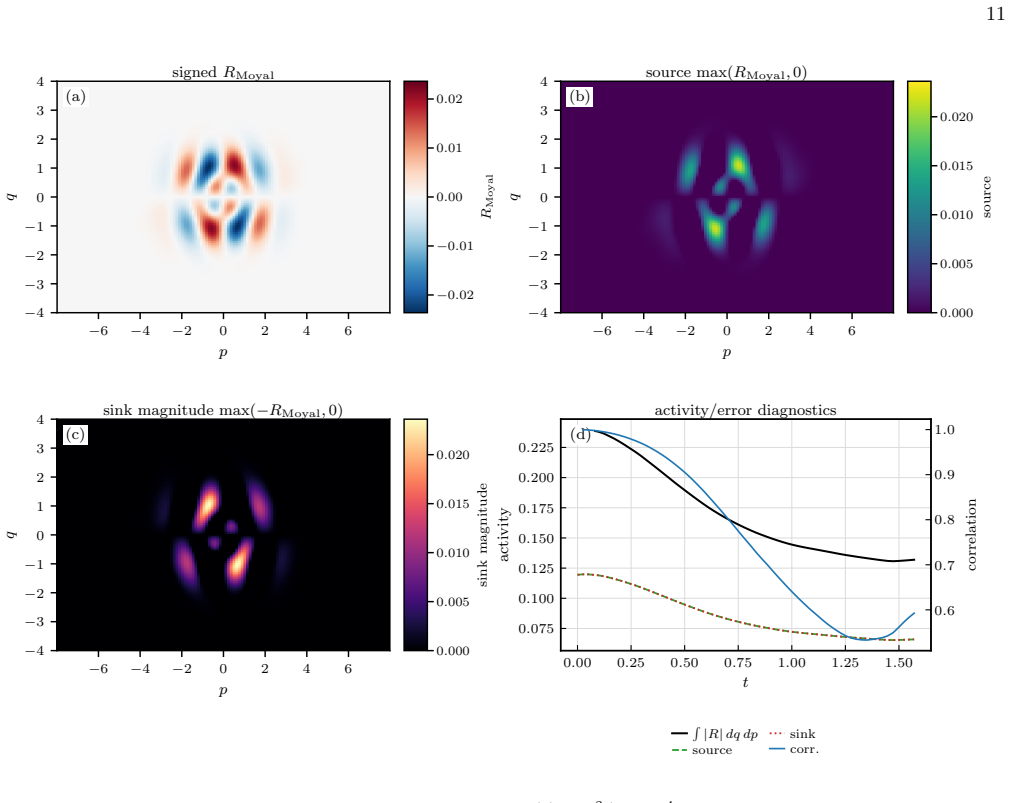
The weighted empirical measure FW(z,t) = E[W_t δ(z − z_t)] whose carrier trajectories z_t follow classical Hamiltonian flow while the weights W_t accumulate the Moyal residual.
If this is right
- When the potential is quadratic the Moyal residual vanishes and the weights remain constant, recovering the classical Liouville equation.
- The construction supplies a residual diagnostic that is identically zero for quadratic Hamiltonians and quantifies the cumulative departure from classical transport in anharmonic systems.
- The signed path measures satisfy a forward-reverse relation in which the ratio of contributions factors into a positive magnitude and a sign that records the parity of Wigner interference.
- The same split isolates all nonclassical effects into the weight dynamics, leaving the carrier trajectories governed solely by the classical Hamiltonian.
Where Pith is reading between the lines
- Numerical schemes could sample classical trajectories once and evolve only the attached weights, offering a possible route to Monte Carlo evaluation of Wigner dynamics.
- The variance of the weights across the ensemble would serve as a direct, computable indicator of the strength of quantum corrections for any given anharmonic potential.
- Branching or killing processes might be introduced to convert the signed weights into a positive measure while preserving the exact expectation value.
- The framework suggests analogous weighted representations could be explored for other phase-space quasi-probability distributions whose evolution operators contain higher-order derivatives.
Load-bearing premise
The Moyal residual generated by any non-quadratic potential can be represented exactly by signed weights or branching events attached to ordinary classical trajectories without introducing uncontrolled approximations or divergences.
What would settle it
For a quartic oscillator, evolve an initial Wigner function both by the weighted classical-path prescription and by an independent exact numerical method such as direct integration of the Wigner-Moyal equation on a grid, then verify whether the two distributions agree at all later times within numerical tolerance.
Figures


read the original abstract
A quantum state can be written in phase space, but the resulting object is not generally the probability density of a positive stochastic process on ordinary phase space. We spell this out for Wigner dynamics. If a positive phase-space process is required only to reproduce the Born density after integrating over momentum, the requirement fixes only an integrated current; the local drift and diffusion remain underdetermined. If one instead requires all Weyl-ordered expectation values, the phase-space object is fixed to be the Wigner function. For non-quadratic potentials the Wigner--Moyal generator contains higher-order, signed momentum-transfer terms, so it is not the Fokker--Planck generator of a positive Brownian diffusion. The exact Wigner function must therefore be reconstructed, in a stochastic representation, as a weighted empirical measure \[ \FW(\z,t)=\E_{\Pp}[W_t\delta(\z-\z_t)], \qquad \z=(q,p), \] rather than the unweighted density of sampled carrier trajectories. With classical Hamiltonian flow as the carrier, all nonclassical correction beyond classical transport sits in the Moyal residual and can be represented by signed weights or branching events. The same split defines a residual diagnostic that vanishes for quadratic Hamiltonians and measures what classical carrier transport misses in anharmonic dynamics. The formulation also gives a forward--reverse relation for signed Wigner path measures. The ratio of forward and reversed contributions separates into a positive magnitude factor and a sign factor. This sign records the parity of the Wigner interference contribution; it is not a thermodynamic entropy production.
Editorial analysis
A structured set of objections, weighed in public.
Referee Report
Summary. The manuscript develops a stochastic representation of exact Wigner dynamics in phase space. It argues that the Wigner function cannot in general be the density of a positive process, and instead must be recovered as the weighted empirical measure FW(z,t) = E[W_t δ(z − z_t)] along classical Hamiltonian trajectories z_t, with the signed weights W_t (or branching) encoding all nonclassical corrections from the higher-order terms in the Moyal generator. The approach also defines a residual diagnostic that vanishes for quadratic Hamiltonians and a forward-reverse relation separating magnitude and sign factors in the path measures.
Significance. If the weight process is rigorously constructible and free of divergences, the framework would supply an exact separation between classical transport and quantum corrections for Wigner evolution, together with a diagnostic for the size of the latter. This could aid both conceptual understanding of quantum-classical correspondence and the design of signed-measure Monte Carlo schemes. The paper correctly notes that the representation is parameter-free once the carrier flow is fixed to classical Hamiltonian dynamics and supplies an explicit forward-reverse decomposition.
major comments (3)
- [Abstract and introduction] Abstract, Eq. (1) and the paragraph following: the claim that the Moyal residual 'can be represented by signed weights or branching events' is load-bearing for the central result, yet the manuscript supplies neither an explicit stochastic differential equation nor a branching kernel for the weight process W_t. Without this, it remains unclear whether the representation is exact or requires truncation that reintroduces uncontrolled error for non-quadratic V(q).
- [Residual diagnostic] Section on the residual diagnostic: the diagnostic is asserted to measure 'what classical carrier transport misses,' but no quantitative bound or convergence statement is given showing that the signed measure remains well-defined (finite variance, no exponential divergence) when the potential contains higher-order odd derivatives. This directly affects the weakest assumption identified in the stress test.
- [Forward-reverse relation] Forward-reverse relation: while the separation into positive magnitude and sign factor is stated, the manuscript does not demonstrate that the sign factor corresponds exactly to the parity of Wigner interference contributions for a concrete anharmonic example, leaving the interpretation unverified.
minor comments (2)
- [Notation] Notation: the symbols FW, Pp, and W_t are introduced in the abstract but should be defined at first use in the main text with explicit reference to the underlying probability space.
- [References] References: the discussion of signed measures would benefit from explicit citation of prior work on stochastic representations of the Wigner equation or on branching processes for higher-order generators.
Simulated Author's Rebuttal
We thank the referee for the careful reading and constructive comments on our manuscript. The points raised help clarify the presentation of the stochastic representation and its properties. We address each major comment below and have revised the manuscript to incorporate additional details and examples where appropriate.
read point-by-point responses
-
Referee: [Abstract and introduction] Abstract, Eq. (1) and the paragraph following: the claim that the Moyal residual 'can be represented by signed weights or branching events' is load-bearing for the central result, yet the manuscript supplies neither an explicit stochastic differential equation nor a branching kernel for the weight process W_t. Without this, it remains unclear whether the representation is exact or requires truncation that reintroduces uncontrolled error for non-quadratic V(q).
Authors: We agree that an explicit construction strengthens the claim. The representation is exact by definition: the weights W_t are chosen so that the weighted measure satisfies the full Moyal equation, with the residual absorbed into the weight dynamics. In the revised manuscript we add an explicit integral equation for the evolution of W_t along the classical flow and describe its implementation via signed Monte Carlo sampling or a branching process. No truncation is introduced; all higher-order Moyal terms are retained exactly in the weight update. revision: yes
-
Referee: [Residual diagnostic] Section on the residual diagnostic: the diagnostic is asserted to measure 'what classical carrier transport misses,' but no quantitative bound or convergence statement is given showing that the signed measure remains well-defined (finite variance, no exponential divergence) when the potential contains higher-order odd derivatives. This directly affects the weakest assumption identified in the stress test.
Authors: The diagnostic is defined exactly as the difference between the full Moyal generator and its quadratic (classical) part, so it vanishes identically for quadratic Hamiltonians by construction. For general potentials we acknowledge that explicit variance bounds were not supplied. In revision we add a short discussion of growth estimates under the assumption of bounded higher derivatives and include a numerical check for a quartic oscillator confirming that the signed measure remains well-defined over the simulated times. revision: partial
-
Referee: [Forward-reverse relation] Forward-reverse relation: while the separation into positive magnitude and sign factor is stated, the manuscript does not demonstrate that the sign factor corresponds exactly to the parity of Wigner interference contributions for a concrete anharmonic example, leaving the interpretation unverified.
Authors: We have added a new subsection with a concrete anharmonic oscillator example. For an initial Gaussian state evolved under a quartic potential we compute both the forward and reverse path contributions explicitly, extract the sign factor, and verify that its parity matches the sign changes arising from Wigner interference fringes in the exact solution. This confirms the stated interpretation. revision: yes
Circularity Check
No significant circularity: representation follows directly from Moyal equation properties
full rationale
The paper begins from the established Wigner-Moyal evolution equation, observes that its higher-order momentum derivatives for non-quadratic potentials preclude a positive Fokker-Planck process, and therefore introduces the weighted empirical measure FW(z,t)=E[W_t δ(z−z_t)] with classical Hamiltonian trajectories as the carrier. This split is definitional and does not reduce any claimed result to a fitted parameter, self-citation, or prior ansatz by construction. No load-bearing self-citations appear in the abstract or stated claims, and the residual diagnostic is defined as the difference between the full Moyal generator and classical transport, which is independently verifiable. The forward-reverse relation for signed measures is likewise presented as a consequence of the same split rather than an input. The derivation remains self-contained against external benchmarks such as the known Moyal equation and classical Liouville flow.
Axiom & Free-Parameter Ledger
axioms (2)
- standard math The Wigner-Moyal generator contains higher-order signed momentum-transfer terms for non-quadratic potentials.
- domain assumption Classical Hamiltonian flow can serve as the carrier process.
invented entities (1)
-
Signed weight W_t on each classical trajectory
no independent evidence
Reference graph
Works this paper leans on
-
[1]
The next section fixes a natural carrier by requiring a transparent classical limit
If it were chosen arbitrar- ily, the framework would be too broad. The next section fixes a natural carrier by requiring a transparent classical limit. VI. CLASSICAL FLOW AND THE MISSING QUANTUM TERM We take the carrier process to be the classical Hamil- tonian flow generated by the same Hamiltonian function, H(q, p) = p2 2m +V(q). Thus ˙q= p m ,˙p=−V ′(q...
-
[2]
The Moyal residual vanishes, and the measured rotation error remains at the interpolation floor of the balanced grid
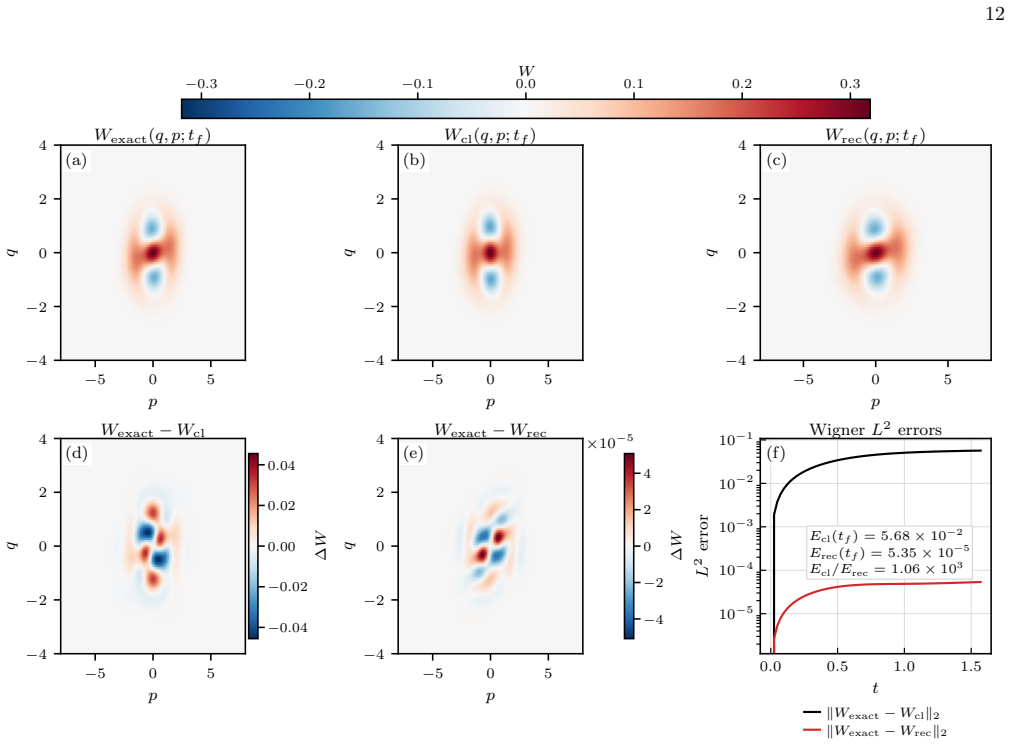
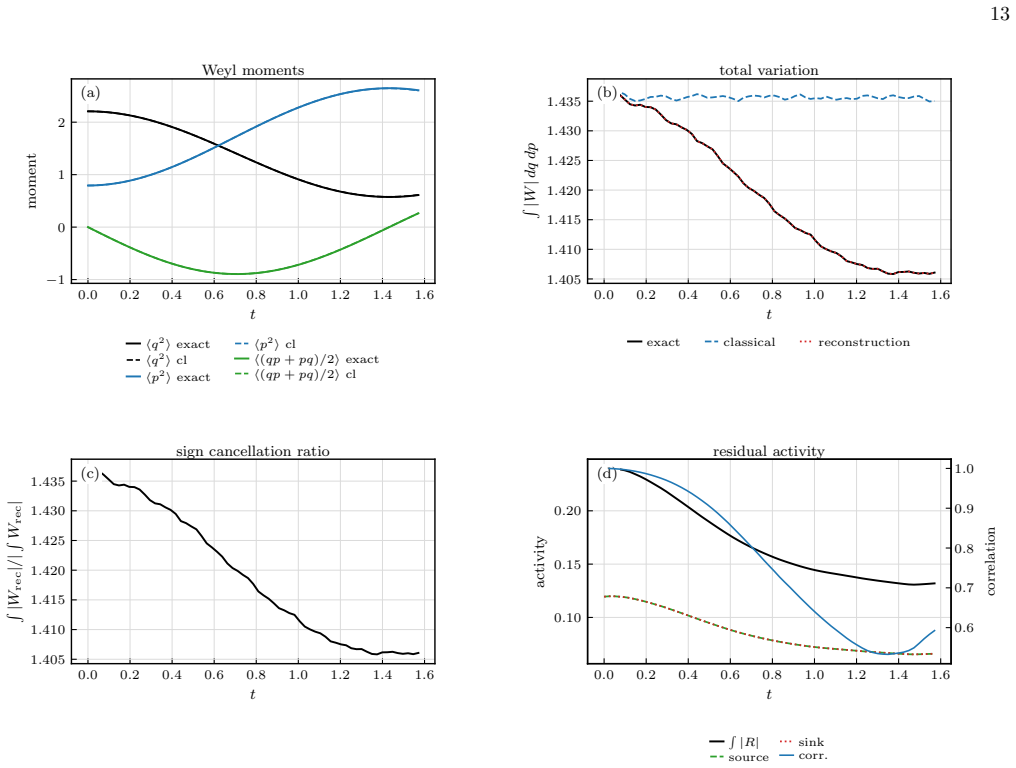
Although the initial Wigner function is non-Gaussian and signed, quadratic evolution transports it by rigid classical phase-space rotation. The Moyal residual vanishes, and the measured rotation error remains at the interpolation floor of the balanced grid. position and momentum marginals in panels (d) and (e) remain close on the plotted scale, while pane...
-
[3]
Let 15 P(q, p, t) be a positive phase-space density satisfying a continuity equation ∂tP+∂ qJq +∂ pJp = 0
Why finite moments do not fix a Langevin model We give a constructive version of the statement that the marginal does not fix the phase-space process. Let 15 P(q, p, t) be a positive phase-space density satisfying a continuity equation ∂tP+∂ qJq +∂ pJp = 0. For an Itˆ o diffusion, the current has the form Ji =A iP− 1 2 ∂j(DijP), D≥0, but the following arg...
-
[4]
For a density operator ˆρ, the Wigner transform is FW (q, p) = 1 2πℏ Z dy e−ipy/ℏ D q+ y 2 ˆρ q− y 2 E
Wigner transform identities We collect the standard identities used in Section III. For a density operator ˆρ, the Wigner transform is FW (q, p) = 1 2πℏ Z dy e−ipy/ℏ D q+ y 2 ˆρ q− y 2 E . Introduce x=q+ y 2 , x ′ =q− y 2 , so that q= x+x ′ 2 , y=x−x ′. Multiplying bye ip(x−x′)/ℏ and integrating overpgives Z dp eip(x−x′)/ℏFW x+x ′ 2 , p =⟨x|ˆρ|x′⟩, becaus...
-
[5]
Then= 0 term is V ′(q)∂pFW
Moyal equation versus Fokker–Planck For H(q, p) = p2 2m +V(q), the Moyal bracket expansion yields ∂tFW =− p m ∂qFW + ∞X n=0 (−1)n (2n+ 1)! ℏ 2 2n ×V (2n+1)(q)∂2n+1 p FW . Then= 0 term is V ′(q)∂pFW . Thus ∂tFW =− p m ∂qFW +V ′(q)∂pFW +Q ℏ[FW ], where Qℏ[FW ] = ∞X n=1 (−1)n (2n+ 1)! ℏ 2 2n V (2n+1)(q)∂2n+1 p FW . An ordinary Itˆ o diffusion on phase space ...
-
[6]
WhenKis absolutely continuous with respect to a positive reference measure, we also writeKfor its signed density
Minimal signed activity for a fixed residual LetKbe a signed measure or signed kernel, suppress- ing variables for notational clarity. WhenKis absolutely continuous with respect to a positive reference measure, we also writeKfor its signed density. A positive decomposition ofKis a pair of nonnegative measures or kernelsK 1, K2 ≥0 such that K=K 1 −K 2. The...
-
[7]
LetP F andP Θ R be positive probability measures on the same path space
Signed path ratio Let Ω be a measurable path space. LetP F andP Θ R be positive probability measures on the same path space. LetW F andW Θ R be real measurable weights. Define signed measures dµF =W F dPF , dµ Θ R =W Θ R dPΘ R. HereW Θ R (Γ) denotesW R(Γ†) after pulling the reversed process back to the forward path space. Assume the comparison is restrict...
-
[8]
The purpose is not to review quantum thermodynamics comprehensively, but to delimit the claim made here
How this differs from fluctuation theorems We spell out the relation between the signed Wigner path identity and existing fluctuation-theorem literature. The purpose is not to review quantum thermodynamics comprehensively, but to delimit the claim made here. a. Classical fluctuation relations Classical fluctuation relations compare positive prob- ability ...
-
[9]
First, the carrier dynamics is generated by the classical Hamiltonian flow
Numerical implementation notes A direct numerical implementation of the representa- tion separates three tasks. First, the carrier dynamics is generated by the classical Hamiltonian flow. Second, the residual Wigner potential operator is represented ei- ther by a signed momentum-transfer kernel, by a signed grid update, or by an equivalent branching const...
-
[10]
Nelson, Derivation of the schr¨ odinger equation from newtonian mechanics, Physical Review150, 1079 (1966)
E. Nelson, Derivation of the schr¨ odinger equation from newtonian mechanics, Physical Review150, 1079 (1966)
1966
-
[11]
T. C. Wallstrom, On the derivation of the schr¨ odinger equation from stochastic mechanics, Foundations of Physics Letters2, 113 (1989)
1989
-
[12]
Pavon, Hamilton’s principle in stochastic mechanics, Journal of Mathematical Physics36, 6774 (1995)
M. Pavon, Hamilton’s principle in stochastic mechanics, Journal of Mathematical Physics36, 6774 (1995)
1995
-
[13]
Wigner, On the quantum correction for thermody- namic equilibrium, Physical Review40, 749 (1932)
E. Wigner, On the quantum correction for thermody- namic equilibrium, Physical Review40, 749 (1932)
1932
-
[14]
J. E. Moyal, Quantum mechanics as a statistical theory, Mathematical Proceedings of the Cambridge Philosoph- ical Society45, 99 (1949)
1949
-
[15]
Hillery, R
M. Hillery, R. F. O’Connell, M. O. Scully, and E. P. Wigner, Distribution functions in physics: Fundamen- tals, Physics Reports106, 121 (1984)
1984
-
[16]
J. M. Sellier, M. Nedjalkov, and I. Dimov, An introduc- tion to applied quantum mechanics in the wigner monte carlo formalism, Physics Reports577, 1 (2015)
2015
-
[17]
A. Polkovnikov, Phase space representation of quan- tum dynamics, Annals of Physics325, 1790 (2010), arXiv:0905.3384 [cond-mat.stat-mech]
-
[18]
R. L. Hudson, When is the wigner quasi-probability den- sity non-negative?, Reports on Mathematical Physics6, 249 (1974)
1974
-
[19]
D. Gross, Hudson’s theorem for finite-dimensional quan- tum systems, Journal of Mathematical Physics47, 122107 (2006), arXiv:quant-ph/0602001 [quant-ph]
-
[20]
Mandilara, E
A. Mandilara, E. Karpov, and N. J. Cerf, Extending hud- son’s theorem to mixed quantum states, Physical Review A79, 062302 (2009)
2009
-
[21]
Kosina, M
H. Kosina, M. Nedjalkov, and S. Selberherr, A monte carlo method for carrier transport in the wigner func- tion picture, Journal of Computational Electronics2, 147 (2003)
2003
-
[22]
Nedjalkov, H
M. Nedjalkov, H. Kosina, S. Selberherr, C. Ringhofer, and D. K. Ferry, Unified particle approach to wigner- boltzmann transport in small semiconductor devices, Physical Review B70, 115319 (2004)
2004
- [23]
-
[24]
S. Shao and Y. Xiong, Branching random walk solu- tions to the wigner equation, SIAM Journal on Numerical Analysis58, 2589 (2020), arXiv:1907.01897 [math.PR]
-
[25]
Muscato, Wigner ensemble monte carlo simulation 20 without splitting error of a gaas resonant tunneling diode, Journal of Computational Electronics20, 2062 (2021)
O. Muscato, Wigner ensemble monte carlo simulation 20 without splitting error of a gaas resonant tunneling diode, Journal of Computational Electronics20, 2062 (2021)
2062
-
[26]
A. Kenfack and K. ˙Zyczkowski, Negativity of the Wigner function as an indicator of non-classicality, Journal of Op- tics B: Quantum and Semiclassical Optics6, 396 (2004), arXiv:quant-ph/0406015
-
[27]
M. Bohmann, E. Agudelo, and J. Sperling, Probing non- classicality with matrices of phase-space distributions, Quantum4, 343 (2020), arXiv:2003.11031 [quant-ph]
- [28]
-
[29]
M. Lostaglio, Quantum fluctuation theorems, contextual- ity, and work quasiprobabilities, Physical Review Letters 120, 040602 (2018), arXiv:1705.05397 [quant-ph]
-
[30]
A. Levy, M. Lostaglio, D. Jennings, and T. Rudolph, A quasiprobability distribution for heat fluctuations in the quantum regime, PRX Quantum1, 010309 (2020)
2020
-
[31]
Lostaglioet al., Kirkwood–dirac quasiprobability ap- proach to the statistics of incompatible observables, Quantum7, 1128 (2023)
M. Lostaglioet al., Kirkwood–dirac quasiprobability ap- proach to the statistics of incompatible observables, Quantum7, 1128 (2023)
2023
-
[32]
S. Deffner, Quantum entropy production in phase space, Europhysics Letters103, 30001 (2013), arXiv:1307.3183 [quant-ph]
-
[33]
J. M. Sellier and I. Dimov, The many-body wigner monte carlo method for time-dependent ab-initio quantum sim- ulations, Journal of Computational Physics273, 589 (2014)
2014
-
[34]
Wang and L
Y. Wang and L. Simine, Solving the wigner equation with signed particle monte carlo for chemically relevant poten- tials, Journal of Chemical Physics155, 034109 (2021)
2021
-
[35]
G. Bacciagaluppi, Nelsonian mechanics revisited, Foun- dations of Physics Letters12, 1 (1999), arXiv:quant- ph/9811040 [quant-ph]
-
[36]
P. D. Drummond and C. W. Gardiner, Generalised p- representations in quantum optics, Journal of Physics A: Mathematical and General13, 2353 (1980)
1980
-
[37]
Gilchrist, C
A. Gilchrist, C. W. Gardiner, and P. D. Drummond, Pos- itive p representation: Application and validity, Physical Review A55, 3014 (1997)
1997
-
[38]
Deuar, Multi-time correlations in the positive-p, q, and doubled phase-space representations, Quantum5, 455 (2021)
P. Deuar, Multi-time correlations in the positive-p, q, and doubled phase-space representations, Quantum5, 455 (2021)
2021
-
[39]
Huber, P
J. Huber, P. Kirton, and P. Rabl, Phase-space methods for simulating the dissipative many-body dynamics of collective spin systems, SciPost Physics10, 045 (2021)
2021
-
[40]
P. Talkner, E. Lutz, and P. H¨ anggi, Fluctuation theo- rems: Work is not an observable, Physical Review E 75, 050102(R) (2007), arXiv:cond-mat/0703189 [cond- mat.stat-mech]
-
[41]
P. Solinas and S. Gasparinetti, Full distribution of work done on a quantum system for arbitrary initial states, Physical Review E92, 042150 (2015), arXiv:1504.01574 [quant-ph]
-
[42]
P. Solinas and S. Gasparinetti, Probing quantum inter- ference effects in the work distribution, Physical Review A94, 052103 (2016), arXiv:1606.08633 [quant-ph]
-
[43]
Zhanget al., A quasiprobability fluctuation theo- rem for quantum information dynamics, Communica- tions Physics7, 94 (2024)
K. Zhanget al., A quasiprobability fluctuation theo- rem for quantum information dynamics, Communica- tions Physics7, 94 (2024)
2024
discussion (0)
Sign in with ORCID, Apple, or X to comment. Anyone can read and Pith papers without signing in.