Recognition: unknown
Isomer depletion via nuclear excitation by inelastic electron scattering
Pith reviewed 2026-05-08 04:26 UTC · model grok-4.3
The pith
Inelastic electron scattering can excite nuclear isomers to levels that allow their depletion and release of stored energy.
A machine-rendered reading of the paper's core claim, the machinery that carries it, and where it could break.
Core claim
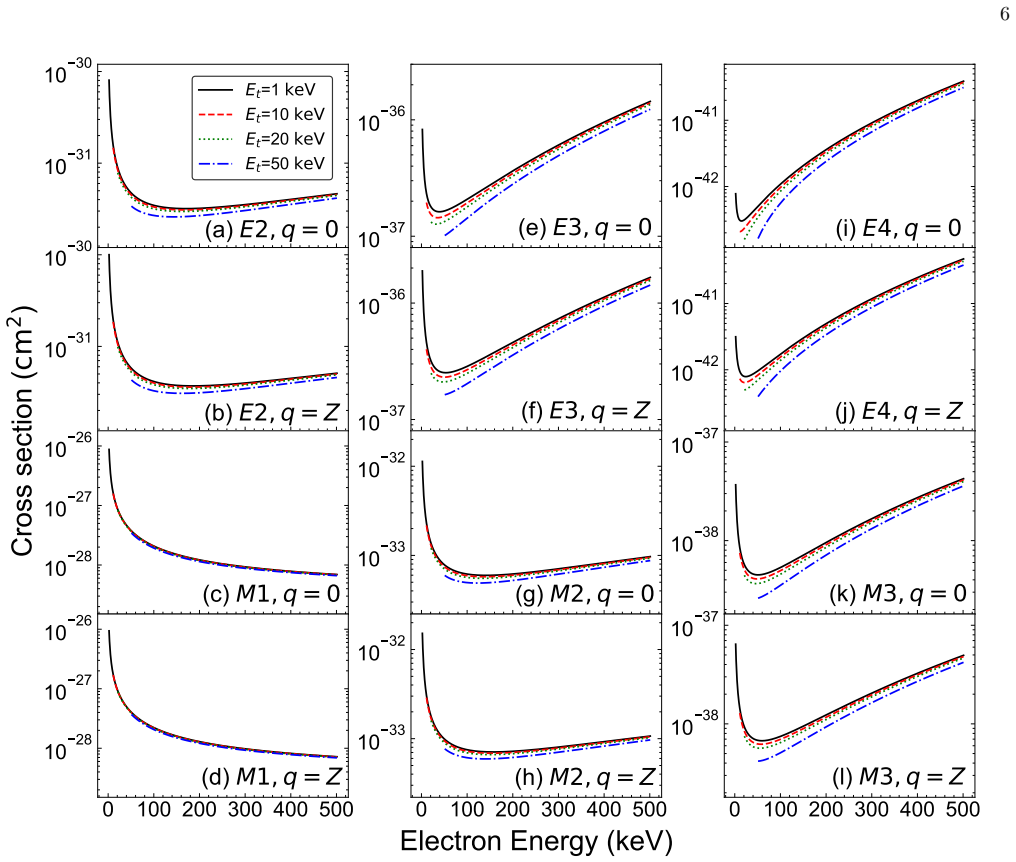
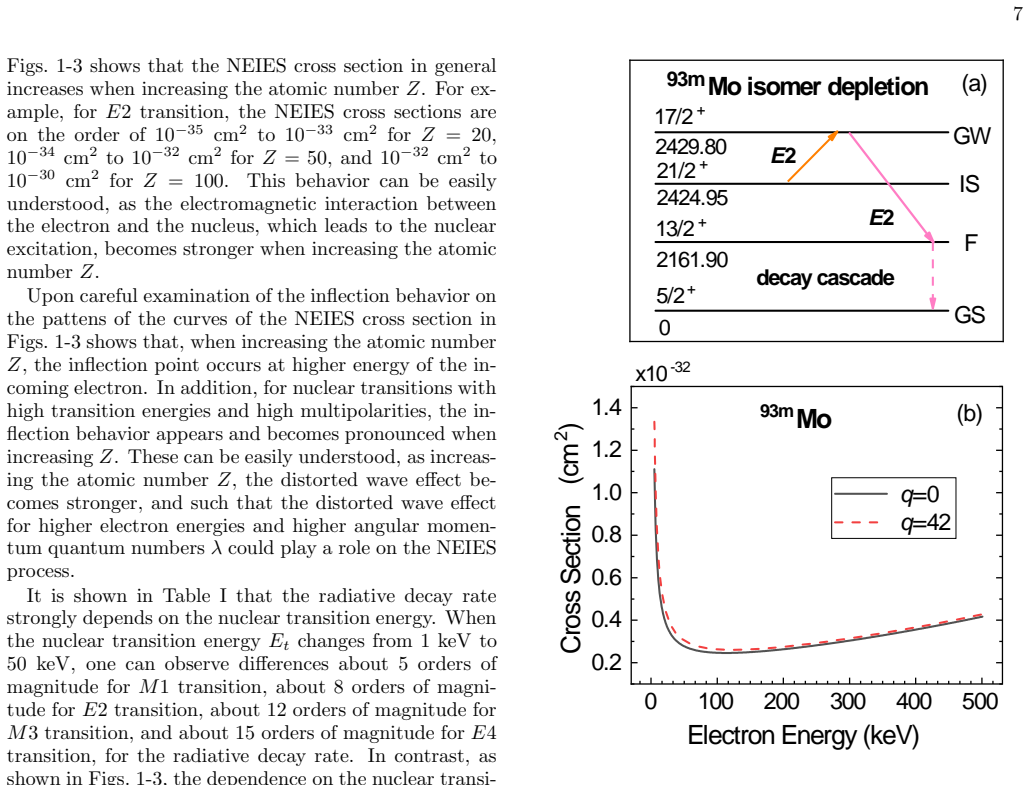
The paper establishes that the process of nuclear excitation by inelastic electron scattering is capable of depleting the isomers 93mMo, 152mEu, and 178mHf. An excitation from the isomeric state to a nuclear level above it can lead to decay to a level below the isomer, releasing the stored energy. The authors perform a comprehensive study of low-energy excitations to quantify the effects of nuclear and ion charge, transition energy, and multipolarity on the relevant cross sections.
What carries the argument
The inelastic electron scattering cross section for low-energy nuclear transitions from isomeric states, whose magnitude depends on nuclear charge, transition energy, and multipolarity.
If this is right
- Higher nuclear charge increases the cross section for isomer excitation via inelastic electron scattering.
- Favorable transition energies and multipolarities make depletion feasible for the three studied isomers.
- Excitation from the isomeric state to a higher level followed by decay to a lower level releases the isomer's stored energy.
- The analysis identifies conditions under which electron scattering efficiently depletes these isomers.
Where Pith is reading between the lines
- Electron beams could serve as a controllable alternative to photon-based methods for triggering isomer decay.
- If cross sections prove measurable, targeted experiments on thin targets of these isomers could test depletion rates directly.
- The dependence on nuclear charge suggests the process may scale differently for heavier versus lighter isomers in future studies.
Load-bearing premise
The theoretical calculations of inelastic electron scattering cross sections at low energies correctly capture the nuclear transition strengths and multipolarities for the isomers studied.
What would settle it
An experiment that measures the depletion cross section for 178mHf using low-energy electrons and finds it far below the predicted value would show the process cannot achieve depletion as claimed.
Figures



read the original abstract
Isomer depletion via the process of nuclear excitation by inelastic electron scattering is investigated theoretically. A comprehensive study on low-energy nuclear excitations by inelastic electron scattering is performed to analyze the impact of the nuclear and ion charge, the nuclear transition energy, and the nuclear transition multipolarity on the cross section of the process. We apply the analysis to the case of isomer depletion, in which an excitation from the isomeric state to a nuclear level above the isomeric state can lead to decay to a nuclear level below the isomer itself and hence lead to the release of the energy stored in the isomer. For this purpose, the isomer depletion of $\mathrm{{}^{93m}{Mo}}$, $\mathrm{{}^{152m}{Eu}}$, and $\mathrm{{}^{178m}{Hf}}$, which represent the most important scenarios of isomer depletion, are studied. Our results demonstrate the capability of the process of nuclear excitation by inelastic electron scattering for isomer depletion.
Editorial analysis
A structured set of objections, weighed in public.
Referee Report
Summary. The manuscript theoretically investigates isomer depletion through nuclear excitation by inelastic electron scattering (NEIES). It performs a parameter study of the inelastic electron scattering cross section at low energies, examining the effects of nuclear/ion charge, transition energy, and multipolarity. The framework is applied to the specific cases of ^{93m}Mo, ^{152m}Eu, and ^{178m}Hf, with the conclusion that NEIES demonstrates capability for depleting these isomers by exciting them above the isomeric state to allow decay to lower levels.
Significance. If the computed cross sections hold, the work could be significant for developing electron-beam methods to control nuclear isomers, with relevance to energy storage, gamma sources, and nuclear structure. The systematic analysis of cross-section dependencies provides general utility beyond the specific isomers. The application of standard scattering theory to known nuclear properties is a strength, as is the focus on three representative high-interest cases.
major comments (1)
- [Results for specific isomers] The central claim that NEIES demonstrates capability for depleting the three isomers rests on the computed cross sections being large enough to compete with other channels. The results section applying the framework to ^{93m}Mo, ^{152m}Eu, and ^{178m}Hf should include explicit quantitative comparisons of the predicted NEIES rates to competing depletion mechanisms (e.g., direct gamma decay or other excitations), along with sensitivity to the input nuclear transition strengths and multipolarities.
minor comments (2)
- [Abstract] The abstract states that 'our results demonstrate the capability' but would be strengthened by a brief quantitative statement on the scale of the cross sections or the key finding that supports this demonstration.
- [Theoretical framework] Notation for multipole orders (e.g., E1, M2) and transition energies should be defined consistently at first use and used uniformly in equations and text.
Simulated Author's Rebuttal
We thank the referee for the positive evaluation of the significance of our work and for the constructive major comment. We address it below and will revise the manuscript to incorporate the requested additions.
read point-by-point responses
-
Referee: The central claim that NEIES demonstrates capability for depleting the three isomers rests on the computed cross sections being large enough to compete with other channels. The results section applying the framework to ^{93m}Mo, ^{152m}Eu, and ^{178m}Hf should include explicit quantitative comparisons of the predicted NEIES rates to competing depletion mechanisms (e.g., direct gamma decay or other excitations), along with sensitivity to the input nuclear transition strengths and multipolarities.
Authors: We agree that explicit quantitative comparisons to competing depletion channels and a sensitivity analysis would strengthen the results section and better support the central claim. In the revised manuscript we will add, for each of the three isomers, direct comparisons of the calculated NEIES rates (at representative electron energies and beam intensities) to the rates of direct gamma decay from the isomeric state and to other relevant excitation or de-excitation processes. We will also include a dedicated discussion of the sensitivity of the NEIES cross sections to variations in the input nuclear transition strengths (B(E/M) values) and multipolarities, using the range of values consistent with available experimental data and nuclear structure models. These additions will be placed in the results section immediately following the presentation of the isomer-specific cross sections. revision: yes
Circularity Check
No circularity: standard theory applied to independent nuclear inputs
full rationale
The paper computes inelastic electron scattering cross sections for isomer depletion using established low-energy scattering formalism and known nuclear transition strengths, multipolarities, and energies for 93mMo, 152mEu, and 178mHf. No equations reduce the predicted depletion capability to a fit of the same data, no self-definitional loops exist, and no load-bearing premise rests on self-citation chains. The derivation chain is self-contained against external nuclear data and standard Coulomb-distorted wave treatments.
Axiom & Free-Parameter Ledger
axioms (1)
- domain assumption Standard nuclear structure models and electron scattering theory (e.g., for multipole transitions) are applicable to low-energy excitations in the studied isomers.
Reference graph
Works this paper leans on
-
[1]
Walker and G
P. Walker and G. Dracoulis, Nature399, 35 (1999)
1999
-
[2]
Walker and Z
P. Walker and Z. Podoly´ ak, Physica Scripta95, 044004 (2020)
2020
-
[3]
E. V. Tkalya, Phys. Rev. Lett.106, 162501 (2011)
2011
-
[4]
G. D. Dracoulis, P. M. Walker, and F. G. Kondev, Re- ports on Progress in Physics79, 076301 (2016)
2016
-
[5]
Beeks, T
K. Beeks, T. Sikorsky, T. Schumm, J. Thielking, M. V. Okhapkin, and E. Peik, Nature Reviews Physics4, 238 (2021)
2021
-
[6]
E. Peik, T. Schumm, M. S. Safronova, A. P´ alffy, J. Weit- enberg, and P. G. Thirolf, Quantum Sci. Technol.6, 034002 (2021)
2021
-
[7]
Tiedau, M
J. Tiedau, M. V. Okhapkin, K. Zhang, J. Thielk- ing, G. Zitzer, E. Peik, F. Schaden, T. Pronebner, I. Morawetz, L. T. De Col, F. Schneider, A. Leitner, M. Pressler, G. A. Kazakov, K. Beeks, T. Sikorsky, and T. Schumm, Phys. Rev. Lett.132, 182501 (2024)
2024
-
[8]
Elwell, C
R. Elwell, C. Schneider, J. Jeet, J. E. S. Terhune, H. W. T. Morgan, A. N. Alexandrova, H. B. Tran Tan, A. Derevianko, and E. R. Hudson, Phys. Rev. Lett.133, 013201 (2024)
2024
-
[9]
Zhang, T
C. Zhang, T. Ooi, J. S. Higgins, J. F. Doyle, L. von der Wense, K. Beeks, A. Leitner, G. A. Kazakov, P. Li, P. G. Thirolf, T. Schumm, and J. Ye, Nature633, 63 (2024)
2024
-
[10]
P´ alffy, J
A. P´ alffy, J. Evers, and C. H. Keitel, Phys. Rev. Lett. 99, 172502 (2007)
2007
-
[11]
Chiara, J
C. Chiara, J. Carroll, M. Carpenter, J. Greene, D. Hart- ley, R. Janssens, G. Lane, J. Marsh, D. Matters, M. Po- lasik, J. Rzadkiewicz, D. Seweryniak, S. Zhu, S. Bottoni, A. Hayes, and S. Karamian, Nature554, 216 (2018)
2018
-
[12]
M. B. Smith, P. M. Walker, G. C. Ball, J. J. Carroll, P. E. Garrett, G. Hackman, R. Propri, F. Sarazin, and H. C. Scraggs, Phys. Rev. C68, 031302 (2003)
2003
-
[13]
C. B. Collins, F. Davanloo, M. C. Iosif, R. Dussart, J. M. Hicks, S. A. Karamian, C. A. Ur, I. I. Popescu, V. I. Kirischuk, J. J. Carroll, H. E. Roberts, P. McDaniel, and C. E. Crist, Phys. Rev. Lett.82, 695 (1999)
1999
-
[14]
C. B. Collins, F. Davanloo, A. C. Rusu, M. C. Iosif, N. C. Zoita, D. T. Camase, J. M. Hicks, S. A. Karamian, C. A. Ur, I. I. Popescu, R. Dussart, J. M. Pouvesle, V. I. Kirischuk, N. V. Strilchuk, P. McDaniel, and C. E. Crist, Phys. Rev. C61, 054305 (2000)
2000
-
[15]
Ahmad, J
I. Ahmad, J. C. Banar, J. A. Becker, D. S. Gemmell, A. Kraemer, A. Mashayekhi, D. P. McNabb, G. G. Miller, E. F. Moore, L. N. Pangault, R. S. Rundberg, J. P. Schif- fer, S. D. Shastri, T. F. Wang, and J. B. Wilhelmy, Phys. Rev. Lett.87, 072503 (2001)
2001
-
[16]
Ahmad, J
I. Ahmad, J. C. Banar, J. A. Becker, T. A. Bre- deweg, J. R. Cooper, D. S. Gemmell, A. Kraemer, A. Mashayekhi, D. P. McNabb, G. G. Miller, E. F. Moore, 10 P. Palmer, L. N. Pangault, R. S. Rundberg, J. P. Schiffer, S. D. Shastri, T. F. Wang, and J. B. Wilhelmy, Phys. Rev. C71, 024311 (2005)
2005
-
[17]
Carroll, S
J. Carroll, S. Karamian, R. Propri, D. Gohlke, N. Cald- well, P. Ugorowski, T. Drummond, J. Lazich, H. Roberts, M. Helba, Z. Zhong, M.-T. Tang, J.-J. Lee, and K. Liang, Physics Letters B679, 203 (2009)
2009
-
[18]
C.-J. Yang, K. M. Spohr, M. O. Cernaianu, D. Doria, P. Ghenuche, and V. Horn´ y, Matter Radiat. Extremes 10, 057201 (2025)
2025
-
[19]
Matinyan, Physics Reports298, 199 (1998)
S. Matinyan, Physics Reports298, 199 (1998)
1998
-
[20]
Aprahamian and Y
A. Aprahamian and Y. S. Sun, Nature Physics1, 81 (2005)
2005
-
[21]
E. V. Tkalya, Nuclear Physics A539, 209 (1992)
1992
-
[22]
Kishimoto, Y
S. Kishimoto, Y. Yoda, M. Seto, Y. Kobayashi, S. Kitao, R. Haruki, T. Kawauchi, K. Fukutani, and T. Okano, Phys. Rev. Lett.85, 1831 (2000)
2000
-
[23]
Morita, Progress of Theoretical Physics49, 1574 (1973)
M. Morita, Progress of Theoretical Physics49, 1574 (1973)
1973
-
[24]
Kishimoto, Y
S. Kishimoto, Y. Yoda, Y. Kobayashi, S. Kitao, R. Haruki, and M. Seto, Nuclear Physics A748, 3 (2005)
2005
-
[25]
Gosselin, V
G. Gosselin, V. M´ eot, and P. Morel, Phys. Rev. C76, 044611 (2007)
2007
-
[26]
Goldanskii and V
V. Goldanskii and V. Namiot, Physics Letters B62, 393 (1976)
1976
-
[27]
P´ alffy, Contemporary Physics51, 471 (2010)
A. P´ alffy, Contemporary Physics51, 471 (2010)
2010
-
[28]
Gunst, Y
J. Gunst, Y. A. Litvinov, C. H. Keitel, and A. P´ alffy, Phys. Rev. Lett.112, 082501 (2014)
2014
-
[29]
G. D. Doolen, Phys. Rev. Lett.40, 1695 (1978)
1978
-
[30]
M. R. Harston and J. F. Chemin, Phys. Rev. C59, 2462 (1999)
1999
-
[31]
C. J. Cerjan, L. Bernstein, L. B. Hopkins, R. M. Bionta, D. L. Bleuel, J. A. Caggiano, W. S. Cassata, C. R. Brune, D. Fittinghoff, J. Frenje, M. Gatu-Johnson, N. Gharibyan, G. Grim, C. Hagmann, A. Hamza, R. Hatarik, E. P. Hartouni, E. A. Henry, H. Herrmann, N. Izumi, D. H. Kalantar, H. Y. Khater, Y. Kim, A. Kritcher, Y. A. Litvinov, F. Merrill, K. Moody, ...
2018
-
[32]
Y. Wu, S. Gargiulo, F. Carbone, C. H. Keitel, and A. P´ alffy, Phys. Rev. Lett.128, 162501 (2022)
2022
-
[33]
Gargiulo, I
S. Gargiulo, I. Madan, and F. Carbone, Phys. Rev. Lett. 128, 212502 (2022)
2022
-
[34]
Z. Ma, C. Fu, W. He, and Y. Ma, Science Bulletin67, 1526 (2022)
2022
-
[35]
J. Qi, H. Zhang, and X. Wang, Phys. Rev. Lett.130, 112501 (2023)
2023
-
[36]
K. M. Spohr, D. Doria, V. Baran, M. O. Cernaianu, P. V. Ghenuche, V. Nastasa, D. O’Donnell, P.-A. S¨ oderstr¨ om, L. Tudor, C. A. Ur, and C.-J. Yang, Eur. Phys. J. A59, 281 (2023)
2023
-
[37]
Gargiulo, M
S. Gargiulo, M. F. Gu, F. Carbone, and I. Madan, Phys. Rev. Lett.129, 142501 (2022)
2022
-
[38]
N. S. Oreshkina and J. C. Berengut, Phys. Rev. Lett. 132, 129201 (2024)
2024
-
[39]
Gargiulo, M
S. Gargiulo, M. F. Gu, F. Carbone, and I. Madan, Phys. Rev. Lett.132, 129202 (2024)
2024
-
[40]
S. G. Porsev, V. V. Flambaum, E. Peik, and C. Tamm, Phys. Rev. Lett.105, 182501 (2010)
2010
-
[41]
J. C. Berengut, Phys. Rev. Lett.121, 253002 (2018)
2018
-
[42]
B. S. Nickerson, M. Pimon, P. V. Bilous, J. Gugler, K. Beeks, T. Sikorsky, P. Mohn, T. Schumm, and A. P´ alffy, Phys. Rev. Lett.125, 032501 (2020)
2020
-
[43]
P. V. Bilous, H. Bekker, J. C. Berengut, B. Seiferle, L. von der Wense, P. G. Thirolf, T. Pfeifer, J. R. C. L´ opez-Urrutia, and A. P´ alffy, Phys. Rev. Lett.124, 192502 (2020)
2020
-
[44]
A. Y. Dzyublik, Phys. Rev. C102, 024604 (2020)
2020
-
[45]
Cai, G.-Q
N.-Q. Cai, G.-Q. Zhang, C.-B. Fu, and Y.-G. Ma, Nu- clear Science and Techniques32, 59 (2021)
2021
-
[46]
W. Wang, F. Zou, S. Fritzsche, and Y. Li, Phys. Rev. Lett.133, 223001 (2024)
2024
-
[47]
Y. Wu, C. H. Keitel, and A. P´ alffy, Phys. Rev. Lett. 122, 212501 (2019)
2019
-
[48]
Rzadkiewicz, M
J. Rzadkiewicz, M. Polasik, K. S labkowska, L. Syrocki, J. J. Carroll, and C. J. Chiara, Phys. Rev. Lett.127, 042501 (2021)
2021
-
[49]
Rzadkiewicz, K
J. Rzadkiewicz, K. Slabkowska, M. Polasik, L. Syrocki, J. J. Carroll, and C. J. Chiara, Phys. Rev. C108, L031302 (2023)
2023
-
[50]
S. Guo, Y. Fang, X. Zhou, and C. M. Petrache, Nature 594, E1 (2021)
2021
-
[51]
Chiara, J
C. Chiara, J. Carroll, M. Carpenter, J. Greene, D. Hart- ley, R. Janssens, G. Lane, J. Marsh, D. Matters, M. Po- lasik, J. Rzadkiewicz, D. Seweryniak, S. Zhu, S. Bottoni, and A. Hayes, Nature594, E3 (2021)
2021
-
[52]
S. Guo, B. Ding, X. H. Zhou, Y. B. Wu, J. G. Wang, S. W. Xu, Y. D. Fang, C. M. Petrache, E. A. Lawrie, Y. H. Qiang, Y. Y. Yang, H. J. Ong, J. B. Ma, J. L. Chen, F. Fang, Y. H. Yu, B. F. Lv, F. F. Zeng, Q. B. Zeng, H. Huang, Z. H. Jia, C. X. Jia, W. Liang, Y. Li, N. W. Huang, L. J. Liu, Y. Zheng, W. Q. Zhang, A. Rohilla, Z. Bai, S. L. Jin, K. Wang, F. F. D...
2022
-
[53]
B. Ding, C. X. Jia, S. Guo, X. H. Zhou, Y. B. Wu, F. F. Zeng, J. G. Wang, Y. H. Qiang, S. W. Xu, Y. D. Fang, Y. Y. Yang, H. J. Ong, J. B. Ma, K. Wang, F. F. Duan, P. Ma, Z. R. Chen, J. Y. Zhao, Z. W. Li, W. Hua, C. M. Petrache, E. A. Lawrie, R. Wei, H. X. Chen, J. L. Chen, F. Fang, Y. H. Yu, H. Huang, Q. B. Zeng, T. H. Huang, S. Dutt, B. F. Lv, J. H. Li, ...
2026
-
[54]
J. A. Thie, C. J. Mullin, and E. Guth, Phys. Rev.87, 962 (1952)
1952
-
[55]
L. I. Schiff, Phys. Rev.96, 765 (1954)
1954
-
[56]
E. V. Tkalya, Phys. Rev. Lett.124, 242501 (2020)
2020
-
[57]
Zhang, W
H. Zhang, W. Wang, and X. Wang, Phys. Rev. C106, 044604 (2022)
2022
-
[58]
Liu and X
B. Liu and X. Wang, Phys. Rev. C106, 064604 (2022)
2022
-
[59]
Zhang and X
H. Zhang and X. Wang, Frontiers in Physics11, 1166566 (2023)
2023
-
[60]
W. C. Barber, Annual Review of Nuclear and Particle Science12, 1 (1962)
1962
-
[61]
Xu, J.-H
Y.-Y. Xu, J.-H. Cheng, Y.-T. Zou, Q. Xiao, and T.-P. Yu, Phys. Rev. C110, 064621 (2024)
2024
-
[62]
J. Feng, W. Wang, C. Fu, L. Chen, J. Tan, Y. Li, J. Wang, Y. Li, G. Zhang, Y. Ma, and J. Zhang, Phys. Rev. Lett.128, 052501 (2022)
2022
-
[63]
J. Feng, J. Qi, H. Zhang, S. Chen, M. Zhu, X. Hu, H. Xu, C. Fu, X. Wang, L. Chen, and J. Zhang, Proceedings 11 of the National Academy of Sciences121, e2413221121 (2024)
2024
-
[64]
Alder, A
K. Alder, A. Bohr, T. Huus, B. Mottelson, and A. Winther, Rev. Mod. Phys.28, 432 (1956)
1956
-
[65]
Rose,Relativistic Electron Theory(Wiley, New York, 1961)
M. Rose,Relativistic Electron Theory(Wiley, New York, 1961)
1961
-
[66]
Salvat and J
F. Salvat and J. M. Fernandez-Varea, Computer Physics Communications240, 165 (2019)
2019
-
[67]
Liberman, J
D. Liberman, J. T. Waber, and D. T. Cromer, Phys. Rev.137, A27 (1965)
1965
-
[68]
Liberman, D
D. Liberman, D. Cromer, and J. Waber, Computer Physics Communications2, 107 (1971)
1971
-
[69]
Evaluated Nuclear Structure Data Files, https://www.nndc.bnl.gov/ensdf
-
[70]
Hasegawa, Y
M. Hasegawa, Y. Sun, S. Tazaki, K. Kaneko, and T. Mizusaki, Physics Letters B696, 197 (2011)
2011
-
[71]
Y. Wu, J. Gunst, C. H. Keitel, and A. P´ alffy, Phys. Rev. Lett.120, 052504 (2018)
2018
-
[72]
Gunst, Y
J. Gunst, Y. Wu, C. H. Keitel, and A. P´ alffy, Phys. Rev. E97, 063205 (2018)
2018
discussion (0)
Sign in with ORCID, Apple, or X to comment. Anyone can read and Pith papers without signing in.