Recognition: no theorem link
Emergent spin quantum Hall edge states at the boundary of two-dimensional electron gas proximitized by an s-wave superconductor
Pith reviewed 2026-05-11 00:52 UTC · model grok-4.3
The pith
A 2DEG proximitized by an s-wave superconductor hosts topologically protected spin quantum Hall edge states.
A machine-rendered reading of the paper's core claim, the machinery that carries it, and where it could break.
Core claim
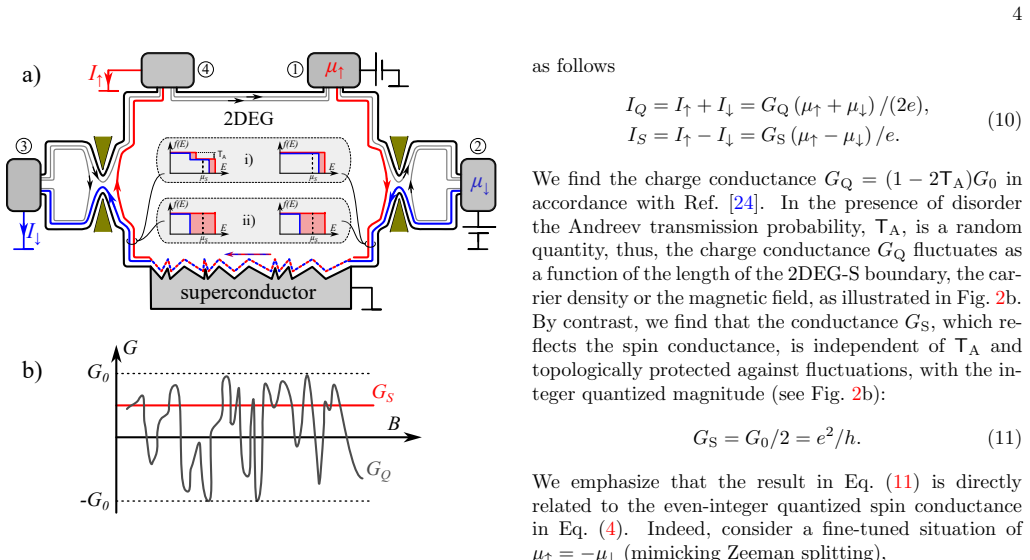
The 2DEG-S system belongs to symmetry class C of the Altland-Zirnbauer classification, which supports an even-integer quantized transverse spin conductivity. We demonstrate that 2DEG-S hybrids host topologically protected edge states carrying a spin current with an even-integer quantized spin conductance robust against disorder. We propose an experimental setup to probe this protection via electrical measurements.
What carries the argument
The Altland-Zirnbauer symmetry class C, which enforces the topological protection of spin-carrying chiral edge states in the hybrid system.
If this is right
- Chiral Andreev edge states support quantized spin transport.
- The quantized spin conductance is robust against disorder.
- Electrical measurements can detect the topological spin protection.
- The class C nature explains the origin of the edge states.
Where Pith is reading between the lines
- This suggests that charge-nonquantized Andreev states can still be topologically nontrivial in the spin sector.
- The proposed setup could be used in other 2DEG-superconductor experiments to test for spin Hall quantization.
- It opens a path to studying disorder effects on spin topology in hybrid platforms.
Load-bearing premise
The hybrid system must exactly match the symmetries required for class C without extra terms that mix spin and charge channels or lift the protection.
What would settle it
An experiment using the proposed electrical setup that finds the spin conductance to be either non-quantized or sensitive to disorder would show the claim is incorrect.
Figures

read the original abstract
Hybrid two-dimensional electron gas-superconductor (2DEG-S) structures in a quantized magnetic field offer a promising platform for realizing new topological phases. While recent experiments reveal chiral Andreev edge states, their charge conductance is not integer quantized and is disorder sensitive, raising the question of whether topological protection survives. We argue that it does, but manifests in the spin transport channel. The 2DEG-S system belongs to symmetry class C of the Altland-Zirnbauer classification, which supports an even-integer quantized transverse spin conductivity - the spin quantum Hall effect, so far unobserved experimentally. We demonstrate that 2DEG-S hybrids host topologically protected edge states carrying a spin current with an even-integer quantized spin conductance robust against disorder. Finally, we propose an experimental setup to probe this protection via electrical measurements, establishing a concrete route to detect the class C origin of the chiral Andreev edge states.
Editorial analysis
A structured set of objections, weighed in public.
Referee Report
Summary. The manuscript claims that hybrid 2DEG-superconductor structures placed in a strong perpendicular magnetic field realize the Altland-Zirnbauer symmetry class C. This classification is argued to imply topologically protected chiral edge states that carry an even-integer quantized spin current (the spin quantum Hall effect), which remains robust against disorder. The authors further propose a concrete electrical measurement geometry to detect this quantized spin conductance and thereby confirm the class-C origin of the observed chiral Andreev edge states.
Significance. If the symmetry assignment and the resulting quantization are rigorously established, the result would be significant: the spin quantum Hall effect remains experimentally unobserved, and the 2DEG-S platform is already accessible in the laboratory. The proposed electrical detection scheme is a concrete strength, as it translates the topological prediction into a measurable quantity without requiring spin-resolved probes. The work correctly invokes the standard class-C classification but applies it to a hybrid system whose symmetry must be verified explicitly.
major comments (2)
- [symmetry classification / effective Hamiltonian section] The central symmetry-class argument (abstract and the section deriving the effective Hamiltonian): class C requires unbroken SU(2) spin rotation symmetry in addition to particle-hole symmetry and broken time-reversal symmetry. The perpendicular magnetic field that produces Landau quantization also generates a Zeeman term gμ_B B·σ that reduces SU(2) to U(1) unless this term is shown to vanish or to be cancelled by other interactions. No explicit demonstration that the full 2DEG-S Hamiltonian lies in class C (or that the Zeeman term can be neglected without altering the topological invariant) is supplied; this step is load-bearing for the even-integer spin conductance claim.
- [results / edge-state demonstration] The demonstration that the edge states carry even-integer quantized spin conductance (the paragraph beginning 'We demonstrate that 2DEG-S hybrids host...'): the abstract and text assert topological protection and disorder robustness, yet supply neither an explicit band-structure calculation of the edge dispersion nor a disorder-averaged transport formula that maps the class-C invariant to the spin conductance. Without this mapping, the claim that the conductance is 'even-integer quantized' and 'robust against disorder' rests on an unshown step.
minor comments (2)
- [abstract] The abstract states that the charge conductance of the chiral Andreev states 'is not integer quantized and is disorder sensitive'; a brief reference to the relevant experimental papers would help readers connect the present spin-channel prediction to those observations.
- [experimental proposal] Notation for the spin current and the proposed measurement geometry could be introduced earlier (e.g., a schematic figure of the electrical setup) to make the final experimental proposal easier to follow.
Simulated Author's Rebuttal
We thank the referee for the careful and constructive review. The comments correctly identify two areas where the original manuscript could be strengthened by more explicit derivations. We have revised the manuscript to address both points directly.
read point-by-point responses
-
Referee: [symmetry classification / effective Hamiltonian section] The central symmetry-class argument (abstract and the section deriving the effective Hamiltonian): class C requires unbroken SU(2) spin rotation symmetry in addition to particle-hole symmetry and broken time-reversal symmetry. The perpendicular magnetic field that produces Landau quantization also generates a Zeeman term gμ_B B·σ that reduces SU(2) to U(1) unless this term is shown to vanish or to be cancelled by other interactions. No explicit demonstration that the full 2DEG-S Hamiltonian lies in class C (or that the Zeeman term can be neglected without altering the topological invariant) is supplied; this step is load-bearing for the even-integer spin conductance claim.
Authors: We agree that an explicit verification is required. In the revised manuscript we have expanded the effective-Hamiltonian section with a dedicated paragraph that retains the full Zeeman term gμ_B B·σ_z. We show analytically that, for the experimentally relevant regime (cyclotron energy ≫ induced gap ≫ Zeeman energy), the Zeeman term acts as a small perturbation that does not close the bulk gap or alter the topological invariant. We further demonstrate that the low-energy Bogoliubov-de Gennes Hamiltonian remains invariant under the combined particle-hole and spin-rotation operations that define class C. A brief discussion of material parameters (InAs 2DEG, g≈4, B≈1 T) is included to justify the perturbative treatment. revision: yes
-
Referee: [results / edge-state demonstration] The demonstration that the edge states carry even-integer quantized spin conductance (the paragraph beginning 'We demonstrate that 2DEG-S hybrids host...'): the abstract and text assert topological protection and disorder robustness, yet supply neither an explicit band-structure calculation of the edge dispersion nor a disorder-averaged transport formula that maps the class-C invariant to the spin conductance. Without this mapping, the claim that the conductance is 'even-integer quantized' and 'robust against disorder' rests on an unshown step.
Authors: We accept that the original text relied on general class-C properties without explicit verification. The revised manuscript now contains (i) a numerical diagonalization of the ribbon geometry that explicitly displays the chiral edge dispersion and (ii) a Kubo-formula calculation of the spin Hall conductivity averaged over disorder realizations. The numerics confirm that each edge carries a spin conductance of 2e²/h (even integer) and that the quantization survives moderate disorder as long as the bulk gap remains open. These results are presented in a new figure and the accompanying text. revision: yes
Circularity Check
No significant circularity; central claim rests on external standard classification
full rationale
The paper assigns the 2DEG-S system to Altland-Zirnbauer class C and derives the even-integer spin Hall quantization and protected edge states from the known properties of that class. This assignment invokes a standard, externally established result rather than any self-referential definition, fitted parameter renamed as prediction, or load-bearing self-citation chain. No equations or steps in the abstract reduce the claimed spin conductance to the paper's own inputs by construction. Potential concerns about Zeeman terms or Rashba coupling affect model validity and correctness but do not constitute circularity in the derivation.
Axiom & Free-Parameter Ledger
axioms (1)
- domain assumption The 2DEG proximitized by an s-wave superconductor in a quantized magnetic field belongs to symmetry class C of the Altland-Zirnbauer classification.
Reference graph
Works this paper leans on
-
[1]
von Klitzing, G
K. von Klitzing, G. Dorda, and M. Pepper, New method for high-accuracy determination of the fine-structure con- stant based on quantized Hall resistance, Phys. Rev. Lett. 45, 494 (1980)
1980
-
[2]
Tsui and A
D. Tsui and A. Gossard, Resistance standard using quan- tization of the Hall resistance of GaAs-Al xGa1−xAs het- erostructures, Appl. Phys. Lett.38, 550 (1981)
1981
-
[3]
C. L. Kane and E. J. Mele,Z 2 topological order and the quantum spin Hall effect, Phys. Rev. Lett.95, 146802 (2005)
2005
-
[4]
B. A. Bernevig, T. L. Hughes, and S.-C. Zhang, Quantum spin Hall effect and topological phase transition in HgTe quantum wells, Science314, 1757 (2006)
2006
-
[5]
K¨ onig, S
M. K¨ onig, S. Wiedmann, C. Br¨ une, A. Roth, H. Buh- mann, L. W. Molenkamp, X.-L. Qi, and S.-C. Zhang, Quantum spin Hall insulator state in HgTe quantum wells, Science318, 766 (2007)
2007
-
[6]
T. H. Hsieh, H. Ishizuka, L. Balents, and T. L. Hughes, Bulk topological proximity effect, Phys. Rev. Lett.116, 086802 (2016)
2016
-
[7]
Cheng, P
P. Cheng, P. W. Klein, K. Plekhanov, K. Sengstock, M. Aidelsburger, C. Weitenberg, and K. Le Hur, Topo- logical proximity effects in a Haldane graphene bilayer system, Phys. Rev. B100, 081107 (2019)
2019
-
[8]
Panas, B
J. Panas, B. Irsigler, J.-H. Zheng, and W. Hofstetter, Bulk topological proximity effect in multilayer systems, Phys. Rev. B102, 075403 (2020)
2020
-
[9]
Ronen, Y
Y. Ronen, Y. Cohen, D. Banitt, M. Heiblum, and V. Umansky, Robust integer and fractional helical modes in the quantum Hall effect, Nature Physics14, 411 (2018)
2018
-
[10]
J. I. V¨ ayrynen, M. Goldstein, and Y. Gefen, Super- conducting correlations out of repulsive interactions on a fractional quantum Hall edge, Phys. Rev. Lett.122, 236802 (2019)
2019
-
[11]
Hoppe, U
H. Hoppe, U. Z¨ ulicke, and G. Sch¨ on, Andreev reflection in strong magnetic fields, Phys. Rev. Lett.84, 1804 (2000)
2000
-
[12]
Eroms, D
J. Eroms, D. Weiss, J. D. Boeck, G. Borghs, and U. Z¨ ulicke, Andreev reflection at high magnetic fields: Evidence for electron and hole transport in edge states, Phys. Rev. Lett.95, 107001 (2005)
2005
-
[13]
Z¨ ulicke, H
U. Z¨ ulicke, H. Hoppe, and G. Sch¨ on, Andreev reflection at superconductor-semiconductor interfaces in high mag- netic fields, Physica B298, 453 (2001)
2001
-
[14]
Giazotto, M
F. Giazotto, M. Governale, U. Z¨ ulicke, and F. Bel- tram, Andreev reflection and cyclotron motion at superconductor—normal-metal interfaces, Phys. Rev. B 72, 054518 (2005)
2005
-
[15]
N. M. Chtchelkatchev and I. S. Burmistrov, Conductance oscillations with magnetic field of a two-dimensional electron gas–superconductor junction, Phys. Rev. B75, 214510 (2007)
2007
-
[16]
I. M. Khaymovich, N. M. Chtchelkatchev, I. A. Shere- shevskii, and A. S. Mel’nikov, Andreev transport in two- dimensional normal-superconducting systems in strong magnetic fields, Europhys. Lett.91, 17005 (2010)
2010
-
[17]
R. S. K. Mong, D. J. Clarke, J. Alicea, N. H. Lindner, P. Fendley, C. Nayak, Y. Oreg, A. Stern, E. Berg, K. Sht- engel, and M. P. A. Fisher, Universal topological quan- tum computation from a superconductor-abelian quan- tum Hall heterostructure, Phys. Rev. X4, 011036 (2014). 6
2014
-
[18]
Clarke, J
D. Clarke, J. Alicea, and K. Shtengel, Ex- otic circuit elements from zero-modes in hybrid superconductor–quantum-Hall systems, Nature Phys. 10, 877 (2014)
2014
-
[19]
G. H. Lee, K. F. Huang, D. Efetov, D. S. Wei, S. Hart, T. Taniguchi, K. Watanabe, A. Yacoby, and P. Kim, In- ducing superconducting correlation in quantum Hall edge states, Nature Phys.13, 693 (2017)
2017
-
[20]
L. Zhao, E. G. Arnault, A. Bondarev, A. Seredinski, T. F. Q. Larson, A. W. Draelos, H. Li, K. Watanabe, T. Taniguchi, F. Amet, H. U. Baranger, and G. Finkel- stein, Interference of chiral Andreev edge states, Nat. Phys.16, 862 (2020)
2020
-
[21]
Hatefipour, J
M. Hatefipour, J. J. Cuozzo, J. Kanter, W. M. Strickland, C. R. Allemang, T.-M. Lu, E. Rossi, and J. Shabani, Induced superconducting pairing in integer quantum Hall edge states, Nano Lett.22, 6173 (2022)
2022
-
[22]
L. Zhao, Z. Iftikhar, T. F. Q. Larson, E. G. Arnault, K. Watanabe, T. Taniguchi, F. Amet, and G. Finkel- stein, Loss and decoherence at the quantum Hall- superconductor interface, Phys. Rev. Lett.131, 176604 (2023)
2023
-
[23]
L. Zhao, E. G. Arnault, T. F. Q. Larson, K. Watan- abe, T. Taniguchi, F. Amet, and G. Finkelstein, Non- local transport measurements in hybrid quantum Hall- superconducting devices, Phys. Rev. B109, 115416 (2024)
2024
-
[24]
V. D. Kurilovich, Z. M. Raines, and L. I. Glazman, Disorder-enabled andreev reflection of a quantum Hall edge, Nat. Commun.14, 2237 (2023)
2023
-
[26]
Volovik, On edge states in superconductors with time inversion symmetry breaking, JETP Lett.66, 522 (1997)
G. Volovik, On edge states in superconductors with time inversion symmetry breaking, JETP Lett.66, 522 (1997)
1997
-
[27]
I. A. Gruzberg, A. W. W. Ludwig, and N. Read, Exact exponents for the spin quantum Hall transition, Phys. Rev. Lett.82, 4524 (1999)
1999
-
[28]
Senthil, J
T. Senthil, J. B. Marston, and M. P. A. Fisher, Spin quantum Hall effect in unconventional superconductors, Phys. Rev. B60, 4245 (1999)
1999
-
[29]
Read and D
N. Read and D. Green, Paired states of fermions in two dimensions with breaking of parity and time-reversal symmetries and the fractional quantum Hall effect, Phys. Rev. B61, 10267 (2000)
2000
-
[30]
Kagalovsky, B
V. Kagalovsky, B. Horovitz, Y. Avishai, and J. T. Chalker, Quantum Hall plateau transitions in disordered superconductors, Phys. Rev. Lett.82, 3516 (1999)
1999
-
[31]
A. Y. Kitaev, Periodic table for topological insulators and superconductors, AIP Conf. Proc.1134, 22 (2009)
2009
-
[32]
A. P. Schnyder, S. Ryu, A. Furusaki, and A. W. W. Lud- wig, Classification of topological insulators and supercon- ductors, AIP Conf. Proc.1134, 10 (2009)
2009
-
[33]
Altland and M
A. Altland and M. R. Zirnbauer, Nonstandard symme- try classes in mesoscopic normal-superconducting hybrid structures, Phys. Rev. B55, 1142 (1997)
1997
-
[34]
see Supplemental Material
-
[35]
However, since the structure of the NLσM action is dictated by the symmetries it is believed that the action (8) holds for allN
Technically, derivation of the NLσM action (8) requires the conditionN ≫1. However, since the structure of the NLσM action is dictated by the symmetries it is believed that the action (8) holds for allN
-
[36]
Salis, Y
G. Salis, Y. Kato, K. Ensslin, D. C. Driscoll, A. C. Gos- sard, and D. D. Awschalom, Electrical control of spin coherence in semiconductor nanostructures, Nature414, 619 (2001)
2001
-
[37]
H. L. Zhao and S. Hershfield, Tunneling, relaxation of spin-polarized quasiparticles, and spin-charge separation in superconductors, Phys. Rev. B52, 3632 (1995)
1995
-
[38]
P. L. Stroganov and Y. V. Fominov, Cooper pair splitting in ballistic ferromagnetic squids, Phys. Rev. B96, 174508 (2017)
2017
-
[39]
M. V. Parfenov and I. S. Burmistrov, Bulk-edge cor- respondence at the spin-to-integer quantum Hall effect crossover in topological superconductors, Phys. Rev. B 112, L161407 (2025)
2025
-
[40]
B. J. van Wees, L. P. Kouwenhoven, E. M. M. Willems, C. J. P. M. Harmans, J. E. Mooij, H. van Houten, C. W. J. Beenakker, J. G. Williamson, and C. T. Foxon, Quantum ballistic and adiabatic electron transport stud- ied with quantum point contacts, Phys. Rev. B43, 12431 (1991)
1991
-
[41]
C. W. J. Beenakker and H. van Houten, Quantum trans- port in semiconductor nanostructures, inSemiconduc- tor Heterostructures and Nanostructures, Solid State Physics, Vol. 44, edited by H. Ehrenreich and D. Turnbull (Academic Press, 1991) pp. 1–228
1991
-
[42]
Carrega, L
M. Carrega, L. Chirolli, S. Heun, and L. Sorba, Anyons in quantum Hall interferometry, Nat. Rev. Phys.3, 698 (2021)
2021
-
[43]
Zimmermann, A
K. Zimmermann, A. Jordan, F. Gay, K. Watan- abe, T. Taniguchi, Z. Han, V. Bouchiat, H. Sellier, and B. Sac´ ep´ e, Tunable transmission of quantum Hall edge channels with full degeneracy lifting in split-gated graphene devices, Nature Communications8, 14983 (2017)
2017
-
[44]
Such sequence of inner and outer ECs assumes negative g-factor of 2DEG
-
[45]
M. P. Anantram and S. Datta, Current fluctuations in mesoscopic systems with Andreev scattering, Phys. Rev. B53, 16390 (1996)
1996
-
[46]
A. B. Michelsen, P. Recher, B. Braunecker, and T. L. Schmidt, Supercurrent-enabled Andreev reflection in a chiral quantum Hall edge state, Phys. Rev. Res.5, 013066 (2023)
2023
-
[47]
(10) remain valid for arbitrary relations betweenµ ↑ andµ ↓
Although in describing the experimental setup we as- sumedµ ↑ > µ ↓ >0, the expressions in Eq. (10) remain valid for arbitrary relations betweenµ ↑ andµ ↓
-
[48]
Torr` es and T
J. Torr` es and T. Martin, Positive and negative Hanbury-Brown and Twiss correlations in normal metal- superconducting devices, The European Physical Jour- nal B - Condensed Matter and Complex Systems12, 319 (1999)
1999
-
[49]
Lesovik, T
G. Lesovik, T. Martin, and G. Blatter, Electronic entan- glement in the vicinity of a superconductor, The Euro- pean Physical Journal B24, 287 (2001)
2001
-
[50]
Khrapai, Quantum Hall Bogoliubov interferometer, Physical Review B107, L241401 (2023)
V. Khrapai, Quantum Hall Bogoliubov interferometer, Physical Review B107, L241401 (2023)
2023
-
[51]
E. S. Tikhonov and V. S. Khrapai, Efficient Cooper pair splitting without interactions, Phys. Rev. B110, 075429 (2024)
2024
-
[52]
L. Zhao, T. F. Q. Larson, Z. Iftikhar, J. Chiles, K. Watan- abe, T. Taniguchi, F. Amet, and G. Finkelstein, Thermal properties of the superconductor–quantum Hall interface, Phys. Rev. Lett.134, 066001 (2025)
2025
-
[53]
Y. Baba, A. Levy Yeyati, and P. Burset, Emergent topology from Landau level mixing in quantum Hall- superconductor nanostructures, Phys. Rev. Lett.136, 176601 (2026). 7
2026
-
[54]
D. S. Antonenko, L. Fu, and L. I. Glazman, Making s-wave superconductors topological with magnetic field, Phys. Rev. B112, 134508 (2025)
2025
-
[55]
D. S. Antonenko, L. Fu, and L. I. Glazman, Unified topo- logical phase diagram of quantum Hall and supercon- ducting vortex-lattice states 10.48550/arXiv.2601.00108 (2025)
work page internal anchor Pith review Pith/arXiv arXiv doi:10.48550/arxiv.2601.00108 2025
-
[56]
V. D. Kurilovich and L. I. Glazman, Criticality in the crossed Andreev reflection of a quantum Hall edge, Phys. Rev. X13, 031027 (2023)
2023
-
[57]
G¨ ul, Y
O. G¨ ul, Y. Ronen, S. Y. Lee, H. Shapourian, J. Zauber- man, Y. H. Lee, K. Watanabe, T. Taniguchi, A. Vish- wanath, A. Yacoby, and P. Kim, Andreev reflection in the fractional quantum Hall state, Phys. Rev. X12, 021057 (2022)
2022
-
[58]
Khalaf, Mesoscopic Phenomena in Topological Insu- lators, Superconductors and Semimetals, Ph.D
E. Khalaf, Mesoscopic Phenomena in Topological Insu- lators, Superconductors and Semimetals, Ph.D. thesis, Stuttgart University 10.18419/opus-9185 (2016)
-
[59]
Khalaf, M
E. Khalaf, M. A. Skvortsov, and P. M. Ostrovsky, Semiclassical electron transport at the edge of a two- dimensional topological insulator: Interplay of protected and unprotected modes, Phys. Rev. B93, 125405 (2016). ONLINE SUPPORTING INFORMATION Emergence of spin quantum Hall edge states at the boundary of two-dimensional electron gas proximized with an s...
2016
-
[60]
Giazotto, M
F. Giazotto, M. Governale, U. Zülicke, and F. Beltram, Andreev reflection and cyclotron motion at superconductor— normal-metal interfaces, Phys. Rev. B 72, 054518 (2005)
2005
-
[61]
Hoppe, U
H. Hoppe, U. Zülicke, and G. Schön, Andreev reflection in strong magnetic fields, Phys. Rev. Lett. 84, 1804 (2000)
2000
-
[62]
Zülicke, H
U. Zülicke, H. Hoppe, and G. Schön, Andreev reflection at superconductor-semiconductor interfaces in high magnetic fields, Physica B 298, 453 (2001)
2001
-
[63]
A. B. Michelsen, P. Recher, B. Braunecker, and T. L. Schmidt, Supercurrent-enabled Andreev reflection in a chiral quantum Hall edge state, Phys. Rev. Res. 5, 013066 (2023)
2023
-
[64]
Bateman and A
H. Bateman and A. Erdélyi, Higher Transcendental Functions, Vol. 2 (McGraw-Hill Book Company, Inc., New York, 1953)
1953
-
[65]
V. D. Kurilovich, Z. M. Raines, and L. I. Glazman, Disorder-enabled andreev reflection of a quantum Hall edge, Nat. Commun. 14, 2237 (2023)
2023
-
[66]
I. L. Aleiner and A. I. Larkin, Divergence of classical trajectories and weak localization, Phys. Rev. B 54, 14423 (1996)
1996
-
[67]
M. V. Parfenov and I. S. Burmistrov, Bulk-edge correspondence at the spin-to-integer quantum Hall effect crossover in topological superconductors, Phys. Rev. B 112, L161407 (2025)
2025
-
[68]
Altland and M
A. Altland and M. R. Zirnbauer, Nonstandard symmetry classes in mesoscopic normal-superconducting hybrid structures, Phys. Rev. B 55, 1142 (1997)
1997
-
[69]
M. V. Parfenov and I. S. Burmistrov, Instanton analysis for the spin quantum Hall symmetry class: Nonperturbative corrections to physical observables and generalized multifractal spectrum, Phys. Rev. B 110, 165431 (2024)
2024
-
[70]
I. M. Khaymovich, N. M. Chtchelkatchev, I. A. Shereshevskii, and A. S. Mel’nikov, Andreev transport in two-dimensional normal-superconducting systems in strong magnetic fields, Europhys. Lett. 91, 17005 (2010)
2010
-
[71]
M. J. M. de Jong and C. W. J. Beenakker, Andreev reflection in ferromagnet-superconductor junctions, Phys. Rev. Lett. 74, 1657 (1995)
1995
-
[72]
Mélin, Spin-resolved Andreev reflection in ferromagnet-superconductor junctions with Zeeman splitting, Europhys
R. Mélin, Spin-resolved Andreev reflection in ferromagnet-superconductor junctions with Zeeman splitting, Europhys. Lett. 51, 202 (2000)
2000
-
[73]
Zheng, D
Z. Zheng, D. Y. Xing, G. Sun, and J. Dong, Andreev reflection effect on spin-polarized transport in ferromag- net/superconductor/ferromagnet double tunnel junctions, Phys. Rev. B 62, 14326 (2000)
2000
discussion (0)
Sign in with ORCID, Apple, or X to comment. Anyone can read and Pith papers without signing in.