Recognition: unknown
Fermi energy Weyl nodes in AMTe₄ (A=Ta, Nb, M=Ir, Rh)
Pith reviewed 2026-05-08 08:50 UTC · model grok-4.3
The pith
AMTe4 compounds host Weyl points of multiple types within a few meV of the Fermi energy.
A machine-rendered reading of the paper's core claim, the machinery that carries it, and where it could break.
Core claim
Employing a generalised search procedure that accounts for all subbands close to the Fermi energy, these compounds are predicted to feature Weyl points within a few meV of the Fermi energy which significantly influence their properties. Most of the considered compounds host Weyl points of more than one type, including NbRhTe4 which hosts type-I, II and III Weyl points. The comparative analysis of structure and computational parameters provides a detailed mapping of the complex electronic structure and clarifies quantum oscillations and magnetoresistance observations.
What carries the argument
The generalised search procedure that accounts for all subbands close to the Fermi energy to locate every Weyl point.
If this is right
- Weyl points within a few meV of the Fermi energy significantly influence the properties of these compounds.
- Most compounds host Weyl points of more than one type.
- NbRhTe4 hosts type-I, type-II, and type-III Weyl points.
- The mapping clarifies quantum oscillations and magnetoresistance observations and supplies a framework for tuning the Weyl points.
Where Pith is reading between the lines
- The same comprehensive scan applied to other known topological compounds could uncover previously missed Weyl points near the Fermi energy.
- Coexistence of several Weyl point types inside one material may produce transport signatures that are more complex than those in single-type Weyl semimetals.
- Small shifts in doping or strain could move the Fermi level across different Weyl point types, allowing experimental control over the dominant topological response.
Load-bearing premise
The generalised search procedure together with the chosen computational models and parameters accurately locates all Weyl points near the Fermi energy without missing relevant subbands or introducing artifacts.
What would settle it
Angle-resolved photoemission spectroscopy or quantum oscillation measurements that fail to find Weyl points at the predicted energies, momenta, and types within a few meV of the Fermi level would falsify the prediction.
Figures


read the original abstract
Key aspects of the quantum oscillations and magnetoresistance in Weyl semimetals $AM$Te$_4$ ($A$=Nb,Ta, $M$=Rh, Ir) persist as open questions, obscuring the link between their topological electronic structure and practical implementations. Employing a generalised search procedure, we carry out a comprehensive scan of WPs accounting for all the subbands close to the Fermi energy, and show that this dramatically alters the WP landscape in these compounds. In particular, we predict these compounds to feature WPs within a few meV of the Fermi energy which significantly influence their properties. Remarkably, most of the considered compounds host WPs of more than one type, including NbRhTe$_4$ which hosts type-I, II and III Weyl points. Our comparative analysis of structure and fidelity of computational parameters/models not only provides a detailed mapping of the complex electronic structure in these compounds, but also clarifies quantum oscillations and magnetoresistance observations in this family, bridging the gap between theory and experiments and offering a framework for precise tunability of WPs.
Editorial analysis
A structured set of objections, weighed in public.
Referee Report
Summary. The paper employs a generalized search procedure to comprehensively scan for Weyl points (WPs) across all subbands near the Fermi energy in the AMTe4 family (A=Ta,Nb; M=Ir,Rh). It predicts that these compounds host WPs within a few meV of EF that strongly influence their properties, with most materials exhibiting multiple WP types; notably, NbRhTe4 is reported to contain type-I, II, and III WPs simultaneously. The work includes a comparative analysis of computational models and parameters to map the electronic structure and link it to observed quantum oscillations and magnetoresistance.
Significance. If the central predictions hold, the identification of multiple coexisting WP types near EF would offer a concrete explanation for unresolved magnetotransport features in this family and a practical route to tuning topological nodes via composition or strain. The emphasis on a systematic scan of subbands near EF addresses a common limitation in prior studies of these materials.
major comments (2)
- [Abstract and Computational Methods] Abstract and Computational Methods: The abstract asserts that a 'comparative analysis of structure and fidelity of computational parameters/models' was performed and that WPs lie 'within a few meV of the Fermi energy,' yet no quantitative details are supplied on k-mesh density, smearing parameter, SOC treatment, pseudopotential choice, or convergence tests for WP energies and tilt parameters. Because DFT band positions near EF are known to shift by 1-2 meV under modest changes in these controls, and because the central claim (including type classification in NbRhTe4) is sensitive to such shifts, the absence of these controls leaves the reported WP landscape unverified.
- [Results on NbRhTe4] Results on NbRhTe4: The claim that NbRhTe4 hosts type-I, II, and III WPs simultaneously is load-bearing for the 'multiple types' narrative, but the text provides neither the explicit energies (relative to EF), momentum coordinates, nor the tilt parameters that distinguish the three classes. Without these data or a direct comparison to earlier calculations, it is impossible to confirm that the generalized search has correctly located and classified all crossings or that the coexistence is robust rather than an artifact of subband truncation.
minor comments (2)
- The abstract refers to 'dramatically alters the WP landscape' without citing the specific prior calculations or figures that are being superseded; adding a brief comparison table or reference to earlier WP counts would improve clarity.
- Figure captions and axis labels should explicitly state the energy window (e.g., 'within 10 meV of EF') and the k-path used for the band plots to allow readers to assess proximity to the Fermi level.
Simulated Author's Rebuttal
We thank the referee for the careful and constructive review. The comments correctly identify areas where additional quantitative details and explicit data would strengthen the manuscript. We will revise accordingly to improve verifiability while preserving the core findings from our generalized Weyl-point search.
read point-by-point responses
-
Referee: [Abstract and Computational Methods] Abstract and Computational Methods: The abstract asserts that a 'comparative analysis of structure and fidelity of computational parameters/models' was performed and that WPs lie 'within a few meV of the Fermi energy,' yet no quantitative details are supplied on k-mesh density, smearing parameter, SOC treatment, pseudopotential choice, or convergence tests for WP energies and tilt parameters. Because DFT band positions near EF are known to shift by 1-2 meV under modest changes in these controls, and because the central claim (including type classification in NbRhTe4) is sensitive to such shifts, the absence of these controls leaves the reported WP landscape unverified.
Authors: We agree that the absence of explicit numerical controls limits independent verification, especially given the known sensitivity of near-EF DFT states. In the revised manuscript we will add a dedicated paragraph (or table) in the Computational Methods section specifying the k-mesh density, smearing parameter, SOC treatment, pseudopotential choice, and convergence tests performed on WP energies and tilt parameters. These additions will directly demonstrate that the reported positions remain within a few meV of EF under the controls used. revision: yes
-
Referee: [Results on NbRhTe4] Results on NbRhTe4: The claim that NbRhTe4 hosts type-I, II, and III WPs simultaneously is load-bearing for the 'multiple types' narrative, but the text provides neither the explicit energies (relative to EF), momentum coordinates, nor the tilt parameters that distinguish the three classes. Without these data or a direct comparison to earlier calculations, it is impossible to confirm that the generalized search has correctly located and classified all crossings or that the coexistence is robust rather than an artifact of subband truncation.
Authors: We accept that explicit values are required to substantiate the simultaneous presence of all three WP types. The revised manuscript will include a table listing the energy (relative to EF), momentum coordinates, and tilt parameters for each Weyl point in NbRhTe4, together with the classification criteria applied. We will also add a brief comparison to prior calculations in the literature to show that the generalized search recovers previously reported nodes while identifying additional ones, thereby addressing concerns about subband truncation and robustness. revision: yes
Circularity Check
No circularity in computational Weyl point search
full rationale
The paper's central derivation applies a generalised search procedure to first-principles DFT band structures, scanning all subbands near the Fermi energy to locate and classify Weyl points (including type-I/II/III coexistence in NbRhTe4). This is a forward computational prediction from external electronic-structure calculations rather than any self-referential definition, fitted parameter renamed as output, or load-bearing self-citation chain. No equations or steps reduce the reported WP energies, types, or influences on properties to the inputs by construction; the comparative analysis of computational parameters/models serves as validation of the scan, not a tautology. The result remains independent of the target claims.
Axiom & Free-Parameter Ledger
axioms (1)
- domain assumption Standard assumptions of density-functional theory and band-structure calculations for periodic solids
Reference graph
Works this paper leans on
-
[1]
[001] Frequency [T] Angle [θ ] TaIrTe4(GGA) H1 H2 H3 H4 H5 E1 E2 b H1 H2 H3 H4 H5 E1 E2 0 100 200 300 400 500 600 0 20 40 60 80
-
[2]
divergent
[001] Frequency [T] Angle [θ ] TaRhTe4(GGA) H1 H2 H3 H4 E1 E2 c H1 H2 H3 H4 E1 E2 Figure 3:Angular dependance of dHvA frequencies in Ta-based systems. (a)The observed dHvA frequencies from Ref. [24].(b-c)Calculated angular dependance of dHvA for (b) optimized structure of TaIrTe4, and (c) otpimized structure of TaRhTe4. In all cases,k-mesh with20×10×10int...
-
[3]
[001] Frequency [T] Angle [θ ] NbIrTe4(GGA) H1 H2 H3 E1 E2 a H1 H2 H3 E1 E2 0 100 200 300 400 500 600 0 20 40 60 80
-
[4]
Correlated Magnetism: From Frustration to Topology
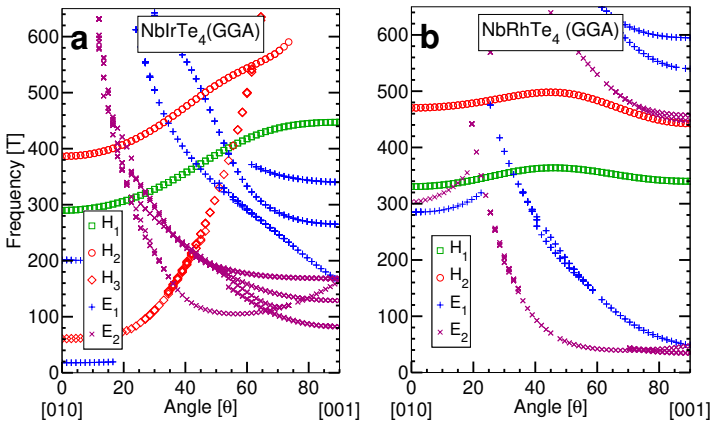
[001] Frequency [T] Angle [θ ] NbRhTe4 (GGA) H1 H2 E1 E2 b H1 H2 E1 E2 Figure 5:Angular dependence of dHvA in Nb compounds. (a-b)Calculated angular dependence of dHvA for optimized crystal structure of (a) NbIrTe4 and (b) NbRhTe4 TaRhTe4, the needle-like hole pocket alongΓ−Yis absent as the bands along this path of the BZ are shifted down compared to TaRh...
2022
-
[5]
Accidental degeneracy in the energy bands of crystals.Phys
Herring, C. Accidental degeneracy in the energy bands of crystals.Phys. Rev.52, 365–373 (1937). URLhttps://link.aps.org/doi/10.1103/PhysRev.52.365
-
[6]
& Felser, C
Yan, B. & Felser, C. Topological materials: Weyl semimetals.Annual Review of Condensed Matter Physics8, 337–354 (2017). URLhttp://dx.doi.org/10.1146/ annurev-conmatphys-031016-025458
2017
-
[7]
Armitage, N. P., Mele, E. J. & Vishwanath, A. Weyl and Dirac semimetals in three- dimensional solids.Rev. Mod. Phys.90, 015001 (2018). URLhttps://link.aps.org/ doi/10.1103/RevModPhys.90.015001
-
[8]
Nielsen, H. & Ninomiya, M. A no-go theorem for regularizing chiral fermions.Physics Letters B105, 219–223 (1981). URLhttp://dx.doi.org/10.1016/0370-2693(81) 91026-1
-
[9]
Wawrzik, D., You, J.-S., Facio, J. I., van den Brink, J. & Sodemann, I. Infinite Berry curvature of Weyl Fermi arcs.Phys. Rev. Lett.127, 056601 (2021). URLhttps://link.aps. org/doi/10.1103/PhysRevLett.127.056601
-
[10]
URL https://arxiv.org/abs/2504.01300
Zhong, M.et al.Weyl semimetals: from principles, materials to applications (2025). URL https://arxiv.org/abs/2504.01300
-
[11]
Wan, X., Turner, A. M., Vishwanath, A. & Savrasov, S. Y . Topological semimetal and Fermi- arc surface states in the electronic structure of pyrochlore iridates.Phys. Rev. B83, 205101 (2011). URLhttps://link.aps.org/doi/10.1103/PhysRevB.83.205101. 20
-
[12]
A.et al.Type-II Weyl semimetals.Nature527, 495–498 (2015)
Soluyanov, A. A.et al.Type-II Weyl semimetals.Nature527, 495–498 (2015). URLhttp: //dx.doi.org/10.1038/nature15768
-
[13]
Li, X.-P.et al.Type-III Weyl semimetals: (TaSe 4)2I.Phys. Rev. B103, L081402 (2021). URL https://link.aps.org/doi/10.1103/PhysRevB.103.L081402
-
[14]
Li, X.-P.et al.Observation of a single pair of type-III Weyl points in sonic crystals.Phys. Rev. B106, L220302 (2022). URLhttps://link.aps.org/doi/10.1103/PhysRevB. 106.L220302
-
[15]
Koepernik, K.et al.TaIrTe 4: A ternary type-II Weyl semimetal.Phys. Rev. B93, 201101 (2016). URLhttps://link.aps.org/doi/10.1103/PhysRevB.93.201101
-
[16]
Haubold, E.et al.Experimental realization of type-II Weyl state in noncentrosymmetric TaIrTe4.Phys. Rev. B95, 241108 (2017). URLhttps://link.aps.org/doi/10. 1103/PhysRevB.95.241108
2017
-
[17]
URLhttp://dx.doi.org/10.1093/nsr/nwz204
Xing, Y .et al.Surface superconductivity in the type II Weyl semimetal TaIrTe4.National Sci- ence Review7, 579–587 (2019). URLhttp://dx.doi.org/10.1093/nsr/nwz204
-
[18]
URLhttp://dx.doi.org/10.1038/s41586-023-06977-7
Kuibarov, A.et al.Evidence of superconducting Fermi arcs.Nature626, 294–299 (2024). URLhttp://dx.doi.org/10.1038/s41586-023-06977-7
-
[19]
URL http://dx.doi.org/10.1103/PhysRevB.104.144503
Long, S.et al.Observation of nearly identical superconducting transition temperatures in the pressurized Weyl semimetalsMIrTe 4 (M= Nb and Ta).Physical Review B104(2021). URL http://dx.doi.org/10.1103/PhysRevB.104.144503
-
[20]
Mu, Q.-G.et al.Pressure-induced superconductivity and modification of Fermi surface in type-II Weyl semimetal NbIrTe 4.npj Quantum Materials6(2021). URLhttp://dx. doi.org/10.1038/s41535-021-00357-y
-
[21]
URLhttp://dx.doi.org/10.1038/s41563-019-0296-5
Ma, J.et al.Nonlinear photoresponse of type-II Weyl semimetals.Nature Materials18, 476–481 (2019). URLhttp://dx.doi.org/10.1038/s41563-019-0296-5
-
[22]
URLhttp://dx.doi.org/10.1038/ s41467-024-48872-3
Bainsla, L.et al.Large out-of-plane spin–orbit torque in topological Weyl semimetal TaIrTe4.Nature Communications15(2024). URLhttp://dx.doi.org/10.1038/ s41467-024-48872-3
2024
-
[23]
Tang, T.et al.Anisotropy of linear and nonlinear charge-spin conversion in Weyl semimetal TaIrTe4.Phys. Rev. B111, 104404 (2025). URLhttps://link.aps.org/doi/10. 1103/PhysRevB.111.104404. 21
2025
-
[24]
URLhttp: //dx.doi.org/10.1103/PhysRevB.110.035423
Li, D.et al.Room-temperature van der Waals magnetoresistive memories with data writing by orbital current in the Weyl semimetal TaIrTe4.Physical Review B110(2024). URLhttp: //dx.doi.org/10.1103/PhysRevB.110.035423
-
[25]
Kumar, D.et al.Room-temperature nonlinear Hall effect and wireless radiofrequency rectification in Weyl semimetal TaIrTe4.Nature Nanotechnology16, 421–425 (2021). URL http://dx.doi.org/10.1038/s41565-020-00839-3
-
[26]
URLhttp://dx.doi.org/ 10.1038/s41467-025-61347-3
Jiang, H.et al.Probing interplay of topological properties and electron correlation in TaIrTe 4 via nonlinear Hall effect.Nature Communications16(2025). URLhttp://dx.doi.org/ 10.1038/s41467-025-61347-3
-
[27]
URLhttp://dx.doi.org/10.1038/ s41467-017-00938-1
Belopolski, I.et al.Signatures of a time-reversal symmetric Weyl semimetal with only four Weyl points.Nature Communications8(2017). URLhttp://dx.doi.org/10.1038/ s41467-017-00938-1
2017
-
[28]
Khim, S.et al.Magnetotransport and de Haas–van Alphen measurements in the type-II Weyl semimetal TaIrTe4.Phys. Rev. B94, 165145 (2016). URLhttps://link.aps.org/ doi/10.1103/PhysRevB.94.165145
-
[29]
Pletikosi ´c, I., Ali, M. N., Fedorov, A. V ., Cava, R. J. & Valla, T. Electronic structure basis for the extraordinary magnetoresistance in WTe2.Phys. Rev. Lett.113, 216601 (2014). URL https://link.aps.org/doi/10.1103/PhysRevLett.113.216601
-
[30]
& Yazyev, O
Zhang, S., Wu, Q., Liu, Y . & Yazyev, O. V . Magnetoresistance from Fermi surface topology. Phys. Rev. B99, 035142 (2019). URLhttps://link.aps.org/doi/10.1103/ PhysRevB.99.035142
2019
-
[31]
& Ray, R
Zhang, X., Mao, N., Janson, O., van den Brink, J. & Ray, R. Layer dependent topological phases and transitions in TaRhTe 4: From monolayer and bilayer to bulk. Phys. Rev. Mater .8, 094201 (2024). URLhttps://link.aps.org/doi/10.1103/ PhysRevMaterials.8.094201
2024
-
[32]
Son, D. T. & Spivak, B. Z. Chiral anomaly and classical negative magnetoresistance of Weyl metals.Phys. Rev. B88, 104412 (2013). URLhttps://link.aps.org/doi/10. 1103/PhysRevB.88.104412
2013
-
[33]
Behnami, M.et al.Signature of chiral anomaly in the Weyl semimetal TaRhTe 4.Phys. Rev. B 112, 045101 (2025). URLhttps://link.aps.org/doi/10.1103/n7lw-7xqj. 22
-
[34]
URLhttp://dx.doi.org/ 10.1002/aelm.201900250
Zhou, W.et al.Nonsaturating magnetoresistance and nontrivial band topology of type-II Weyl semimetal NbIrTe4.Advanced Electronic Materials5(2019). URLhttp://dx.doi.org/ 10.1002/aelm.201900250
-
[35]
Pandey, P. & Pandey, S. K. Revisiting the topological nature of TaIrTe 4, SrSi2, and Cu2XY3: An ab-initio investigation (2025). URLhttps://arxiv.org/abs/2505.24359
-
[36]
Koepernik, K. & Eschrig, H. Full-potential nonorthogonal local-orbital minimum-basis band- structure scheme.Phys. Rev. B59, 1743–1757 (1999). URLhttps://link.aps.org/ doi/10.1103/PhysRevB.59.1743
-
[37]
Perdew, J. P. & Wang, Y . Accurate and simple analytic representation of the electron-gas correlation energy.Phys. Rev. B45, 13244–13249 (1992). URLhttps://link.aps. org/doi/10.1103/PhysRevB.45.13244
-
[38]
The supplementary material contain details of the crystal structure, parameter dependence, dHvA analysis, energy, position and low-energy dispersion of the Weyl points, and addition- ally uses Ref. [45]
-
[39]
Liu, J., Wang, H., Fang, C., Fu, L. & Qian, X. van der Waals stacking-induced topological phase transition in layered ternary transition metal chalcogenides.Nano Letters17, 467–475 (2016). URLhttp://dx.doi.org/10.1021/acs.nanolett.6b04487
-
[40]
Sch ¨onemann, R.et al.Bulk Fermi surface of the Weyl type-II semimetallic candidate NbIrTe4.Phys. Rev. B99, 195128 (2019). URLhttps://link.aps.org/doi/10. 1103/PhysRevB.99.195128
2019
-
[41]
AI Feynman: A physics-inspired method for symbolic regression.Science Advances, 6(16):eaay2631, 2020
Lu, Z.et al.Weyl fermion magneto-electrodynamics and ultralow field quantum limit in TaAs.Science Advances8(2022). URLhttp://dx.doi.org/10.1126/sciadv. abj1076
-
[42]
Abrikosov, A. A. Quantum magnetoresistance.Phys. Rev. B58, 2788–2794 (1998). URL https://link.aps.org/doi/10.1103/PhysRevB.58.2788
-
[43]
URLhttp://dx.doi.org/10
Arnold, F.et al.Negative magnetoresistance without well-defined chirality in the Weyl semimetal TaP.Nature Communications7(2016). URLhttp://dx.doi.org/10. 1038/ncomms11615
2016
-
[44]
Alexandradinata, A. & Glazman, L. Geometric phase and orbital moment in quantization rules for magnetic breakdown.Phys. Rev. Lett.119, 256601 (2017). URLhttps://link.aps. org/doi/10.1103/PhysRevLett.119.256601. 23
-
[45]
Li, L.et al.Ternary Weyl semimetal NbIrTe 4 proposed from first-principles calculation. Phys. Rev. B96, 024106 (2017). URLhttps://link.aps.org/doi/10.1103/ PhysRevB.96.024106
2017
-
[46]
P., Burke, K
Perdew, J. P., Burke, K. & Ernzerhof, M. Generalized gradient approximation made simple. Physical Review Letters77, 3865–3868 (1996). URLhttp://dx.doi.org/10.1103/ PhysRevLett.77.3865
1996
-
[47]
URLhttp: //dx.doi.org/10.1021/acs.jpclett.1c01648
Shipunov, G.et al.Layered van der Waals topological metals of TaT MTe 4 (T M= Ir, Rh, Ru) Family.The Journal of Physical Chemistry Letters12, 6730–6735 (2021). URLhttp: //dx.doi.org/10.1021/acs.jpclett.1c01648
-
[48]
URLhttp://dx.doi.org/10.1038/s41467-024-47643-4
Lee, J.-E.et al.Spin-orbit-splitting-driven nonlinear Hall effect in NbIrTe 4.Nature Commu- nications15(2024). URLhttp://dx.doi.org/10.1038/s41467-024-47643-4
-
[49]
Onsager, L. Interpretation of the de Haas-van Alphen effect.The London, Edinburgh, and Dublin Philosophical Magazine and Journal of Science43, 1006–1008 (1952). URLhttp: //dx.doi.org/10.1080/14786440908521019. 24 Supplementary Information Suppementary Note I: Structural Details The DFT calculations were carried out forAMTe 4 (A=Ta, Nb,M=Ir, Rh). For Ir-ba...
-
[50]
[001] Frequency [T] Angle [θ ] TaIrTe * 4(LDA) H1 H2 H3 H4 H5 E1 E2 b H1 H2 H3 H4 H5 E1 E2 0 100 200 300 400 500 0 20 40 60 80
-
[51]
[001] Frequency [T] Angle [θ ] TaIrTe * 4(GGA)c 0 100 200 300 400 500 0 20 40 60 80
-
[52]
The experimental data is shown in (a)
[001] Frequency [T] Angle [θ ] TaIrTe4(LDA)d Figure S8: A detailed comparison of the dHvA frequencies between observed different crystal structures and XC functional. The experimental data is shown in (a). (b) and (c) correspond to the DFT calculations using the experimental crystal structure with a densek-mesh, while (d) corresponds to DFT calculations o...
discussion (0)
Sign in with ORCID, Apple, or X to comment. Anyone can read and Pith papers without signing in.