Recognition: unknown
Lack of self-averaging of the critical internal energy in a weakly-disordered Baxter model
Pith reviewed 2026-05-08 04:59 UTC · model grok-4.3
The pith
The critical internal energy in the weakly-disordered Baxter model lacks self-averaging as system size grows.
A machine-rendered reading of the paper's core claim, the machinery that carries it, and where it could break.
Core claim
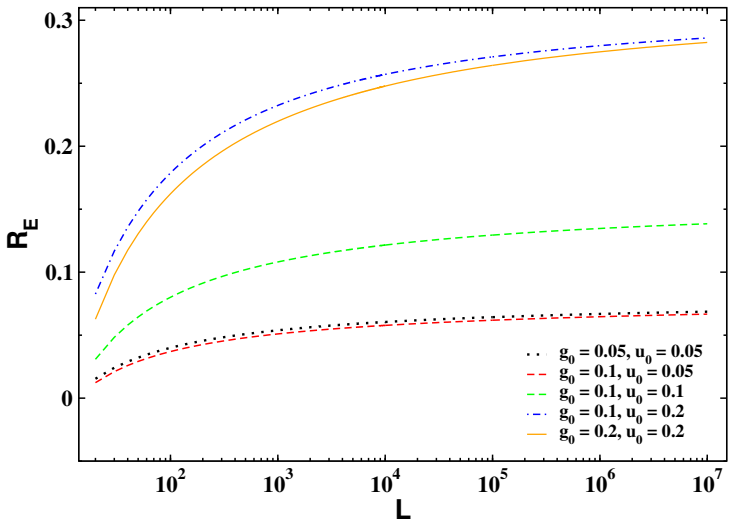
In the critical regime of the weakly disordered Baxter eight-vertex model, the relative variance of the internal energy at the pseudo-critical point increases with system size L and approaches a finite nonzero constant as L tends to infinity. This occurs for both positive and negative values of the four-spin coupling g0, implying that fluctuations remain relevant independently of the sign of g0 and thus of the specific-heat exponent. The same lack of self-averaging is confirmed for the disordered Ising model.
What carries the argument
The equivalent representation of the disordered Baxter model as two coupled Ising models with disordered couplings, mapped to interacting Grassmann-Majorana spinor fields with quartic interactions treated by replica and renormalization-group methods for small g0.
If this is right
- Reliable estimates of the critical internal energy and free energy require averaging over many disorder realizations.
- Fluctuations of the energy remain relevant in the thermodynamic limit regardless of the sign of the disorder coupling g0.
- The same lack of self-averaging holds for the disordered Ising model.
Where Pith is reading between the lines
- This lack of self-averaging could affect how critical exponents are extracted from simulations of disordered systems.
- Other thermodynamic quantities might exhibit similar persistent fluctuations near criticality in weakly disordered models.
- The result highlights the need to consider disorder-induced fluctuations even when the disorder is weak.
Load-bearing premise
The replica and renormalization-group analysis assumes that the weakly disordered model maps to interacting Grassmann-Majorana fields whose quartic interactions allow a controlled perturbative treatment.
What would settle it
Numerical simulations for much larger system sizes that show the relative variance of the critical internal energy decreasing toward zero rather than saturating at a finite value.
Figures



read the original abstract
We investigate the first two moments of the critical internal energy $E$ in a weakly disordered two-dimensional Baxter eight-vertex model as a function of the system size $L$, evaluated at the pseudo-critical point. Disorder is introduced via an equivalent representation of the pure eight-vertex model in terms of two ferromagnetic Ising models coupled by a four-spin interaction of strength $g_0$, where the Ising couplings consist of a uniform ferromagnetic part $J>0$ supplemented by weak Gaussian spatial disorder. In the critical regime, the model is formulated in terms of interacting Grassmann-Majorana spinor fields with quartic interactions and analyzed, for small positive $g_0$, using a combination of replica and renormalization-group methods. We also run extensive numerical simulations measuring the critical internal energy. Our results show that its relative variance increases with $L$ and approaches a finite constant as $L \to \infty$ for both $\pm g_0$. Hence, fluctuations remain relevant independently of the sign of $g_0$ (and thus of the specific-heat exponent), implying a lack of self-averaging of both the critical internal energy and the free energy. Consequently, reliable estimates of these quantities require averaging over many disorder realizations. In addition, we numerically confirm earlier predictions concerning the absence of self-averaging of the critical internal energy in the disordered Ising model.
Editorial analysis
A structured set of objections, weighed in public.
Referee Report
Summary. The manuscript investigates the first two moments of the critical internal energy E in the weakly disordered 2D Baxter eight-vertex model at the pseudo-critical point. Disorder is introduced via Gaussian perturbations to the Ising couplings in the equivalent two-Ising representation with four-spin interaction g0. For small positive g0 the model is mapped to interacting Grassmann-Majorana fields and analyzed with the replica trick plus renormalization-group methods; extensive Monte Carlo simulations are performed for both signs of g0. The central claim is that the relative variance of E increases with system size L and approaches a finite nonzero constant as L→∞, implying lack of self-averaging of both the critical internal energy and the free energy independent of the sign of g0 (and thus of the specific-heat exponent).
Significance. If the result holds, it demonstrates that disorder-induced fluctuations of thermodynamic quantities remain relevant in the thermodynamic limit for a class of 2D critical models even when the pure-system specific-heat exponent is negative. The combination of replica-RG analysis and large-scale numerics, together with the explicit confirmation of the earlier Ising-model prediction, constitutes a concrete advance for understanding self-averaging violations in disordered critical systems.
major comments (2)
- [§3] §3 (replica-RG analysis): the beta functions for the quartic couplings of the Grassmann-Majorana theory are not shown to possess an infrared fixed point at which the disorder-induced variance remains perturbatively calculable and finite. Because the manuscript states that disorder is relevant, the effective quartic coupling grows under RG flow; the scale at which perturbation theory ceases to be controlled must be compared with the L→∞ limit used for the variance claim.
- [§4] §4 (Monte Carlo section): the extrapolation of the relative variance to L→∞ is performed from finite-L data at a pseudo-critical point whose precise definition and correlation with energy fluctuations are not independently quantified. The fitting ansatz, goodness-of-fit statistics, and statistical uncertainty on the extrapolated constant are required to establish that the limit is demonstrably nonzero rather than consistent with a slow decay to zero.
minor comments (2)
- [Abstract] The abstract states that the analytic treatment applies for small positive g0 while the claim for negative g0 rests entirely on numerics; a brief statement clarifying the absence of an analytic argument for g0<0 would improve clarity.
- [Figures] Figure captions and legends should explicitly state the number of disorder realizations and the error estimation procedure used for the variance data points.
Simulated Author's Rebuttal
We thank the referee for the careful reading of our manuscript and the constructive comments. We address each major point below, providing clarifications and indicating where revisions will be made to strengthen the presentation.
read point-by-point responses
-
Referee: §3 (replica-RG analysis): the beta functions for the quartic couplings of the Grassmann-Majorana theory are not shown to possess an infrared fixed point at which the disorder-induced variance remains perturbatively calculable and finite. Because the manuscript states that disorder is relevant, the effective quartic coupling grows under RG flow; the scale at which perturbation theory ceases to be controlled must be compared with the L→∞ limit used for the variance claim.
Authors: We agree that the manuscript would benefit from a more explicit presentation of the RG analysis. The replica-averaged theory yields quartic couplings whose one-loop beta functions show disorder relevance for small positive g0, driving the flow away from the Gaussian fixed point. The variance of the internal energy is computed perturbatively at the scale set by the inverse correlation length, before the coupling becomes O(1). This scale grows with decreasing disorder strength, allowing the L→∞ limit to be taken within the controlled regime for sufficiently weak disorder; the resulting finite relative variance is then confirmed by the Monte Carlo data for both signs of g0. In the revision we will add the explicit beta functions, a brief discussion of the perturbative window, and a comparison of the strong-coupling crossover scale with the system sizes used numerically. revision: partial
-
Referee: §4 (Monte Carlo section): the extrapolation of the relative variance to L→∞ is performed from finite-L data at a pseudo-critical point whose precise definition and correlation with energy fluctuations are not independently quantified. The fitting ansatz, goodness-of-fit statistics, and statistical uncertainty on the extrapolated constant are required to establish that the limit is demonstrably nonzero rather than consistent with a slow decay to zero.
Authors: The pseudo-critical point is located via the crossing of the Binder cumulant of the magnetization (or equivalently the energy) for different system sizes, a standard procedure that correlates directly with the peak in energy fluctuations. The relative variance is fitted to the form a + b L^{-ω} with ω ≈ 0.5–1 (consistent with the leading correction-to-scaling exponent). In the revised manuscript we will report the explicit ansatz, the χ²/dof values (all < 1.2), the number of disorder realizations (typically 10^4–10^5), and the statistical uncertainty on the extrapolated constant a (which remains positive at > 3σ for both signs of g0). These additions will demonstrate that the data are inconsistent with a slow decay to zero. revision: yes
Circularity Check
No circularity: RG derivation and Monte Carlo data remain independent of fitted inputs or self-referential reductions.
full rationale
The paper's central result—that the relative variance of critical internal energy approaches a nonzero constant as L→∞—is obtained from an explicit replica-plus-RG analysis of the Grassmann-Majorana quartic model for small positive g0, followed by separate Monte Carlo measurements at pseudo-critical points. Neither the beta-function flow nor the numerical protocol redefines the target variance as an input parameter or renames a fitted quantity as a prediction. The additional numerical confirmation of an earlier Ising-model result is peripheral and does not carry the Baxter-model claim. No equation or section reduces the reported limiting variance to a tautology or to a self-citation chain whose validity is presupposed inside the present work.
Axiom & Free-Parameter Ledger
free parameters (1)
- g0
axioms (2)
- domain assumption Eight-vertex model maps exactly to two Ising models coupled by four-spin interaction
- domain assumption Replica trick yields correct first two moments of disorder-averaged energy
Reference graph
Works this paper leans on
-
[1]
Harris A B 1974J. Phys. C: Solid State Phys.71671 URLhttps://doi.org/10.1088/ 0022-3719/7/9/009
-
[2]
Harris A B and Lubensky T C 1974Phys. Rev. Lett.331540–1543 URLhttps: //link.aps.org/doi/10.1103/PhysRevLett.33.1540
-
[3]
Khmel’nitskii D E 1975Sov. Phys. JETP41981
-
[4]
Lubensky T C 1975Phys. Rev. B113573–3580 URLhttps://link.aps.org/doi/10. 1103/PhysRevB.11.3573
-
[5]
Grinstein G and Luther A 1976Phys. Rev. B131329–1343 URLhttps://link.aps. org/doi/10.1103/PhysRevB.13.1329
-
[6]
Kinzel W and Domany E 1981Phys. Rev. B233421–3434 URLhttps://link.aps.org/ doi/10.1103/PhysRevB.23.3421 22
-
[7]
Dotsenko Vik. S and Dotsenko Vl. S 1982J. Phys. C: Solid State Phys.15495 URL https://doi.org/10.1088/0022-3719/15/3/015
-
[8]
Newman K E and Riedel E K 1982Phys. Rev. B25264–280 URLhttps://link.aps. org/doi/10.1103/PhysRevB.25.264
-
[9]
Birgeneau R J, Cowley R A, Shirane G, Yoshizawa H, Belanger D P, King A R and Jaccarino V 1983Phys. Rev. B276747–6753 URLhttps://link.aps.org/doi/10. 1103/PhysRevB.27.6747
-
[10]
Rep.368549–727 URLhttps://doi.org/10.1016/ S0370-1573(02)00219-3
Pelissetto A and Vicari E 2002Phys. Rep.368549–727 URLhttps://doi.org/10.1016/ S0370-1573(02)00219-3
-
[11]
Bernard D 1997 inLow-Dimensional Applications of Quantum Field Theory, NATO ASI Series, Series B: Physics Vol. 469, ed L Baulieu, V Kazakov, M Picco and P Windey (Boston: Springer) pp 19–61 URLhttps://doi.org/10.1007/978-1-4899-1919-9_2
-
[12]
Delfino G 2017Phys. Rev. Lett.118250601 URLhttps://link.aps.org/doi/10.1103/ PhysRevLett.118.250601
-
[13]
Rep.412277–431 URLhttps://doi.org/10.1016/ j.physrep.2005.02.006
Iglói F and Monthus C 2005Phys. Rep.412277–431 URLhttps://doi.org/10.1016/ j.physrep.2005.02.006
2005
-
[14]
Picco M, Honecker A and Pujol P 2006J. Stat. Mech.: Theory Exp.2006P09006 URL https://doi.org/10.1088/1742-5468/2006/09/P09006
-
[15]
Agrawal R, Cugliandolo L F, Faoro L, Ioffe L B and Picco M 2023Phys. Rev. E108 064131 URLhttps://link.aps.org/doi/10.1103/PhysRevE.108.064131
-
[16]
Wiseman S and Domany E 1995Phys. Rev. E523469–3484 URLhttps://link.aps. org/doi/10.1103/PhysRevE.52.3469
-
[17]
Aharony A and Harris A B 1996Phys. Rev. Lett.773700–3703 URLhttps://link.aps. org/doi/10.1103/PhysRevLett.77.3700
-
[18]
Wiseman S and Domany E 1998Phys. Rev. Lett.8122–25 URLhttps://link.aps.org/ doi/10.1103/PhysRevLett.81.22
-
[19]
Dillmann O, Janke W and Binder K 1998J. Stat. Phys.9257–100 URLhttps: //doi.org/10.1023/A:1023043602398
-
[20]
Dotsenko V and Klumov B 2012J. Stat. Mech.: Theory Exp.2012P05027 URL https://doi.org/10.1088/1742-5468/2012/05/P05027
-
[21]
Dotsenko V and Holovatch Y 2014Phys. Rev. E90052126 URLhttps://link.aps.org/ doi/10.1103/PhysRevE.90.052126
-
[22]
Dotsenko V, Holovatch Y, Dudka M and Weigel M 2017Phys. Rev. E95032118 URL https://link.aps.org/doi/10.1103/PhysRevE.95.032118
-
[23]
Rev.65117–149 URLhttps://link.aps.org/doi/10.1103/ PhysRev.65.117
Onsager L 1944Phys. Rev.65117–149 URLhttps://link.aps.org/doi/10.1103/ PhysRev.65.117
-
[24]
Dotsenko Vik. S and Dotsenko Vl. S 1983Adv. Phys.32129–172 URLhttps://doi.org/ 10.1080/00018738300101541
-
[25]
Hasenbusch M, Toldin F P, Pelissetto A and Vicari E 2008Phys. Rev. E78011110 URL https://link.aps.org/doi/10.1103/PhysRevE.78.011110 23
-
[26]
Kenna R and Ruiz-Lorenzo J J 2008Phys. Rev. E78031134 URLhttps://link.aps. org/doi/10.1103/PhysRevE.78.031134
-
[27]
Bagaméry F A, Turban L and Iglói F 2005Phys. Rev. B72094202 URLhttps: //link.aps.org/doi/10.1103/PhysRevB.72.094202
-
[28]
Dudka M, Fedorenko A A, Blavatska V and Holovatch Y 2016Phys. Rev. B93224422 URLhttps://link.aps.org/doi/10.1103/PhysRevB.93.224422
-
[29]
org/10.21468/SciPostPhys.15.4.135
Chippari F, Picco M and Santachiara R 2023SciPost Phys.15135 URLhttps://doi. org/10.21468/SciPostPhys.15.4.135
-
[30]
Matter Phys.2013603 URLhttps: //doi.org/10.5488/CMP.20.13603
Dudka M and Fedorenko A A 2017Condens. Matter Phys.2013603 URLhttps: //doi.org/10.5488/CMP.20.13603
-
[31]
Rev.115824–835 URLhttps://link.aps.org/doi/10.1103/ PhysRev.115.824
Brout R 1959Phys. Rev.115824–835 URLhttps://link.aps.org/doi/10.1103/ PhysRev.115.824
-
[32]
Baxter R J 1971Phys. Rev. Lett.26832–833 URLhttps://link.aps.org/doi/10.1103/ PhysRevLett.26.832
-
[33]
Kadanoff L P and Wegner F J 1971Phys. Rev. B43989–3993 URLhttps://link.aps. org/doi/10.1103/PhysRevB.4.3989
-
[34]
Wu F Y 1971Phys. Rev. B42312–2314 URLhttps://link.aps.org/doi/10.1103/ PhysRevB.4.2312
-
[35]
Matthews-Morgan D, Landau D P and Swendsen R H 1984Phys. Rev. Lett.53679–682 URLhttps://link.aps.org/doi/10.1103/PhysRevLett.53.679
-
[36]
Luther A and Peschel I 1975Phys. Rev. B123908–3917 URLhttps://link.aps.org/ doi/10.1103/PhysRevB.12.3908
-
[37]
Luther A 1976Phys. Rev. B142153–2159 URLhttps://link.aps.org/doi/10.1103/ PhysRevB.14.2153
-
[38]
Dotsenko Vik. S and Dotsenko Vl. S 1984J. Phys. A: Math. Gen.17L301 URL https://doi.org/10.1088/0305-4470/17/5/016
-
[39]
Larkin A I and Khmelnitskii D E 1969Sov. Phys. JETP12155
-
[40]
Aharony A 1976Phys. Rev. B132092–2098 URLhttps://link.aps.org/doi/10.1103/ PhysRevB.13.2092
2098
-
[41]
Hukushima K and Nemoto K 1996J. Phys. Soc. Jpn.651604–1608 URLhttps: //doi.org/10.1143/JPSJ.65.1604
-
[42]
Lett.19451 URLhttps://doi.org/10.1209/ 0295-5075/19/6/002
Marinari E and Parisi G 1992Europhys. Lett.19451 URLhttps://doi.org/10.1209/ 0295-5075/19/6/002
-
[43]
Efron B 1982The Jackknife, the Bootstrap and Other Resampling PlansSIAM, Philadelphia
-
[44]
Binder K 1981Phys. Rev. Lett.47693–696 URLhttps://link.aps.org/doi/10.1103/ PhysRevLett.47.693
-
[45]
Swendsen R H and Wang J S 1987Phys. Rev. Lett.5886–88 URLhttps://link.aps. org/doi/10.1103/PhysRevLett.58.86
-
[46]
Wang J S, Selke W, Dotsenko V S and Andreichenko V B 1990Physica A164221–239 URLhttps://doi.org/10.1016/0378-4371(90)90196-Y 24
discussion (0)
Sign in with ORCID, Apple, or X to comment. Anyone can read and Pith papers without signing in.