Recognition: unknown
Toward Reliable Spectroscopic Analysis of Reaction Kinetics in Polaritonic Chemistry
Pith reviewed 2026-05-08 04:18 UTC · model grok-4.3
The pith
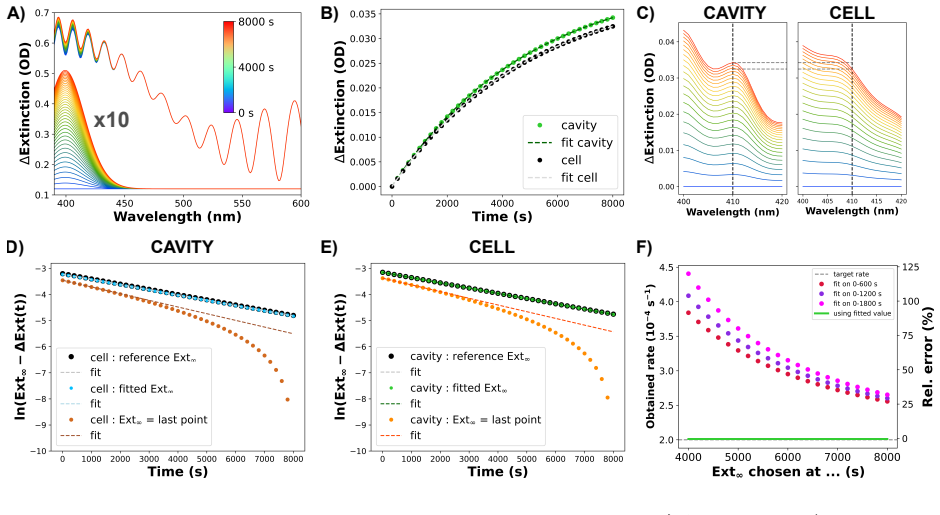
Cavity thickness variations distort apparent reaction kinetics in polaritonic chemistry when monitored at single wavelengths.
A machine-rendered reading of the paper's core claim, the machinery that carries it, and where it could break.
Core claim
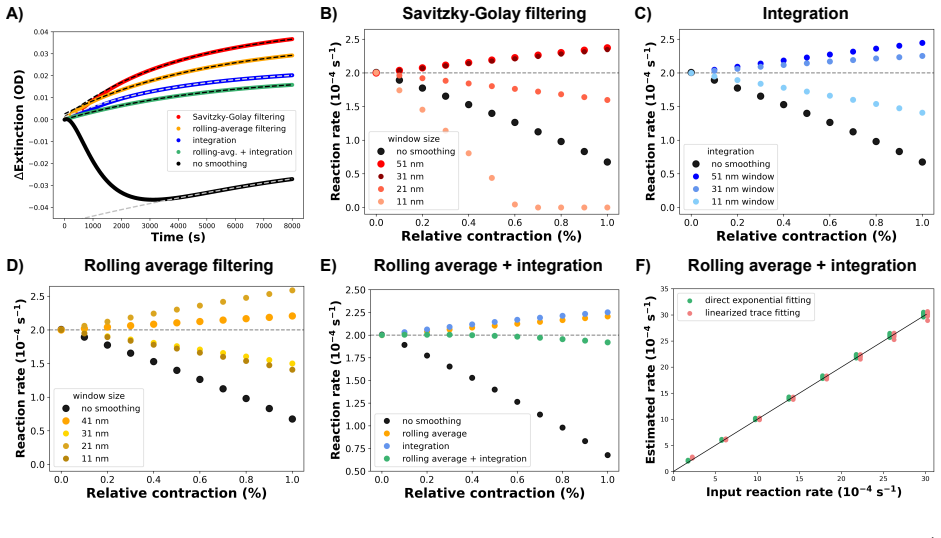
By modeling a pseudo-first-order reaction with the Transfer Matrix Method, the study shows that transient cavity thickness variations strongly affect single-wavelength kinetic traces, leading to incorrect rate constants. This artifact is mitigated by smoothing spectra, and fitting protocols should allow the asymptotic extinction to vary rather than fix it to the experimental endpoint.
What carries the argument
Transfer Matrix Method simulations of light propagation through a layered cavity structure undergoing a pseudo-first-order reaction, used to compute time-dependent absorption spectra under varying thickness conditions.
If this is right
- Single-wavelength monitoring can yield artifactual rate constants due to thickness-induced spectral shifts.
- Applying spectral smoothing recovers more reliable kinetic data.
- Fitting the asymptotic extinction as a parameter rather than fixing it avoids systematic errors in rate extraction.
- These adjustments provide a basis for standardized, reproducible cavity experiments in chemistry.
- The findings apply directly to UV/Vis monitoring of reactions in optical resonators.
Where Pith is reading between the lines
- Correcting these analysis errors may reconcile conflicting experimental results reported in polaritonic chemistry literature.
- The method could be extended to analyze data from more complex reaction mechanisms or different spectroscopic techniques.
- Implementing these protocols might accelerate the development of cavity-based catalysts by enabling trustworthy comparisons across studies.
Load-bearing premise
The dominant effects on observed spectra are captured by a simple pseudo-first-order reaction model plus cavity thickness changes, without needing to include significant chemical side reactions or strong spatial inhomogeneities.
What would settle it
If applying spectral smoothing and free asymptotic fitting to real cavity data produces rate constants matching independent non-cavity measurements, it supports the analysis; persistent mismatches after these corrections would indicate other unaccounted factors.
Figures



read the original abstract
Recent reports suggest that chemical reaction rates can change when reactants are placed inside an optical cavity. These effects have been attributed to the hybridization of molecular vibrational modes with cavity modes into polaritons, but the underlying mechanism remains debated. Recently, attempts to reproduce the key experiments have sometimes failed, which poses also ambiguity and impedes the determination of the possible mechanism. Without a reliable theoretical framework, polaritonic chemistry -- which seeks to use optical resonators as catalysts to control reactions -- has reached a pivotal stage. Standardized protocols for reproducible cavity experiments are therefore urgently needed. Here, we identify pitfalls in approaches that monitor reaction progress with UV/Vis spectroscopy. Using the Transfer Matrix Method, we analyze a model pseudo-first-order reaction and assess how transient cavity thickness variations, cavity inhomogeneity, and fitting protocols influence the extracted rate constant. We find that changes in cavity thickness upon reactant introduction can strongly distort apparent kinetics when monitoring at a single wavelength, an artifact that can be mitigated by spectral smoothing. Additionally, we demonstrate that, unlike in many previous studies, the asymptotic extinction should be treated as a fitting parameter rather than fixed to the final experimental value. By identifying these pitfalls, our work lays the foundation for more robust analyses and reliable measurements in polaritonic chemistry.
Editorial analysis
A structured set of objections, weighed in public.
Referee Report
Summary. The manuscript uses the Transfer Matrix Method (TMM) to simulate a model pseudo-first-order reaction inside an optical cavity and analyzes how transient cavity thickness variations, inhomogeneity, and fitting choices affect extracted rate constants from UV/Vis spectroscopy. It concludes that single-wavelength monitoring is prone to strong distortions from thickness changes (mitigated by spectral smoothing) and that the asymptotic extinction must be treated as a free fitting parameter rather than fixed to the final experimental value.
Significance. If the modeling results hold, the work is significant for polaritonic chemistry because it supplies a concrete, simulation-based protocol to avoid common artifacts that have contributed to reproducibility failures. The explicit demonstration of thickness-induced kinetic distortions and the quantitative assessment of inhomogeneity provide actionable guidance that goes beyond qualitative warnings in prior literature.
minor comments (3)
- §3 (TMM implementation): clarify how the cavity thickness variation is parameterized as a function of reactant concentration; the current description leaves ambiguous whether the change is assumed linear or derived from a physical model of refractive-index shift.
- Figure 4 (or equivalent single-wavelength vs. smoothed comparison): add error bars or shaded uncertainty regions arising from the Monte-Carlo noise model so readers can judge whether the reported distortion exceeds typical experimental noise.
- Discussion section: the statement that 'inhomogeneity was assessed' should be accompanied by a brief table or paragraph quantifying the maximum rate-constant error introduced by the modeled spatial variation, rather than a qualitative statement.
Simulated Author's Rebuttal
We thank the referee for their positive summary of our manuscript and for recommending minor revision. The referee accurately captures our main conclusions regarding thickness-induced distortions in single-wavelength UV/Vis data and the need to fit the asymptotic extinction as a free parameter. We appreciate the recognition of the work's significance for improving reproducibility in polaritonic chemistry.
Circularity Check
No significant circularity
full rationale
The paper's central analysis relies on applying the standard Transfer Matrix Method (an external, well-established optical simulation technique) to a defined pseudo-first-order reaction model. This allows direct numerical assessment of how cavity thickness variations and fitting choices affect extracted kinetics, without any self-referential definitions, fitted inputs renamed as predictions, or load-bearing self-citations. The derivation chain is self-contained: inputs are the TMM equations plus the reaction model, and outputs are simulated artifacts and protocol recommendations that do not reduce to the inputs by construction.
Axiom & Free-Parameter Ledger
axioms (1)
- domain assumption Transfer Matrix Method models the cavity optics accurately for the purposes of this analysis.
Reference graph
Works this paper leans on
-
[1]
2019 , author =
Fundamentals of Photonics , publisher =. 2019 , author =
2019
-
[2]
Nonmodal Plasmonics: Controlling the Forced Optical Response of Nanostructures , author =. Phys. Rev. X , volume =. 2020 , month =. doi:10.1103/PhysRevX.10.011071 , url =
-
[3]
and Simpkins, Blake S
Michon, Michael A. and Simpkins, Blake S. , title =. Journal of the American Chemical Society , volume =. 2024 , doi =
2024
-
[4]
Triana and Felipe Recabal and Felipe Herrera and Blake S
Wonmi Ahn and Johan F. Triana and Felipe Recabal and Felipe Herrera and Blake S. Simpkins , title =. Science , volume =. 2023 , doi =
2023
-
[5]
and Coimbra, C
Orosco, J. and Coimbra, C. F. M. , title =. Applied Optics , volume =. 2018 , doi =
2018
-
[6]
Lather, Jyoti and Bhatt, Pooja and Thomas, Anoop and Ebbesen, Thomas W. and George, Jino , title =. Angewandte Chemie International Edition , volume =. doi:https://doi.org/10.1002/anie.201905407 , url =. https://onlinelibrary.wiley.com/doi/pdf/10.1002/anie.201905407 , abstract =
-
[7]
Singh, Jaibir and Lather, Jyoti and George, Jino , title =. ChemPhysChem , volume =. doi:https://doi.org/10.1002/cphc.202300016 , url =. https://chemistry-europe.onlinelibrary.wiley.com/doi/pdf/10.1002/cphc.202300016 , abstract =
-
[8]
Wiesehan, Garret D. and Xiong, Wei , title =. The Journal of Chemical Physics , volume =. 2021 , month =. doi:10.1063/5.0077549 , url =
-
[9]
Hiura and A
H. Hiura and A. Shalabney and J. George , title =. ChemRxiv 7234721.v3 , doi =
-
[10]
Hirai, Kenji and Takeda, Rie and Hutchison, James A. and Uji-i, Hiroshi , title =. Angewandte Chemie International Edition , volume =. doi:https://doi.org/10.1002/anie.201915632 , url =. https://onlinelibrary.wiley.com/doi/pdf/10.1002/anie.201915632 , year =
-
[11]
Pang, Yantao and Thomas, Anoop and Nagarajan, Kalaivanan and Vergauwe, Robrecht M. A. and Joseph, Kripa and Patrahau, Bianca and Wang, Kuidong and Genet, Cyriaque and Ebbesen, Thomas W. , title =. Angewandte Chemie International Edition , volume =. doi:https://doi.org/10.1002/anie.202002527 , url =. https://onlinelibrary.wiley.com/doi/pdf/10.1002/anie.202...
-
[12]
Vergauwe, Robrecht M. A. and Thomas, Anoop and Nagarajan, Kalaivanan and Shalabney, Atef and George, Jino and Chervy, Thibault and Seidel, Marcus and Devaux, Eloïse and Torbeev, Vladimir and Ebbesen, Thomas W. , title =. Angewandte Chemie International Edition , volume =. doi:https://doi.org/10.1002/anie.201908876 , url =. https://onlinelibrary.wiley.com...
-
[13]
Thomas and L
A. Thomas and L. Lethuillier-Karl and K. Nagarajan and R. M. A. Vergauwe and J. George and T. Chervy and A. Shalabney and E. Devaux and C. Genet and J. Moran and T. W. Ebbesen , title =. Science , volume =. 2019 , doi =
2019
-
[14]
Sau, Abhijit and Nagarajan, Kalaivanan and Patrahau, Bianca and Lethuillier-Karl, Lucas and Vergauwe, Robrecht M. A. and Thomas, Anoop and Moran, Joseph and Genet, Cyriaque and Ebbesen, Thomas W. , title =. Angewandte Chemie International Edition , volume =. doi:https://doi.org/10.1002/anie.202013465 , url =. https://onlinelibrary.wiley.com/doi/pdf/10.100...
-
[15]
Patrahau, B. and Piejko, M. and Mayer, R. J. and Antheaume, C. and Sangchai, T. and Ragazzon, G. and Jayachandran, A. and Devaux, E. and Genet, C. and Moran, J. and Ebbesen, T. W. , title =. Angewandte Chemie International Edition , volume =. doi:https://doi.org/10.1002/anie.202401368 , url =. https://onlinelibrary.wiley.com/doi/pdf/10.1002/anie.202401368...
-
[16]
Jayachandran, A. and Patrahau, B. and Ricca, J. G. and Mahato, M. K. and Pang, Y. and Nagarajan, K. and Thomas, A. and Genet, C. and Ebbesen, T. W. , title =. Angewandte Chemie International Edition , volume =. doi:https://doi.org/10.1002/anie.202503915 , url =. https://onlinelibrary.wiley.com/doi/pdf/10.1002/anie.202503915 , abstract =
-
[17]
, title =
Nagarajan, Kalaivanan and Thomas, Anoop and Ebbesen, Thomas W. , title =. Journal of the American Chemical Society , volume =. 2021 , doi =
2021
-
[18]
Mid-infrared optical properties of thin films of aluminum oxide, titanium dioxide, silicon dioxide, aluminum nitride, and silicon nitride , volume =
Jan Kischkat and Sven Peters and Bernd Gruska and Mykhaylo Semtsiv and Mikaela Chashnikova and Matthias Klinkm\". Mid-infrared optical properties of thin films of aluminum oxide, titanium dioxide, silicon dioxide, aluminum nitride, and silicon nitride , volume =. Appl. Opt. , keywords =. 2012 , url =
2012
-
[19]
Aleksandar D. Raki\'. Optical properties of metallic films for vertical-cavity optoelectronic devices , volume =. Appl. Opt. , keywords =. 1998 , url =
1998
-
[20]
Brawley and Sindhana Pannir-Sivajothi and Ju Eun Yim and Yong Rui Poh and Joel Yuen-Zhou and Matthew Sheldon , title =
Zachary T. Brawley and Sindhana Pannir-Sivajothi and Ju Eun Yim and Yong Rui Poh and Joel Yuen-Zhou and Matthew Sheldon , title =. Nature Chemistry , volume =. 2025 , doi =
2025
-
[21]
Myers and Russell G
Tanya L. Myers and Russell G. Tonkyn and Tyler O. Danby and Matthew S. Taubman and Bruce E. Bernacki and Jerome C. Birnbaum and Steven W. Sharpe and Timothy J. Johnson , title =. Applied Spectroscopy , volume =. 2018 , doi =
2018
-
[22]
and Genet, Cyriaque and Ebbesen, Thomas W
George, Jino and Shalabney, Atef and Hutchison, James A. and Genet, Cyriaque and Ebbesen, Thomas W. , title =. The Journal of Physical Chemistry Letters , volume =. 2015 , doi =
2015
-
[23]
Angewandte Chemie International Edition , volume =
Muller, Cyprien and Piejko, Maciej and Bascil, Sinan and Moran, Joseph , title =. Angewandte Chemie International Edition , volume =. doi:https://doi.org/10.1002/anie.202509391 , url =. https://onlinelibrary.wiley.com/doi/pdf/10.1002/anie.202509391 , abstract =
-
[24]
Ebbesen , title =
Afef Shalabney, Jino George, James Hutchison, Guido Pupillo, Cyriaque Genet & Thomas W. Ebbesen , title =. Nature Communications , volume =. 2015 , doi =
2015
-
[25]
and Chandrasekharan, Gokul and Mattiotti, Francesco and Vergauwe, Robrecht M
Kumar, Sunil and Biswas, Subha and Rashid, Umar and Mony, Kavya S. and Chandrasekharan, Gokul and Mattiotti, Francesco and Vergauwe, Robrecht M. A. and Hagenmuller, David and Kaliginedi, Veerabhadrarao and Thomas, Anoop , title =. Journal of the American Chemical Society , volume =. 2024 , doi =
2024
-
[26]
Chemical Reviews , volume =
Xiang, Bo and Xiong, Wei , title =. Chemical Reviews , volume =. 2024 , doi =
2024
-
[27]
and Dunkelberger, Adam D
Simpkins, Blake S. and Dunkelberger, Adam D. and Owrutsky, Jeffrey C. , title =. The Journal of Physical Chemistry C , volume =. 2021 , doi =
2021
-
[28]
The Journal of Physical Chemistry Letters , volume =
Fukushima, Tomohiro and Itatani, Masaki and Murakoshi, Kei , title =. The Journal of Physical Chemistry Letters , volume =. 2025 , doi =
2025
-
[29]
and Goudarzi, Masoumeh and Askes, Sven H
Verdelli, Francesco and Wei, Yu-Chen and Joseph, Kripa and Abdelkhalik, Mohamed S. and Goudarzi, Masoumeh and Askes, Sven H. C. and Baldi, Andrea and Meijer, E. W. and Gomez Rivas, Jaime , title =. Angewandte Chemie International Edition , volume =. doi:https://doi.org/10.1002/anie.202409528 , url =. https://onlinelibrary.wiley.com/doi/pdf/10.1002/anie.20...
-
[30]
The Journal of Physical Chemistry Letters , volume =
Hsu, Liang-Yan , title =. The Journal of Physical Chemistry Letters , volume =. 2025 , doi =
2025
-
[31]
and Weight, Braden M
Mandal, Arkajit and Taylor, Michael A.D. and Weight, Braden M. and Koessler, Eric R. and Li, Xinyang and Huo, Pengfei , title =. Chemical Reviews , volume =. 2023 , doi =
2023
-
[32]
Campos-Gonzalez-Angulo, J. A. and Poh, Y. R. and Du, M. and Yuen-Zhou, J. , title =. The Journal of Chemical Physics , volume =. 2023 , month =. doi:10.1063/5.0143253 , url =
-
[33]
Joseph, Kripa and Kushida, Soh and Smarsly, Emanuel and Ihiawakrim, Dris and Thomas, Anoop and Paravicini-Bagliani, Gian Lorenzo and Nagarajan, Kalaivanan and Vergauwe, Robrecht and Devaux, Eloise and Ersen, Ovidiu and Bunz, Uwe H. F. and Ebbesen, Thomas W. , title =. Angewandte Chemie International Edition , volume =. doi:https://doi.org/10.1002/anie.202...
-
[34]
Sahin, Mehmet Akif and Shehzad, Muhammad and Destgeer, Ghulam , title =. Small , volume =. doi:https://doi.org/10.1002/smll.202307956 , url =. https://onlinelibrary.wiley.com/doi/pdf/10.1002/smll.202307956 , abstract =
-
[35]
The Journal of Physical Chemistry B , volume =
Yamada, Hayata and Stemo, Garrek and Katsuki, Hiroyuki and Yanagi, Hisao , title =. The Journal of Physical Chemistry B , volume =. 2022 , doi =
2022
-
[36]
Reproducibility of cavity-enhanced chemical reaction rates in the vibrational strong coupling regime , author =
-
[37]
Thomas and William L
Philip A. Thomas and William L. Barnes , title =. J. Phys. Chem. Lett. , year = 2024, volume = 15, number = 6, pages =
2024
-
[38]
and Piejko, Maciej and Patrahau, Bianca and Bauer, Valentin and Moran, Joseph , title =
Muller, Cyprien and Mayer, Robert J. and Piejko, Maciej and Patrahau, Bianca and Bauer, Valentin and Moran, Joseph , title =. Angewandte Chemie International Edition , volume =. doi:https://doi.org/10.1002/anie.202410770 , url =. https://onlinelibrary.wiley.com/doi/pdf/10.1002/anie.202410770 , abstract =
-
[39]
Joseph, Kripa and de Waal, Bas and Jansen, Stef A. H. and van der Tol, Joost J. B. and Vantomme, Ghislaine and Meijer, E. W. , title =. Journal of the American Chemical Society , volume =. 2024 , doi =
2024
-
[40]
The Journal of Physical Chemistry Letters , volume =
Sun, Jing and Vendrell, Oriol , title =. The Journal of Physical Chemistry Letters , volume =. 2023 , doi =
2023
-
[41]
Communications Materials , year =
Ying, Wenxiang and Huo, Pengfei , title =. Communications Materials , year =. doi:10.1038/s43246-024-00551-y , URL =
-
[42]
Sun, Kaihong and Ribeiro, Raphael F. , title =. Nature Communications , year =. doi:10.1038/s41467-024-46442-1 , URL =
-
[43]
and Ronca, Enrico and Koch, Henrik and Sch
Castagnola, Matteo and Haugland, Tor S. and Ronca, Enrico and Koch, Henrik and Sch. Collective Strong Coupling Modifies Aggregation and Solvation , journal =. 2024 , doi =
2024
-
[44]
The Journal of Physical Chemistry Letters , volume =
Schnappinger, Thomas and Kowalewski, Markus , title =. The Journal of Physical Chemistry Letters , volume =. 2024 , doi =
2024
-
[45]
The Journal of Physical Chemistry Letters , volume =
Wei, Yu-Chen and Hsu, Liang-Yan , title =. The Journal of Physical Chemistry Letters , volume =. 2024 , doi =
2024
-
[46]
and Nitzan, Abraham and Subotnik, Joseph E
Li, Tao E. and Nitzan, Abraham and Subotnik, Joseph E. , title =. Nature Communications , volume =. 2022 , doi =
2022
-
[47]
and Feist, Johannes , title =
Fregoni, Jacopo and Garcia-Vidal, Francisco J. and Feist, Johannes , title =. ACS Photonics , volume =. 2022 , doi =
2022
-
[48]
Physical Chemistry Chemical Physics , volume =
Climent, Claudia and Feist, Johannes , title =. Physical Chemistry Chemical Physics , volume =. 2020 , doi =
2020
-
[49]
T. Strong coupling between surface plasmon polaritons and emitters: a review , journal =. 2014 , month =. doi:10.1088/0034-4885/78/1/013901 , url =
-
[50]
Joseph, Kripa and Fu, Hailin and van der Tol, Joost J. B. and Steffen, Werner and Ruan, Feixia and Fytas, George and Meijer, E. W. Impact of vibrational strong coupling on liquid-liquid phase separation in supramolecular polymers. Chem. Sci. 2025. doi:10.1039/D5SC04149J
-
[51]
The Rise and Current Status of Polaritonic Photochemistry and Photophysics , journal =
Bhuyan, Rahul and Mony, J. The Rise and Current Status of Polaritonic Photochemistry and Photophysics , journal =. 2023 , doi =
2023
-
[52]
2025 , eprint=
Ultrafast optical modulation of vibrational strong coupling in ReCl(CO) _3 (2,2-bipyridine) , author=. 2025 , eprint=
2025
-
[53]
and Haberland, Matt and Reddy, Tyler and Cournapeau, David and Burovski, Evgeni and Peterson, Pearu and Weckesser, Warren and Bright, Jonathan and
Virtanen, Pauli and Gommers, Ralf and Oliphant, Travis E. and Haberland, Matt and Reddy, Tyler and Cournapeau, David and Burovski, Evgeni and Peterson, Pearu and Weckesser, Warren and Bright, Jonathan and. Nature Methods , year =
-
[54]
Hendrik Bruus , title =
-
[55]
and Rao,Akshay and Musser,Andrew J
Renken,Scott and Pandya,Raj and Georgiou,Kyriacos and Jayaprakash,Rahul and Gai,Lizhi and Shen,Zhen and Lidzey,David G. and Rao,Akshay and Musser,Andrew J. , title =. J. Chem. Phys. , volume =
discussion (0)
Sign in with ORCID, Apple, or X to comment. Anyone can read and Pith papers without signing in.