Recognition: unknown
Dzyaloshinskii-Moriya interaction as a coherence diagnostic for chirality-induced spin selectivity
Pith reviewed 2026-05-08 06:30 UTC · model grok-4.3
The pith
Coherent chirality-induced spin selectivity generates a giant Dzyaloshinskii-Moriya interaction through molecular bridges while any incoherent version produces none.
A machine-rendered reading of the paper's core claim, the machinery that carries it, and where it could break.
Core claim
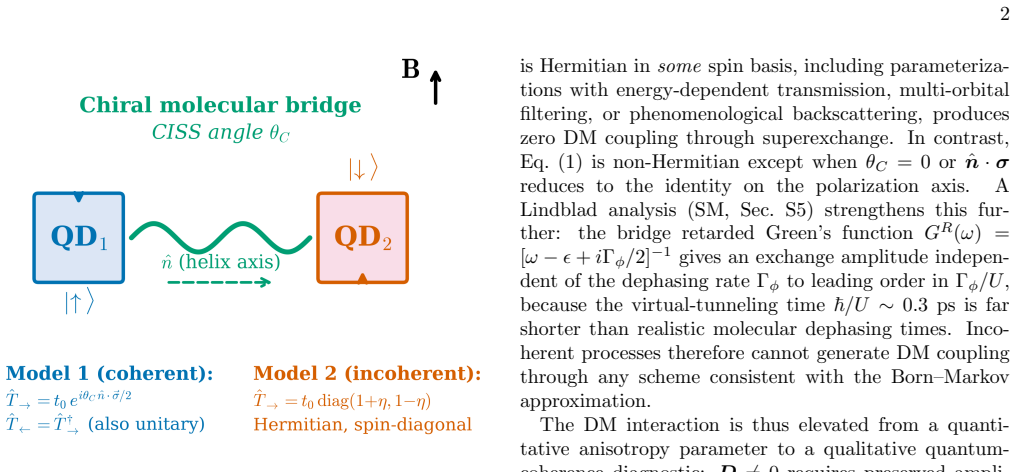
Coherent CISS implemented as a unitary spin rotation of the tunneling electron generates a giant Dzyaloshinskii-Moriya interaction with |D|/J_H up to 3. Incoherent CISS, represented by any Hermitian non-unitary but spin-diagonal tunneling matrix, produces D identically zero; this is proven as a structural theorem and reinforced by a Lindblad argument that dissipative spin filtering leaves virtual-tunneling-mediated superexchange unchanged. The DM interaction therefore functions as a coherence order parameter that is nonzero only when quantum amplitudes for opposite-spin transmission maintain a fixed relative phase.
What carries the argument
The Dzyaloshinskii-Moriya interaction generated by virtual tunneling through the chiral molecular bridge, which serves as a coherence order parameter nonzero solely for unitary spin rotation.
If this is right
- The critical coherent rotation angle needed for observable DM lies two orders of magnitude below values inferred from transport.
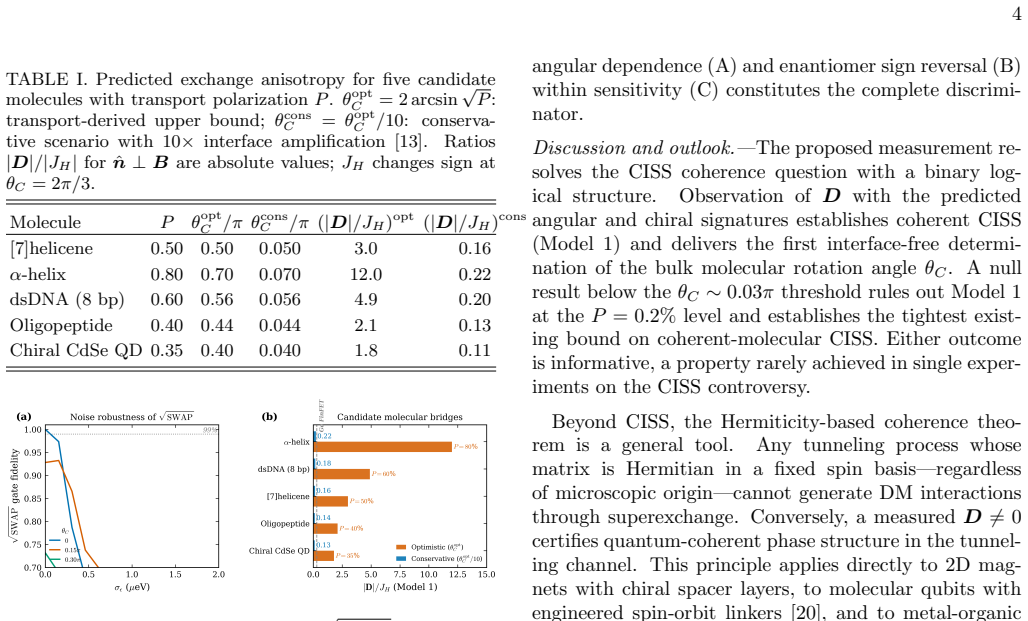
- Five candidate molecules are predicted to exceed the detection threshold even under conservative interface amplification.
- The measurement converts the transport controversy into a binary spin-qubit experiment with quantum-amplitude resolution.
- Closed-form angular, enantiomeric, and sensitivity signatures follow directly from the unitary-rotation model.
Where Pith is reading between the lines
- If the DM signature is confirmed, it would provide a phase-sensitive probe that transport measurements lack.
- The same symmetry criterion could be applied to other chiral bridges or helical structures to test coherence without requiring full quantum-dot fabrication.
- Confirmation of large DM would also imply that virtual processes in molecular spintronics can carry phase information over longer distances than expected.
Load-bearing premise
That incoherent CISS can be faithfully represented by any Hermitian non-unitary spin-diagonal tunneling matrix and that dissipative spin filtering treated with Lindblad operators cannot alter the virtual-tunneling superexchange.
What would settle it
A 10 kHz exchange-spectroscopy measurement on two gate-defined quantum dots linked by one of the five predicted chiral molecules that either detects a DM interaction with |D|/J_H greater than 0.1 or shows its complete absence.
Figures

read the original abstract
Whether chirality-induced spin selectivity (CISS) reflects coherent SU(2) spin rotation or incoherent spin-dependent filtering is a central unresolved question in molecular spintronics, with implications ranging from asymmetric chemistry to quantum information. We show that these two scenarios are distinguishable by a sharp symmetry criterion on the superexchange interaction mediated by a chiral molecular bridge. Coherent CISS, implemented as a unitary spin rotation of the tunneling electron, generates a giant Dzyaloshinskii-Moriya (DM) interaction with ratio |D|/JH up to 3, which is two orders of magnitude beyond intrinsic Rashba spin-orbit coupling in Si/SiGe. Incoherent CISS, represented by any Hermitian (non-unitary but spin-diagonal) tunneling matrix, produces D = 0 identically; we prove this as a structural theorem, reinforced by a Lindblad argument that dissipative spin filtering cannot modify virtual-tunneling-mediated superexchange. The DM interaction thus serves as a coherence order parameter, nonzero only when quantum amplitudes for opposite-spin transmission maintain a fixed relative phase. We derive closed-form angular, enantiomeric, and sensitivity signatures and show that the critical coherent rotation angle lies two orders of magnitude below current transport-inferred values and is accessible to existing 10 kHz exchange spectroscopy in gate-defined quantum dots. Five candidate molecules are predicted to exceed this threshold by one to two orders of magnitude even in a conservative interface-amplification scenario. The proposed measurement converts a long-standing transport controversy into a binary spin-qubit experiment with quantum-amplitude resolution.
Editorial analysis
A structured set of objections, weighed in public.
Referee Report
Summary. The manuscript claims that the Dzyaloshinskii-Moriya (DM) interaction mediated by a chiral molecular bridge distinguishes coherent from incoherent chirality-induced spin selectivity (CISS). Coherent CISS is modeled as a unitary spin rotation and generates a giant DM interaction with |D|/J_H up to 3. Incoherent CISS is represented by any Hermitian non-unitary spin-diagonal tunneling matrix and produces D=0 identically, proven as a structural theorem and reinforced by a Lindblad argument that dissipative spin filtering leaves virtual-tunneling superexchange unmodified. Closed-form angular, enantiomeric, and sensitivity signatures are derived; five candidate molecules are predicted to exceed the threshold, accessible via 10 kHz exchange spectroscopy in quantum dots.
Significance. If the modeling assumptions and derivations hold, the work supplies a symmetry-based, largely parameter-free diagnostic that converts the CISS coherence debate into a binary spin-qubit experiment with quantum-amplitude resolution. The structural theorem for D=0 and the explicit predictions for molecules and experimental signatures are notable strengths. The approach could impact molecular spintronics, asymmetric chemistry, and quantum information by providing a coherence order parameter two orders of magnitude more sensitive than transport measurements.
major comments (2)
- [Structural theorem and modeling of incoherent CISS] The structural theorem asserting D=0 for any Hermitian non-unitary spin-diagonal tunneling matrix (abstract and the section presenting the theorem) is load-bearing for the central claim that incoherent CISS produces no DM. The theorem's generality rests on the modeling choice that incoherent CISS introduces no relative phase or effective spin-mixing after tracing out the environment. Alternative representations (non-Markovian baths or adiabatic elimination of a chiral bridge with internal spin-orbit dynamics) could allow nonzero DM while preserving spin-diagonal incoherent transmission; the manuscript should demonstrate why the chosen representation is exhaustive or sufficient.
- [Lindblad argument] The Lindblad argument that dissipative spin filtering cannot modify virtual-tunneling-mediated superexchange (the section on the Lindblad treatment) assumes dissipators act only on real-time transmission channels and do not renormalize the second-order effective interaction between localized spins. Explicit operator algebra or error analysis showing that virtual intermediate-state propagators remain unmodified is required to support the D=0 result under this representation.
minor comments (2)
- [Abstract] The abstract states that five candidate molecules are predicted but does not name them or point to the relevant table/section; adding this information would improve readability.
- [Derivations of signatures] In the derivations of closed-form signatures, ensure all intermediate steps for the angular dependence and enantiomeric contrast are shown explicitly to facilitate reproduction.
Simulated Author's Rebuttal
We thank the referee for the careful reading, positive assessment of the work's significance, and constructive comments. We address each major comment below, providing clarifications on the modeling scope and committing to explicit additions in the revised manuscript.
read point-by-point responses
-
Referee: The structural theorem asserting D=0 for any Hermitian non-unitary spin-diagonal tunneling matrix (abstract and the section presenting the theorem) is load-bearing for the central claim that incoherent CISS produces no DM. The theorem's generality rests on the modeling choice that incoherent CISS introduces no relative phase or effective spin-mixing after tracing out the environment. Alternative representations (non-Markovian baths or adiabatic elimination of a chiral bridge with internal spin-orbit dynamics) could allow nonzero DM while preserving spin-diagonal incoherent transmission; the manuscript should demonstrate why the chosen representation is exhaustive or sufficient.
Authors: The structural theorem is derived specifically for the standard phenomenological class of incoherent CISS models, in which the tunneling matrix is Hermitian and strictly spin-diagonal (no off-diagonal spin terms or relative phases between channels after environment tracing). This choice aligns with the common literature distinction between coherent unitary spin rotation and incoherent spin-dependent filtering without phase coherence. Within this class, the theorem holds rigorously because the absence of spin-mixing terms forces the second-order superexchange to be purely Heisenberg (D identically zero). Alternative representations such as non-Markovian baths or adiabatic elimination with internal chiral spin-orbit dynamics would generally introduce effective spin-mixing or phase relations, which we classify as coherent or partially coherent rather than purely incoherent. We will add a dedicated paragraph in the revised manuscript explicitly stating these modeling assumptions, contrasting them with the alternatives raised, and noting that the latter fall outside the incoherent regime as defined in the paper. revision: partial
-
Referee: The Lindblad argument that dissipative spin filtering cannot modify virtual-tunneling-mediated superexchange (the section on the Lindblad treatment) assumes dissipators act only on real-time transmission channels and do not renormalize the second-order effective interaction between localized spins. Explicit operator algebra or error analysis showing that virtual intermediate-state propagators remain unmodified is required to support the D=0 result under this representation.
Authors: We agree that the Lindblad section would benefit from more explicit supporting algebra. The argument relies on the fact that the dissipators (modeling real-time spin filtering) act on the transmission channels and do not couple to the virtual intermediate states in a manner that renormalizes the second-order effective Hamiltonian between the localized spins. In the revision we will insert a short appendix or expanded paragraph providing the perturbative expansion of the effective interaction, showing explicitly that the Lindblad operators commute with the virtual-tunneling propagators to the relevant order and leave the DM term zero. This will include the requested operator-level demonstration. revision: yes
Circularity Check
No significant circularity; structural theorem follows from explicit model calculation
full rationale
The paper defines incoherent CISS via an explicit Hermitian spin-diagonal tunneling matrix and derives D=0 as a direct algebraic consequence of that matrix having no relative phases or spin-mixing terms in the second-order superexchange. This is a standard model-to-result mapping, not a redefinition or fit renamed as prediction. The coherent case similarly follows from inserting a unitary rotation matrix. The Lindblad reinforcement is presented as an independent open-system argument without reducing to self-citation or unverified assumptions about the target DM result. No parameters are fitted to data and then called predictions, and no uniqueness theorems or ansatze are smuggled via self-citation. The derivation chain is therefore self-contained against the stated modeling choices.
Axiom & Free-Parameter Ledger
axioms (2)
- domain assumption Tunneling through a molecular bridge can be represented either as a unitary SU(2) operator or as a Hermitian but non-unitary spin-diagonal matrix
- standard math Superexchange between two localized spins is mediated by virtual tunneling through the chiral bridge
Reference graph
Works this paper leans on
-
[1]
K. Ray, S. Ananthavel, D. Waldeck, and R. Naaman, Asymmetric scattering of polarized electrons by orga- nized organic films of chiral molecules, Science283, 814 (1999)
1999
-
[2]
Gohler, V
B. Gohler, V. Hamelbeck, T. Markus, M. Kettner, G. Hanne, Z. Vager, R. Naaman, and H. Zacharias, Spin selectivity in electron transmission through self- assembled monolayers of double-stranded dna, Science 331, 894 (2011)
2011
-
[3]
Naaman, Y
R. Naaman, Y. Paltiel, and D. H. Waldeck, Chiral molecules and the electron spin, Nature Reviews Chem- istry3, 250 (2019)
2019
-
[4]
B. P. Bloom, Y. Paltiel, R. Naaman, and D. H. Waldeck, Chiral induced spin selectivity, Chemical Reviews124, 1950 (2024)
1950
-
[5]
Mishra, T
D. Mishra, T. Z. Markus, R. Naaman, M. Kettner, B. Gohler, H. Zacharias, N. Friedman, M. Sheves, and C. Fontanesi, Spin-dependent electron transmission through bacteriorhodopsin embedded in purple mem- brane, Proceedings of the National Academy of Sciences 110, 14872 (2013)
2013
-
[6]
Kettner, V
M. Kettner, V. V. Maslyuk, D. Nuerenberg, J. Seibel, R. Gutierrez, G. Cuniberti, K.-H. Ernst, and H. Zacharias, Chirality-dependent electron spin fil- tering by molecular monolayers of helicenes, The journal of physical chemistry letters9, 2025 (2018)
2025
-
[7]
Kiran, S
V. Kiran, S. P. Mathew, S. R. Cohen, I. Hern´ andez Del- gado, J. Lacour, and R. Naaman, Helicenes—a new class of organic spin filter, Advanced Materials28, 1957 (2016)
1957
-
[8]
H. Lu, J. Wang, C. Xiao, X. Pan, X. Chen, R. Bru- necky, J. J. Berry, K. Zhu, M. C. Beard, and Z. V. Var- deny, Spin-dependent charge transport through 2d chi- ral hybrid lead-iodide perovskites, Science advances5, eaay0571 (2019)
2019
-
[9]
Y. Dong, M. P. Hautzinger, M. A. Haque, and M. C. Beard, Chirality-induced spin selectivity in hybrid organic-inorganic perovskite semiconductors, Annual Re- view of Physical Chemistry76, 519 (2025)
2025
-
[10]
Shiby, R
E. Shiby, R. Sun, B. P. Bloom, J. A. Albro, D. Sun, and D. H. Waldeck, Interplay between chiro-optical and spin transport properties in chiral cdse quantum dots, ACS nano19, 35119 (2025)
2025
-
[11]
Fransson, Vibrational origin of exchange splitting and” chiral-induced spin selectivity, Physical Review B102, 235416 (2020)
J. Fransson, Vibrational origin of exchange splitting and” chiral-induced spin selectivity, Physical Review B102, 235416 (2020)
2020
-
[12]
T. K. Das, R. Naaman, and J. Fransson, Insights into the mechanism of chiral-induced spin selectivity: The effect of magnetic field direction and temperature, Advanced Materials36, 2313708 (2024)
2024
-
[13]
Y. Zhao, K. Zhang, J. Xiao, K. Sun, and B. Yan, Magne- tochiral charge pumping due to charge trapping and skin effect in chirality-induced spin selectivity, Nature com- munications16, 37 (2025)
2025
-
[14]
Evers, A
F. Evers, A. Aharony, N. Bar-Gill, O. Entin-Wohlman, P. Hedeg˚ ard, O. Hod, P. Jelinek, G. Kamieniarz, M. Lemeshko, K. Michaeli,et al., Theory of chirality induced spin selectivity: Progress and challenges, Ad- vanced Materials34, 2106629 (2022)
2022
-
[15]
Medina, L
E. Medina, L. A. Gonz´ alez-Arraga, D. Finkelstein- Shapiro, B. Berche, and V. Mujica, Continuum model for chiral induced spin selectivity in helical molecules, The Journal of chemical physics142(2015)
2015
-
[16]
Dalum and P
S. Dalum and P. Hedeg˚ ard, Theory of chiral induced spin selectivity, Nano letters19, 5253 (2019)
2019
-
[17]
Yeganeh, M
S. Yeganeh, M. A. Ratner, E. Medina, and V. Mujica, Chiral electron transport: Scattering through helical po- tentials, The Journal of chemical physics131(2009)
2009
-
[18]
Guo and Q.-f
A.-M. Guo and Q.-f. Sun, Spin-selective transport of elec- trons in dna double helix, Physical review letters108, 218102 (2012)
2012
-
[19]
X. Yang, C. H. van der Wal, and B. J. van Wees, Spin-dependent electron transmission model for chiral molecules in mesoscopic devices, Physical Review B99, 024418 (2019)
2019
-
[20]
Chiesa, A
A. Chiesa, A. Privitera, E. Macaluso, M. Mannini, R. Bittl, R. Naaman, M. R. Wasielewski, R. Sessoli, and S. Carretta, Chirality-induced spin selectivity: An en- abling technology for quantum applications, Advanced Materials35, 2300472 (2023)
2023
-
[21]
Banerjee-Ghosh, O
K. Banerjee-Ghosh, O. Ben Dor, F. Tassinari, E. Ca- pua, S. Yochelis, A. Capua, S.-H. Yang, S. S. Parkin, S. Sarkar, L. Kronik,et al., Separation of enantiomers by their enantiospecific interaction with achiral magnetic substrates, Science360, 1331 (2018)
2018
-
[22]
C. D. Aiello, J. M. Abendroth, M. Abbas, A. Afanasev, S. Agarwal, A. S. Banerjee, D. N. Beratan, J. N. Belling, B. Berche, A. Botana,et al., A chirality-based quantum leap, ACS nano16, 4989 (2022)
2022
-
[23]
H. J. Eckvahl, N. A. Tcyrulnikov, A. Chiesa, J. M. Bradley, R. M. Young, S. Carretta, M. D. Krzya- niak, and M. R. Wasielewski, Direct observation of chirality-induced spin selectivity in electron donor– acceptor molecules, Science382, 197 (2023)
2023
-
[24]
J. R. Petta, A. C. Johnson, J. M. Taylor, E. A. Laird, A. Yacoby, M. D. Lukin, C. M. Marcus, M. P. Hanson, and A. C. Gossard, Coherent manipulation of coupled electron spins in semiconductor quantum dots, Science 309, 2180 (2005)
2005
-
[25]
O. Dial, M. D. Shulman, S. P. Harvey, H. Bluhm, V. Umansky, and A. Yacoby, Charge noise spectroscopy using coherent exchange oscillations in a singlet-triplet qubit, Physical review letters110, 146804 (2013)
2013
-
[26]
Yoneda, K
J. Yoneda, K. Takeda, T. Otsuka, T. Nakajima, M. R. Delbecq, G. Allison, T. Honda, T. Kodera, S. Oda, Y. Hoshi,et al., A quantum-dot spin qubit with co- herence limited by charge noise and fidelity higher than 99.9%, Nature nanotechnology13, 102 (2018)
2018
-
[27]
E. J. Connors, J. Nelson, L. F. Edge, and J. M. Nichol, Charge-noise spectroscopy of si/sige quantum dots via dynamically-decoupled exchange oscillations, Nature communications13, 940 (2022)
2022
-
[28]
Struck, A
T. Struck, A. Hollmann, F. Schauer, O. Fedorets, A. Schmidbauer, K. Sawano, H. Riemann, N. V. Abrosi- mov, L. Cywi´ nski, D. Bougeard,et al., Low-frequency spin qubit energy splitting noise in highly purified 28si/sige, npj Quantum Information6, 40 (2020)
2020
-
[29]
J. R. Schrieffer and P. A. Wolff, Relation between the anderson and kondo hamiltonians, Physical Review149, 491 (1966)
1966
-
[30]
Bravyi, D
S. Bravyi, D. P. DiVincenzo, and D. Loss, Schrieffer–wolff transformation for quantum many-body systems, Annals of physics326, 2793 (2011)
2011
-
[31]
P. W. Anderson, New approach to the theory of superex- change interactions, Physical Review115, 2 (1959). 6
1959
-
[32]
See Supplemental Material at [URL] for the full Schrieffer–Wolff derivation, explicit evaluation of both models, the gauge-triviality proof, multi-orbital gen- eralization, Lindblad analysis, perturbative sensitivity derivation, Monte Carlo noise simulation, two-qubit gate analysis, and computational reproducibility details
-
[33]
Geyer, B
S. Geyer, B. Het´ enyi, S. Bosco, L. C. Camenzind, R. S. Eggli, A. Fuhrer, D. Loss, R. J. Warburton, D. M. Zumb¨ uhl, and A. V. Kuhlmann, Anisotropic exchange interaction of two hole-spin qubits, Nature Physics20, 1152 (2024)
2024
-
[34]
Saez-Mollejo, D
J. Saez-Mollejo, D. Jirovec, Y. Schell, J. Kukucka, S. Calcaterra, D. Chrastina, G. Isella, M. Rimbach-Russ, S. Bosco, and G. Katsaros, Exchange anisotropies in microwave-driven singlet-triplet qubits, Nature Commu- nications16, 3862 (2025)
2025
-
[35]
Hendrickx, D
N. Hendrickx, D. Franke, A. Sammak, G. Scappucci, and M. Veldhorst, Fast two-qubit logic with holes in germa- nium, Nature577, 487 (2020)
2020
-
[36]
A. C. Aragon` es, E. Medina, M. Ferrer-Huerta, N. Gi- meno, M. Teixid´ o, J. L. Palma, N. Tao, J. M. Ugalde, E. Giralt, I. D´ ıez-P´ erez,et al., Measuring the spin- polarization power of a single chiral molecule, small , 1602519 (2017)
2017
-
[37]
Burzur´ ı, Y
E. Burzur´ ı, Y. Yamamoto, M. Warnock, X. Zhong, K. Park, A. Cornia, and H. S. van der Zant, Franck– condon blockade in a single-molecule transistor, Nano letters14, 3191 (2014)
2014
-
[38]
Kiczynski, S
M. Kiczynski, S. K. Gorman, H. Geng, M. B. Donnelly, Y. Chung, Y. He, J. G. Keizer, and M. Y. Simmons, En- gineering topological states in atom-based semiconductor quantum dots, Nature606, 694 (2022)
2022
discussion (0)
Sign in with ORCID, Apple, or X to comment. Anyone can read and Pith papers without signing in.