Recognition: unknown
Quantum oscillations and nonsaturating magnetoresistivity in nodal-line semimetals
Pith reviewed 2026-05-08 06:26 UTC · model grok-4.3
The pith
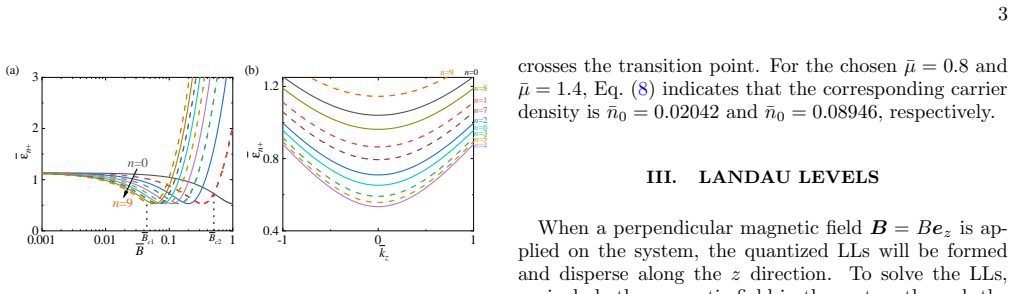
Nodal-line semimetals exhibit two distinct quantum oscillation frequencies from their torus Fermi surface.
A machine-rendered reading of the paper's core claim, the machinery that carries it, and where it could break.
Core claim
The torus Fermi surface in nodal-line semimetals leads to two distinct oscillation frequencies in the magnetoconductivity and chemical potential, which can be regarded as an important experimental signature. Although the magnetoresistivity is nonsaturating in the low-energy region, the MR ratio is much smaller than that reported in the experiment on EuGa4.
What carries the argument
The torus Fermi surface, which supports two different extremal cross sections for cyclotron motion in a magnetic field.
If this is right
- Two oscillation frequencies serve as a signature to identify nodal-line semimetals experimentally.
- Magnetoresistivity does not saturate as the magnetic field increases.
- The calculated MR ratio being smaller suggests the model misses some contributions present in real materials.
- Oscillations occur in both chemical potential and conductivity.
Where Pith is reading between the lines
- This signature could help differentiate nodal-line semimetals from Weyl or Dirac semimetals in transport measurements.
- The MR discrepancy may be resolved by including disorder, interactions, or higher bands in future models.
- The results could guide experiments on other nodal-line materials to verify the torus-induced dual frequencies.
Load-bearing premise
The low-energy effective model for the nodal-line semimetal captures the dominant magnetotransport features without significant contributions from other bands, disorder, or interactions.
What would settle it
Observation of only one frequency in quantum oscillation experiments on a nodal-line semimetal would falsify the prediction of two frequencies from the torus Fermi surface.
Figures



read the original abstract
Understanding the magnetotransport behaviors in topological systems remains alluring, as a lot of intrinsic information could be extracted, e.g., the band structures, Berry phase, Fermi surface, carrier density, and so on. Motivated by the recent magnetotransport developments in nodal-line semimetal, EuGa4, in this paper, we will study the magnetotransport properties of the system, focusing on the quantum oscillations and nonsaturating magnetoresistivity (MR). Firstly, we analyze the chemical potential and magnetoconductivity oscillations with the magnetic field and reveal that there exist two distinct oscillation frequencies, which are caused by the characteristic torus Fermi surface and can be regarded as an important experimental signature of nodal-line semimetals. Then we calculate the MR and find that although the MR is nonsaturating with the magnetic field in the low-energy region, the MR ratio is much smaller than that reported in the experiment.
Editorial analysis
A structured set of objections, weighed in public.
Referee Report
Summary. The manuscript studies magnetotransport in nodal-line semimetals via a low-energy effective model motivated by EuGa4. It reports two distinct frequencies in quantum oscillations of chemical potential and magnetoconductivity, attributed to the torus Fermi surface and proposed as an experimental signature of nodal-line semimetals. It also finds nonsaturating magnetoresistivity whose magnitude is much smaller than experimental values.
Significance. The two-frequency oscillation pattern, if robust, would provide a distinctive signature tied directly to the nodal-line torus geometry. The nonsaturating MR is consistent with expectations for open-orbit or topological systems, but the quantitative shortfall relative to experiment indicates that the low-energy model captures only part of the physics. The work adds to the literature on how Fermi-surface topology controls oscillation spectra in semimetals.
major comments (2)
- [Abstract and results on oscillations] Abstract and main results section: the assertion that the two oscillation frequencies 'can be regarded as an important experimental signature of nodal-line semimetals' rests on the low-energy torus model, yet the same model is stated to produce an MR ratio 'much smaller than that reported in the experiment.' No analysis is given of whether additional bands, disorder, or interactions (omitted by construction) would introduce extra frequencies or change the relative amplitudes, which directly affects whether the two frequencies constitute a clean signature.
- [Model and methods] Model section: the effective Hamiltonian and the procedure for extracting the two frequencies from the torus Fermi surface are not compared against a full tight-binding or DFT band structure of EuGa4. Without this check it is unclear whether the reported frequencies survive when the low-energy approximation is relaxed, which is load-bearing for the experimental-signature claim.
minor comments (2)
- [Abstract] The abstract states results from calculations but supplies no equations, parameter values, or error estimates; a brief methods summary would improve readability.
- [Results] Notation for the two frequencies (e.g., F1 and F2) and the precise definition of the torus cross-sections should be introduced earlier and used consistently in figures and text.
Simulated Author's Rebuttal
We thank the referee for the careful reading and constructive comments on our manuscript. We address each major comment below and have revised the text to better clarify the scope and limitations of the low-energy model while defending the robustness of the reported signatures within that framework.
read point-by-point responses
-
Referee: Abstract and main results section: the assertion that the two oscillation frequencies 'can be regarded as an important experimental signature of nodal-line semimetals' rests on the low-energy torus model, yet the same model is stated to produce an MR ratio 'much smaller than that reported in the experiment.' No analysis is given of whether additional bands, disorder, or interactions (omitted by construction) would introduce extra frequencies or change the relative amplitudes, which directly affects whether the two frequencies constitute a clean signature.
Authors: We agree that the low-energy model is minimal by design and that omitted physics could quantitatively affect MR amplitudes. However, the two frequencies arise directly from the distinct extremal orbits on the inner and outer equators of the torus Fermi surface, a geometric feature tied to the nodal-line dispersion. Within the model, both chemical-potential and conductivity oscillations exhibit these frequencies cleanly, without additional peaks. Additional bands or disorder would primarily rescale carrier densities or scattering times but are not expected to generate new extremal areas at the nodal-line energy scale. We have added a clarifying paragraph in the discussion section that explicitly addresses this point, notes the model's underestimation of the experimental MR ratio, and explains why the two-frequency pattern remains a distinctive topological signature. revision: partial
-
Referee: Model section: the effective Hamiltonian and the procedure for extracting the two frequencies from the torus Fermi surface are not compared against a full tight-binding or DFT band structure of EuGa4. Without this check it is unclear whether the reported frequencies survive when the low-energy approximation is relaxed, which is load-bearing for the experimental-signature claim.
Authors: The effective Hamiltonian is obtained by a standard low-energy expansion around the nodal line, with parameters chosen to reproduce the torus Fermi surface reported in prior studies of EuGa4. The frequency extraction follows the semiclassical Onsager relation applied to the two extremal cross-sections of that torus. We acknowledge that an explicit side-by-side comparison with a full magnetic-field DFT or tight-binding calculation would provide further validation. Such a computation, however, lies beyond the scope of the present work, which is devoted to analytic and numerical results within the effective model. In the revised manuscript we have added citations to the relevant DFT literature on EuGa4 and a brief statement on the regime of validity of the low-energy approximation. revision: partial
- Explicit numerical extraction of quantum-oscillation frequencies from a full DFT or tight-binding band structure of EuGa4 under finite magnetic field
Circularity Check
No circularity: frequencies derived directly from model torus surface
full rationale
The paper constructs a low-energy effective Hamiltonian for the nodal-line semimetal, computes the torus-shaped Fermi surface, then derives the two distinct oscillation frequencies from the extremal orbits on that surface via standard semiclassical quantization. No parameters are stated to be fitted to the EuGa4 magnetotransport data and then reused as 'predictions'; the MR calculation is performed within the same model and the smaller ratio is explicitly reported as a limitation rather than hidden. No self-citations, uniqueness theorems, or ansatzes imported from prior work by the same authors appear in the derivation chain. The analysis remains self-contained within the stated model assumptions.
Axiom & Free-Parameter Ledger
Reference graph
Works this paper leans on
-
[1]
B. Q. Lv, T. Qian, H. Ding, Experimental perspective on three-dimensional topological semimetals, Rev. Mod. Phys.93, 025002 (2021)
2021
-
[2]
J. A. Sobota, Y. He, Z. X. Shen, Angle-resolved photoe- mission studies of quantum materials, Rev. Mod. Phys. 93, 025006 (2021)
2021
-
[3]
A. A. Burkov, M. D. Hook, and L. Balents, Topological nodal semimetals, Phys. Rev. B84, 235126 (2011)
2011
-
[4]
Phillips and V
M. Phillips and V. Aji, Tunable line node semimetals, Phys. Rev. B90, 115111 (2014)
2014
-
[5]
C. Fang, Y. Chen, H. Y. Kee, and L. Fu, Topological nodal line semimetals with and without spin-orbital cou- pling, Phys. Rev. B92, 081201 (2015)
2015
-
[6]
Y. H. Chan, C. K. Chiu, M. Y. Chou, and A. P. Schnyder, Ca3P2 and other topological semimetals with line nodes and drumhead surface states, Phys. Rev. B93, 205132 (2016)
2016
-
[7]
G. Bian, T. R. Chang, H. Zheng, S. Velury, S. Y. Xu, T. Neupert, C. K. Chiu, S. M. Huang, D. S. Sanchez, I. Belopolski, N. Alidoust, P. J. Chen, G. Chang, A. Bansil, H. T. Jeng, H. Lin, and M. Z. Hasan, Drum- head surface states and topological nodal-line fermions in TlTaSe2, Phys. Rev. B93, 121113(R) (2016). 8
2016
-
[8]
Belopolski, K
I. Belopolski, K. Manna, D. S. Sanchez, G. Chang, B. Ernst, J. Yin, S. S. Zhang, T. Cochran, N. Shumiya, H. Zheng, B. Singh, G. Bian, D. Multer, M. Litskevich, X. Zhou, S. M. Huang, B. Wang, T. R. Chang, S. Y. Xu, A. Bansil, C. Felser, H. Lin, M. Z. Hasan, Discovery of topological Weyl fermion lines and drumhead surface states in a room temperature magnet...
2019
-
[9]
S. T. Ramamurthy, T. L. Hughes, Quasitopological elec- tromagnetic response of line-node semimetals, Phys. Rev. B95, 075138 (2017)
2017
-
[10]
Barati and S
S. Barati and S. H. Abedinpour, Optical conductiv- ity of three and two dimensional topological nodal-line semimetals, Phys. Rev. B96, 155150 (2017)
2017
-
[11]
C. Wang, W. H. Xu, C. Y. Zhu, J. N. Chen, Y. L. Zhou, M. X. Deng, H. J. Duan, and R. Q. Wang, Anomalous Hall optical conductivity in tilted topological nodal-line semimetals, Phys. Rev. B103, 165104 (2021)
2021
-
[12]
Y. Huh, E. G. Moon, and Y. B. Kim, Long-range Coulomb interaction in nodal-ring semimetals, Phys. Rev. B93, 035138 (2016)
2016
-
[13]
Y. Shao, A. N. Rudenko, J. Hu, Z. Sun, Y. Zhu, S. Moon, A. J. Millis, S. Yuan, A. I. Lichtenstein, D. Smirnov, Z. Q. Mao, M. I. Katsnelson, and D. N. Basov, Electronic correlations in nodal-line semimetals, Nat. Phys.16, 636 (2020)
2020
-
[14]
Wu and Y
Z. Wu and Y. Wang, Nodal topological superconductiv- ity in nodal-line semimetals, Phys. Rev. B108, 224503 (2023)
2023
-
[15]
L. S. Xie, L. M. Schoop, E. M. Seibel, Q. D. Gibson, W. Xie, and R. J. Cava, A new form of Ca 3P2 with a ring of Dirac nodes, APL Mater.3, 083602 (2015)
2015
-
[16]
G. Bian, T. R. Chang, R. Sankar, S. Y. Xu, H. Zheng, T. Neupert, C. K. Chiu, S. M. Huang, G. Chang, I. Be- lopolski, D. S. Sanchez, M. Neupane, N. Alidoust, C. Liu, B. Wang, C. C. Lee, H. T. Jeng, C. Zhang, Z. Yuan, S. Jia, A. Bansil, F. Chou, H. Lin, and M. Z. Hasan, Topo- logical nodal-line fermions in spin-orbit metal PbTaSe 2, Nat. Commun.7, 10556 (2016)
2016
-
[17]
Takane, Z
D. Takane, Z. Wang, S. Souma, K. Nakayama, C. X. Trang, T. Sato, T. Takahashi, and Y. Ando, Dirac-node arc in the topological line-node semimetal HfSiS, Phys. Rev. B94121108(R) (2016)
2016
-
[18]
Okamoto, T
Y. Okamoto, T. Inohara, A. Yamakage, Y. Yamakawa, and Koshi Takenaka, Low carrier density metal real- ized in candidate line-node Dirac semimetals CaAgP and CaAgAs, J. Phys. Soc. Jpn,85, 123701 (2016)
2016
-
[19]
Emmanouilidou, B
E. Emmanouilidou, B. Shen, X. Deng, T. R. Chang, A. Shi, G. Kotliar, S. Y. Xu, and N. Ni, Magnetotransport properties of the single-crystalline nodal-line semimetal candidates CaTX (T=Ag, Cd; X=As, Ge), Phys. Rev. B 95, 245113 (2017)
2017
-
[20]
Y. H. Kwan, P. Reiss, Y. Han, M. Bristow, D. Prab- hakaran, D. Graf, A. McCollam, S. A. Parameswaran, and A. I. Coldea, Quantum oscillations probe the Fermi surface topology of the nodal-line semimetal CaAgAs, Phys. Rev. Res.2, 012055(R) (2020)
2020
-
[21]
H. T. Hirose, T. Terashima, T. Wada, Y. Matsushita, Y. Okamoto, K. Takenaka, and S. Uji, Real spin and pseu- dospin topologies in the noncentrosymmetric topological nodal-line semimetal CaAgAs, Phys. Rev. B101, 245104 (2020)
2020
-
[22]
X. B. Wang, X. M. Ma, E. Emmanouilidou, B. Shen, C. H. Hsu, C. S. Zhou, Y. Zuo, R. R. Song, S. Y. Xu, G. Wang, L. Huang, N. Ni, and C. Liu, Topological surface electronic states in candidate nodal-line semimetal CaA- gAs, Phys. Rev. B96, 161112(R) (2017)
2017
-
[23]
N. Xu, Y. T. Qian, Q. S. Wu, G. Aut` es, C. E. Matt, B. Q. Lv, M. Y. Yao, V. N. Strocov, E. Pomjakushina, K. Conder N. C. Plumb, M. Radovic, O. V. Yazyev, T. Qian, H. Ding, J. Mesot, and M. Shi, Trivial topological phase of CaAgP and the topological nodal-line transition in CaAg(P1−xAsx), Phys. Rev. B97, 161111(R) (2018)
2018
-
[24]
L. M. Schoop, M. N. Ali, C. Straßer, A. Topp, A. Varykhalov, D. Marchenko, V. Duppel, S. S. P. Parkin, B. V. Lotsch, and C. R. Ast, Dirac cone protected by non-symmorphic symmetry and three-dimensional Dirac line node in ZrSiS, Nat. Commun.7, 11696 (2016)
2016
-
[25]
Neupane, I
M. Neupane, I. Belopolski, M. M. Hosen, D. S. Sanchez, R. Sankar, M. Szlawska, S. Y. Xu, K. Dimitri, N. Dhakal, P. Maldonado, P. M. Oppeneer, D. Kaczorowski, F. Chou, M. Z. Hasan, and T. Durakiewicz, Observation of topological nodal fermion semimetal phase in ZrSiS, Phys. Rev. B93, 201104(R) (2016)
2016
-
[26]
J. Hu, Z. Tang, J. Liu, X. Liu, Y. Zhu, D. Graf, K. Myhro, S. Tran, C. N. Lau, J. Wei, and Z. Mao, Evidence of topological nodal-line fermions in ZrSiSe and ZrSiTe, Phys. Rev. Lett.117, 016602 (2016)
2016
-
[27]
S. Lei, K. Allen, J. Huang, J. M. Moya, T. C. Wu, B. Casas, Y. Zhang, J. S. Oh, M. Hashimoto, D. Lu, J. Denlinger, C. Jozwiak, A. Bostwick, E. Rotenberg, L. Balicas, R. Birgeneau, M. S. Foster, M. Yi, Y. Sun and E. Morosan, Weyl nodal ring states and Landau quan- tization with very large magnetoresistance in square-net magnet EuGa4, Nat. Commun.14, 5812 (2023)
2023
-
[28]
M. N. Ali, J. Xiong, S. Flynn, J. Tao, Q. D. Gib- son, L. M. Schoop, T. Liang, N. Haldolaarachchige, M. Hirschberger, N. P. Ong, and R. J. Cava, Large, non- saturating magnetoresistance in WTe 2, Nature514, 205 (2014)
2014
-
[29]
Shekhar1, A
C. Shekhar1, A. K. Nayak, Y. Sun, M. Schmidt, M. Nick- las, I. Leermakers, U. Zeitler, Y. Skourski, J. Wosnitza, Z. Liu, Y. Chen, W. Schnelle, H. Borrmann, Y. Grin, C. Felser and B. Yan, Extremely large magnetoresistance and ultrahigh mobility in the topologicalWeyl semimetal candidate NbP, Nat. Phys.11, 645 (2015)
2015
-
[30]
Huang, L
X. Huang, L. Zhao, Y. Long, P. Wang, D. Chen, Z. Yang, H. Liang, M. Xue, H. Weng, Z. Fang, X. Dai, and G. Chen, Observation of the Chiral-Anomaly-Induced Neg- ative Magnetoresistance in 3D Weyl Semimetal TaAs, Phys. Rev. X5, 031023 (2015)
2015
-
[31]
Fauqu´ e, X
B. Fauqu´ e, X. Yang, W. Tabis, M. Shen, Z. Zhu, C. Proust, Y. Fuseya, and K. Behnia, Magnetoresistance of semimetals: The case of antimony, Phys. Rev. Mat.2, 114201 (2018)
2018
-
[32]
M. X. Yang, W. Luo, and W. Chen, Quantum transport in topological nodal-line semimetals. Adv. Phys.: X7, 2065216 (2022)
2022
-
[33]
Pandey, D
V. Pandey, D. Joy, D. Culcer, and P. Bhalla, Longitudinal dc conductivity in Dirac nodal line semimetals: Intrinsic and extrinsic contributions, Phys. Rev. B110, 155108 (2024)
2024
-
[34]
Shoenberg,Magnetic Oscillations in MetalsCam- bridge University Press, Cambridge, (1984)
D. Shoenberg,Magnetic Oscillations in MetalsCam- bridge University Press, Cambridge, (1984)
1984
-
[35]
Zhang, X
L. Zhang, X. Y. Song, and F. Wang, Quantum oscil- lation in narrow-gap topological insulators, Phys. Rev. Lett.116, 046404 (2016). 9
2016
-
[36]
Knolle and N
J. Knolle and N. R. Cooper, Anomalous de Haas–van Alphen effect in InAs=GaSb quantum wells, Phys. Rev. Lett.118, 176801 (2017)
2017
-
[37]
Y. X. Wang and Z. Cai, Quantum oscillations and three- dimensional quantum Hall effect in ZrTe 5, Phys. Rev. B 107, 125203 (2023)
2023
-
[38]
C. Li, C. M. Wang, B. Wan, X. Wan, H.-Z. Lu, and X. C. Xie, Rules for phase shifts of quantum oscillations in topological nodal-line semimetals, Phys. Rev. Lett.120, 146602 (2018)
2018
-
[39]
Oroszl´ any, B
L. Oroszl´ any, B. D´ ora, J. Cserti, and A. Cortijo, Topo- logical and trivial magnetic oscillations in nodal loop semimetals, Phys. Rev. B97, 205107 (2018)
2018
-
[40]
H. Yang, R. Moessner, and L. K. Lim, Quantum oscil- lations in nodal line systems, Phys. Rev. B97, 165118 (2018)
2018
-
[41]
Y. Zhao, H. Liu, C. Zhang, H. Wang, J. Wang, Z. Lin, Y. Xing, H. Lu, J. Liu, Y. Wang, S. M. Brombosz, Z. Xiao, S. Jia, X. C. Xie, and J. Wang, Anisotropic Fermi sur- face and quantum limit transport in high mobility three- dimensional Dirac semimetal Cd 3As2, Phys. Rev. X5, 031037 (2015)
2015
-
[42]
W. B. Rui, Y. X. Zhao, and A. P. Schnyder, Topological transport in Dirac nodal-line semimetals, Phys. Rev. B 97, 161113(R) (2018)
2018
-
[43]
Devakul, Y
T. Devakul, Y. H. Kwan, S. L. Sondhi, S. A. Parameswaran, Quantum oscillations in the zeroth Lan- dau level: serpentine Landau fan and the chiral anomaly, Phys. Rev. Lett.127116602 (2021)
2021
-
[44]
Y. X. Wang and F. Li, Unconventional optical selection rules in ZrTe 5 under an in-plane magnetic field, Phys. Rev. B106205102 (2022)
2022
-
[45]
Bastin, C
A. Bastin, C. Lewiner, O. Betbeder-Matibet, and P. Nozieres, Quantum oscillations of the Hall effect of a fermion gas with random impurity scattering, J. Phys. Chem. Solids.32, 1811 (1971)
1971
-
[46]
Smrcka and P
L. Smrcka and P. Streda, Transport coefficients in strong magnetic fields, J. Phys. C: Solid State Phys.10, 2153 (1977)
1977
-
[47]
Cai and Y
Z. Cai and Y. X. Wang, Magnetic field driven Lifshitz transition and one-dimensional Weyl nodes in three- dimensional pentatellurides, Phys. Rev. B108155202 (2023)
2023
-
[48]
A. A. Abrikosov, Quantum magnetoresistance, Phys. Rev. B58, 2788 (1998)
1998
-
[49]
K¨ onye and M
V. K¨ onye and M. Ogata, Magnetoresistance of a three- dimensional Dirac gas, Phys. Rev. B98, 195420 (2018)
2018
-
[50]
H. W. Wang, B. Fu, and S. Q. Shen, Theory of the anomalous Hall effect in the transition metal pentatel- lurides ZrTe 5 and HfTe 5, Phys. Rev. B108, 045141 (2023)
2023
-
[51]
See Supplemental Materials for more calculation details and analysis, including: (i) the conductivity within the Boltzmann transport equation, (ii) the oscillation fre- quency in 3D band inversion model
-
[52]
Yan and Z
Z. Yan and Z. Wang, Tunable Weyl points in periodi- cally driven nodal line semimetals, Phys. Rev. Lett.117, 087402 (2016)
2016
-
[53]
H. K. Pal, F. Pi´ echon, J. N. Fuchs, M. Goerbig, and G. Montambaux, Chemical potential asymmetry and quan- tum oscillations in insulators, Phys. Rev. B94, 125140 (2016)
2016
-
[54]
Rukelj and A
Z. Rukelj and A. Akrap, Carrier concentrations and opti- cal conductivity of a band-inverted semimetal in two and three dimensions, Phys. Rev. B104, 075108 (2021)
2021
-
[55]
Santos-Cottin, I
D. Santos-Cottin, I. Mohelsk´ y, J. Wyzula, F. Le Mardel´ e, I. Kapon, S. Nasrallah, N. Bariˇ si´ c, I.ˇZivkovi´ c, J. R. Soh, F. Guo, K. Rigaux, M. Puppin, J. H. Dil, B. Gudac, Z. Rukelj, M. Novak, A. B. Kuzmenko, C. C. Homes, Tomasz Dietl, M. Orlita, and A. Akrap, EuCd 2As2: A magnetic semiconductor, Phys. Rev. Lett.131, 186704 (2023)
2023
discussion (0)
Sign in with ORCID, Apple, or X to comment. Anyone can read and Pith papers without signing in.