Recognition: unknown
A Family of Hybrid Beyond-Diagonal RIS Architectures: Design and Performance Analysis
Pith reviewed 2026-05-08 06:55 UTC · model grok-4.3
The pith
Hybrid beyond-diagonal RIS architectures achieve equal or higher SNR than diagonal designs while using significantly fewer amplifiers.
A machine-rendered reading of the paper's core claim, the machinery that carries it, and where it could break.
Core claim
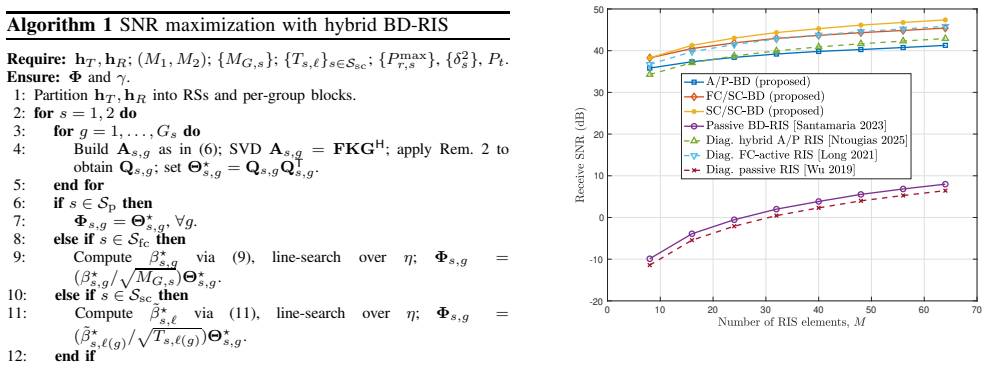
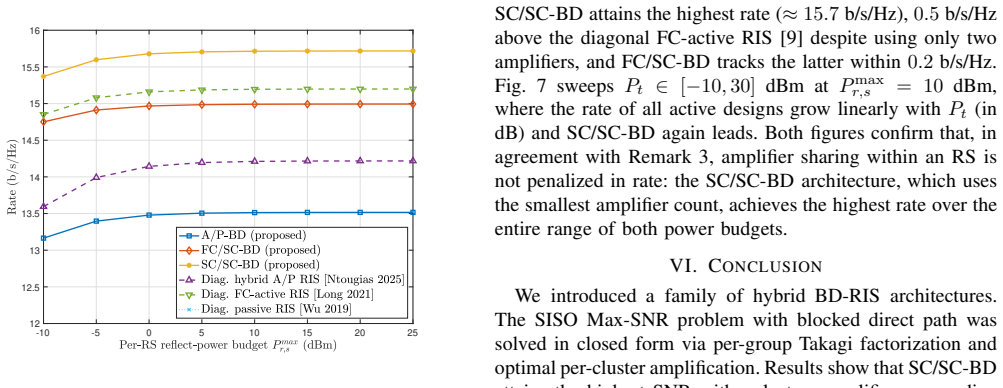
The paper establishes a family of hybrid BD-RIS architectures that partition the reflecting surface into two subsurfaces, each configured as either a passive or active group-connected beyond-diagonal RIS. For each such group, the optimal reflection coefficients are obtained via Takagi's factorization of a complex symmetric matrix, paired with a closed-form amplification factor that meets the per-group power budget. Numerical evaluation in a SISO system with blocked direct link confirms that the proposed designs attain equivalent or superior receive SNR compared to diagonal RIS architectures, yet employ significantly fewer active amplifiers.
What carries the argument
The closed-form SNR-maximizing solution that applies Takagi's factorization to a complex symmetric matrix for each BD-RIS group and pairs it with an optimal per-group amplification factor under the reflect-power budget.
Load-bearing premise
The performance claims rely on perfect channel state information being available and the power budget being satisfiable independently per group without interference or hardware flaws.
What would settle it
A physical experiment in a SISO setup with blocked direct path that implements the hybrid BD-RIS prototypes, measures achieved SNR, and counts how many amplifiers are required to match the performance of a diagonal RIS baseline.
Figures




read the original abstract
Beyond-diagonal reconfigurable intelligent surfaces (BD-RISs) extend conventional diagonal RISs by allowing inter-element coupling, thereby enlarging the set of attainable scattering matrices and improving the achievable signal-to-noise ratio (SNR). On the other hand, hybrid active/passive RISs use reflect-type power amplifiers in a fraction of the elements to alleviate the multiplicative path loss. In this paper, we bring these two ideas together and introduce a \emph{family of hybrid BD-RIS architectures}, in which the surface is partitioned into two reflecting subsurfaces (RSs), each adopting either a passive or an active group-connected BD-RIS design. We derive a closed-form SNR-maximizing solution that combines, for every BD-RIS group, Takagi's factorization of a certain complex symmetric matrix with an optimal per-group amplification factor that satisfies the reflect-power budget. Three architectures within the proposed family (active/passive, fully-connected-active/sub-connected-active, and sub-connected-active/sub-connected-active hybrid BD-RIS) are studied. Numerical results in a single-input single-output (SISO) link with blocked direct path show that the proposed hybrid BD-RIS architectures attain the same or higher receive SNR than their diagonal counterparts while using significantly fewer reflect-type amplifiers.
Editorial analysis
A structured set of objections, weighed in public.
Referee Report
Summary. The paper introduces a family of hybrid beyond-diagonal RIS (BD-RIS) architectures that partition the surface into two reflecting subsurfaces, each using either passive or active group-connected BD-RIS designs. It derives a closed-form SNR-maximizing solution that applies Takagi factorization to a complex symmetric matrix per BD-RIS group followed by an optimal per-group amplification factor satisfying the reflect-power budget. Three specific architectures (active/passive, fully-connected-active/sub-connected-active, and sub-connected-active/sub-connected-active) are analyzed. Numerical results for a SISO link with blocked direct path claim that the proposed designs achieve the same or higher receive SNR than diagonal RIS counterparts while using significantly fewer reflect-type amplifiers.
Significance. If the closed-form derivations hold under the stated assumptions, the work usefully combines the enlarged scattering-matrix set of BD-RIS with the path-loss mitigation of hybrid active/passive elements. The explicit closed-form solution via Takagi factorization per group is a constructive strength that could aid practical implementation. The numerical demonstration of SNR parity or gain with reduced amplifier count, if robust, would support hardware-efficient RIS deployments in blocked-line-of-sight scenarios.
major comments (2)
- [§III (derivation) and §IV (numerical results)] The closed-form SNR-maximizing solution (abstract and §III) and the headline numerical claim (abstract and §IV) both presuppose perfect CSI together with independent per-group reflect-power budgets that can be met without mutual coupling, shared hardware constraints, or amplifier non-idealities. These assumptions directly define the feasible set of scattering matrices; their violation would change the attainable SNR and therefore the central comparison to diagonal RIS.
- [§IV] Table or figure in §IV that reports the SISO SNR comparisons does not include sensitivity to CSI error or inter-group power coupling; because the headline claim of “same or higher SNR with significantly fewer amplifiers” rests on these numerical results, an explicit robustness check or worst-case analysis is required to substantiate the performance advantage.
minor comments (2)
- [Abstract] The abstract lists three architectures but does not explicitly name the third (sub-connected-active/sub-connected-active) in the sentence that introduces the family; a parenthetical list would improve immediate clarity.
- [§II–III] Notation for the per-group amplification factor and the complex symmetric matrix to which Takagi factorization is applied should be introduced once in §II or §III and used consistently thereafter to avoid reader re-derivation.
Simulated Author's Rebuttal
We thank the referee for the constructive feedback on our manuscript. We address each major comment point by point below, clarifying the role of the modeling assumptions and outlining targeted revisions to enhance the presentation and evaluation.
read point-by-point responses
-
Referee: [§III (derivation) and §IV (numerical results)] The closed-form SNR-maximizing solution (abstract and §III) and the headline numerical claim (abstract and §IV) both presuppose perfect CSI together with independent per-group reflect-power budgets that can be met without mutual coupling, shared hardware constraints, or amplifier non-idealities. These assumptions directly define the feasible set of scattering matrices; their violation would change the attainable SNR and therefore the central comparison to diagonal RIS.
Authors: We agree that both the closed-form SNR-maximizing solution derived in §III and the numerical comparisons in §IV are obtained under the assumptions of perfect CSI and independent per-group reflect-power budgets, without incorporating mutual coupling, shared hardware constraints, or amplifier non-idealities. These assumptions are standard in the RIS literature and are applied identically to the diagonal RIS baselines to ensure a fair comparison. The Takagi factorization approach yields the optimal scattering matrix for each group precisely within this feasible set, as detailed in the derivation. To address the comment, we will revise §III to more explicitly articulate these assumptions and their direct impact on the attainable scattering matrices, and we will add a brief discussion in §IV on how violations would affect the SNR comparison. revision: partial
-
Referee: [§IV] Table or figure in §IV that reports the SISO SNR comparisons does not include sensitivity to CSI error or inter-group power coupling; because the headline claim of “same or higher SNR with significantly fewer amplifiers” rests on these numerical results, an explicit robustness check or worst-case analysis is required to substantiate the performance advantage.
Authors: We acknowledge that the SISO SNR results presented in §IV are obtained under ideal conditions and do not currently include sensitivity analyses with respect to CSI estimation errors or inter-group power coupling. While the core contribution lies in the closed-form per-group optimization, we concur that an explicit robustness evaluation would better substantiate the claimed performance advantage. Accordingly, we will incorporate a new subsection and accompanying figure in §IV that examines the SNR degradation under imperfect CSI (modeled via additive estimation errors) for both the proposed hybrid BD-RIS architectures and the diagonal baselines, along with a qualitative discussion of inter-group coupling effects. revision: yes
Circularity Check
Derivation is self-contained via standard matrix factorization and optimization; no reduction to inputs or self-citations.
full rationale
The paper presents a closed-form SNR-maximizing solution obtained by applying Takagi factorization to complex symmetric matrices for each BD-RIS group, followed by selection of per-group amplification factors to satisfy the reflect-power budget. This is a direct algebraic derivation from the system model and constraints, without parameter fitting to the target SNR, renaming of known results, or load-bearing reliance on self-citations for the core steps. Numerical validation in SISO scenarios uses the derived solution under explicit assumptions (perfect CSI, independent group power constraints) but does not alter the independence of the derivation itself. No patterns of self-definition, fitted-input prediction, or ansatz smuggling are present.
Axiom & Free-Parameter Ledger
axioms (1)
- standard math Takagi's factorization applies to the complex symmetric matrix arising from the BD-RIS group scattering model.
Reference graph
Works this paper leans on
-
[1]
Smart radio environments empowered by reconfig- urable intelligent surfaces: How it works, state of researc h, and the road ahead,
M. Di Renzo et al., “Smart radio environments empowered by reconfig- urable intelligent surfaces: How it works, state of researc h, and the road ahead,” IEEE J. Sel. Areas Commun. , vol. 38, no. 11, pp. 2450–2525, Nov. 2020
2020
-
[2]
Multicell MIMO communications relying on intelligent reflecting surfaces,
C. Pan et al. , “Multicell MIMO communications relying on intelligent reflecting surfaces,” IEEE Trans. Wireless Commun. , vol. 19, no. 8, pp. 5218–5233, Aug. 2020
2020
-
[3]
Reconfigurable intelligent surfaces for energy ef ficiency in wireless communication,
C. Huang, A. Zappone, G. C. Alexandropoulos, M. Debbah, a nd C. Y uen, “Reconfigurable intelligent surfaces for energy ef ficiency in wireless communication,” IEEE Trans. Wireless Commun., vol. 18, no. 8, pp. 4157–4170, Aug. 2019
2019
-
[4]
Intelligent reflecting surface enhan ced wireless network via joint active and passive beamforming,
Q. Wu and R. Zhang, “Intelligent reflecting surface enhan ced wireless network via joint active and passive beamforming,” IEEE Trans. Wireless Commun., vol. 18, no. 11, pp. 5394–5409, Nov. 2019
2019
-
[5]
Modeling and architec ture design of reconfigurable intelligent surfaces using scattering pa rameter network analysis,
S. Shen, B. Clerckx, and R. Murch, “Modeling and architec ture design of reconfigurable intelligent surfaces using scattering pa rameter network analysis,” IEEE Trans. Wireless Commun., vol. 21, no. 2, pp. 1229–1243, Feb. 2022
2022
-
[6]
Beyond diagonal reconfigu rable intelli- gent surfaces: From transmitting and reflecting modes to sin gle-, group- , and fully-connected architectures,
H. Li, S. Shen, and B. Clerckx, “Beyond diagonal reconfigu rable intelli- gent surfaces: From transmitting and reflecting modes to sin gle-, group- , and fully-connected architectures,” IEEE Trans. Wireless Commun. , vol. 22, no. 4, pp. 2311–2324, Apr. 2023
2023
-
[7]
Closed-form global o ptimization of beyond diagonal reconfigurable intelligent surfaces,
M. Nerini, S. Shen, and B. Clerckx, “Closed-form global o ptimization of beyond diagonal reconfigurable intelligent surfaces,” IEEE Trans. Wireless Commun., 2023, early access
2023
-
[8]
SNR maximization in beyond diagonal RIS-assisted single and mu ltiple antenna links,
I. Santamaria, M. Soleymani, E. Jorswieck, and J. Guti´ e rrez, “SNR maximization in beyond diagonal RIS-assisted single and mu ltiple antenna links,” IEEE Signal Process. Lett. , vol. 30, pp. 923–926, 2023
2023
-
[9]
Active re configurable intelligent surface-aided wireless communications,
R. Long, Y .-C. Liang, Y . Pei, and E. G. Larsson, “Active re configurable intelligent surface-aided wireless communications,” IEEE Trans. Wire- less Commun. , vol. 20, no. 8, pp. 4962–4975, Aug. 2021
2021
-
[10]
Active RIS vs. passive RIS: Which will prevail in 6G?
Z. Zhang et al., “Active RIS vs. passive RIS: Which will prevail in 6G?” IEEE Trans. Commun. , vol. 71, no. 3, pp. 1707–1725, Mar. 2023
2023
-
[11]
Sub-conne cted active reconfigurable intelligent surface for massive MIMO system s,
N. T. Nguyen, Q.-D. Vu, K. Lee, and M. Juntti, “Sub-conne cted active reconfigurable intelligent surface for massive MIMO system s,” Proc. IEEE Globecom , 2022
2022
-
[12]
Hybrid R IS with sub- connected active partitions: Performance analysis and tra nsmission de- sign,
K. Ntougias, S. Chatzinotas, and I. Krikidis, “Hybrid R IS with sub- connected active partitions: Performance analysis and tra nsmission de- sign,” IEEE Trans. Wireless Commun. , vol. 24, no. 8, pp. 6705–6721, 2025
2025
discussion (0)
Sign in with ORCID, Apple, or X to comment. Anyone can read and Pith papers without signing in.