Recognition: unknown
Variationally Compressing Quantum Circuits to Approximate Nonadiabatic Molecular Quantum Dynamics
Pith reviewed 2026-05-08 11:28 UTC · model grok-4.3
The pith
Variational compression of Trotter terms preserves reaction rate coefficients in nonadiabatic quantum dynamics simulations
A machine-rendered reading of the paper's core claim, the machinery that carries it, and where it could break.
Core claim
We show the variational compression of Trotter terms preserve reaction rate coefficients via classical emulation of a hybrid quantum-classical optimization method, as well as fast-forwarded adiabatic dynamics on quantum hardware. Compressed circuits can be incorporated with product-formula-based time evolution to approximate dynamics of a particle in two coupled harmonic potentials, allowing tunability when removing high-cost qubit interactions. Approximate rate coefficients are recovered after substituting terms in a nonadiabatic dynamic process.
What carries the argument
Variational compression of Trotter terms, which approximates the unitary operators in the decomposition to reduce circuit depth while preserving key observables
If this is right
- Shallower circuits can simulate nonadiabatic dynamics on near-term quantum hardware.
- Reaction rate coefficients remain recoverable after term substitution.
- Accuracy can be tuned by adjusting the variational approximation level.
- Gate and qubit resources are minimized for the same observable accuracy.
Where Pith is reading between the lines
- This compression technique might apply to simulating larger or more complex molecular systems beyond the harmonic model.
- It suggests a pathway to hybrid methods that balance quantum accuracy with classical optimization for dynamics.
- Future work could explore error bounds on the preserved rates for different compression levels.
Load-bearing premise
That the variational approximation to the Trotter terms sufficiently preserves the relevant observables without introducing uncontrolled errors in the nonadiabatic dynamics.
What would settle it
Observing a significant discrepancy in the reaction rate coefficients between simulations using the original and variationally compressed Trotter terms for the same coupled harmonic potential model.
Figures





read the original abstract
Quantum simulation has begun to penetrate the field of quantum chemistry in hopes of efficiently calculating ground state energies and approximating real-time evolution. With modern research highlighting nonadiabatic dynamics, tunably approximating deep circuits representing potential landscapes becomes crucial for simulating real quantum systems. Variationally approximating unitaries allows for shallower circuits and accuracy tunable to hardware fidelity, so long as the observable quantities are preserved. We show the variational compression of Trotter terms preserve reaction rate coefficients via classical emulation of a hybrid quantum-classical optimization method, as well as fast-forwarded adiabatic dynamics on quantum hardware. Compressed circuits can be incorporated with product-formula-based time evolution to approximate dynamics of a particle in two coupled harmonic potentials, allowing tunability when removing high-cost qubit interactions. Approximate rate coefficients are recovered after substituting terms in a nonadiabatic dynamic process, giving proof-of-principle for observable preservation under variational optimization. Attention is paid to minimizing qubit and gate-count resources.
Editorial analysis
A structured set of objections, weighed in public.
Referee Report
Summary. The manuscript claims that variationally compressed Trotter unitaries can be substituted into product-formula time-evolution operators to approximate nonadiabatic dynamics of a particle in two coupled harmonic potentials while preserving reaction rate coefficients. This is supported by classical emulation of a hybrid quantum-classical optimizer for the nonadiabatic case and by fast-forwarded adiabatic dynamics executed on quantum hardware, with emphasis on reducing qubit and gate-count resources through tunable compression.
Significance. If the observed numerical agreement in rates holds with controlled errors and generalizes, the work would offer a practical route to shallower circuits for quantum dynamics simulations on NISQ hardware, addressing the tension between Trotter depth and hardware fidelity while maintaining key observables. The hybrid optimization and resource-minimization focus are strengths that could influence variational methods in quantum chemistry.
major comments (3)
- [Abstract] Abstract: the central claim that 'approximate rate coefficients are recovered after substituting terms in a nonadiabatic dynamic process' is stated without any quantitative error metrics, comparison to the uncompressed baseline, scaling of rate error versus compression depth, or description of the variational cost function (e.g., whether it targets fidelity, Hilbert-Schmidt distance, or the rate observable itself).
- [Classical emulation of hybrid optimization] Classical emulation results: the preservation of reaction rates under substitution of compressed Trotter terms is presented as a proof-of-principle, yet the manuscript provides no explicit error bounds, phase-error analysis, or demonstration that the variational objective controls interference-sensitive quantities over multiple time steps; generic fidelity minimization does not automatically guarantee this for integrated observables.
- [Quantum hardware results] Hardware demonstration: results are restricted to fast-forwarded adiabatic dynamics, leaving the nonadiabatic preservation claim supported solely by classical simulation of the low-dimensional model; this limits the strength of the assertion that the method applies to full nonadiabatic processes on quantum hardware.
minor comments (2)
- [Model and methods] The description of the coupled-harmonic model and the precise form of the Trotter terms being compressed would benefit from an explicit equation or diagram early in the text to clarify the starting point for compression.
- Notation for the variational parameters and the compression ratio should be standardized across figures and text to improve readability.
Simulated Author's Rebuttal
We thank the referee for the constructive comments, which have helped clarify the scope and presentation of our work. We address each major comment below and have revised the manuscript to incorporate additional details and clarifications where appropriate.
read point-by-point responses
-
Referee: [Abstract] Abstract: the central claim that 'approximate rate coefficients are recovered after substituting terms in a nonadiabatic dynamic process' is stated without any quantitative error metrics, comparison to the uncompressed baseline, scaling of rate error versus compression depth, or description of the variational cost function (e.g., whether it targets fidelity, Hilbert-Schmidt distance, or the rate observable itself).
Authors: We agree that the abstract would benefit from greater specificity. In the revised manuscript we have updated the abstract to state that the variational cost function is the Hilbert-Schmidt distance, to report that approximate rate coefficients are recovered with relative errors below 10% relative to the uncompressed baseline for the compression levels examined, and to reference the scaling behavior of the rate error with compression depth (now shown in a new supplementary figure). revision: yes
-
Referee: [Classical emulation of hybrid optimization] Classical emulation results: the preservation of reaction rates under substitution of compressed Trotter terms is presented as a proof-of-principle, yet the manuscript provides no explicit error bounds, phase-error analysis, or demonstration that the variational objective controls interference-sensitive quantities over multiple time steps; generic fidelity minimization does not automatically guarantee this for integrated observables.
Authors: The optimization targets the Hilbert-Schmidt distance, which supplies an operator-norm bound on the unitary approximation error and thereby limits accumulated phase errors in the product-formula evolution. Numerical results for the two-state model confirm that the integrated observable (reaction rate) remains accurate across the simulated time steps. We have added a short error-propagation paragraph in the methods section of the revised manuscript that connects the chosen cost function to preservation of the rate coefficient. We acknowledge that a general analytical guarantee for arbitrary systems is not derived here and would require a separate theoretical study. revision: partial
-
Referee: [Quantum hardware results] Hardware demonstration: results are restricted to fast-forwarded adiabatic dynamics, leaving the nonadiabatic preservation claim supported solely by classical simulation of the low-dimensional model; this limits the strength of the assertion that the method applies to full nonadiabatic processes on quantum hardware.
Authors: The manuscript presents the hardware results as a demonstration that the compressed circuits can be executed on present-day quantum processors for adiabatic dynamics, while the nonadiabatic substitution is validated through classical emulation of the hybrid optimizer. We have revised the text to make this distinction explicit and to frame the work as a proof-of-principle for the compression technique rather than a direct hardware implementation of the full nonadiabatic process. As hardware fidelity and qubit counts improve, direct execution of the nonadiabatic case will become feasible. revision: yes
Circularity Check
No circularity; preservation shown via independent numerical emulation and hardware runs
full rationale
The paper's central claim is a proof-of-principle numerical demonstration that variationally compressed Trotter terms, when substituted into product-formula evolution, recover approximate reaction rates for a specific coupled-harmonic model. This rests on classical emulation of the hybrid optimizer and hardware execution of fast-forwarded adiabatic dynamics, not on any derivation that reduces to its own inputs by construction. No self-definitional steps, fitted parameters renamed as predictions, or load-bearing self-citations appear in the provided abstract or described results. The variational optimization targets circuit fidelity or distance to target unitaries, with observable preservation checked post-hoc via simulation rather than enforced by definition.
Axiom & Free-Parameter Ledger
free parameters (1)
- variational parameters for circuit compression
axioms (2)
- standard math Trotterization provides a valid approximation to time evolution operators
- domain assumption Observable preservation under unitary approximation is sufficient for rate coefficient accuracy
Reference graph
Works this paper leans on
-
[1]
Best Cost
Each compressed term uses thel-local truncated ansatz from Eq. (14), op- timized to achieveC LHST ≤0.01. For an 8-qubit position register, the kinetic term is approximated as beingl= 4- local, and the potential termsV ′ 0,V ′ 1 are truncated to be l= 6-local for linear qubit connectivity andl= 4-local for a ring topology. We calculate rate coefficients fr...
2020
-
[2]
G. H. Low,Quantum signal processing by single-qubit dy- namics, Ph.D. thesis, Massachusetts Institute of Technol- ogy (2017)
2017
-
[3]
G. H. Low and I. L. Chuang, Quantum3, 163 (2019)
2019
-
[4]
Motlagh and N
D. Motlagh and N. Wiebe, PRX Quantum5, 020368 (2024)
2024
-
[5]
A. W. Harrow, A. Hassidim, and S. Lloyd, Physical re- view letters103, 150502 (2009)
2009
-
[6]
D. W. Berry, G. Ahokas, R. Cleve, and B. C. Sanders, Communications in Mathematical Physics270, 359 (2007)
2007
-
[7]
D. W. Berry, D. Motlagh, G. Pantaleoni, and N. Wiebe, Physical Review A110, 012612 (2024)
2024
-
[8]
Q. Zhao, Y. Zhou, A. F. Shaw, T. Li, and A. M. Childs, Physical Review Letters129, 270502 (2022)
2022
-
[9]
R. P. Feynman, International Journal of Theoretical Physics21(1982)
1982
-
[10]
Preskill, Quantum2, 79 (2018)
J. Preskill, Quantum2, 79 (2018)
2018
-
[11]
Stamatopoulos, D
N. Stamatopoulos, D. J. Egger, Y. Sun, C. Zoufal, R. Iten, N. Shen, and S. Woerner, Quantum4, 291 (2020)
2020
-
[12]
Baiardi, M
A. Baiardi, M. Christandl, and M. Reiher, Chem- BioChem24, e202300120 (2023)
2023
-
[13]
Tavernelli, Accounts of chemical research48, 792 (2015)
I. Tavernelli, Accounts of chemical research48, 792 (2015)
2015
-
[14]
T. R. Nelson, A. J. White, J. A. Bjorgaard, A. E. Sifain, Y. Zhang, B. Nebgen, S. Fernandez-Alberti, D. Mozyrsky, A. E. Roitberg, and S. Tretiak, Chemical reviews120, 2215 (2020)
2020
-
[15]
Burghardt, K
I. Burghardt, K. Giri, and G. Worth, The Journal of chemical physics129(2008)
2008
-
[16]
B. H. Lengsfield and D. R. Yarkony, Adv. Chem. Phys 82, 1 (1992)
1992
-
[17]
W. H. Miller, The Journal of Chemical Physics53, 3578 (1970)
1970
-
[18]
Sadri, D
K. Sadri, D. Lauvergnat, F. Gatti, and H.-D. Meyer, The Journal of Chemical Physics141(2014)
2014
-
[19]
Meyer, F
H.-D. Meyer, F. Gatti, and G. A. Worth,Multidimen- sional quantum dynamics: MCTDH theory and applica- tions(John Wiley & Sons, 2009)
2009
-
[20]
Molignini, S
P. Molignini, S. Dutta, and E. Fasshauer, SciPost Physics Lecture Notes , 094 (2025)
2025
-
[21]
J. Ren, W. Li, T. Jiang, Y. Wang, and Z. Shuai, Wi- ley Interdisciplinary Reviews: Computational Molecular Science12, e1614 (2022)
2022
-
[22]
Baiardi, Journal of Chemical Theory and Computa- tion17, 3320 (2021)
A. Baiardi, Journal of Chemical Theory and Computa- tion17, 3320 (2021)
2021
-
[23]
Wang, The Journal of Physical Chemistry A119, 7951 (2015)
H. Wang, The Journal of Physical Chemistry A119, 7951 (2015)
2015
-
[24]
P. J. Ollitrault, G. Mazzola, and I. Tavernelli, Physical Review Letters125, 260511 (2020)
2020
-
[25]
Navickas, R
T. Navickas, R. J. MacDonell, C. H. Valahu, V. C. Olaya- Agudelo, F. Scuccimarra, M. J. Millican, V. G. Matsos, H. L. Nourse, A. D. Rao, M. J. Biercuk,et al., Journal of the American Chemical Society (2025)
2025
-
[26]
D. Wang, O. Higgott, and S. Brierley, Physical review letters122, 140504 (2019)
2019
-
[27]
Peruzzo, J
A. Peruzzo, J. McClean, P. Shadbolt, M.-H. Yung, X.-Q. Zhou, P. J. Love, A. Aspuru-Guzik, and J. L. O’brien, Nature communications5, 4213 (2014)
2014
-
[28]
R. R. Ferguson, L. Dellantonio, A. A. Balushi, K. Jansen, W. D¨ ur, and C. A. Muschik, Physical review letters126, 220501 (2021)
2021
-
[29]
Cerezo, K
M. Cerezo, K. Sharma, A. Arrasmith, and P. J. Coles, npj Quantum Information8, 113 (2022)
2022
-
[30]
Park, APL Quantum1(2024)
C.-Y. Park, APL Quantum1(2024)
2024
-
[31]
Tamiya, S
S. Tamiya, S. Koh, and Y. O. Nakagawa, Physical Review Research3, 023244 (2021)
2021
-
[32]
J. R. McClean, S. Boixo, V. N. Smelyanskiy, R. Babbush, and H. Neven, Nature communications9, 4812 (2018)
2018
-
[33]
Zhang, L
Y. Zhang, L. Cincio, C. F. Negre, P. Czarnik, P. J. Coles, P. M. Anisimov, S. M. Mniszewski, S. Tretiak, and P. A. Dub, npj Quantum Information8, 96 (2022)
2022
-
[34]
S. Endo, Z. Cai, S. C. Benjamin, and X. Yuan, Journal of the Physical Society of Japan90, 032001 (2021)
2021
-
[35]
J. R. McClean, J. Romero, R. Babbush, and A. Aspuru- Guzik, New Journal of Physics18, 023023 (2016)
2016
-
[36]
S. Endo, J. Sun, Y. Li, S. C. Benjamin, and X. Yuan, Physical Review Letters125, 010501 (2020)
2020
-
[37]
Y.-X. Yao, N. Gomes, F. Zhang, C.-Z. Wang, K.-M. Ho, T. Iadecola, and P. P. Orth, PRX Quantum2, 030307 (2021)
2021
-
[38]
Benedetti, M
M. Benedetti, M. Fiorentini, and M. Lubasch, Physical Review Research3, 033083 (2021)
2021
- [39]
-
[40]
Barison, F
S. Barison, F. Vicentini, and G. Carleo, Quantum5, 512 (2021)
2021
-
[41]
McArdle, S
S. McArdle, S. Endo, A. Aspuru-Guzik, S. C. Benjamin, and X. Yuan, Reviews of Modern Physics92, 015003 (2020)
2020
-
[42]
Y. Cao, J. Romero, J. P. Olson, M. Degroote, P. D. John- son, M. Kieferov´ a, I. D. Kivlichan, T. Menke, B. Per- opadre, N. P. Sawaya,et al., Chemical reviews119, 10856 (2019)
2019
-
[43]
H. Liu, G. H. Low, D. S. Steiger, T. H¨ aner, M. Reiher, and M. Troyer, Materials Theory6, 11 (2022)
2022
- [44]
-
[45]
A. Cook, P. Stancil, M. Geller, H. You, and A. Sorn- borger, inAPS March Meeting Abstracts, Vol. 2016 (2016) pp. G1–274
2016
-
[46]
T. E. O’Brien, B. Senjean, R. Sagastizabal, X. Bonet- Monroig, A. Dutkiewicz, F. Buda, L. DiCarlo, and L. Visscher, npj Quantum Information5, 113 (2019). 16 FIG. 17. Three-qubit initializations using a UCC ansatz circuit. Probabilities are given for each basis state using (a) a noise-free simulator, (b)ibm brisbane(F= 0.991±0.000623), and (c)ibm sherbrook...
2019
-
[47]
Bornman, arXiv preprint arXiv:2311.05537 (2023)
N. Bornman, arXiv preprint arXiv:2311.05537 (2023)
-
[48]
Lloyd, Science273, 1073 (1996)
S. Lloyd, Science273, 1073 (1996)
1996
-
[49]
Staelens and F
M. Staelens and F. Marsiglio, American Journal of Physics89, 693 (2021)
2021
-
[50]
A. M. Childs, Y. Su, M. C. Tran, N. Wiebe, and S. Zhu, Physical Review X11, 011020 (2021)
2021
- [51]
-
[52]
Atia and D
Y. Atia and D. Aharonov, Nature communications8, 1572 (2017)
2017
-
[53]
Cirstoiu, Z
C. Cirstoiu, Z. Holmes, J. Iosue, L. Cincio, P. J. Coles, and A. Sornborger, npj Quantum Information6, 82 (2020)
2020
-
[54]
B. Commeau, M. Cerezo, Z. Holmes, L. Cincio, P. J. Coles, and A. Sornborger, arXiv preprint arXiv:2009.02559 (2020)
-
[55]
M. R. Geller, Z. Holmes, P. J. Coles, and A. Sornborger, Physical Review Research3, 033200 (2021)
2021
-
[56]
Balasubramanian, M
V. Balasubramanian, M. DeCross, A. Kar, and O. Par- rikar, Journal of High Energy Physics2020, 1 (2020)
2020
-
[57]
Khatri, R
S. Khatri, R. LaRose, A. Poremba, L. Cincio, A. T. Sorn- borger, and P. J. Coles, Quantum3, 140 (2019)
2019
-
[58]
Sharma, S
K. Sharma, S. Khatri, M. Cerezo, and P. J. Coles, New Journal of Physics22, 043006 (2020)
2020
-
[59]
J. L. Walsh, American Journal of Mathematics45, 5 (1923)
1923
-
[60]
Benenti and G
G. Benenti and G. Strini, American Journal of Physics 76, 657 (2008)
2008
-
[61]
Kandala, A
A. Kandala, A. Mezzacapo, K. Temme, M. Takita, M. Brink, J. M. Chow, and J. M. Gambetta, nature549, 242 (2017)
2017
-
[62]
R. A. Marcus, The Journal of chemical physics24, 966 (1956)
1956
-
[63]
Tachiya, The Journal of Physical Chemistry97, 5911 (1993)
M. Tachiya, The Journal of Physical Chemistry97, 5911 (1993)
1993
-
[64]
Nitzan,Chemical dynamics in condensed phases: re- laxation, transfer, and reactions in condensed molecular systems(Oxford university press, 2024)
A. Nitzan,Chemical dynamics in condensed phases: re- laxation, transfer, and reactions in condensed molecular systems(Oxford university press, 2024)
2024
-
[65]
Kassal, S
I. Kassal, S. P. Jordan, P. J. Love, M. Mohseni, and A. Aspuru-Guzik, Proceedings of the National Academy of Sciences105, 18681 (2008)
2008
-
[66]
Babbush, D
R. Babbush, D. W. Berry, and H. Neven, Physical Review A99, 040301 (2019)
2019
-
[67]
J. M. Martyn, Y. Liu, Z. E. Chin, and I. L. Chuang, The Journal of Chemical Physics158(2023)
2023
-
[68]
Temme, S
K. Temme, S. Bravyi, and J. M. Gambetta, Physical re- view letters119, 180509 (2017)
2017
-
[69]
Kandala, K
A. Kandala, K. Temme, A. D. C´ orcoles, A. Mezzacapo, J. M. Chow, and J. M. Gambetta, Nature567, 491 (2019)
2019
-
[70]
B. J. Braams and J. M. Bowman, International Reviews in Physical Chemistry28, 577 (2009)
2009
-
[71]
Jiang, J
B. Jiang, J. Li, and H. Guo, International Reviews in Physical Chemistry35, 479 (2016)
2016
-
[72]
T. J. Yoder, E. Schoute, P. Rall, E. Pritchett, J. M. Gam- betta, A. W. Cross, M. Carroll, and M. E. Beverland, arXiv preprint arXiv:2506.03094 (2025)
work page internal anchor Pith review arXiv 2025
-
[73]
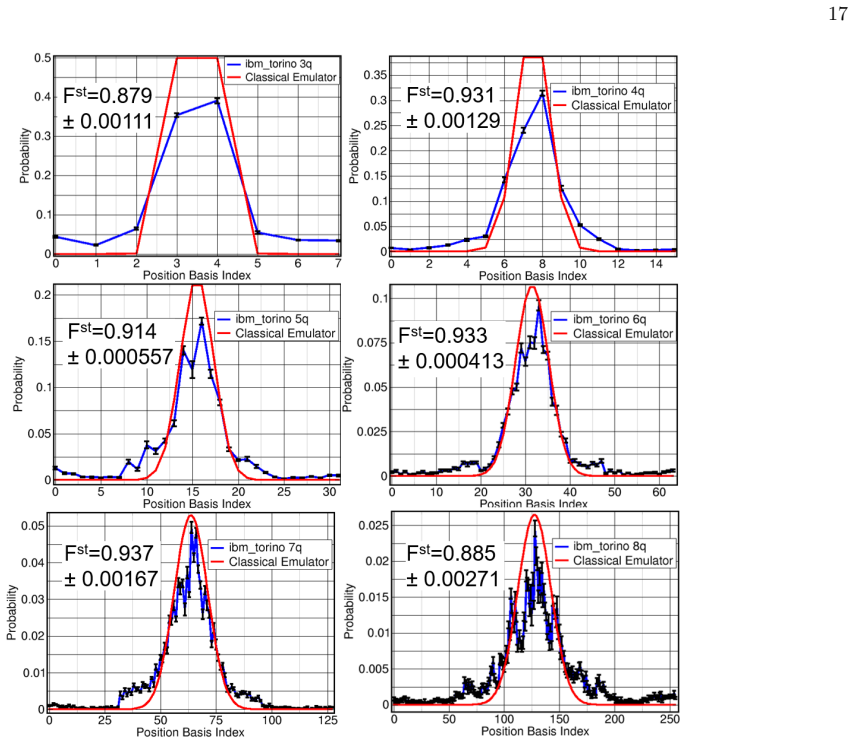
M. H. Shaw and B. M. Terhal, Physical review letters 134, 090602 (2025). 17 FIG. 18. Wavepacket initializations using a UCC ansatz circuit forn= 3−8 qubits. Probabilities are given for each basis state using average results foribm torino(blue) a classical emulator (red). Error bars foribm torinowere taken as the standard error over ten independent runs (j...
2025
-
[74]
Courtney and P
J. Courtney and P. Stancil, Variationally-Compression- Scripts,https://github.com/jmcourtneyuga/ Variationally-Compression-Scripts(2025)
2025
-
[75]
Ortiz, J
G. Ortiz, J. E. Gubernatis, E. Knill, and R. Laflamme, Physical Review A64, 022319 (2001)
2001
discussion (0)
Sign in with ORCID, Apple, or X to comment. Anyone can read and Pith papers without signing in.