Recognition: unknown
Probing the density dependence of nuclear symmetry energy through isospin transport in heavy-ion reactions
Pith reviewed 2026-05-08 04:09 UTC · model grok-4.3
The pith
Isospin transport ratios from heavy-ion collisions constrain the density dependence of nuclear symmetry energy.
A machine-rendered reading of the paper's core claim, the machinery that carries it, and where it could break.
Core claim
Isospin transport ratios and isospin diffusion currents extracted from recent heavy-ion data, when confronted with state-of-the-art transport calculations, furnish confidence regions for the symmetry energy specifically in the density interval probed by these experiments.
What carries the argument
The isospin transport ratio, an observable that quantifies the degree of isospin equilibration between projectile and target and is designed to be only weakly sensitive to final-state interactions.
If this is right
- The resulting confidence regions support future Bayesian analyses of the full nuclear equation of state.
- Constraints obtained this way help bridge terrestrial heavy-ion data with astrophysical observations of neutron stars and supernovae.
- Emphasis on the specific densities actually reached in the reactions allows targeted refinement of nuclear functionals.
Where Pith is reading between the lines
- The approach may help reconcile conflicting symmetry-energy values obtained from different classes of observables.
- Application at higher beam energies could extend the probed density range toward conditions inside neutron-star mergers.
- Systematic comparison across multiple transport codes would further reduce model dependence in the extracted limits.
Load-bearing premise
The isospin transport ratios remain largely unaffected by final-state interactions and are accurately reproduced by the chosen transport models over the relevant density range.
What would settle it
A calculation or new measurement showing that final-state interactions produce large changes in the isospin transport ratios at the densities reached in these collisions would remove the basis for the reported constraints.
Figures





read the original abstract
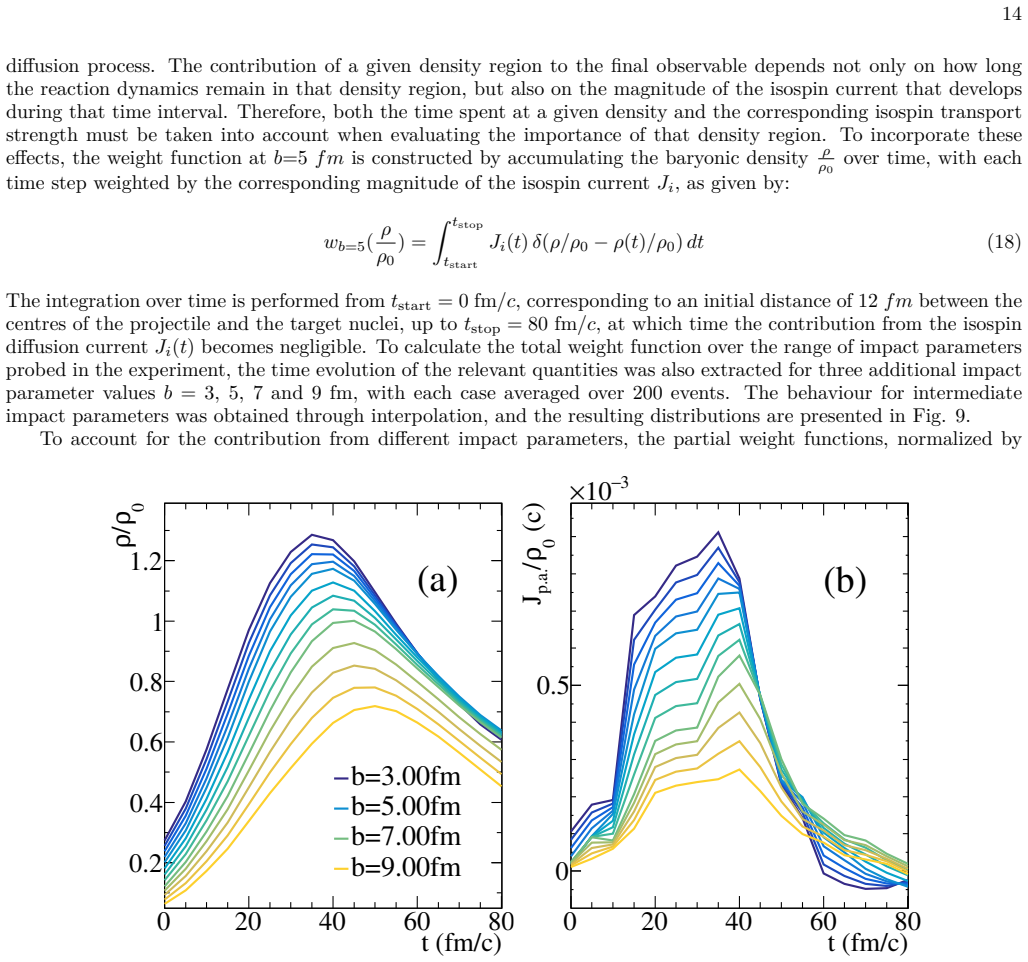
The density dependence of the nuclear symmetry energy remains one of the key uncertainties in contemporary nuclear physics, with significant implications for the structure of exotic nuclei, the dynamics of heavy-ion collisions, and the properties of astrophysical objects such as neutron stars and core-collapse supernovae. However, extracting robust constraints requires observables that are minimally affected by final-state interactions and are reliably predicted by transport models. This review synthesizes recent theoretical and experimental advancements in constraining the symmetry energy by leveraging isospin diffusion in heavy-ion reactions within the Fermi energy domain. Recent results from the INDRA-FAZIA collaboration, including isospin transport ratio data, and Boltzmann-Uehling-Uhlenbeck (BUU) transport model calculations are highlighted. Confidence regions for the symmetry energy are extracted from isospin transport ratios and isospin diffusion currents by utilizing state-of-the-art nuclear functionals, including both ab initio and phenomenological approaches, with a particular focus on the density regions probed by these experiments. The resulting constraints will aid future Bayesian studies of the nuclear equation of state and contribute to a more unified understanding of dense matter in both terrestrial experiments and astrophysical environments.
Editorial analysis
A structured set of objections, weighed in public.
Referee Report
Summary. The manuscript is a review synthesizing recent theoretical and experimental work on constraining the density dependence of the nuclear symmetry energy via isospin diffusion and transport ratios in heavy-ion collisions at Fermi energies. It emphasizes INDRA-FAZIA collaboration data, BUU transport calculations, extraction of confidence regions for parameters such as L and K_sym using ab initio and phenomenological functionals, and the density ranges probed, with implications for the nuclear EOS and astrophysics.
Significance. If the central mapping holds, the synthesis provides useful constraints on the symmetry energy around 0.5-1.5 ρ0 that can inform Bayesian EOS analyses and help unify terrestrial and astrophysical descriptions of dense matter. The explicit use of multiple classes of nuclear functionals is a positive feature for robustness.
major comments (1)
- [BUU transport model calculations and confidence-region extraction] The extraction of symmetry-energy confidence regions from INDRA-FAZIA isospin transport ratios (highlighted in the BUU results section) assumes that the chosen transport models reliably map the observable to the density-dependent symmetry energy. However, no systematic variation of in-medium nucleon-nucleon cross sections or isoscalar effective mass is presented, leaving the reported regions conditional on a single class of implementations.
minor comments (1)
- [Abstract and introduction] The abstract and introduction could more explicitly quantify the density interval over which the constraints are claimed to be most sensitive.
Simulated Author's Rebuttal
We thank the referee for the careful reading of our review and the constructive comment on the BUU transport calculations. We address the point below and will revise the manuscript to incorporate a clearer discussion of the underlying assumptions.
read point-by-point responses
-
Referee: [BUU transport model calculations and confidence-region extraction] The extraction of symmetry-energy confidence regions from INDRA-FAZIA isospin transport ratios (highlighted in the BUU results section) assumes that the chosen transport models reliably map the observable to the density-dependent symmetry energy. However, no systematic variation of in-medium nucleon-nucleon cross sections or isoscalar effective mass is presented, leaving the reported regions conditional on a single class of implementations.
Authors: We agree that the confidence regions presented are conditional on the specific BUU implementations employed in the cited studies, without explicit systematic variations of in-medium nucleon-nucleon cross sections or isoscalar effective mass. As the manuscript is a review synthesizing existing results rather than presenting new transport calculations, we focused on the range of nuclear functionals (ab initio and phenomenological) used to map the observables. To address the referee's concern, we will add a dedicated paragraph in the revised BUU results section that explicitly states this limitation, notes the conditional character of the extracted regions, and references prior works that have examined the sensitivity of isospin transport ratios to these transport-model ingredients. This addition will improve the clarity and balance of the presentation without altering the synthesized data or conclusions. revision: yes
Circularity Check
No circularity detected; derivation relies on external data and models
full rationale
The paper is a review synthesizing INDRA-FAZIA experimental isospin transport ratios with BUU transport calculations and state-of-the-art nuclear functionals (ab initio and phenomenological). No equation or step in the abstract or described chain reduces a claimed prediction to a quantity defined by the paper's own fitted parameters, self-citations, or ansatz. Constraints are extracted from observables using independently developed inputs, with no self-definitional mapping or load-bearing uniqueness theorem from the authors' prior work. This is the expected outcome for a synthesis paper whose central claims remain externally falsifiable.
Axiom & Free-Parameter Ledger
axioms (1)
- domain assumption Boltzmann-Uehling-Uhlenbeck transport models with state-of-the-art nuclear functionals reliably predict isospin transport ratios with minimal contamination from final-state interactions.
Reference graph
Works this paper leans on
-
[1]
(MeV)0ρ/ρS( -EFTχ HIC isodiff HIC n/p Dα Mass (Skyrme) Mass (DFT) IAS PREX-II This result σ1 σ2 σ3 FIG. 10. Constraint on the density dependence of the symmetry energy extracted in the present work. The colored regions represent the 1σ, 2σ, and 3σ confidence intervals, while the gray band corresponds to the microscopic uncertainty from [36]. Constraints f...
-
[2]
B. A. Li, L. W. Chen, and C. M. Ko, Phys. Rep. 464, 113 (2008)
2008
-
[3]
Danielewicz, R
P. Danielewicz, R. Lacey and W. G. Lynch, Science 298, 1592, (2002)
2002
-
[4]
Y. Ye, X. Yang, H. Sakurai et al. Nat Rev Phys 7, 21 (2025)
2025
-
[5]
B. A. Brown, Phys. Rev. Lett. 85, 5296 (2000)
2000
-
[6]
Baran, M
V. Baran, M. Colonna, V. Greco and M. Di Toro, Phys. Rep. 410, 335 (2005)
2005
-
[7]
J. M. Lattimer and M. Prakash, Phys. Rep. 333, 121 (2000)
2000
-
[8]
Burgio, H.-J
G.F. Burgio, H.-J. Schulze, I. Vidaña, J.-B. Wei, , Prog. Part. Nucl. Phys. 120, 103879 (2021)
2021
-
[9]
Sumiyoshi, S
K. Sumiyoshi, S. Furusawa, H. Nagakura, A. Harada, H. Togashi, K. Nakazato, and H. Suzuki, Prog. Theor. Exp. Phys. 2023, 013E02 (2022)
2023
-
[10]
B.P.Abbott et al., Phys. Rev. X 9, 011001 (2019)
2019
-
[11]
B.P.Abbott et al., Astrophys. J. 892, L3 (2017)
2017
-
[12]
B.P.Abbott et al., Astrophys. J. 896, L44 (2020)
2020
-
[13]
J. M. Lattimer and M. Prakash, Astrophys. J. 550, 426 (2001)
2001
-
[14]
Bao-An Li and Wolf-Udo Schroder, Isospin Physics in Heavy-Ion Collisions at Intermediate Energies , Nova Science Pub. Inc. (2001)
2001
-
[15]
Das Gupta, S
S. Das Gupta, S. Mallik and G. Chaudhuri, Heavy ion reaction at intermediate energies: Theoretical Models , World Scientific Publishers (2019)
2019
-
[16]
F. Rami et. al., Phys. Rev. Lett. 84, 1120 (2000)
2000
-
[17]
Shi and P
L. Shi and P. Danielewicz, Phys. Rev. C 68, 064604 (2003)
2003
-
[18]
Lie-Wen Chen, Che Ming Ko and Bao-An Li, Phys. Rev. C 69, 054606 (2004)
2004
-
[19]
M. B. Tsang et. al., Phys. Rev. Lett. 92, 062701 (2004)
2004
-
[20]
M. B. Tsang et. al., Phys. Rev. Lett. 102, 122701 (2009)
2009
-
[21]
Johnston, T
H. Johnston, T. White, J. Winger, D. Rowland, B. Hurst, F. Gimeno-Nogues, D. O’Kelly, and S. J. Yennello, Phys. Lett. B 371, 186 (1996)
1996
-
[22]
M. B. Tsang, J. R. Stone, F. Camera et al., Phys. Rev. C 86, 015803 (2012)
2012
-
[23]
Zhang, M
Y. Zhang, M. Liu, C. J. Xia, Z. Li, and S. K. Biswal, Phys. Rev. C 101, 034303 (2020)
2020
-
[24]
Zhang, D
Y. Zhang, D. D. S. Coupland, P. Danielewicz, Z. Li, H. Liu, F. Lu, G. Lynch and M. B. Tsang, Phys. Rev. C 85, 024602 (2012)
2012
-
[25]
M. B. Tsang et al., Phys. Rev. Lett. 86, 5023 (2001)
2001
-
[26]
Colonna, Phys
M. Colonna, Phys. Rev. Lett. 110, 042701 (2013)
2013
-
[27]
Mallik and G
S. Mallik and G. Chaudhuri, Phys. Rev. C 87 011602 (2013) (Rapid Communication)
2013
-
[28]
Mallik and G
S. Mallik and G. Chaudhuri, Phys. Let. B 727, 282 (2013)
2013
-
[29]
Ono et al., Phys
A. Ono et al., Phys. Rev. C 68 , 051601(R) (2003)
2003
-
[30]
Huang et al., Phys
M. Huang et al., Phys. Rev. C 81 , 044620 (2010)
2010
-
[31]
Russotto, P.Z
P. Russotto, P.Z. Wu, M. Zoric, M. Chartier, Y. Leifels, R.C. Lemmon, Q. Li, J. Łukasik, A. Pagano, P. Pawłowski, W. Trautmann, Phys. Lett. B 697, 471 (2011)
2011
-
[32]
Trautmann, H
W. Trautmann, H. H. Wolter; Int. J. Mod. Phys. E 21, 1230003 (2012). 17
2012
-
[33]
B. A. Li, Phys. Rev. Lett. 88, 192701 (2002)
2002
-
[34]
Z. Xiao, B. A. Li, L. W. Chen, G. C. Yong, and M. Zhang, Phys. Rev. Lett. 102, 062502 (2009)
2009
-
[35]
Cozma, Phys
M.D. Cozma, Phys. Lett. B 753, 166 (2016)
2016
-
[36]
B. A. Li, Phys. Rev. Lett. 85, 4221 (2000)
2000
-
[37]
Drischler, et
C. Drischler, et. al. , Phys. Rev. C 93, 054314 (2016)
2016
-
[38]
Margueron, R
J. Margueron, R. Casali, and F. Gulminelli, Phys. Rev. C 97, 025805 (2018)
2018
-
[39]
Ciampi et al., Phys
C. Ciampi et al., Phys. Rev. C 106 , 024603 (2022)
2022
-
[40]
J. D. Frankland et al., Phys. Rev. C 104 , 034609 (2021)
2021
-
[41]
Ciampi et al., Phys
C. Ciampi et al., Phys. Rev. C 111 , 044601 (2025)
2025
-
[42]
Mallik, G
S. Mallik, G. Chaudhuri and F. Gulminelli, Phys. Rev. C 100, 024611 (2019)
2019
-
[43]
Mallik, F
S. Mallik, F. Gulminelli and D. Gruyer, Jour. Phys. G: Nucl. Part. Phys 49, 015102 (2021)
2021
-
[44]
Mallik, S
S. Mallik, S. Das Gupta and G. Chaudhuri, Phys. Rev. C 89, 044614 (2014)
2014
-
[45]
S. J. Lee, H. H. Gan, E. D. Cooper and S. Das Gupta, Phys. Rev. C 40 , 2585 (1989)
1989
-
[46]
W. D. Myers, Nucl. Phys. A 296, 177 (1978)
1978
-
[47]
Cugnon, D
J. Cugnon, D. L. Hote and J. Vandermeulen, Nucl. Inst. Meth. B 111, 215 (1996)
1996
-
[48]
Chabanat, P
E. Chabanat, P. Bonche, P. Haensel, J. Meyer, and R. Schaeffer, Nucl. Phys. A 635, 231 (1997)
1997
-
[49]
Lalazissis, J
G.A. Lalazissis, J. König, P. Ring, Phys. Rev. C 55, 540 (1997)
1997
-
[50]
Roca-Maza, G
X. Roca-Maza, G. Colò, H. Sagawa, Phys. Rev. C 86, 31306 (2012)
2012
-
[51]
N.V. Giai, H. Sagawa, Phys. Lett. B 106 (5) , 379 (1981)
1981
-
[52]
R. J. Lenk and V. R. Pandharipande, Phys. Rev. C 39, 2242(1989)
1989
-
[53]
Walter et al, Prog
H. Walter et al, Prog. Part. Nucl. Phys. 125, 103962 (2022)
2022
-
[54]
Y. X. Zhang. et al, Phys. Rev. C 97, 034625 (2018)
2018
-
[55]
Ono et al, Phys
A. Ono et al, Phys. Rev. C 100, 044617 (2019)
2019
-
[56]
Colonna et al., Phys
M. Colonna et al., Phys. Rev. C 104, 024603 (2021)
2021
-
[57]
Bauer, G
W. Bauer, G. F. Bertsch and S Das Gupta, Phys. Rev. Lett. 58, 863 (1987)
1987
-
[58]
Mallik, S
S. Mallik, S. Das Gupta and G. Chaudhuri, Phys. Rev. C 91, 034616 (2015)
2015
-
[59]
Mallik, S
S. Mallik, S. Das Gupta and G. Chaudhuri, Phys. Rev. C 93, 041603(R)(2016)
2016
-
[60]
Mallik, G
S. Mallik, G. Chaudhuri and F. Gulminelli, Phys. Rev. C 97, 024606 (2018)
2018
-
[61]
Camaiani et al., Phys
A. Camaiani et al., Phys. Rev. C 102, 044607 (2020)
2020
-
[62]
Mallik, G
S. Mallik, G. Chaudhuri and S. Das Gupta, Phys. Rev. C 91, 044614 (2015)
2015
-
[63]
R. J. Charity, Phys. Rev. C 58, 1073 (1998)
1998
-
[64]
Mancusi, R
D. Mancusi, R. J. Charity and J. Cugnon, Phys. Rev. C 82, 044610 (2010)
2010
-
[65]
B. A. Li, X. Han, Phys. Lett. B 727 276 (2013)
2013
-
[66]
Ciampi et al., Phys
C. Ciampi et al., Phys. Lett. B 868, 139815 (2025)
2025
-
[67]
S.Huth et al., Phys. Rev. C 103, 025803 (2021)
2021
-
[68]
Sorensen, K
A. Sorensen, K. Agarwal, K.W. Brown, Z. Chajecki, P. Danielewicz, C. Drischler, S. Gandolfi et. al, , Prog. Part. Nucl. Phys. 134, 104080 (2024)
2024
-
[69]
Lynch, M
W. Lynch, M. Tsang, Decoding the density dependence of the nuclear symmetry energy, Phys. Lett. B 830, 137098 (2022)
2022
-
[70]
Tsang, Y
M.B. Tsang, Y. Zhang, P. Danielewicz, M. Famiano, Z. Li, W.G. Lynch, A.W. Steiner, Phys. Rev. Lett. 102, 122701 (2009)
2009
-
[71]
Morfouace, C
P. Morfouace, C. Tsang, Y. Zhang, W. Lynch, M. Tsang, D. Coupland, M. Youngs, Z. Chajecki, M. Famiano, T. Ghosh, G. Jhang, J. Lee, H. Liu, A. Sanetullaev, R. Showal-ter, J. Winkelbauer, Phys. Lett. B 799, 135045 (2019)
2019
-
[72]
Brown, Phys
B.A. Brown, Phys. Rev. Lett. 111, 232502 (2013)
2013
-
[73]
Kortelainen, J
M. Kortelainen, J. Mcdonnell, W. Nazarewicz, P.-G. Reinhard, J. Sarich, N. Schunck, M.V. Stoitsov, S.M. Wild, Phys. Rev. C 85, 24304 (2012)
2012
-
[74]
Danielewicz, J
P. Danielewicz, J. Lee, Nucl. Phys. A 922 1 (2014)
2014
-
[75]
Zhang, L.-W
Z. Zhang, L.-W. Chen, Phys. Rev. C 92, 31301 (2015)
2015
-
[76]
Reed, F.J
B.T. Reed, F.J. Fattoyev, C.J. Horowitz, J. Piekarewicz, Phys. Rev. Lett. 126, 172503 (2021)
2021
discussion (0)
Sign in with ORCID, Apple, or X to comment. Anyone can read and Pith papers without signing in.