Recognition: unknown
Mixing of miscible liquids: Dimensionless scaling for intermediate-to-large density differences in a stirred tank
Pith reviewed 2026-05-08 05:54 UTC · model grok-4.3
The pith
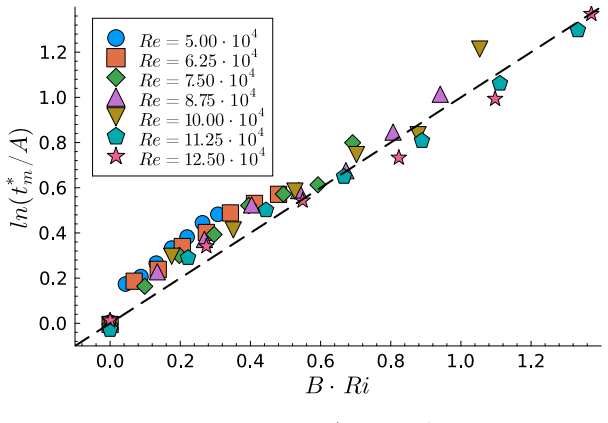
An exponential scaling using Power, Froude, and Richardson numbers collapses dimensionless mixing times for miscible liquids with varying densities in stirred tanks.
A machine-rendered reading of the paper's core claim, the machinery that carries it, and where it could break.
Core claim
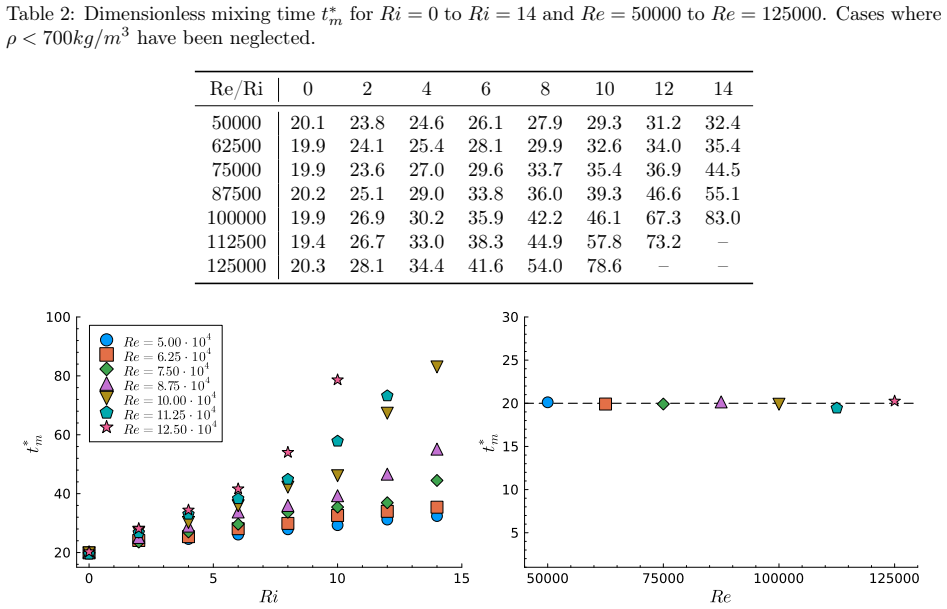
In numerical simulations of a stirred tank mixing two miscible liquids at 50/50 ratio, the dimensionless mixing time follows an exponential scaling with the Power number, Froude number, and Richardson number that collapses data across the studied range of Reynolds and Richardson numbers onto one master curve.
What carries the argument
Exponential scaling relation constructed from the Power, Froude, and Richardson numbers to normalize dimensionless mixing time.
If this is right
- Mixing time increases systematically with Richardson number due to buoyancy stratification.
- The chosen dimensionless groups suffice to unify results without separate Reynolds corrections in the examined regime.
- The master curve supplies a practical predictor for homogenization time once power input, impeller speed, and density difference are known.
- Industrial stirred-tank design can use the scaling to estimate performance across moderate to large density contrasts.
Where Pith is reading between the lines
- The scaling may guide selection of impeller speed or power to achieve target mixing times when densities differ.
- It could reduce reliance on full CFD runs for preliminary process design if the groups remain dominant.
- Testing the same groups in tanks with different aspect ratios or impeller types would check broader applicability.
- Continuous-flow or non-batch mixers might follow analogous collapse if buoyancy and inertia are similarly parameterized.
Load-bearing premise
Reynolds number effects remain secondary and the Power, Froude, and Richardson numbers together capture the dominant physics without needing extra terms across the studied range of density differences.
What would settle it
A new set of simulations or experiments at Reynolds numbers well outside the original range that produce dimensionless mixing times falling off the master curve.
Figures



read the original abstract
Mixing of miscible liquids is an essential process in multiple industrial settings, usually with the intent to homogenize the product. This seemingly simple process is in fact a complex hydrodynamic problem that has a direct impact on the product quality. In this study, numerical simulations of a stirred tank were performed with a 50/50 ratio of liquids and systematically varied the Reynolds and Richardson numbers. A positive correlation between the mixing time and the Richardson number was observed, as reported in the literature. The influence of the Reynolds number was not as pronounced and clear. Based on the Power, Froude and Richardson numbers, we were able to derive an exponential scaling for the dimensionless mixing time that collapsed all our data onto one master curve.
Editorial analysis
A structured set of objections, weighed in public.
Referee Report
Summary. The manuscript reports numerical simulations of mixing two miscible liquids at a 50/50 volume ratio in a stirred tank, with systematic variation of Reynolds and Richardson numbers. It observes a positive correlation of mixing time with Richardson number (consistent with prior literature) but finds Reynolds number effects less pronounced. Using the Power, Froude, and Richardson numbers, the authors derive an exponential scaling for the dimensionless mixing time that collapses all simulation data onto a single master curve.
Significance. If the data collapse is robust, the scaling offers a practical engineering correlation for mixing times under intermediate-to-large density differences, where many existing models assume small density contrasts. The empirical collapse onto Power-Froude-Richardson groups is a concrete strength that could guide industrial stirred-tank design, though its value is limited by the absence of independent validation or theoretical derivation.
major comments (3)
- [Methods] Methods section: The manuscript provides no information on grid resolution, grid-independence tests, numerical scheme details, or quantitative error estimates for the computed mixing times. These omissions are load-bearing because the central claim rests on the reliability of the simulation data used to fit and collapse the exponential scaling.
- [Results] Results and scaling section: The exponential scaling is presented as derived from the Power, Froude, and Richardson numbers, yet the exact functional form (including fitted coefficients) and the precise definitions of these groups under variable density are not stated. Without these, it is impossible to assess whether the collapse is a genuine prediction or a post-hoc fit, directly affecting the claim's generality.
- [Results] Validation: No comparison of the simulated mixing times against experimental data or established benchmarks is reported, even for the limiting case of equal densities. This weakens confidence in the data collapse, especially given the noted uncertainty in Reynolds-number effects.
minor comments (2)
- [Abstract] The abstract states that Reynolds-number influence 'was not as pronounced and clear' but does not quantify this (e.g., via partial derivatives or additional figures at fixed Ri). Adding such quantification would clarify the decision to omit Re from the scaling.
- [Results] Notation for the dimensionless mixing time and the exact exponential expression should be introduced explicitly with an equation number in the main text to improve reproducibility.
Simulated Author's Rebuttal
We thank the referee for the detailed and constructive feedback on our manuscript. We have carefully considered each comment and revised the manuscript to improve clarity and completeness. Below, we provide point-by-point responses to the major comments.
read point-by-point responses
-
Referee: [Methods] Methods section: The manuscript provides no information on grid resolution, grid-independence tests, numerical scheme details, or quantitative error estimates for the computed mixing times. These omissions are load-bearing because the central claim rests on the reliability of the simulation data used to fit and collapse the exponential scaling.
Authors: We fully agree that these details are essential for assessing the reliability of our results. In the revised manuscript, we have expanded the Methods section to include information on the computational grid resolution, the outcomes of grid-independence studies demonstrating that mixing times are converged to within acceptable tolerances, the specific numerical schemes used for solving the governing equations, and quantitative estimates of numerical errors based on our sensitivity analyses. revision: yes
-
Referee: [Results] Results and scaling section: The exponential scaling is presented as derived from the Power, Froude, and Richardson numbers, yet the exact functional form (including fitted coefficients) and the precise definitions of these groups under variable density are not stated. Without these, it is impossible to assess whether the collapse is a genuine prediction or a post-hoc fit, directly affecting the claim's generality.
Authors: We appreciate this observation. The scaling relation was obtained by fitting the simulation data, and we have now explicitly stated the functional form in the revised Results section, including the fitted coefficients. We have also provided the precise definitions of the Power, Froude, and Richardson numbers as applied to the variable-density flows in our simulations, clarifying how density variations are accounted for in each group. revision: yes
-
Referee: [Results] Validation: No comparison of the simulated mixing times against experimental data or established benchmarks is reported, even for the limiting case of equal densities. This weakens confidence in the data collapse, especially given the noted uncertainty in Reynolds-number effects.
Authors: We acknowledge the value of validation against experiments. Our study is numerical in nature, and direct experimental comparisons were not included in the original manuscript. In the revision, we have added a paragraph discussing our results in the context of existing literature for the equal-density limit, where our findings align with known trends for mixing times at high Reynolds numbers. For cases with significant density differences, we note that experimental data are limited, which motivated our numerical approach. We have also highlighted the less pronounced Reynolds number effects as an area requiring further study. revision: partial
Circularity Check
Exponential scaling fitted to collapse simulation data onto master curve
specific steps
-
fitted input called prediction
[Abstract]
"Based on the Power, Froude and Richardson numbers, we were able to derive an exponential scaling for the dimensionless mixing time that collapsed all our data onto one master curve."
The scaling is obtained by choosing an exponential form in Po, Fr and Ri that forces collapse of the simulation results (varying Re and Ri at fixed 50/50 ratio). The 'derivation' is therefore the fitting procedure itself; the collapsed master curve is guaranteed once the functional dependence is selected to match the data trends.
full rationale
The central result is an empirical exponential scaling for dimensionless mixing time constructed from Power, Froude and Richardson numbers to collapse the authors' own simulation dataset. While the paper presents this as a derivation, the explicit statement that it collapses 'all our data' indicates the functional form and coefficients were selected to match the observed trends rather than predicted independently from first principles. No self-citation chain or definitional loop is present, but the 'prediction' reduces to a post-hoc fit of the input data. The assumption that Re effects are secondary is stated directly from the same dataset, supporting the choice of groups without external validation.
Axiom & Free-Parameter Ledger
free parameters (1)
- exponential scaling coefficients
axioms (1)
- domain assumption Mixing time depends primarily on Power, Froude, and Richardson numbers for the studied conditions
Reference graph
Works this paper leans on
-
[1]
On the. SLAS Technology , author =. 2014 , pages =. doi:10.1177/2211068214540156 , abstract =
-
[2]
Verification and
Roache, Patrick J , file =. Verification and
-
[3]
1950 , journal =
Power Characteristics of Mixing Impellers , author =. 1950 , journal =
1950
-
[4]
Impact of a Core--Shell Compound Droplet on a Solid Surface , author =. Exp Fluids , volume =. doi:10.1007/s00348-025-04022-z , urldate =
-
[5]
Journal of Food Engineering , volume =
Potential for Damage to Fruits during Transport through Cross-Section Constrictions , author =. Journal of Food Engineering , volume =. doi:10.1016/j.jfoodeng.2025.112473 , urldate =
-
[6]
, year = 2009, month = may, journal =
Roisman, Ilia V. , year = 2009, month = may, journal =. Inertia Dominated Drop Collisions. doi:10.1063/1.3129283 , urldate =
-
[7]
Singh, Ramesh Kumar and Mahato, Lukesh Kumar and Mandal, Deepak Kumar , year = 2021, month = aug, journal =. Airflow-. doi:10.1021/acs.langmuir.1c01367 , urldate =
-
[8]
, year =
Succi, S. , year =. The
-
[9]
and Cowling, T
Chapman, S. and Cowling, T. G. , year =. The
-
[10]
He, X. and Luo, L. S. , year =. Theory of the Lattice. Phys. Rev. E , volume =. doi:10.1103/PhysRevE.56.6811 , abstract =
-
[11]
, year =
Enskog, D. , year =. Kinetische
-
[12]
Wu, H. and Patterson, G. K. , year = 1989, month = jan, journal =. Laser-. doi:10.1016/0009-2509(89)85155-3 , urldate =
-
[13]
Sommer, A. -E. and Rox, H. and Shi, P. and Eckert, K. and Rzehak, R. , year = 2021, month = dec, journal =. Solid-Liquid Flow in Stirred Tanks: ``. doi:10.1016/j.ces.2021.116743 , urldate =
-
[14]
Chemical engineering research & design , volume=
Mixing of stratified liquids , author=. Chemical engineering research & design , volume=
-
[15]
Proceedings of the 6th European Conference on Mixing, Pavia Italy , pages=
The mixing of Newtonian liquids with large density and viscosity differences in mechanically agitated contactors , author=. Proceedings of the 6th European Conference on Mixing, Pavia Italy , pages=
-
[16]
Zadghaffari, R. and Moghaddas, J. S. and Revstedt, J. , year = 2009, month = jul, journal =. A Mixing Study in a Double-. doi:10.1016/j.compchemeng.2009.01.017 , urldate =
-
[17]
Application of Bioreactor Technology for Cell Culture-Based Viral Vaccine Production:
Fang, Zhongbiao and Lyu, Jingting and Li, Jianhua and Li, Chaonan and Zhang, Yuxuan and Guo, Yikai and Wang, Ying and Zhang, Yanjun and Chen, Keda , year = 2022, month = aug, journal =. Application of Bioreactor Technology for Cell Culture-Based Viral Vaccine Production:. doi:10.3389/fbioe.2022.921755 , urldate =
-
[18]
Afshar Ghotli, Reza and Raman, Abdul A. A. and Ibrahim, Shaliza and Baroutian, Saeid , year = 2013, month = may, journal =. Liquid-. doi:10.1080/00986445.2012.717313 , urldate =
-
[19]
Biotechnology and Bioengineering , volume =
Analyzing the Effect of Using Axial Impellers in Large-Scale Bioreactors , author =. Biotechnology and Bioengineering , volume =. doi:10.1002/bit.28163 , urldate =
-
[20]
Chemical Engineering Science , volume =
Local Gas Holdup Simulation and Validation of Industrial-Scale Aerated Bioreactors , author =. Chemical Engineering Science , volume =. doi:10.1016/j.ces.2016.06.053 , urldate =
-
[21]
Jaworski, Z. and Bujalski, W. and Otomo, N. and Nienow, A. W. , year = 2000, month = apr, journal =. doi:10.1205/026387600527437 , urldate =
-
[22]
Physical Review Letters , author =
Lattice-. Physical Review Letters , author =. 1986 , pages =. doi:10.1103/PhysRevLett.56.1505 , language =
-
[23]
Discrete lattice effects on the forcing term in the lattice. Physical Review E , author =. 2002 , pages =. doi:10.1103/PhysRevE.65.046308 , language =
-
[24]
Journal of Statistical Physics , author =
Lattice. Journal of Statistical Physics , author =. 1997 , pages =. doi:10.1023/B:JOSS.0000015179.12689.e4 , language =
-
[25]
Bernauer, S. Characterization of the Gas Dispersion Behavior of Multiple Impeller Stages by Flow Regime Analysis and. Biotechnology and Bioengineering , volume =. doi:10.1002/bit.27815 , urldate =
-
[26]
Eibl, P. and Witz, C. and Khinast, J. , year = 2022, journal =. A Generalized Framework for Modeling the Gas-Phase in Aerated Stirred Tanks Using the. doi:10.1002/cite.202255145 , urldate =
-
[27]
Kr. The. doi:10.1007/978-3-319-44649-3 , urldate =
-
[28]
Fernando, H. J. S. , year = 1991, month = jan, journal =. Turbulent. doi:10.1146/annurev.fl.23.010191.002323 , urldate =
-
[29]
Chemical Engineering Science , volume =
Mixing by Agitation of Miscible Liquids. Chemical Engineering Science , volume =. doi:10.1016/0009-2509(55)85020-8 , urldate =
-
[30]
doi:10.48550/arXiv.2508.13867 , urldate =
Zhong, Mingliang and Kummerl. doi:10.48550/arXiv.2508.13867 , urldate =. arXiv , langid =:2508.13867 , primaryclass =
-
[31]
Hussain, Muattaz and Binici, Burcu and O'Connor, Liam and Perrie, Yvonne , year = 2024, month = dec, journal =. Production of. doi:10.1093/jpp/rgae122 , urldate =
-
[32]
Microfluidic Technologies and Devices for Lipid Nanoparticle-Based
Maeki, Masatoshi and Uno, Shuya and Niwa, Ayuka and Okada, Yuto and Tokeshi, Manabu , year = 2022, month = apr, journal =. Microfluidic Technologies and Devices for Lipid Nanoparticle-Based. doi:10.1016/j.jconrel.2022.02.017 , urldate =
-
[33]
Understanding the Formation Mechanism of Lipid Nanoparticles in Microfluidic Devices with Chaotic Micromixers , author =. PLOS ONE , volume =. doi:10.1371/journal.pone.0187962 , urldate =
-
[34]
Optimal Self-Assembly of Lipid Nanoparticles (
Ripoll, Manon and Martin, Elian and Enot, Mathilde and Robbe, Oscar and Rapisarda, Chiara and Nicolai, Marie-Claire and Deliot, Aur. Optimal Self-Assembly of Lipid Nanoparticles (. Sci Rep , volume =. doi:10.1038/s41598-022-13112-5 , urldate =
-
[35]
Advances in Colloid and Interface Science , volume =
A Review of Immiscible Fluid Mixing , author =. Advances in Colloid and Interface Science , volume =. doi:10.1016/S0001-8686(99)00002-0 , urldate =
-
[36]
Analysis of Immiscible Liquid-Liquid Mixing in Stirred Tanks by
Maluta, Francesco and Montante, Giuseppina and Paglianti, Alessandro , year = 2020, month = dec, journal =. Analysis of Immiscible Liquid-Liquid Mixing in Stirred Tanks by. doi:10.1016/j.ces.2020.115898 , urldate =
-
[37]
Deglon, D. A. and Meyer, C. J. , year = 2006, month = aug, journal =. doi:10.1016/j.mineng.2006.04.001 , urldate =
-
[38]
Bhatnagar, P. L. and Gross, E. P. and Krook, M. , year = 1954, month = may, journal =. A. doi:10.1103/PhysRev.94.511 , urldate =
-
[39]
An Improved Bounce-Back Scheme for Complex Boundary Conditions in Lattice
Yin, Xuewen and Zhang, Junfeng , year = 2012, month = jun, journal =. An Improved Bounce-Back Scheme for Complex Boundary Conditions in Lattice. doi:10.1016/j.jcp.2012.02.014 , urldate =
-
[40]
Chemical Engineering Science , volume =
Mixing of Liquids in Cylindrical Storage Tanks with Side-Entering Propellers , author =. Chemical Engineering Science , volume =. doi:10.1016/0009-2509(75)80064-9 , urldate =
-
[41]
Blending of Miscible Liquids with Different Densities Starting from a Stratified State , author =. Computers & Fluids , volume =. doi:10.1016/j.compfluid.2011.06.013 , urldate =
-
[42]
Javed, K. H. and Mahmud, T. and Zhu, J. M. , year = 2006, month = feb, journal =. Numerical Simulation of Turbulent Batch Mixing in a Vessel Agitated by a. doi:10.1016/j.cep.2005.06.006 , urldate =
-
[44]
doi:10.3901/CJME.2016.1107.129 , urldate =
Li, Liangchao and Xu, Bin , year = 2017, month = jan, journal =. doi:10.3901/CJME.2016.1107.129 , urldate =
-
[45]
and Luo, Li-Shi , year = 2005, month = nov, journal =
Yu, Huidan and Girimaji, Sharath S. and Luo, Li-Shi , year = 2005, month = nov, journal =. doi:10.1016/j.jcp.2005.03.022 , urldate =
-
[46]
Grenville, Richard K. and Nienow, Alvin W. , year = 2003, pages =. Blending of. Handbook of. doi:10.1002/0471451452.ch9 , urldate =
-
[47]
, year = 1963, month = mar, journal =
Smagorinsky, J. , year = 1963, month = mar, journal =
1963
-
[48]
General Bounce-Back Scheme for Concentration Boundary Condition in the Lattice-
Zhang, Ting and Shi, Baochang and Guo, Zhaoli and Chai, Zhenhua and Lu, Jianhua , year = 2012, month = jan, journal =. General Bounce-Back Scheme for Concentration Boundary Condition in the Lattice-. doi:10.1103/PhysRevE.85.016701 , urldate =
-
[49]
Hartmann, H. and Derksen, J. J. and. Mixing Times in a Turbulent Stirred Tank by Means of. AIChE Journal , volume =. doi:10.1002/aic.10997 , urldate =
-
[50]
The Blending Efficiencies of Some Impellers in Batch Mixing , author =. AIChE Journal , volume =. doi:10.1002/aic.690180133 , urldate =
-
[51]
Chemical Engineering Science , volume =
A Comparative Study on the Rate of Mixing in Stirred Tanks , author =. Chemical Engineering Science , volume =. doi:10.1016/0009-2509(53)80006-0 , urldate =
-
[52]
Large-Eddy Simulation Coupled with Wall Models for Turbulent Channel Flows at High
Haussmann, Marc and Barreto, Alejandro CLARO and Kouyi, Gislain LIPEME and Rivi. Large-Eddy Simulation Coupled with Wall Models for Turbulent Channel Flows at High. Computers & Mathematics with Applications , volume =. doi:10.1016/j.camwa.2019.04.033 , urldate =
-
[53]
Ladd, Anthony J. , year = 1994, journal =. Numerical. doi:10.1017/S0022112094001771 , abstract =
-
[54]
M\'emoires de l'Acad\'emie des sciences de l'Institut de France , volume=
M\'emoire sur les lois du mouvement des fluides , author=. M\'emoires de l'Acad\'emie des sciences de l'Institut de France , volume=. 1823 , publisher=
-
[55]
Transactions of the Cambridge Philosophical Society , volume=
On the steady motion of incompressible fluids , author=. Transactions of the Cambridge Philosophical Society , volume=. 1842 , publisher=
-
[56]
Yu, Zhao and Finch, Brian A. and Hale, Dean A. , year = 2018, month = mar, journal =. Mixing of. doi:10.1021/acs.iecr.7b04618 , urldate =
-
[57]
International Journal of Engineering Science , volume =
Modelling the Interfacial Flow of Two Immiscible Liquids in Mixing Processes , author =. International Journal of Engineering Science , volume =. doi:10.1016/j.ijengsci.2005.03.011 , urldate =
-
[58]
Application of a Continuously Stirred Tank Bioreactor (
Gargouri, Boutheina and Karray, Fatma and Mhiri, Najla and Aloui, Fathi and Sayadi, Sami , year = 2011, month = may, journal =. Application of a Continuously Stirred Tank Bioreactor (. doi:10.1016/j.jhazmat.2011.02.057 , urldate =
-
[59]
Advanced Manufacturing of Nanoparticle Formulations of Drugs and Biologics Using Microfluidics , author =. Analyst , volume =. doi:10.1039/D3AN01739G , urldate =
-
[60]
Chemical Engineering Research and Design , author =
Blending in unbaffled and baffled mechanically agitated vessels –. Chemical Engineering Research and Design , author =. 2023 , keywords =. doi:10.1016/j.cherd.2023.06.025 , abstract =
-
[61]
Grenville, R. K. , month = apr, year =. Blending of viscous
-
[62]
Chemical Engineering Research and Design , author =. 2008 , keywords =. doi:10.1016/j.cherd.2008.07.008 , abstract =
-
[63]
Ruszkowski, Steve , booktitle=. A. 1994 , organization=
1994
-
[64]
Derksen, J. J. , year = 2012, month = may, journal =. Direct. doi:10.1021/ie3000419 , urldate =
-
[65]
Chemical Engineering Science , series =
On Impeller Circulation and Mixing Effectiveness in the Turbulent Flow Regime , author =. Chemical Engineering Science , series =. doi:10.1016/S0009-2509(97)00072-9 , urldate =
-
[66]
The Canadian Journal of Chemical Engineering , author =
Mixing. The Canadian Journal of Chemical Engineering , author =. 2004 , doi =. doi:10.1002/cjce.5450820504 , abstract =
-
[67]
Bogner, Simon and R. Curvature Estimation from a Volume-of-Fluid Indicator Function for the Simulation of Surface Tension and Wetting with a Free-Surface Lattice. Physical Review E , volume =. doi:10.1103/PhysRevE.93.043302 , urldate =
-
[68]
Mayorga, C. and Morchain, J. and Lin. Reconstruction of the. Chemical Engineering Science , volume =. doi:10.1016/j.ces.2021.117220 , urldate =
-
[69]
Cabaret, F. and Fradette, L. and Tanguy, P. A. , year = 2008, journal =. New. doi:10.1002/ceat.200800385 , urldate =
-
[70]
The Canadian Journal of Chemical Engineering , author =
Scalar mixing measurements in a continuously operated stirred tank , volume =. The Canadian Journal of Chemical Engineering , author =. 2001 , keywords =. doi:10.1002/cjce.5450790202 , abstract =
-
[71]
Canadian Journal of Chemical Engineering , author =
Scalar. Canadian Journal of Chemical Engineering , author =. 1997 , note =
1997
-
[72]
Chemical Engineering Research and Design , author =
Blending. Chemical Engineering Research and Design , author =. 1997 , keywords =. doi:10.1205/026387697524443 , abstract =
-
[73]
Procedure for
, doi =. Procedure for. Journal of Fluids Engineering , year =
-
[74]
Lattice. Computers & Fluids , author =. 2016 , pages =. doi:10.1016/j.compfluid.2015.08.004 , abstract =
-
[75]
Comparison of Passive Scalar Transport Models Coupled with the
K. Comparison of Passive Scalar Transport Models Coupled with the. Computers & Mathematics with Applications , series =. doi:10.1016/j.camwa.2018.01.017 , urldate =
-
[76]
and III, Arthur W
Kresta, Suzanne M. and III, Arthur W. Etchells and Dickey, David S. and Atiemo-Obeng, Victor A. and Forum, North American Mixing , month = nov, year =. Advances in
discussion (0)
Sign in with ORCID, Apple, or X to comment. Anyone can read and Pith papers without signing in.